
This is an English translation of Implicitization法によるベジェ曲線の交点検出 ~ 代数方程式の実用的解法の検討と実装 ~.
Abstract
This paper proposes a method for computing intersections between cubic Bézier curves with high accuracy and high performance. The Implicitization method, which algebraically determines the parameter values of intersections by converting Bézier curves into implicit form, has been known. However, a stable and efficient method for finding the real roots of the resulting algebraic equations had not been established. In this work, we narrow down candidates using Budan–Fourier's theorem, perform real-root isolation using the VAG method—an application of Vincent's theorem—and then compute real roots using the bisection method and Ridder's method. Compared with the DKA method, which is generally used to solve high-degree algebraic equations, the proposed approach allows the search domain for roots to be restricted to the real parameter range of the Bézier curves and is not affected by roots outside this range. When multiple roots occur depending on the shape of the Bézier curves or the intersection pattern, iterative root-finding methods such as the bisection method and Ridder's method cannot be applied directly. This issue is identified, and a solution is devised by extending the VAG method to also handle root finding; its effectiveness is confirmed. A trial implementation of the proposed method is carried out in a C++/Qt environment. It is verified that intersections between arbitrarily specified cubic Bézier curves can be computed correctly, and that the required memory usage and computation time are at a practically acceptable level. The proposed method is not limited to Bézier curves and is expected to be applicable to other cubic parametric curves as well.
Examples of Bézier curve intersections discussed in this paper are shown below. The orange curve is the Bézier curve ${\boldsymbol{B}}_0$ defined by control points ${\boldsymbol{p}}_0, {\boldsymbol{p}}_1, {\boldsymbol{p}}_2, {\boldsymbol{p}}_3$, and the blue curve is the Bézier curve ${\boldsymbol{B}}_1$ defined by control points ${\boldsymbol{p}}_4, {\boldsymbol{p}}_5, {\boldsymbol{p}}_6, {\boldsymbol{p}}_7$.
| Ex.1 |  |
Intersects at one point |
| Ex.2 | 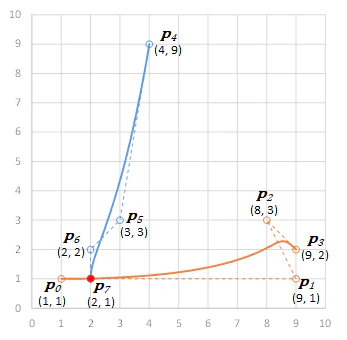 |
Intersects at one point |
| Ex.3 |  |
Intersects at nine points |
| Ex.4 |  |
${\boldsymbol{B}}_0$ is quadratic |
| Ex.5 | 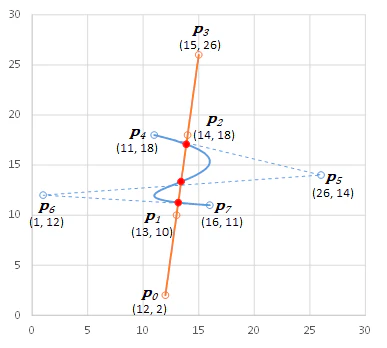 |
${\boldsymbol{B}}_0$ is linear |
| Ex.6 |  |
Intersects at one point first derivatives coincide at the intersection |
| Ex.7 |  |
Intersects at one point first derivatives coincide at the intersection |
| Ex.8 |  |
Contacts at one point first derivatives coincide at the contact point |
| Ex.9 |  |
Contacts at one point first derivatives coincide at the contact point |
| Ex.10 |  |
A cusp point contacts |
| Ex.11 | 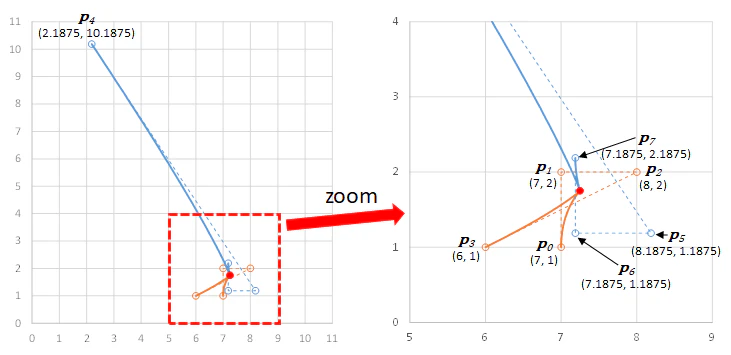 |
Two cusp points contact each other |
Background and Related Work
Bézier curves are parametric curves widely used in computer graphics, GUI rendering, CAD, and related fields. There is a strong need to compute intersections between curves.
As an existing intersection-detection technique, there is the polyline approximation method, in which curves are subdivided into small line segments and collision detection is performed. In rendering processes for displaying Bézier curves on the screen, drawing APIs such as OpenGL do not directly support curve rendering, so Bézier curves are approximated by polylines at higher levels (e.g., Qt GUI or Cairo). Because this polyline information can be reused for collision detection, intersection detection via polyline approximation is a reasonable approach. In rendering processing, the accuracy of the intersection points is sufficient if they are on the order of a pixel or a fraction of that.
In contrast, in CAD and similar applications, approximating Bézier curves by polylines solely for intersection detection is inefficient, and the required accuracy is much higher, so making polyline approximation method is not suitable. For such use cases, the subdivision method has been employed. This method exploits the property that a Bézier curve is contained within the polygon formed by its control points. By detecting intersections between such polygons, the parameter ranges of the curves that contain intersections are narrowed down, and the same process is iteratively applied to subdivided curves. Bézier clipping, proposed by T. W. Sederberg and Tomoyuki Nishita, is a well-known example of this approach [1]. However, this method may have poor convergence or may be difficult to guarantee accuracy depending on the shape of the Bézier curve and/or the intersection pattern.
T. W. Sederberg and colleagues proposed the "Implicitization" method, which converts Bézier curves into implicit form, transforms the intersection problem into an algebraic equation (a ninth-degree equation for intersections between two cubic Bézier curves), and solves it [2][3]. In the Implicitization method, a parametric Bézier curve is converted into an implicit function, and the parametric equations of the other curve are substituted into it to obtain an algebraic equation (the implicit equation). This method is less affected by the shape of the Bézier curve and/or the intersection pattern, and is expected to be able to determine the intersection position efficiently and with high accuracy. However, a suitable method for solving the implicit equation had not been shown. Therefore, this study aims to develop an efficient and stable method for solving the implicit equation based on the Implicitization approach and to realize a practical implementation for computing Bézier curve intersections.
Since a ninth-degree equation cannot be solved algebraically, approximate solutions must be obtained using iterative root-finding methods. The DKA method, an extension of the Newton–Raphson method for higher-degree equations, is commonly used. The DKA method handles complex roots and places initial values evenly on a circle in the complex plane that encloses all roots (Aberth's initial values), then iteratively refines them. To prevent multiple approximations from converging to the same root, a repulsive force between approximations is incorporated into the recurrence formula. The radius of the initial circle must be set appropriately using Aberth's method. If the radius is too small, unstable behavior occurs during iteration; if it is too large, convergence becomes slow.
Initially, we attempted to find the real roots of the implicit equation using the DKA method. The DKA implementation was constructed as an evaluation worksheet in Excel, referring to [4]. The radius of the initial circle was computed using the program in [5]. For samples in which all roots were real numbers in the interval $(0, 1)$, good convergence was achieved; Ex.3 corresponds to this case. (blue text indicates roots at intersections)
| Roots of $F_0(u)=0$ | Roots of $F_1(t)=0$ |
|---|---|
| 0.0192470 0.0549916 0.122057 0.320989 0.442531 0.488156 0.900476 0.944674 0.963072 |
0.0705391 0.0972454 0.151318 0.423317 0.504785 0.616234 0.858628 0.947328 0.966598 |
The radius of the initial circles were small, 0.891145 and 0.815073, and the DKA method converged after about 15 iterations.
However, when the intersection pattern caused the equation to include roots far outside the parameter range of the Bézier curve (roots irrelevant to intersection detection), the initial circle became extremely large, significantly degrading convergence. Ex.1 corresponds to this case. (red text indicates roots that negatively affect convergence)
| Roots of $F_0(u)=0$ | Roots of $F_1(t)=0$ |
|---|---|
|
-567116 0.557665 1.61807 5.16799 5.79814 -0.570942-0.800873*I -0.570942+0.800873*I 283560-491136*I 283560+491136*I |
-248197 -1.03331 0.446194 1.86453 2.90335 -213844-446352*I -213844+446352*I 0.534608-0.882298*I 0.534608+0.882298*I |
The radius of the initial circles were huge, 624194 and 518608, and the DKA method did not converge even after 50 iterations. Based on these results, we concluded that the DKA method is unsuitable for the present application.
Alexander Reshetov of NVIDIA proposed an approach for ray tracing of hair and fur in PBRT, which are modeled using many Bézier curves. His approach first isolates real roots, identifies intervals containing exactly one real root, and then applies an iterative root-finding method [6].
- Finds the intersection of a cubic Bézier curve and a ray (straight line). Bézier curves must be treated as having thickness, and the root of its derivative (a quintic function) is found to determine the position where the square of the distance between the curve and the line (a sextic function) is smallest.
- To find the root, the Boudin-Fourier theorem is used to narrow down the search, and Vincent's theorem is used to isolate the real root, then a root-finding algorithm is applied with as few iterations as possible.
- By combining techniques such as narrowing down the range where roots exist based on the spatial relationship between the Bézier curve and the line, a combination of the Ridder's method (without iterations, one time) and the secant method can achieve sufficient approximation accuracy.
- Significant improvements in both performance and accuracy compared to existing methods (broken-line approximation).
Inspired by this work, we aim to apply a similar approach to detecting intersections between Bézier curves. Among the algorithms derived from Vincent's theorem—VAS, VCA, and VAG—we select the VAG (Vincent–Alesina–Galuzzi) method due to its ease of implementation. For iterative root finding on isolated intervals, we first narrow the interval using the bisection method and then apply Ridder's method. Since the bisection method and Ridder's method do not handle multiple roots, we extend the VAG method to address this issue.
Adopted Method
Target Curves
For the Bézier curve ${\boldsymbol{B}}_0$ defined by control points ${\boldsymbol{p}}_0, {\boldsymbol{p}}_1, {\boldsymbol{p}}_2, {\boldsymbol{p}}_3$, the coordinates $(x,y)$ of an arbitrary point on the curve are given by the following matrix-form parametric functions [7]:
\begin{array}{l}
x=f_0(t)=
\begin{bmatrix}
t^3 & t^2 & t & 1
\end{bmatrix}
{\boldsymbol{R}}_{bz}
\begin{bmatrix}
p_{0x} \\
p_{1x} \\
p_{2x} \\
p_{3x}
\end{bmatrix}
=a_0t^3+a_1t^2+a_2t+a_3
\\
y=g_0(t)=
\begin{bmatrix}
t^3 & t^2 & t & 1
\end{bmatrix}
{\boldsymbol{R}}_{bz}
\begin{bmatrix}
p_{0y} \\
p_{1y} \\
p_{2y} \\
p_{3y}
\end{bmatrix}
=b_0t^3+b_1t^2+b_2t+b_3
\end{array}
Similarly, for the Bézier curve ${\boldsymbol{B}}_1$ defined by control points ${\boldsymbol{p}}_4, {\boldsymbol{p}}_5, {\boldsymbol{p}}_6, {\boldsymbol{p}}_7$, the coordinates $(x,y)$ are defined as follows:
\begin{array}{l}
x=f_1(u)=
\begin{bmatrix}
u^3 & u^2 & u & 1
\end{bmatrix}
{\boldsymbol{R}}_{bz}
\begin{bmatrix}
p_{4x} \\
p_{5x} \\
p_{6x} \\
p_{7x}
\end{bmatrix}
=c_0u^3+c_1u^2+c_2u+c_3
\\
y=g_1(u)=
\begin{bmatrix}
u^3 & u^2 & u & 1
\end{bmatrix}
{\boldsymbol{R}}_{bz}
\begin{bmatrix}
p_{4y} \\
p_{5y} \\
p_{6y} \\
p_{7y}
\end{bmatrix}
=d_0u^3+d_1u^2+d_2u+d_3
\end{array}
where, ${\boldsymbol{R}}_{bz}$ is the coefficient matrix specific to cubic Bézier curves:
{\boldsymbol{R}}_{bz}=
\begin{bmatrix}
-1 & 3 & -3 & 1 \\
3 & -6 & 3 & 0 \\
-3 & 3 & 0 & 0 \\
1 & 0 & 0 & 0
\end{bmatrix}
Requirement Definition: Parameter Range
Assuming composite Bézier curves composed of multiple connected segments, the parameter range of the Bézier curves ($t$ and $u$) is defined as the half-open interval $[0,1)$. Since Budan–Fourier's theorem and Vincent's theorem apply to open intervals, separate logic is added to determine whether $0$ is a root.

If the Bézier curve is isolated, with a closed interval $[0,1]$, additional logic is required to determine whether $1$ is a root.
Requirement Definition: Classification of Intersection Patterns and Roots of the Implicit Equation
The following classification is based on empirical observations and requires further analytical investigation:
- Even if curves do not intersect, the implicit equation has real roots in $[0,1]$ if the curves intersect when extended.
- If the first derivatives of both curves coincide at an intersection point, the implicit equation has a triple root.
- If the curves contact at a single point with matching first derivatives, the implicit equation has a double root.
- If a cusp point contacts a curve, the implicit equation has a double root.
- If two cusp points contact, the implicit equation has a quadruple root.
The table summarizes these cases, where “true” and “false” indicate the presence or absence of real roots in $[0,1]$.
| Curve #0 | Curve #1 | Multi- plicity |
Example | ||
|---|---|---|---|---|---|
 |
No intersection | false | false | ||
 |
No intersection Intersects if extended |
true | false | ||
 |
Intersects at one point | true | true | 1 |
Ex.1 Ex.2 |
 |
Intersects at one point first derivatives coincide at the intersection |
true | true | 3 |
Ex.6 Ex.7 |
 |
Contacts at one point first derivatives coincide at the contact point |
true | true | 2 |
Ex.8 Ex.9 |
 |
A cusp point contacts | true | true | 2 | Ex.10 |
 |
Two cusp points contact each other |
true | true | 4 | Ex.11 |
Procedure
- Convert $x=f_0(t)$ and $y=g_0(t)$ of curve ${\boldsymbol{B}}_0$ into the implicit form $F_0(x,y)=0$.
- Substitute $x=f_1(u)$, $y=g_1(u)$ of curve ${\boldsymbol{B}}_1$ into $F_0(x,y)=0$ to obtain the implicit equation $F_0(u)=0$.
- Find the real roots of $F_0(u)=0$ for $u \in (0,1)$.
- Substitute the roots into $x=f_1(u)$, $y=g_1(u)$ to obtain candidate intersection points on ${\boldsymbol{B}}_1$.
- Convert $x=f_1(u)$ and $y=g_1(u)$ of curve ${\boldsymbol{B}}_1$ into the implicit form $F_1(x,y)=0$.
- Substitute $x=f_0(t)$, $y=g_0(t)$ of curve ${\boldsymbol{B}}_0$ into $F_1(x,y)=0$ to obtain the implicit equation $F_1(t)=0$.
- Find the real roots of $F_1(t)=0$ for $t \in (0,1)$.
- Substitute the roots into $x=f_0(t)$, $y=g_0(t)$ to obtain candidate intersection points on ${\boldsymbol{B}}_0$.
- Match candidate points; paired points are intersections.
Implicitization of Bézier Curves
From the parametric representation $x=f_0(t)=a_0t^3+a_1t^2+a_2t+a_3$, $y=g_0(t)=b_0t^3+b_1t^2+b_2t+b_3$ of the curve ${\boldsymbol{B}}_0$, we obtain the implicit representation $F_0(x,y)=0$. Specifically, referring to [8], the parameter $t$ is eliminated using the Eliminate function of Wolfram Alpha, and the resulting expression is rearranged into the form of the implicit function $F_0(x,y)=0$. The notebook and execution results are shown in Appendix A.
- The implicit representation of the curve ${\boldsymbol{B}}_0$ obtained in this way is as follows:
$F_0(x,y)=a_3^3 b_0^3-a_2 a_3^2 b_0^2 b_1+a_1 a_3^2 b_0 b_1^2-a_0 a_3^2 b_1^3+a_2^2 a_3 b_0^2 b_2-2 a_1 a_3^2 b_0^2 b_2 $
$\qquad -a_1 a_2 a_3 b_0 b_1 b_2+3 a_0 a_3^2 b_0 b_1 b_2+a_0 a_2 a_3 b_1^2 b_2+a_1^2 a_3 b_0 b_2^2-2 a_0 a_2 a_3 b_0 b_2^2 $
$\qquad -a_0 a_1 a_3 b_1 b_2^2+a_0^2 a_3 b_2^3-a_2^3 b_0^2 b_3+3 a_1 a_2 a_3 b_0^2 b_3-3 a_0 a_3^2 b_0^2 b_3+a_1 a_2^2 b_0 b_1 b_3 $
$\qquad -2 a_1^2 a_3 b_0 b_1 b_3-a_0 a_2 a_3 b_0 b_1 b_3-a_0 a_2^2 b_1^2 b_3+2 a_0 a_1 a_3 b_1^2 b_3-a_1^2 a_2 b_0 b_2 b_3 $
$\qquad +2 a_0 a_2^2 b_0 b_2 b_3+a_0 a_1 a_3 b_0 b_2 b_3+a_0 a_1 a_2 b_1 b_2 b_3-3 a_0^2 a_3 b_1 b_2 b_3-a_0^2 a_2 b_2^2 b_3 $
$\qquad +a_1^3 b_0 b_3^2-3 a_0 a_1 a_2 b_0 b_3^2+3 a_0^2 a_3 b_0 b_3^2-a_0 a_1^2 b_1 b_3^2+2 a_0^2 a_2 b_1 b_3^2+a_0^2 a_1 b_2 b_3^2 $
$\qquad -a_0^3 b_3^3 $
$\quad +(-3 a_3^2 b_0^3+2 a_2 a_3 b_0^2 b_1-2 a_1 a_3 b_0 b_1^2+2 a_0 a_3 b_1^3-a_2^2 b_0^2 b_2+4 a_1 a_3 b_0^2 b_2 $
$\qquad +a_1 a_2 b_0 b_1 b_2-6 a_0 a_3 b_0 b_1 b_2-a_0 a_2 b_1^2 b_2-a_1^2 b_0 b_2^2+2 a_0 a_2 b_0 b_2^2+a_0 a_1 b_1 b_2^2 $
$\qquad -a_0^2 b_2^3-3 a_1 a_2 b_0^2 b_3+6 a_0 a_3 b_0^2 b_3+2 a_1^2 b_0 b_1 b_3+a_0 a_2 b_0 b_1 b_3-2 a_0 a_1 b_1^2 b_3 $
$\qquad -a_0 a_1 b_0 b_2 b_3+3 a_0^2 b_1 b_2 b_3-3 a_0^2 b_0 b_3^2)x $
$\quad +(a_2^3 b_0^2-3 a_1 a_2 a_3 b_0^2+3 a_0 a_3^2 b_0^2-a_1 a_2^2 b_0 b_1+2 a_1^2 a_3 b_0 b_1+a_0 a_2 a_3 b_0 b_1+a_0 a_2^2 b_1^2 $
$\qquad -2 a_0 a_1 a_3 b_1^2+a_1^2 a_2 b_0 b_2-2 a_0 a_2^2 b_0 b_2-a_0 a_1 a_3 b_0 b_2-a_0 a_1 a_2 b_1 b_2+3 a_0^2 a_3 b_1 b_2 $
$\qquad +a_0^2 a_2 b_2^2-2 a_1^3 b_0 b_3+6 a_0 a_1 a_2 b_0 b_3-6 a_0^2 a_3 b_0 b_3+2 a_0 a_1^2 b_1 b_3-4 a_0^2 a_2 b_1 b_3 $
$\qquad -2 a_0^2 a_1 b_2 b_3+3 a_0^3 b_3^2)y $
$\quad +(3 a_3 b_0^3-a_2 b_0^2 b_1+a_1 b_0 b_1^2-a_0 b_1^3-2 a_1 b_0^2 b_2+3 a_0 b_0 b_1 b_2-3 a_0 b_0^2 b_3)x^2 $
$\quad +(3 a_1 a_2 b_0^2-6 a_0 a_3 b_0^2-2 a_1^2 b_0 b_1-a_0 a_2 b_0 b_1+2 a_0 a_1 b_1^2+a_0 a_1 b_0 b_2-3 a_0^2 b_1 b_2 $
$\qquad +6 a_0^2 b_0 b_3)x y $
$\quad +(a_1^3 b_0-3 a_0 a_1 a_2 b_0+3 a_0^2 a_3 b_0-a_0 a_1^2 b_1+2 a_0^2 a_2 b_1+a_0^2 a_1 b_2-3 a_0^3 b_3)y^2 $
$\quad -b_0^3x^3 +3 a_0 b_0^2 x^2 y -3 a_0^2 b_0 x y^2 +a_0^3 y^3 \quad =0 $
Depending on the shape of the curve, the degree of the Bézier curve may be reduced to a quadratic curve, i.e., when $a_0=0$ and $b_0=0$. In this case, the left-hand side of the implicit function becomes $0$, and the roots cannot be obtained. For this case, an implicit representation for quadratic curves is used.
- Implicit representation when the curve ${\boldsymbol{B}}_0$ is quadratic:
$F_0(x,y)=a_3^2 b_1^2-a_2 a_3 b_1 b_2+a_1 a_3 b_2^2+a_2^2 b_1 b_3-2 a_1 a_3 b_1 b_3-a_1 a_2 b_2 b_3+a_1^2 b_3^2$
$ \quad +(-2 a_3 b_1^2+a_2 b_1 b_2-a_1 b_2^2+2 a_1 b_1 b_3) x
+(-a_2^2 b_1+2 a_1 a_3 b_1+a_1 a_2 b_2-2 a_1^2 b_3) y$
$ \quad +b_1^2 x^2-2 a_1 b_1 x y+a_1^2 y^2 \quad =0$
Furthermore, when the curve is linear, i.e., when $a_0=0$, $a_1=0$, $b_0=0$ and $b_1=0$, an implicit representation for linear curves is used.
- Implicit representation when the curve ${\boldsymbol{B}}_0$ is linear:
$F_0(x,y)=-a_3 b_2+a_2 b_3+b_2 x-a_2 y \quad =0$
By substituting the parametric functions $x=f_1(u)$ and $y=g_1(u)$ of curve ${\boldsymbol{B}}_1$ into the implicit function $F_0(x,y)=0$ of curve ${\boldsymbol{B}}_0$, we obtain an implicit equation $F_0(u)=0$ with parameter $u$. The real roots of this equation are the candidate parameters of the intersection points. The formulas for computing the coefficients of each term of the implicit equation $F_0(u)=0$ were derived using SageMath (Notebook: Appendix B).
- Coefficients of each term of the implicit equation $F_0(u)=0$ (a 9th-degree algebraic equation) when ${\boldsymbol{B}}_0$ is cubic:
| Term | Coefficient |
|---|---|
| $u^9$ | $-b_0^3 c_0^3+3 a_0 b_0^2 c_0^2 d_0-3 a_0^2 b_0 c_0 d_0^2+a_0^3 d_0^3$ |
| $u^8$ | $-3 b_0^3 c_0^2 c_1+6 a_0 b_0^2 c_0 c_1 d_0-3 a_0^2 b_0 c_1 d_0^2+3 (a_0 b_0^2 c_0^2-2 a_0^2 b_0 c_0 d_0$$+a_0^3 d_0^2) d_1$ |
| $u^7$ | $-3 b_0^3 c_0 c_1^2-3 b_0^3 c_0^2 c_2-3 a_0^2 b_0 c_2 d_0^2-3 (a_0^2 b_0 c_0-a_0^3 d_0) d_1^2+3 (a_0 b_0^2 c_1^2$$+2 a_0 b_0^2 c_0 c_2) d_0+6 (a_0 b_0^2 c_0 c_1-a_0^2 b_0 c_1 d_0) d_1+3 (a_0 b_0^2 c_0^2-2 a_0^2 b_0 c_0 d_0$$+a_0^3 d_0^2) d_2$ |
| $u^6$ | $-b_0^3 c_1^3-6 b_0^3 c_0 c_1 c_2-3 b_0^3 c_0^2 c_3-3 a_0^2 b_0 c_1 d_1^2+a_0^3 d_1^3+(3 a_3 b_0^3-a_2 b_0^2 b_1$$+a_1 b_0 b_1^2-a_0 b_1^3-3 a_0 b_0^2 b_3-(2 a_1 b_0^2-3 a_0 b_0 b_1) b_2) c_0^2+(a_0^2 a_1 b_2$$-3 a_0^3 b_3-3 a_0^2 b_0 c_3+(a_1^3-3 a_0 a_1 a_2+3 a_0^2 a_3) b_0-(a_0 a_1^2-2 a_0^2 a_2) b_1) d_0^2$$+(6 a_0 b_0^2 c_1 c_2+6 a_0 b_0^2 c_0 c_3+(2 a_0 a_1 b_1^2+6 a_0^2 b_0 b_3+3 (a_1 a_2-2 a_0 a_3) b_0^2$$-(2 a_1^2+a_0 a_2) b_0 b_1+(a_0 a_1 b_0-3 a_0^2 b_1) b_2) c_0) d_0+3 (a_0 b_0^2 c_1^2$$+2 a_0 b_0^2 c_0 c_2-2 a_0^2 b_0 c_2 d_0) d_1+6 (a_0 b_0^2 c_0 c_1-a_0^2 b_0 c_1 d_0-(a_0^2 b_0 c_0$$-a_0^3 d_0) d_1) d_2+3 (a_0 b_0^2 c_0^2-2 a_0^2 b_0 c_0 d_0+a_0^3 d_0^2) d_3$ |
| $u^5$ | $-3 b_0^3 c_1^2 c_2-3 b_0^3 c_0 c_2^2-6 b_0^3 c_0 c_1 c_3-3 a_0^2 b_0 c_2 d_1^2+2 (3 a_3 b_0^3-a_2 b_0^2 b_1$$+a_1 b_0 b_1^2-a_0 b_1^3-3 a_0 b_0^2 b_3-(2 a_1 b_0^2-3 a_0 b_0 b_1) b_2) c_0 c_1-3 (a_0^2 b_0 c_0$$-a_0^3 d_0) d_2^2+(3 a_0 b_0^2 c_2^2+6 a_0 b_0^2 c_1 c_3+(2 a_0 a_1 b_1^2+6 a_0^2 b_0 b_3+3 (a_1 a_2$$-2 a_0 a_3) b_0^2-(2 a_1^2+a_0 a_2) b_0 b_1+(a_0 a_1 b_0-3 a_0^2 b_1) b_2) c_1) d_0$$+(6 a_0 b_0^2 c_1 c_2+6 a_0 b_0^2 c_0 c_3+(2 a_0 a_1 b_1^2+6 a_0^2 b_0 b_3+3 (a_1 a_2-2 a_0 a_3) b_0^2$$-(2 a_1^2+a_0 a_2) b_0 b_1+(a_0 a_1 b_0-3 a_0^2 b_1) b_2) c_0+2 (a_0^2 a_1 b_2-3 a_0^3 b_3$$-3 a_0^2 b_0 c_3+(a_1^3-3 a_0 a_1 a_2+3 a_0^2 a_3) b_0-(a_0 a_1^2-2 a_0^2 a_2) b_1) d_0) d_1$$+3 (a_0 b_0^2 c_1^2+2 a_0 b_0^2 c_0 c_2-2 a_0^2 b_0 c_2 d_0-2 a_0^2 b_0 c_1 d_1+a_0^3 d_1^2) d_2$$+6 (a_0 b_0^2 c_0 c_1-a_0^2 b_0 c_1 d_0-(a_0^2 b_0 c_0-a_0^3 d_0) d_1) d_3$ |
| $u^4$ | $-3 b_0^3 c_1 c_2^2+(3 a_3 b_0^3-a_2 b_0^2 b_1+a_1 b_0 b_1^2-a_0 b_1^3-3 a_0 b_0^2 b_3-(2 a_1 b_0^2$$-3 a_0 b_0 b_1) b_2) c_1^2+2 (3 a_3 b_0^3-a_2 b_0^2 b_1+a_1 b_0 b_1^2-a_0 b_1^3-3 a_0 b_0^2 b_3$$-(2 a_1 b_0^2-3 a_0 b_0 b_1) b_2) c_0 c_2+(a_0^2 a_1 b_2-3 a_0^3 b_3-3 a_0^2 b_0 c_3+(a_1^3$$-3 a_0 a_1 a_2+3 a_0^2 a_3) b_0-(a_0 a_1^2-2 a_0^2 a_2) b_1) d_1^2-3 (a_0^2 b_0 c_1-a_0^3 d_1) d_2^2$$-3 (b_0^3 c_1^2+2 b_0^3 c_0 c_2) c_3+(6 a_0 b_0^2 c_2 c_3+(2 a_0 a_1 b_1^2+6 a_0^2 b_0 b_3+3 (a_1 a_2$$-2 a_0 a_3) b_0^2-(2 a_1^2+a_0 a_2) b_0 b_1+(a_0 a_1 b_0-3 a_0^2 b_1) b_2) c_2) d_0+(3 a_0 b_0^2 c_2^2$$+6 a_0 b_0^2 c_1 c_3+(2 a_0 a_1 b_1^2+6 a_0^2 b_0 b_3+3 (a_1 a_2-2 a_0 a_3) b_0^2-(2 a_1^2$$+a_0 a_2) b_0 b_1+(a_0 a_1 b_0-3 a_0^2 b_1) b_2) c_1) d_1+(6 a_0 b_0^2 c_1 c_2+6 a_0 b_0^2 c_0 c_3$$-6 a_0^2 b_0 c_2 d_1+(2 a_0 a_1 b_1^2+6 a_0^2 b_0 b_3+3 (a_1 a_2-2 a_0 a_3) b_0^2-(2 a_1^2$$+a_0 a_2) b_0 b_1+(a_0 a_1 b_0-3 a_0^2 b_1) b_2) c_0+2 (a_0^2 a_1 b_2-3 a_0^3 b_3-3 a_0^2 b_0 c_3$$+(a_1^3-3 a_0 a_1 a_2+3 a_0^2 a_3) b_0-(a_0 a_1^2-2 a_0^2 a_2) b_1) d_0) d_2+3 (a_0 b_0^2 c_1^2$$+2 a_0 b_0^2 c_0 c_2-2 a_0^2 b_0 c_2 d_0-2 a_0^2 b_0 c_1 d_1+a_0^3 d_1^2-2 (a_0^2 b_0 c_0-a_0^3 d_0) d_2) d_3$ |
| $u^3$ | $-b_0^3 c_2^3-3 b_0^3 c_0 c_3^2-3 a_0^2 b_0 c_2 d_2^2+a_0^3 d_2^3+2 (3 a_3 b_0^3-a_2 b_0^2 b_1+a_1 b_0 b_1^2$$-a_0 b_1^3-3 a_0 b_0^2 b_3-(2 a_1 b_0^2-3 a_0 b_0 b_1) b_2) c_1 c_2-3 (a_0^2 b_0 c_0-a_0^3 d_0) d_3^2$$-(3 a_3^2 b_0^3-2 a_2 a_3 b_0^2 b_1+2 a_1 a_3 b_0 b_1^2-2 a_0 a_3 b_1^3+a_0^2 b_2^3+3 a_0^2 b_0 b_3^2$$-(a_0 a_1 b_1-(a_1^2-2 a_0 a_2) b_0) b_2^2+(a_0 a_2 b_1^2+(a_2^2-4 a_1 a_3) b_0^2-(a_1 a_2$$-6 a_0 a_3) b_0 b_1) b_2+(2 a_0 a_1 b_1^2+3 (a_1 a_2-2 a_0 a_3) b_0^2-(2 a_1^2+a_0 a_2) b_0 b_1$$+(a_0 a_1 b_0-3 a_0^2 b_1) b_2) b_3) c_0-2 (3 b_0^3 c_1 c_2-(3 a_3 b_0^3-a_2 b_0^2 b_1+a_1 b_0 b_1^2$$-a_0 b_1^3-3 a_0 b_0^2 b_3-(2 a_1 b_0^2-3 a_0 b_0 b_1) b_2) c_0) c_3+(a_0^2 a_2 b_2^2+3 a_0^3 b_3^2$$+3 a_0 b_0^2 c_3^2+(a_2^3-3 a_1 a_2 a_3+3 a_0 a_3^2) b_0^2-(a_1 a_2^2-(2 a_1^2+a_0 a_2) a_3) b_0 b_1$$+(a_0 a_2^2-2 a_0 a_1 a_3) b_1^2+((a_1^2 a_2-2 a_0 a_2^2-a_0 a_1 a_3) b_0-(a_0 a_1 a_2$$-3 a_0^2 a_3) b_1) b_2-2 (a_0^2 a_1 b_2+(a_1^3-3 a_0 a_1 a_2+3 a_0^2 a_3) b_0-(a_0 a_1^2$$-2 a_0^2 a_2) b_1) b_3+(2 a_0 a_1 b_1^2+6 a_0^2 b_0 b_3+3 (a_1 a_2-2 a_0 a_3) b_0^2-(2 a_1^2$$+a_0 a_2) b_0 b_1+(a_0 a_1 b_0-3 a_0^2 b_1) b_2) c_3) d_0+(6 a_0 b_0^2 c_2 c_3+(2 a_0 a_1 b_1^2$$+6 a_0^2 b_0 b_3+3 (a_1 a_2-2 a_0 a_3) b_0^2-(2 a_1^2+a_0 a_2) b_0 b_1+(a_0 a_1 b_0$$-3 a_0^2 b_1) b_2) c_2) d_1+(3 a_0 b_0^2 c_2^2+6 a_0 b_0^2 c_1 c_3+(2 a_0 a_1 b_1^2+6 a_0^2 b_0 b_3$$+3 (a_1 a_2-2 a_0 a_3) b_0^2-(2 a_1^2+a_0 a_2) b_0 b_1+(a_0 a_1 b_0-3 a_0^2 b_1) b_2) c_1$$+2 (a_0^2 a_1 b_2-3 a_0^3 b_3-3 a_0^2 b_0 c_3+(a_1^3-3 a_0 a_1 a_2+3 a_0^2 a_3) b_0-(a_0 a_1^2$$-2 a_0^2 a_2) b_1) d_1) d_2+(6 a_0 b_0^2 c_1 c_2+6 a_0 b_0^2 c_0 c_3-6 a_0^2 b_0 c_2 d_1+(2 a_0 a_1 b_1^2$$+6 a_0^2 b_0 b_3+3 (a_1 a_2-2 a_0 a_3) b_0^2-(2 a_1^2+a_0 a_2) b_0 b_1+(a_0 a_1 b_0$$-3 a_0^2 b_1) b_2) c_0+2 (a_0^2 a_1 b_2-3 a_0^3 b_3-3 a_0^2 b_0 c_3+(a_1^3-3 a_0 a_1 a_2$$+3 a_0^2 a_3) b_0-(a_0 a_1^2-2 a_0^2 a_2) b_1) d_0-6 (a_0^2 b_0 c_1-a_0^3 d_1) d_2) d_3$ |
| $u^2$ | $-3 b_0^3 c_1 c_3^2+(3 a_3 b_0^3-a_2 b_0^2 b_1+a_1 b_0 b_1^2-a_0 b_1^3-3 a_0 b_0^2 b_3-(2 a_1 b_0^2$$-3 a_0 b_0 b_1) b_2) c_2^2+(a_0^2 a_1 b_2-3 a_0^3 b_3-3 a_0^2 b_0 c_3+(a_1^3-3 a_0 a_1 a_2$$+3 a_0^2 a_3) b_0-(a_0 a_1^2-2 a_0^2 a_2) b_1) d_2^2-3 (a_0^2 b_0 c_1-a_0^3 d_1) d_3^2-(3 a_3^2 b_0^3$$-2 a_2 a_3 b_0^2 b_1+2 a_1 a_3 b_0 b_1^2-2 a_0 a_3 b_1^3+a_0^2 b_2^3+3 a_0^2 b_0 b_3^2-(a_0 a_1 b_1-(a_1^2$$-2 a_0 a_2) b_0) b_2^2+(a_0 a_2 b_1^2+(a_2^2-4 a_1 a_3) b_0^2-(a_1 a_2-6 a_0 a_3) b_0 b_1) b_2$$+(2 a_0 a_1 b_1^2+3 (a_1 a_2-2 a_0 a_3) b_0^2-(2 a_1^2+a_0 a_2) b_0 b_1+(a_0 a_1 b_0$$-3 a_0^2 b_1) b_2) b_3) c_1-(3 b_0^3 c_2^2-2 (3 a_3 b_0^3-a_2 b_0^2 b_1+a_1 b_0 b_1^2-a_0 b_1^3$$-3 a_0 b_0^2 b_3-(2 a_1 b_0^2-3 a_0 b_0 b_1) b_2) c_1) c_3+(a_0^2 a_2 b_2^2+3 a_0^3 b_3^2+3 a_0 b_0^2 c_3^2$$+(a_2^3-3 a_1 a_2 a_3+3 a_0 a_3^2) b_0^2-(a_1 a_2^2-(2 a_1^2+a_0 a_2) a_3) b_0 b_1+(a_0 a_2^2$$-2 a_0 a_1 a_3) b_1^2+((a_1^2 a_2-2 a_0 a_2^2-a_0 a_1 a_3) b_0-(a_0 a_1 a_2-3 a_0^2 a_3) b_1) b_2$$-2 (a_0^2 a_1 b_2+(a_1^3-3 a_0 a_1 a_2+3 a_0^2 a_3) b_0-(a_0 a_1^2-2 a_0^2 a_2) b_1) b_3$$+(2 a_0 a_1 b_1^2+6 a_0^2 b_0 b_3+3 (a_1 a_2-2 a_0 a_3) b_0^2-(2 a_1^2+a_0 a_2) b_0 b_1$$+(a_0 a_1 b_0-3 a_0^2 b_1) b_2) c_3) d_1+(6 a_0 b_0^2 c_2 c_3+(2 a_0 a_1 b_1^2+6 a_0^2 b_0 b_3$$+3 (a_1 a_2-2 a_0 a_3) b_0^2-(2 a_1^2+a_0 a_2) b_0 b_1+(a_0 a_1 b_0$$-3 a_0^2 b_1) b_2) c_2) d_2+(3 a_0 b_0^2 c_2^2+6 a_0 b_0^2 c_1 c_3-6 a_0^2 b_0 c_2 d_2+3 a_0^3 d_2^2$$+(2 a_0 a_1 b_1^2+6 a_0^2 b_0 b_3+3 (a_1 a_2-2 a_0 a_3) b_0^2-(2 a_1^2+a_0 a_2) b_0 b_1$$+(a_0 a_1 b_0-3 a_0^2 b_1) b_2) c_1+2 (a_0^2 a_1 b_2-3 a_0^3 b_3-3 a_0^2 b_0 c_3+(a_1^3$$-3 a_0 a_1 a_2+3 a_0^2 a_3) b_0-(a_0 a_1^2-2 a_0^2 a_2) b_1) d_1) d_3$ |
| $u$ | $-3 b_0^3 c_2 c_3^2+2 (3 a_3 b_0^3-a_2 b_0^2 b_1+a_1 b_0 b_1^2-a_0 b_1^3-3 a_0 b_0^2 b_3-(2 a_1 b_0^2$$-3 a_0 b_0 b_1) b_2) c_2 c_3-3 (a_0^2 b_0 c_2-a_0^3 d_2) d_3^2-(3 a_3^2 b_0^3-2 a_2 a_3 b_0^2 b_1$$+2 a_1 a_3 b_0 b_1^2-2 a_0 a_3 b_1^3+a_0^2 b_2^3+3 a_0^2 b_0 b_3^2-(a_0 a_1 b_1-(a_1^2$$-2 a_0 a_2) b_0) b_2^2+(a_0 a_2 b_1^2+(a_2^2-4 a_1 a_3) b_0^2-(a_1 a_2-6 a_0 a_3) b_0 b_1) b_2$$+(2 a_0 a_1 b_1^2+3 (a_1 a_2-2 a_0 a_3) b_0^2-(2 a_1^2+a_0 a_2) b_0 b_1+(a_0 a_1 b_0$$-3 a_0^2 b_1) b_2) b_3) c_2+(a_0^2 a_2 b_2^2+3 a_0^3 b_3^2+3 a_0 b_0^2 c_3^2+(a_2^3-3 a_1 a_2 a_3$$+3 a_0 a_3^2) b_0^2-(a_1 a_2^2-(2 a_1^2+a_0 a_2) a_3) b_0 b_1+(a_0 a_2^2-2 a_0 a_1 a_3) b_1^2$$+((a_1^2 a_2-2 a_0 a_2^2-a_0 a_1 a_3) b_0-(a_0 a_1 a_2-3 a_0^2 a_3) b_1) b_2-2 (a_0^2 a_1 b_2$$+(a_1^3-3 a_0 a_1 a_2+3 a_0^2 a_3) b_0-(a_0 a_1^2-2 a_0^2 a_2) b_1) b_3+(2 a_0 a_1 b_1^2$$+6 a_0^2 b_0 b_3+3 (a_1 a_2-2 a_0 a_3) b_0^2-(2 a_1^2+a_0 a_2) b_0 b_1+(a_0 a_1 b_0$$-3 a_0^2 b_1) b_2) c_3) d_2+(6 a_0 b_0^2 c_2 c_3+(2 a_0 a_1 b_1^2+6 a_0^2 b_0 b_3+3 (a_1 a_2$$-2 a_0 a_3) b_0^2-(2 a_1^2+a_0 a_2) b_0 b_1+(a_0 a_1 b_0-3 a_0^2 b_1) b_2) c_2+2 (a_0^2 a_1 b_2$$-3 a_0^3 b_3-3 a_0^2 b_0 c_3+(a_1^3-3 a_0 a_1 a_2+3 a_0^2 a_3) b_0-(a_0 a_1^2$$-2 a_0^2 a_2) b_1) d_2) d_3$ |
| $1$ | $a_3^3 b_0^3-a_2 a_3^2 b_0^2 b_1+a_1 a_3^2 b_0 b_1^2-a_0 a_3^2 b_1^3+a_0^2 a_3 b_2^3-a_0^3 b_3^3-b_0^3 c_3^3$$+a_0^3 d_3^3-(a_0 a_1 a_3 b_1-(a_1^2-2 a_0 a_2) a_3 b_0) b_2^2+(a_0^2 a_1 b_2+(a_1^3$$-3 a_0 a_1 a_2+3 a_0^2 a_3) b_0-(a_0 a_1^2-2 a_0^2 a_2) b_1) b_3^2+(3 a_3 b_0^3-a_2 b_0^2 b_1$$+a_1 b_0 b_1^2-a_0 b_1^3-3 a_0 b_0^2 b_3-(2 a_1 b_0^2-3 a_0 b_0 b_1) b_2) c_3^2+(a_0^2 a_1 b_2$$-3 a_0^3 b_3-3 a_0^2 b_0 c_3+(a_1^3-3 a_0 a_1 a_2+3 a_0^2 a_3) b_0-(a_0 a_1^2-2 a_0^2 a_2) b_1) d_3^2$$+(a_0 a_2 a_3 b_1^2+(a_2^2 a_3-2 a_1 a_3^2) b_0^2-(a_1 a_2 a_3-3 a_0 a_3^2) b_0 b_1) b_2-(a_0^2 a_2 b_2^2$$+(a_2^3-3 a_1 a_2 a_3+3 a_0 a_3^2) b_0^2-(a_1 a_2^2-(2 a_1^2+a_0 a_2) a_3) b_0 b_1+(a_0 a_2^2$$-2 a_0 a_1 a_3) b_1^2+((a_1^2 a_2-2 a_0 a_2^2-a_0 a_1 a_3) b_0-(a_0 a_1 a_2$$-3 a_0^2 a_3) b_1) b_2) b_3-(3 a_3^2 b_0^3-2 a_2 a_3 b_0^2 b_1+2 a_1 a_3 b_0 b_1^2-2 a_0 a_3 b_1^3$$+a_0^2 b_2^3+3 a_0^2 b_0 b_3^2-(a_0 a_1 b_1-(a_1^2-2 a_0 a_2) b_0) b_2^2+(a_0 a_2 b_1^2+(a_2^2$$-4 a_1 a_3) b_0^2-(a_1 a_2-6 a_0 a_3) b_0 b_1) b_2+(2 a_0 a_1 b_1^2+3 (a_1 a_2-2 a_0 a_3) b_0^2$$-(2 a_1^2+a_0 a_2) b_0 b_1+(a_0 a_1 b_0-3 a_0^2 b_1) b_2) b_3) c_3+(a_0^2 a_2 b_2^2+3 a_0^3 b_3^2$$+3 a_0 b_0^2 c_3^2+(a_2^3-3 a_1 a_2 a_3+3 a_0 a_3^2) b_0^2-(a_1 a_2^2-(2 a_1^2+a_0 a_2) a_3) b_0 b_1$$+(a_0 a_2^2-2 a_0 a_1 a_3) b_1^2+((a_1^2 a_2-2 a_0 a_2^2-a_0 a_1 a_3) b_0-(a_0 a_1 a_2$$-3 a_0^2 a_3) b_1) b_2-2 (a_0^2 a_1 b_2+(a_1^3-3 a_0 a_1 a_2+3 a_0^2 a_3) b_0-(a_0 a_1^2$$-2 a_0^2 a_2) b_1) b_3+(2 a_0 a_1 b_1^2+6 a_0^2 b_0 b_3+3 (a_1 a_2-2 a_0 a_3) b_0^2-(2 a_1^2$$+a_0 a_2) b_0 b_1+(a_0 a_1 b_0-3 a_0^2 b_1) b_2) c_3) d_3$ |
- Coefficients of each term of the implicit equation $F_0(u)=0$ (a 6th-degree algebraic equation) when ${\boldsymbol{B}}_0$ is quadratic:
| Term | Coefficient |
|---|---|
| $u^6$ | $b_1^2 c_0^2-2 a_1 b_1 c_0 d_0+a_1^2 d_0^2$ |
| $u^5$ | $2 b_1^2 c_0 c_1-2 a_1 b_1 c_1 d_0-2 (a_1 b_1 c_0-a_1^2 d_0) d_1$ |
| $u^4$ | $b_1^2 c_1^2+2 b_1^2 c_0 c_2-2 a_1 b_1 c_2 d_0-2 a_1 b_1 c_1 d_1+a_1^2 d_1^2-2 (a_1 b_1 c_0-a_1^2 d_0) d_2$ |
| $u^3$ | $2 b_1^2 c_1 c_2+2 b_1^2 c_0 c_3-2 a_1 b_1 c_2 d_1-(2 a_3 b_1^2-a_2 b_1 b_2+a_1 b_2^2-2 a_1 b_1 b_3) c_0$$+(a_1 a_2 b_2-2 a_1^2 b_3-2 a_1 b_1 c_3-(a_2^2-2 a_1 a_3) b_1) d_0-2 (a_1 b_1 c_1$$-a_1^2 d_1) d_2-2 (a_1 b_1 c_0-a_1^2 d_0) d_3$ |
| $u^2$ | $b_1^2 c_2^2+2 b_1^2 c_1 c_3-2 a_1 b_1 c_2 d_2+a_1^2 d_2^2-(2 a_3 b_1^2-a_2 b_1 b_2+a_1 b_2^2$$-2 a_1 b_1 b_3) c_1+(a_1 a_2 b_2-2 a_1^2 b_3-2 a_1 b_1 c_3-(a_2^2-2 a_1 a_3) b_1) d_1$$-2 (a_1 b_1 c_1-a_1^2 d_1) d_3$ |
| $u$ | $2 b_1^2 c_2 c_3-(2 a_3 b_1^2-a_2 b_1 b_2+a_1 b_2^2-2 a_1 b_1 b_3) c_2+(a_1 a_2 b_2-2 a_1^2 b_3$$-2 a_1 b_1 c_3-(a_2^2-2 a_1 a_3) b_1) d_2-2 (a_1 b_1 c_2-a_1^2 d_2) d_3$ |
| $1$ | $a_3^2 b_1^2-a_2 a_3 b_1 b_2+a_1 a_3 b_2^2+a_1^2 b_3^2+b_1^2 c_3^2+a_1^2 d_3^2-(a_1 a_2 b_2-(a_2^2$$-2 a_1 a_3) b_1) b_3-(2 a_3 b_1^2-a_2 b_1 b_2+a_1 b_2^2-2 a_1 b_1 b_3) c_3+(a_1 a_2 b_2$$-2 a_1^2 b_3-2 a_1 b_1 c_3-(a_2^2-2 a_1 a_3) b_1) d_3$ |
- Coefficients of each term of the implicit equation $F_0(u)=0$ (a 3rd-degree algebraic equation) when ${\boldsymbol{B}}_0$ is linear:
| Term | Coefficient |
|---|---|
| $u^3$ | $b_2 c_0-a_2 d_0$ |
| $u^2$ | $b_2 c_1-a_2 d_1$ |
| $u$ | $b_2 c_2-a_2 d_2$ |
| $1$ | $-a_3 b_2+a_2 b_3+b_2 c_3-a_2 d_3$ |
Real-Root Isolation
Narrowing Down Using Budan–Fourier's Theorem
In practical applications of Bézier curve intersection detection, it is assumed that most Bézier curves either do not intersect or intersect at only one point, and that curves with two or more intersection points are extremely rare. Therefore, it is expected that narrowing down will significantly reduce the average computational cost.
For narrowing down, Budan–Fourier's theorem, which has low computational complexity, is used. Budan–Fourier's theorem for the equation $p(x)=0$ consists of the following two statements [9]:
- Budan's statement: using the difference in the number of sign variations of the coefficients of the transformed polynomials. (the difference between the number of sign variations in the coefficients of $p(x+a)$ and $p(x+b)$ )
- Fourier's statement: using the difference in the number of sign variations of the derivative sequences. (the difference between the number of sign variations of $\lbrace p(a), p^{(1)}(a), p^{(2)}(a), \dots, p^{(9)}(a) \rbrace$ at $x=a$ and $\lbrace p(b), p^{(1)}(b), p^{(2)}(b), \dots, p^{(9)}(b) \rbrace$ at $x=b$ )
In this study, both methods were computed and confirmed to produce identical results during verification on desk, and the former method, which is easier to design, was adopted in the trial implementation.
To target the entire Bézier curve, calculate the difference in the number of sign variations when $a=0$ and $b=1$, and subsequent processing is decided accordingly:
- No sign variations → No real roots in the interval $(0,1)$ → No intersections.
- Number of sign variations is $1$ → There is one real root in the interval $(0,1)$ → The entire interval is treated as an isolated interval, and an iterative root-finding method is performed.
- Otherwise → Real-root isolation is performed using Vincent's theorem.
For the polynomial
$\quad p(x)=e_0 x^9+e_1 x^8+e_2 x^7+e_3 x^6+e_4 x^5+e_5 x^4+e_6 x^3+e_7 x^2+e_8 x+e_9$
the transformed polynomial for $b=1$ is:
$\quad p(x+1)=e_0 (x+1)^9+e_1 (x+1)^8+e_2 (x+1)^7+e_3 (x+1)^6+e_4 (x+1)^5$
$\quad \qquad \qquad +e_5 (x+1)^4+e_6 (x+1)^3+e_7 (x+1)^2+e_8 (x+1)+e_9$
The coefficients of each degree were obtained using the following expansions computed with SageMath (Notebook: Appendix C).
| Term | Coefficient |
|---|---|
| $x^9$ | $e_0$ |
| $x^8$ | $9 e_0+e_1$ |
| $x^7$ | $36 e_0+8 e_1+e_2$ |
| $x^6$ | $84 e_0+28 e_1+7 e_2+e_3$ |
| $x^5$ | $126 e_0+56 e_1+21 e_2+6 e_3+e_4$ |
| $x^4$ | $126 e_0+70 e_1+35 e_2+15 e_3+5 e_4+e_5$ |
| $x^3$ | $84 e_0+56 e_1+35 e_2+20 e_3+10 e_4+4 e_5+e_6$ |
| $x^2$ | $36 e_0+28 e_1+21 e_2+15 e_3+10 e_4+6 e_5+3 e_6+e_7$ |
| $x$ | $9 e_0+8 e_1+7 e_2+6 e_3+5 e_4+4 e_5+3 e_6+2 e_7+e_8$ |
| $1$ | $e_0+e_1+e_2+e_3+e_4+e_5+e_6+e_7+e_8+e_9$ |
Real-Root Isolation Using Vincent's Theorem
Using the VAG method (Vincent–Alesina–Galuzzi), an application of Vincent's theorem, intervals containing exactly one real root are determined [9].
For an interval $(a, b)$, the transformed polynomial of $p(x)$ is
f(x) = (x+1)^{deg(p)} p \left (\frac{a+bx}{1+x} \right )
The number of sign variations in the coefficient sequence of $f(x)$ is evaluated:
- If 0 → no real roots → interval $(a, b)$ is discarded
- If 1 → exactly one real root → interval $(a, b)$ is output as an isolated interval
- If 2 or more → at least one real root → split the interval $(a, b)$ at the midpoint $m$, and recursively apply the VAG method to $(a, m)$ and $(m, b)$
Since the entire Bézier curve is considered, the initial values are set to $a=0$ and $b=1$.
The following chart shows an example in which the implicit equation $F_0(u)=0$ from Ex.3 is subjected to iterative interval subdivision using the VAG method for real-root isolation. Red boxes indicate discarded intervals with no real roots, and blue boxes indicate intervals that contain exactly one real root and for which isolation is complete.

For the polynomial
$\quad p(x)=e_0 x^9+e_1 x^8+e_2 x^7+e_3 x^6+e_4 x^5+e_5 x^4+e_6 x^3+e_7 x^2+e_8 x+e_9$
the coefficients of each degree of the transformed polynomial $f(x)$ were obtained using the following expansions computed with SageMath (Notebook: Appendix D).
| Term | Coefficient |
|---|---|
| $x^9$ | $e_0 b^9+e_1 b^8+e_2 b^7+e_3 b^6+e_4 b^5+e_5 b^4+e_6 b^3+e_7 b^2+e_8 b+e_9$ |
| $x^8$ | $9 a e_0+e_1) b^8+2 (4 a e_1+e_2) b^7+(7 a e_2+3 e_3) b^6+2 (3 a e_3+2 e_4) b^5$$+5 (a e_4+e_5) b^4+2 (2 a e_5+3 e_6) b^3+(3 a e_6+7 e_7) b^2+a e_8+2 (a e_7$$+4 e_8) b+9 e_9$ |
| $x^7$ | $(36 a^2 e_0+8 a e_1+e_2) b^7+(28 a^2 e_1+14 a e_2+3 e_3) b^6+3 (7 a^2 e_2$$+6 a e_3+2 e_4) b^5+5 (3 a^2 e_3+4 a e_4+2 e_5) b^4+5 (2 a^2 e_4+4 a e_5$$+3 e_6) b^3+a^2 e_7+3 (2 a^2 e_5+6 a e_6+7 e_7) b^2+8 a e_8+(3 a^2 e_6+14 a e_7$$+28 e_8) b+36 e_9$ |
| $x^6$ | $(84 a^3 e_0+28 a^2 e_1+7 a e_2+e_3) b^6+2 (28 a^3 e_1+21 a^2 e_2+9 a e_3$$+2 e_4) b^5+5 (7 a^3 e_2+9 a^2 e_3+6 a e_4+2 e_5) b^4+a^3 e_6+20 (a^3 e_3$$+2 a^2 e_4+2 a e_5+e_6) b^3+7 a^2 e_7+5 (2 a^3 e_4+6 a^2 e_5+9 a e_6+7 e_7) b^2$$+28 a e_8+2 (2 a^3 e_5+9 a^2 e_6+21 a e_7+28 e_8) b+84 e_9$ |
| $x^5$ | $(126 a^4 e_0+56 a^3 e_1+21 a^2 e_2+6 a e_3+e_4) b^5+a^4 e_5+5 (14 a^4 e_1$$+14 a^3 e_2+9 a^2 e_3+4 a e_4+e_5) b^4+6 a^3 e_6+5 (7 a^4 e_2+12 a^3 e_3$$+12 a^2 e_4+8 a e_5+3 e_6) b^3+21 a^2 e_7+5 (3 a^4 e_3+8 a^3 e_4+12 a^2 e_5$$+12 a e_6+7 e_7) b^2+56 a e_8+5 (a^4 e_4+4 a^3 e_5+9 a^2 e_6+14 a e_7$$+14 e_8) b+126 e_9$ |
| $x^4$ | $a^5 e_4+5 a^4 e_5+(126 a^5 e_0+70 a^4 e_1+35 a^3 e_2+15 a^2 e_3+5 a e_4+e_5) b^4$$+15 a^3 e_6+2 (28 a^5 e_1+35 a^4 e_2+30 a^3 e_3+20 a^2 e_4+10 a e_5+3 e_6) b^3$$+35 a^2 e_7+3 (7 a^5 e_2+15 a^4 e_3+20 a^3 e_4+20 a^2 e_5+15 a e_6+7 e_7) b^2$$+70 a e_8+2 (3 a^5 e_3+10 a^4 e_4+20 a^3 e_5+30 a^2 e_6+35 a e_7+28 e_8) b$$+126 e_9$ |
| $x^3$ | $a^6 e_3+4 a^5 e_4+10 a^4 e_5+20 a^3 e_6+(84 a^6 e_0+56 a^5 e_1+35 a^4 e_2$$+20 a^3 e_3+10 a^2 e_4+4 a e_5+e_6) b^3+35 a^2 e_7+(28 a^6 e_1+42 a^5 e_2$$+45 a^4 e_3+40 a^3 e_4+30 a^2 e_5+18 a e_6+7 e_7) b^2+56 a e_8+(7 a^6 e_2$$+18 a^5 e_3+30 a^4 e_4+40 a^3 e_5+45 a^2 e_6+42 a e_7+28 e_8) b+84 e_9$ |
| $x^2$ | $a^7 e_2+3 a^6 e_3+6 a^5 e_4+10 a^4 e_5+15 a^3 e_6+21 a^2 e_7+(36 a^7 e_0$$+28 a^6 e_1+21 a^5 e_2+15 a^4 e_3+10 a^3 e_4+6 a^2 e_5+3 a e_6+e_7) b^2$$+28 a e_8+2 (4 a^7 e_1+7 a^6 e_2+9 a^5 e_3+10 a^4 e_4+10 a^3 e_5+9 a^2 e_6$$+7 a e_7+4 e_8) b+36 e_9$ |
| $x$ | $a^8 e_1+2 a^7 e_2+3 a^6 e_3+4 a^5 e_4+5 a^4 e_5+6 a^3 e_6+7 a^2 e_7+8 a e_8$$+(9 a^8 e_0+8 a^7 e_1+7 a^6 e_2+6 a^5 e_3+5 a^4 e_4+4 a^3 e_5+3 a^2 e_6+2 a e_7$$+e_8) b+9 e_9$ |
| $1$ | $a^9 e_0+a^8 e_1+a^7 e_2+a^6 e_3+a^5 e_4+a^4 e_5+a^3 e_6+a^2 e_7+a e_8+e_9$ |
Iterative Root-Finding Methods
Interval Reduction Using the Bisection Method
When singular points such as local minima or maxima are included within an interval, convergence may deteriorate significantly, or the Newton–Raphson method may converge to a root outside the isolated interval. Therefore, for isolated intervals that contain a unique real root, an additional step was introduced in which the bisection method is applied three times to reduce the interval to one-eighth of its original size. Ex.2 demonstrates improved convergence due to the addition of the bisection method.
without bisection method:
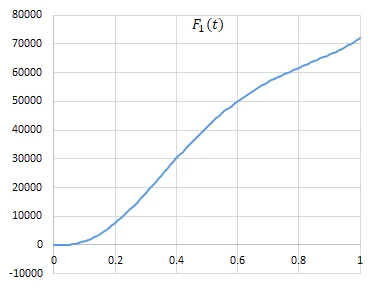

reduced to one-eighth with bisection method:


Root Finding Using Ridder's Method
Ridder's method is applied to the reduced isolated intervals. Ridder's method is a root-finding algorithm that iteratively approximates the root of a continuous function $f(x)$ using fixed-point iteration and exponential functions. A new point $x_{3}$ between $x_{0}$ and $x_{2}$ is obtained by the following formula [11]:
x_3 = x_1 + (x_1 - x_0)\frac{\operatorname{sign}[f(x_0)]f(x_1)}{\sqrt{f(x_1)^2 - f(x_0)f(x_2)}}
In this study, Ridder's method was selected because it allows the search interval for the root to be specified, is easy to implement, and was shown to be superior in the comparative evaluation results reported in [6]. Compared with the Newton–Raphson method, it converges faster and avoids the problem of convergence to roots outside the specified interval. The following figures show the convergence graphs for each isolated interval of the implicit equation $F_0(u)=0$ from Ex.3. (Left: Newton–Raphson method, Right: Ridder's method)


Ridder's method is simpler than other root-finding algorithms such as Müller's method, yet is often regarded as having comparable performance; however, some people have doubts [12]. In the sample evaluations conducted in this study, the combination of the bisection method and Ridder's method exhibited good convergence characteristics, but further investigation is required.
Handling Multiple Roots
The bisection method and Ridder's method do not support multiple roots. The VAG method also does not support them in its original form, but it was extended in this study so that, for multiple roots, subdivision is repeatedly performed until the isolated interval becomes sufficiently short, and the midpoint of the isolated interval output by the VAG method is taken as the root. Originally, Vincent's theorem and the VAG method is intended for real-root isolation. Using it also for convergence-based root finding requires further investigation in terms of reliability and computational efficiency.
The pseudocode of the VAG method from reference [10] was extended as follows to support multiple roots (the additions are shown in red):
1 $var \leftarrow$ the number of sign variations of $(x + 1)^{deg(p)} p(\frac{a + bx}{1 + x})$
2 if $var = 0$ then RETURN $\varnothing$;
3 if $var = 1$ then RETURN $\set{(a, b)}$;
4 $m \leftarrow \frac{1}{2}(a + b)$
+ if $b-a \lt M$ then RETURN $\set{(m-A, m+A)}$;
5 if $p(m) \neq 0$ then
6 RETURN VAG($p$, $(a, m)$) $\cup$ VAG($p$, $(m, b)$)
7 else
+ $var \leftarrow$ the number of sign variations of $(x + 1)^{deg(p)} p(\frac{m-A + (m+A)x}{1 + x})$
+ if $var = 1$ then
8 RETURN VAG($p$, $(a, m)$) $\cup$ $\set{[m, m]}$ $\cup$ VAG($p$, $(m, b)$)
+ else
+ RETURN VAG($p$, $(a, m-A)$) $\cup$ $\set{[m-A, m+A]}$ $\cup$ VAG($p$, $(m+A, b)$)
+ end
9 end
- If the function value $p(m)$ at the midpoint $m$ of the interval is zero, and the number of roots in the interval $(m−A,m+A)$ is one, then the isolated interval $[m,m]$ is output. If the number of roots is two or more, the isolated interval $(m−A,m+A)$ is output.
Here, $A$ is half the length of the isolated interval for multiple roots. - Even if an interval $(a,b)$ contains two or more roots, if the interval length $b−a$ is shorter than $M$, the subdivision process is terminated and an isolated interval $(m−A,m+A)$ containing multiple roots is output.
Here, $M$ is the minimum interval length. - If the output isolated interval has zero length, or if the interval contains two or more roots, subsequent processing (bisection method, Ridder's method) is skipped. In the latter case, the midpoint of the interval is taken as the root.
The reason for allowing $M$ and $A$ to be set independently is to balance the accuracy of multiple-root computation with tolerance for floating-point errors.
Below are the results obtained using SageMath to compute the coefficients of the transformed polynomials in the VAG method for the root $u=0.75$ (multiplicity $4$) in Ex.11 (contact between cusp points), for each interval $(0,0.75-A)$, $[0.75-A,0.75+A]$ and $(0.75+A,1)$. To obtain the expected numbers of sign variations: $\lbrace 0, 4, 0 \rbrace$, the isolated interval needed to be relatively large (with $A \ge 10^{-3}$). Considering the coefficient values, this is presumed to be due to the influence of floating-point arithmetic errors, but further analysis is required.
| $A$ | Terms and Number of Sign Variations of $(x + 1)^{deg(p)} p(\frac{a + bx}{1 + x})$ |
|---|---|
| $10^{-6}$ | 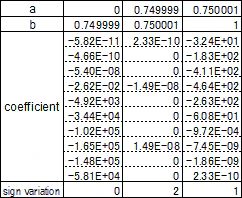 |
| $10^{-5}$ | 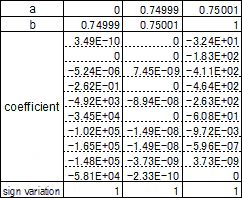 |
| $10^{-4}$ | 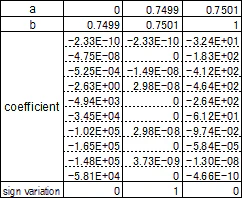 |
| $10^{-3}$ |  |
Intersection Determination
The candidate parameter $t$ is substituted into $x=f_0(t)$ and $y=g_0(t)$ to obtain the coordinates of the candidate intersection point on curve ${\boldsymbol{B}}_0$. Similarly, the candidate parameter $u$ is substituted into $x=f_1(u)$ and $y=g_1(u)$ to obtain the coordinates of the candidate intersection point on curve ${\boldsymbol{B}}_1$.
Pairs that correspond to each other — i.e., those whose Euclidean distance is sufficiently small — are determined to be intersection points.
Implementation
This algorithm was implemented in C++/Qt. The source code is shown in Appendix E.
Ridder's method was implemented in C++ by translating the Python code example provided in [13].
For numerical stability, the following measures were taken:
- Control point coordinates are affine-transformed so that their value range becomes $[0,1]$ before intersection detection. Intersection coordinates are then computed from the original control point coordinates and the intersection parameters.
- For polynomial evaluation of degree four or higher, the implementation was rewritten to use repeated multiplication and addition. For example,
$\quad p(x)=e_0 x^9+e_1 x^8+e_2 x^7+e_3 x^6+e_4 x^5+e_5 x^4+e_6 x^3+e_7 x^2+e_8 x+e_9$
was implemented as follows:
double p_(double *e, double x){
  return ((((((((e[0]*x+e[1])*x+e[2])*x+e[3])*x+e[4])*x+e[5])*x+e[6])*x+e[7])*x+e[8])*x+e[9];
}
- Judgments such as whether a value is zero were implemented with tolerance for floating-point errors. Each threshold value was experimentally determined using sample cases, and further evaluation is required.
- The VAG method was implemented using recursive calls according to the pseudocode, requiring stack frames proportional to recursion depth. In the present implementation, the stack usage of vVAG was measured to be at most 4624 bytes (using MSVC 2022).
Results
- Operation was verified using multiple examples, and correct intersection points were confirmed.
- For root finding, convergence using Ridder's method was sufficiently fast and stable.
- When the implicit equation contained multiple roots, the number of VAG iterations increased, but remained within a practical range.
Discussion
The strength of the implicitization method lies in its ability to algebraically compute intersections even in complex crossing patterns or cases involving twisting and overlapping, which tend to be unstable with conventional geometric methods.
In addition, since numerical procedures are clearly separated (real-root isolation → real-root extraction → intersection determination), the approach offers high portability and generality of implementation. It also has potential applicability to other cubic parametric curves (such as B-splines and Catmull–Rom splines), and even to surfaces.
On the other hand, practical issues require careful attention, including handling multiple roots, coefficient scaling, floating-point errors, and the stability of root-finding algorithms. In particular, the handling of multiple roots is based on a simple heuristic and is insufficient in terms of accuracy guarantees and theoretical rigor.
Conclusion and Future Work
This paper presented a practical method for Bézier curve intersection detection using the implicitization approach, along with its implementation and verification. As a result, it was shown that the method can handle intersection patterns that are difficult for conventional geometric approaches, demonstrating the usefulness of an algebraic approach.
Future work includes the following:
- Classification of curve intersection patterns and root types of implicit equations through analytical approaches
- Further investigation of root-finding methods (Müller's method and others, or combinations of multiple methods)
- More rigorous handling of multiple and closely spaced roots
- Improved robustness against numerical and rounding errors
- Application to real graphics/CAD/GUI systems and evaluation of performance
- Extension to other parametric curves and surfaces
References
[1] T.W. Sederberg, T. Nishita
Curve intersection using Bézier clipping
Computer-Aided Design, Vol.22, Issue 9, Nov.1990, pp.538-549
http://nishitalab.org/user/nis/cdrom/cad/CAGD90Curve.pdf
[2] Thomas W. Sederberg
Computer Aided Geometric Design, pp.191-208
Brigham Young University ScholarsArchive -- Faculty Publications
https://scholarsarchive.byu.edu/facpub/1/
[3] T.W Sederberg, D.C Anderson, R.N Goldman
Implicit representation of parametric curves and surfaces
Computer Vision, Graphics, and Image Processing, Vol.28, Issue 1, Oct.1984, pp.72-84
https://www.sciencedirect.com/science/article/abs/pii/0734189X84901403
[4] ゴッドフット企画
エクセルで操る!デュラン・ケルナー・アバース法(DKA法)による高次代数方程式の解計算
https://godfoot.world.coocan.jp/DKA-Method.htm
[5] PukiWiki for PBCGLab -- 非線形方程式の根
https://pbcglab.jp/cgi-bin/wiki/?%E9%9D%9E%E7%B7%9A%E5%BD%A2%E6%96%B9%E7%A8%8B%E5%BC%8F%E3%81%AE%E6%A0%B9
[6] Alexander Reshetov
Exploiting Budan-Fourier and Vincent's Theorems for Ray Tracing 3D Bézier Curves
Proceedings of HPG '17, Los Angeles, CA, USA, July 28-30, 2017
https://research.nvidia.com/publication/2017-07_exploiting-budan-fourier-and-vincents-theorems-ray-tracing-3d-bezier-curves
[7] Gerald Farin
Curves and Surfaces for Computer Aided Geometric Design: A Practical Guide
Academic Press, ISBN 0-12-249050-9, p.42, 1988
[8] Mathematics Stack Exchange -- Quadratic Bezier curves representation as implicit quadratic equation
https://math.stackexchange.com/questions/438743/quadratic-bezier-curves-representation-as-implicit-quadratic-equation
[9] Wikipedia -- Budan's theorem
https://en.wikipedia.org/wiki/Budan%27s_theorem
[10] Wikipedia -- Vincent's theorem
https://en.wikipedia.org/wiki/Vincent%27s_theorem
[11] Wikipedia -- Ridders' method
https://en.wikipedia.org/wiki/Ridders%27_method
[12] Mathematics Stack Exchange -- Why does Ridders' method work as well as it does?
https://math.stackexchange.com/questions/1596654/why-does-ridders-method-work-as-well-as-it-does
[13] Jaan Kiusalaas
Numerical Methods in Engineering with Python (2nd ed.)
Cambridge University Press, ISBN 978-0-521-19132-6, pp.147–148, 2010
Appendix
A) Converts a parametric function of a curve to an implicit function (for cubic)
Collect[Expand[Eliminate[{a0*t^3+a1*t^2+a2*t+a3==x,b0*t^3+b1*t^2+b2*t+b3==y},t]],{x,y}]
y (-6 a0^2 a3 b0 b3 + 3 a0^2 a3 b1 b2 - a0 a1 a3 b0 b2 - 2 a0 a1 a3 b1^2 + a0 a2 a3 b0 b1 + 3 a0 a3^2 b0^2 + 2 a1^2 a3 b0 b1 - 3 a1 a2 a3 b0^2) + 3 a0^2 a3 b0 b3^2 + 3 a0^2 a3 b0 y^2 - 3 a0^2 a3 b1 b2 b3 + a0^2 a3 b2^3 + x (6 a0 a3 b0^2 b3 - 6 a0 a3 b0^2 y - 6 a0 a3 b0 b1 b2 + 2 a0 a3 b1^3 + 4 a1 a3 b0^2 b2 - 2 a1 a3 b0 b1^2 + 2 a2 a3 b0^2 b1 - 3 a3^2 b0^3) + a0 a1 a3 b0 b2 b3 + 2 a0 a1 a3 b1^2 b3 - a0 a1 a3 b1 b2^2 - a0 a2 a3 b0 b1 b3 - 2 a0 a2 a3 b0 b2^2 + a0 a2 a3 b1^2 b2 - 3 a0 a3^2 b0^2 b3 + 3 a0 a3^2 b0 b1 b2 - a0 a3^2 b1^3 - 2 a1^2 a3 b0 b1 b3 + a1^2 a3 b0 b2^2 + 3 a1 a2 a3 b0^2 b3 - a1 a2 a3 b0 b1 b2 - 2 a1 a3^2 b0^2 b2 + a1 a3^2 b0 b1^2 + a2^2 a3 b0^2 b2 - a2 a3^2 b0^2 b1 + a3^3 b0^3 + 3 a3 b0^3 x^2 = a0^3 b3^3 - a0^3 y^3 + x (y (-6 a0^2 b0 b3 + 3 a0^2 b1 b2 - a0 a1 b0 b2 - 2 a0 a1 b1^2 + a0 a2 b0 b1 + 2 a1^2 b0 b1 - 3 a1 a2 b0^2) + 3 a0^2 b0 b3^2 + 3 a0^2 b0 y^2 - 3 a0^2 b1 b2 b3 + a0^2 b2^3 + a0 a1 b0 b2 b3 + 2 a0 a1 b1^2 b3 - a0 a1 b1 b2^2 - a0 a2 b0 b1 b3 - 2 a0 a2 b0 b2^2 + a0 a2 b1^2 b2 - 2 a1^2 b0 b1 b3 + a1^2 b0 b2^2 + 3 a1 a2 b0^2 b3 - a1 a2 b0 b1 b2 + a2^2 b0^2 b2) - a0^2 a1 b2 b3^2 - 2 a0^2 a2 b1 b3^2 + a0^2 a2 b2^2 b3 + y (-3 a0^3 b3^2 + 2 a0^2 a1 b2 b3 + 4 a0^2 a2 b1 b3 - a0^2 a2 b2^2 - 2 a0 a1^2 b1 b3 - 6 a0 a1 a2 b0 b3 + a0 a1 a2 b1 b2 + 2 a0 a2^2 b0 b2 - a0 a2^2 b1^2 + 2 a1^3 b0 b3 - a1^2 a2 b0 b2 + a1 a2^2 b0 b1 - a2^3 b0^2) + y^2 (3 a0^3 b3 - a0^2 a1 b2 - 2 a0^2 a2 b1 + a0 a1^2 b1 + 3 a0 a1 a2 b0 - a1^3 b0) + a0 a1^2 b1 b3^2 + x^2 (3 a0 b0^2 b3 - 3 a0 b0^2 y - 3 a0 b0 b1 b2 + a0 b1^3 + 2 a1 b0^2 b2 - a1 b0 b1^2 + a2 b0^2 b1) + 3 a0 a1 a2 b0 b3^2 - a0 a1 a2 b1 b2 b3 - 2 a0 a2^2 b0 b2 b3 + a0 a2^2 b1^2 b3 + a1^3 (-b0) b3^2 + a1^2 a2 b0 b2 b3 - a1 a2^2 b0 b1 b3 + a2^3 b0^2 b3 + b0^3 x^3
Manually rearrange into the form of implicit function $F(x,y)=0$.
var('a0 a1 a2 a3')
var('b0 b1 b2 b3')
x=a0*t^3+a1*t^2+a2*t+a3
y=b0*t^3+b1*t^2+b2*t+b3
F3=a3^3*b0^3-a2*a3^2*b0^2*b1+a1*a3^2*b0*b1^2-a0*a3^2*b1^3+a2^2*a3*b0^2*b2-2*a1*a3^2*b0^2*b2-a1*a2*a3*b0*b1*b2+3*a0*a3^2*b0*b1*b2+a0*a2*a3*b1^2*b2+a1^2*a3*b0*b2^2-2*a0*a2*a3*b0*b2^2-a0*a1*a3*b1*b2^2+a0^2*a3*b2^3-a2^3*b0^2*b3+3*a1*a2*a3*b0^2*b3-3*a0*a3^2*b0^2*b3+a1*a2^2*b0*b1*b3-2*a1^2*a3*b0*b1*b3-a0*a2*a3*b0*b1*b3-a0*a2^2*b1^2*b3+2*a0*a1*a3*b1^2*b3-a1^2*a2*b0*b2*b3+2*a0*a2^2*b0*b2*b3+a0*a1*a3*b0*b2*b3+a0*a1*a2*b1*b2*b3-3*a0^2*a3*b1*b2*b3-a0^2*a2*b2^2*b3+a1^3*b0*b3^2-3*a0*a1*a2*b0*b3^2+3*a0^2*a3*b0*b3^2-a0*a1^2*b1*b3^2+2*a0^2*a2*b1*b3^2+a0^2*a1*b2*b3^2-a0^3*b3^3+(-3*a3^2*b0^3+2*a2*a3*b0^2*b1-2*a1*a3*b0*b1^2+2*a0*a3*b1^3-a2^2*b0^2*b2+4*a1*a3*b0^2*b2+a1*a2*b0*b1*b2-6*a0*a3*b0*b1*b2-a0*a2*b1^2*b2-a1^2*b0*b2^2+2*a0*a2*b0*b2^2+a0*a1*b1*b2^2-a0^2*b2^3-3*a1*a2*b0^2*b3+6*a0*a3*b0^2*b3+2*a1^2*b0*b1*b3+a0*a2*b0*b1*b3-2*a0*a1*b1^2*b3-a0*a1*b0*b2*b3+3*a0^2*b1*b2*b3-3*a0^2*b0*b3^2)*x+(a2^3*b0^2-3*a1*a2*a3*b0^2+3*a0*a3^2*b0^2-a1*a2^2*b0*b1+2*a1^2*a3*b0*b1+a0*a2*a3*b0*b1+a0*a2^2*b1^2-2*a0*a1*a3*b1^2+a1^2*a2*b0*b2-2*a0*a2^2*b0*b2-a0*a1*a3*b0*b2-a0*a1*a2*b1*b2+3*a0^2*a3*b1*b2+a0^2*a2*b2^2-2*a1^3*b0*b3+6*a0*a1*a2*b0*b3-6*a0^2*a3*b0*b3+2*a0*a1^2*b1*b3-4*a0^2*a2*b1*b3-2*a0^2*a1*b2*b3+3*a0^3*b3^2)*y+(3*a3*b0^3-a2*b0^2*b1+a1*b0*b1^2-a0*b1^3-2*a1*b0^2*b2+3*a0*b0*b1*b2-3*a0*b0^2*b3)*x^2+(3*a1*a2*b0^2-6*a0*a3*b0^2-2*a1^2*b0*b1-a0*a2*b0*b1+2*a0*a1*b1^2+a0*a1*b0*b2-3*a0^2*b1*b2+6*a0^2*b0*b3)*x*y+(a1^3*b0-3*a0*a1*a2*b0+3*a0^2*a3*b0-a0*a1^2*b1+2*a0^2*a2*b1+a0^2*a1*b2-3*a0^3*b3)*y^2-b0^3*x^3+3*a0*b0^2*x^2*y-3*a0^2*b0*x*y^2+a0^3*y^3
F3.simplify_full()
0
B) Find the coefficients of each term in the implicit equation
var('u a0 a1 a2 a3 b0 b1 b2 b3 c0 c1 c2 c3 d0 d1 d2 d3')
x=c0*u^3+c1*u^2+c2*u+c3
y=d0*u^3+d1*u^2+d2*u+d3
F0=a3^3*b0^3-a2*a3^2*b0^2*b1+a1*a3^2*b0*b1^2-a0*a3^2*b1^3+a2^2*a3*b0^2*b2-2*a1*a3^2*b0^2*b2-a1*a2*a3*b0*b1*b2+3*a0*a3^2*b0*b1*b2+a0*a2*a3*b1^2*b2+a1^2*a3*b0*b2^2-2*a0*a2*a3*b0*b2^2-a0*a1*a3*b1*b2^2+a0^2*a3*b2^3-a2^3*b0^2*b3+3*a1*a2*a3*b0^2*b3-3*a0*a3^2*b0^2*b3+a1*a2^2*b0*b1*b3-2*a1^2*a3*b0*b1*b3-a0*a2*a3*b0*b1*b3-a0*a2^2*b1^2*b3+2*a0*a1*a3*b1^2*b3-a1^2*a2*b0*b2*b3+2*a0*a2^2*b0*b2*b3+a0*a1*a3*b0*b2*b3+a0*a1*a2*b1*b2*b3-3*a0^2*a3*b1*b2*b3-a0^2*a2*b2^2*b3+a1^3*b0*b3^2-3*a0*a1*a2*b0*b3^2+3*a0^2*a3*b0*b3^2-a0*a1^2*b1*b3^2+2*a0^2*a2*b1*b3^2+a0^2*a1*b2*b3^2-a0^3*b3^3+(-3*a3^2*b0^3+2*a2*a3*b0^2*b1-2*a1*a3*b0*b1^2+2*a0*a3*b1^3-a2^2*b0^2*b2+4*a1*a3*b0^2*b2+a1*a2*b0*b1*b2-6*a0*a3*b0*b1*b2-a0*a2*b1^2*b2-a1^2*b0*b2^2+2*a0*a2*b0*b2^2+a0*a1*b1*b2^2-a0^2*b2^3-3*a1*a2*b0^2*b3+6*a0*a3*b0^2*b3+2*a1^2*b0*b1*b3+a0*a2*b0*b1*b3-2*a0*a1*b1^2*b3-a0*a1*b0*b2*b3+3*a0^2*b1*b2*b3-3*a0^2*b0*b3^2)*x+(a2^3*b0^2-3*a1*a2*a3*b0^2+3*a0*a3^2*b0^2-a1*a2^2*b0*b1+2*a1^2*a3*b0*b1+a0*a2*a3*b0*b1+a0*a2^2*b1^2-2*a0*a1*a3*b1^2+a1^2*a2*b0*b2-2*a0*a2^2*b0*b2-a0*a1*a3*b0*b2-a0*a1*a2*b1*b2+3*a0^2*a3*b1*b2+a0^2*a2*b2^2-2*a1^3*b0*b3+6*a0*a1*a2*b0*b3-6*a0^2*a3*b0*b3+2*a0*a1^2*b1*b3-4*a0^2*a2*b1*b3-2*a0^2*a1*b2*b3+3*a0^3*b3^2)*y+(3*a3*b0^3-a2*b0^2*b1+a1*b0*b1^2-a0*b1^3-2*a1*b0^2*b2+3*a0*b0*b1*b2-3*a0*b0^2*b3)*x^2+(3*a1*a2*b0^2-6*a0*a3*b0^2-2*a1^2*b0*b1-a0*a2*b0*b1+2*a0*a1*b1^2+a0*a1*b0*b2-3*a0^2*b1*b2+6*a0^2*b0*b3)*x*y+(a1^3*b0-3*a0*a1*a2*b0+3*a0^2*a3*b0-a0*a1^2*b1+2*a0^2*a2*b1+a0^2*a1*b2-3*a0^3*b3)*y^2-b0^3*x^3+3*a0*b0^2*x^2*y-3*a0^2*b0*x*y^2+a0^3*y^3
cf0=F0.coefficients(u,sparse=False)
cf0[9].simplify_full()
cf0[8].simplify_full()
cf0[7].simplify_full()
cf0[6].simplify_full()
cf0[5].simplify_full()
cf0[4].simplify_full()
cf0[3].simplify_full()
cf0[2].simplify_full()
cf0[1].simplify_full()
cf0[0].simplify_full()
-b0^3*c0^3 + 3*a0*b0^2*c0^2*d0 - 3*a0^2*b0*c0*d0^2 + a0^3*d0^3
-3*b0^3*c0^2*c1 + 6*a0*b0^2*c0*c1*d0 - 3*a0^2*b0*c1*d0^2 + 3*(a0*b0^2*c0^2 - 2*a0^2*b0*c0*d0 + a0^3*d0^2)*d1
-3*b0^3*c0*c1^2 - 3*b0^3*c0^2*c2 - 3*a0^2*b0*c2*d0^2 - 3*(a0^2*b0*c0 - a0^3*d0)*d1^2 + 3*(a0*b0^2*c1^2 + 2*a0*b0^2*c0*c2)*d0 + 6*(a0*b0^2*c0*c1 - a0^2*b0*c1*d0)*d1 + 3*(a0*b0^2*c0^2 - 2*a0^2*b0*c0*d0 + a0^3*d0^2)*d2
-b0^3*c1^3 - 6*b0^3*c0*c1*c2 - 3*b0^3*c0^2*c3 - 3*a0^2*b0*c1*d1^2 + a0^3*d1^3 + (3*a3*b0^3 - a2*b0^2*b1 + a1*b0*b1^2 - a0*b1^3 - 3*a0*b0^2*b3 - (2*a1*b0^2 - 3*a0*b0*b1)*b2)*c0^2 + (a0^2*a1*b2 - 3*a0^3*b3 - 3*a0^2*b0*c3 + (a1^3 - 3*a0*a1*a2 + 3*a0^2*a3)*b0 - (a0*a1^2 - 2*a0^2*a2)*b1)*d0^2 + (6*a0*b0^2*c1*c2 + 6*a0*b0^2*c0*c3 + (2*a0*a1*b1^2 + 6*a0^2*b0*b3 + 3*(a1*a2 - 2*a0*a3)*b0^2 - (2*a1^2 + a0*a2)*b0*b1 + (a0*a1*b0 - 3*a0^2*b1)*b2)*c0)*d0 + 3*(a0*b0^2*c1^2 + 2*a0*b0^2*c0*c2 - 2*a0^2*b0*c2*d0)*d1 + 6*(a0*b0^2*c0*c1 - a0^2*b0*c1*d0 - (a0^2*b0*c0 - a0^3*d0)*d1)*d2 + 3*(a0*b0^2*c0^2 - 2*a0^2*b0*c0*d0 + a0^3*d0^2)*d3
-3*b0^3*c1^2*c2 - 3*b0^3*c0*c2^2 - 6*b0^3*c0*c1*c3 - 3*a0^2*b0*c2*d1^2 + 2*(3*a3*b0^3 - a2*b0^2*b1 + a1*b0*b1^2 - a0*b1^3 - 3*a0*b0^2*b3 - (2*a1*b0^2 - 3*a0*b0*b1)*b2)*c0*c1 - 3*(a0^2*b0*c0 - a0^3*d0)*d2^2 + (3*a0*b0^2*c2^2 + 6*a0*b0^2*c1*c3 + (2*a0*a1*b1^2 + 6*a0^2*b0*b3 + 3*(a1*a2 - 2*a0*a3)*b0^2 - (2*a1^2 + a0*a2)*b0*b1 + (a0*a1*b0 - 3*a0^2*b1)*b2)*c1)*d0 + (6*a0*b0^2*c1*c2 + 6*a0*b0^2*c0*c3 + (2*a0*a1*b1^2 + 6*a0^2*b0*b3 + 3*(a1*a2 - 2*a0*a3)*b0^2 - (2*a1^2 + a0*a2)*b0*b1 + (a0*a1*b0 - 3*a0^2*b1)*b2)*c0 + 2*(a0^2*a1*b2 - 3*a0^3*b3 - 3*a0^2*b0*c3 + (a1^3 - 3*a0*a1*a2 + 3*a0^2*a3)*b0 - (a0*a1^2 - 2*a0^2*a2)*b1)*d0)*d1 + 3*(a0*b0^2*c1^2 + 2*a0*b0^2*c0*c2 - 2*a0^2*b0*c2*d0 - 2*a0^2*b0*c1*d1 + a0^3*d1^2)*d2 + 6*(a0*b0^2*c0*c1 - a0^2*b0*c1*d0 - (a0^2*b0*c0 - a0^3*d0)*d1)*d3
-3*b0^3*c1*c2^2 + (3*a3*b0^3 - a2*b0^2*b1 + a1*b0*b1^2 - a0*b1^3 - 3*a0*b0^2*b3 - (2*a1*b0^2 - 3*a0*b0*b1)*b2)*c1^2 + 2*(3*a3*b0^3 - a2*b0^2*b1 + a1*b0*b1^2 - a0*b1^3 - 3*a0*b0^2*b3 - (2*a1*b0^2 - 3*a0*b0*b1)*b2)*c0*c2 + (a0^2*a1*b2 - 3*a0^3*b3 - 3*a0^2*b0*c3 + (a1^3 - 3*a0*a1*a2 + 3*a0^2*a3)*b0 - (a0*a1^2 - 2*a0^2*a2)*b1)*d1^2 - 3*(a0^2*b0*c1 - a0^3*d1)*d2^2 - 3*(b0^3*c1^2 + 2*b0^3*c0*c2)*c3 + (6*a0*b0^2*c2*c3 + (2*a0*a1*b1^2 + 6*a0^2*b0*b3 + 3*(a1*a2 - 2*a0*a3)*b0^2 - (2*a1^2 + a0*a2)*b0*b1 + (a0*a1*b0 - 3*a0^2*b1)*b2)*c2)*d0 + (3*a0*b0^2*c2^2 + 6*a0*b0^2*c1*c3 + (2*a0*a1*b1^2 + 6*a0^2*b0*b3 + 3*(a1*a2 - 2*a0*a3)*b0^2 - (2*a1^2 + a0*a2)*b0*b1 + (a0*a1*b0 - 3*a0^2*b1)*b2)*c1)*d1 + (6*a0*b0^2*c1*c2 + 6*a0*b0^2*c0*c3 - 6*a0^2*b0*c2*d1 + (2*a0*a1*b1^2 + 6*a0^2*b0*b3 + 3*(a1*a2 - 2*a0*a3)*b0^2 - (2*a1^2 + a0*a2)*b0*b1 + (a0*a1*b0 - 3*a0^2*b1)*b2)*c0 + 2*(a0^2*a1*b2 - 3*a0^3*b3 - 3*a0^2*b0*c3 + (a1^3 - 3*a0*a1*a2 + 3*a0^2*a3)*b0 - (a0*a1^2 - 2*a0^2*a2)*b1)*d0)*d2 + 3*(a0*b0^2*c1^2 + 2*a0*b0^2*c0*c2 - 2*a0^2*b0*c2*d0 - 2*a0^2*b0*c1*d1 + a0^3*d1^2 - 2*(a0^2*b0*c0 - a0^3*d0)*d2)*d3
-b0^3*c2^3 - 3*b0^3*c0*c3^2 - 3*a0^2*b0*c2*d2^2 + a0^3*d2^3 + 2*(3*a3*b0^3 - a2*b0^2*b1 + a1*b0*b1^2 - a0*b1^3 - 3*a0*b0^2*b3 - (2*a1*b0^2 - 3*a0*b0*b1)*b2)*c1*c2 - 3*(a0^2*b0*c0 - a0^3*d0)*d3^2 - (3*a3^2*b0^3 - 2*a2*a3*b0^2*b1 + 2*a1*a3*b0*b1^2 - 2*a0*a3*b1^3 + a0^2*b2^3 + 3*a0^2*b0*b3^2 - (a0*a1*b1 - (a1^2 - 2*a0*a2)*b0)*b2^2 + (a0*a2*b1^2 + (a2^2 - 4*a1*a3)*b0^2 - (a1*a2 - 6*a0*a3)*b0*b1)*b2 + (2*a0*a1*b1^2 + 3*(a1*a2 - 2*a0*a3)*b0^2 - (2*a1^2 + a0*a2)*b0*b1 + (a0*a1*b0 - 3*a0^2*b1)*b2)*b3)*c0 - 2*(3*b0^3*c1*c2 - (3*a3*b0^3 - a2*b0^2*b1 + a1*b0*b1^2 - a0*b1^3 - 3*a0*b0^2*b3 - (2*a1*b0^2 - 3*a0*b0*b1)*b2)*c0)*c3 + (a0^2*a2*b2^2 + 3*a0^3*b3^2 + 3*a0*b0^2*c3^2 + (a2^3 - 3*a1*a2*a3 + 3*a0*a3^2)*b0^2 - (a1*a2^2 - (2*a1^2 + a0*a2)*a3)*b0*b1 + (a0*a2^2 - 2*a0*a1*a3)*b1^2 + ((a1^2*a2 - 2*a0*a2^2 - a0*a1*a3)*b0 - (a0*a1*a2 - 3*a0^2*a3)*b1)*b2 - 2*(a0^2*a1*b2 + (a1^3 - 3*a0*a1*a2 + 3*a0^2*a3)*b0 - (a0*a1^2 - 2*a0^2*a2)*b1)*b3 + (2*a0*a1*b1^2 + 6*a0^2*b0*b3 + 3*(a1*a2 - 2*a0*a3)*b0^2 - (2*a1^2 + a0*a2)*b0*b1 + (a0*a1*b0 - 3*a0^2*b1)*b2)*c3)*d0 + (6*a0*b0^2*c2*c3 + (2*a0*a1*b1^2 + 6*a0^2*b0*b3 + 3*(a1*a2 - 2*a0*a3)*b0^2 - (2*a1^2 + a0*a2)*b0*b1 + (a0*a1*b0 - 3*a0^2*b1)*b2)*c2)*d1 + (3*a0*b0^2*c2^2 + 6*a0*b0^2*c1*c3 + (2*a0*a1*b1^2 + 6*a0^2*b0*b3 + 3*(a1*a2 - 2*a0*a3)*b0^2 - (2*a1^2 + a0*a2)*b0*b1 + (a0*a1*b0 - 3*a0^2*b1)*b2)*c1 + 2*(a0^2*a1*b2 - 3*a0^3*b3 - 3*a0^2*b0*c3 + (a1^3 - 3*a0*a1*a2 + 3*a0^2*a3)*b0 - (a0*a1^2 - 2*a0^2*a2)*b1)*d1)*d2 + (6*a0*b0^2*c1*c2 + 6*a0*b0^2*c0*c3 - 6*a0^2*b0*c2*d1 + (2*a0*a1*b1^2 + 6*a0^2*b0*b3 + 3*(a1*a2 - 2*a0*a3)*b0^2 - (2*a1^2 + a0*a2)*b0*b1 + (a0*a1*b0 - 3*a0^2*b1)*b2)*c0 + 2*(a0^2*a1*b2 - 3*a0^3*b3 - 3*a0^2*b0*c3 + (a1^3 - 3*a0*a1*a2 + 3*a0^2*a3)*b0 - (a0*a1^2 - 2*a0^2*a2)*b1)*d0 - 6*(a0^2*b0*c1 - a0^3*d1)*d2)*d3
-3*b0^3*c1*c3^2 + (3*a3*b0^3 - a2*b0^2*b1 + a1*b0*b1^2 - a0*b1^3 - 3*a0*b0^2*b3 - (2*a1*b0^2 - 3*a0*b0*b1)*b2)*c2^2 + (a0^2*a1*b2 - 3*a0^3*b3 - 3*a0^2*b0*c3 + (a1^3 - 3*a0*a1*a2 + 3*a0^2*a3)*b0 - (a0*a1^2 - 2*a0^2*a2)*b1)*d2^2 - 3*(a0^2*b0*c1 - a0^3*d1)*d3^2 - (3*a3^2*b0^3 - 2*a2*a3*b0^2*b1 + 2*a1*a3*b0*b1^2 - 2*a0*a3*b1^3 + a0^2*b2^3 + 3*a0^2*b0*b3^2 - (a0*a1*b1 - (a1^2 - 2*a0*a2)*b0)*b2^2 + (a0*a2*b1^2 + (a2^2 - 4*a1*a3)*b0^2 - (a1*a2 - 6*a0*a3)*b0*b1)*b2 + (2*a0*a1*b1^2 + 3*(a1*a2 - 2*a0*a3)*b0^2 - (2*a1^2 + a0*a2)*b0*b1 + (a0*a1*b0 - 3*a0^2*b1)*b2)*b3)*c1 - (3*b0^3*c2^2 - 2*(3*a3*b0^3 - a2*b0^2*b1 + a1*b0*b1^2 - a0*b1^3 - 3*a0*b0^2*b3 - (2*a1*b0^2 - 3*a0*b0*b1)*b2)*c1)*c3 + (a0^2*a2*b2^2 + 3*a0^3*b3^2 + 3*a0*b0^2*c3^2 + (a2^3 - 3*a1*a2*a3 + 3*a0*a3^2)*b0^2 - (a1*a2^2 - (2*a1^2 + a0*a2)*a3)*b0*b1 + (a0*a2^2 - 2*a0*a1*a3)*b1^2 + ((a1^2*a2 - 2*a0*a2^2 - a0*a1*a3)*b0 - (a0*a1*a2 - 3*a0^2*a3)*b1)*b2 - 2*(a0^2*a1*b2 + (a1^3 - 3*a0*a1*a2 + 3*a0^2*a3)*b0 - (a0*a1^2 - 2*a0^2*a2)*b1)*b3 + (2*a0*a1*b1^2 + 6*a0^2*b0*b3 + 3*(a1*a2 - 2*a0*a3)*b0^2 - (2*a1^2 + a0*a2)*b0*b1 + (a0*a1*b0 - 3*a0^2*b1)*b2)*c3)*d1 + (6*a0*b0^2*c2*c3 + (2*a0*a1*b1^2 + 6*a0^2*b0*b3 + 3*(a1*a2 - 2*a0*a3)*b0^2 - (2*a1^2 + a0*a2)*b0*b1 + (a0*a1*b0 - 3*a0^2*b1)*b2)*c2)*d2 + (3*a0*b0^2*c2^2 + 6*a0*b0^2*c1*c3 - 6*a0^2*b0*c2*d2 + 3*a0^3*d2^2 + (2*a0*a1*b1^2 + 6*a0^2*b0*b3 + 3*(a1*a2 - 2*a0*a3)*b0^2 - (2*a1^2 + a0*a2)*b0*b1 + (a0*a1*b0 - 3*a0^2*b1)*b2)*c1 + 2*(a0^2*a1*b2 - 3*a0^3*b3 - 3*a0^2*b0*c3 + (a1^3 - 3*a0*a1*a2 + 3*a0^2*a3)*b0 - (a0*a1^2 - 2*a0^2*a2)*b1)*d1)*d3
-3*b0^3*c2*c3^2 + 2*(3*a3*b0^3 - a2*b0^2*b1 + a1*b0*b1^2 - a0*b1^3 - 3*a0*b0^2*b3 - (2*a1*b0^2 - 3*a0*b0*b1)*b2)*c2*c3 - 3*(a0^2*b0*c2 - a0^3*d2)*d3^2 - (3*a3^2*b0^3 - 2*a2*a3*b0^2*b1 + 2*a1*a3*b0*b1^2 - 2*a0*a3*b1^3 + a0^2*b2^3 + 3*a0^2*b0*b3^2 - (a0*a1*b1 - (a1^2 - 2*a0*a2)*b0)*b2^2 + (a0*a2*b1^2 + (a2^2 - 4*a1*a3)*b0^2 - (a1*a2 - 6*a0*a3)*b0*b1)*b2 + (2*a0*a1*b1^2 + 3*(a1*a2 - 2*a0*a3)*b0^2 - (2*a1^2 + a0*a2)*b0*b1 + (a0*a1*b0 - 3*a0^2*b1)*b2)*b3)*c2 + (a0^2*a2*b2^2 + 3*a0^3*b3^2 + 3*a0*b0^2*c3^2 + (a2^3 - 3*a1*a2*a3 + 3*a0*a3^2)*b0^2 - (a1*a2^2 - (2*a1^2 + a0*a2)*a3)*b0*b1 + (a0*a2^2 - 2*a0*a1*a3)*b1^2 + ((a1^2*a2 - 2*a0*a2^2 - a0*a1*a3)*b0 - (a0*a1*a2 - 3*a0^2*a3)*b1)*b2 - 2*(a0^2*a1*b2 + (a1^3 - 3*a0*a1*a2 + 3*a0^2*a3)*b0 - (a0*a1^2 - 2*a0^2*a2)*b1)*b3 + (2*a0*a1*b1^2 + 6*a0^2*b0*b3 + 3*(a1*a2 - 2*a0*a3)*b0^2 - (2*a1^2 + a0*a2)*b0*b1 + (a0*a1*b0 - 3*a0^2*b1)*b2)*c3)*d2 + (6*a0*b0^2*c2*c3 + (2*a0*a1*b1^2 + 6*a0^2*b0*b3 + 3*(a1*a2 - 2*a0*a3)*b0^2 - (2*a1^2 + a0*a2)*b0*b1 + (a0*a1*b0 - 3*a0^2*b1)*b2)*c2 + 2*(a0^2*a1*b2 - 3*a0^3*b3 - 3*a0^2*b0*c3 + (a1^3 - 3*a0*a1*a2 + 3*a0^2*a3)*b0 - (a0*a1^2 - 2*a0^2*a2)*b1)*d2)*d3
a3^3*b0^3 - a2*a3^2*b0^2*b1 + a1*a3^2*b0*b1^2 - a0*a3^2*b1^3 + a0^2*a3*b2^3 - a0^3*b3^3 - b0^3*c3^3 + a0^3*d3^3 - (a0*a1*a3*b1 - (a1^2 - 2*a0*a2)*a3*b0)*b2^2 + (a0^2*a1*b2 + (a1^3 - 3*a0*a1*a2 + 3*a0^2*a3)*b0 - (a0*a1^2 - 2*a0^2*a2)*b1)*b3^2 + (3*a3*b0^3 - a2*b0^2*b1 + a1*b0*b1^2 - a0*b1^3 - 3*a0*b0^2*b3 - (2*a1*b0^2 - 3*a0*b0*b1)*b2)*c3^2 + (a0^2*a1*b2 - 3*a0^3*b3 - 3*a0^2*b0*c3 + (a1^3 - 3*a0*a1*a2 + 3*a0^2*a3)*b0 - (a0*a1^2 - 2*a0^2*a2)*b1)*d3^2 + (a0*a2*a3*b1^2 + (a2^2*a3 - 2*a1*a3^2)*b0^2 - (a1*a2*a3 - 3*a0*a3^2)*b0*b1)*b2 - (a0^2*a2*b2^2 + (a2^3 - 3*a1*a2*a3 + 3*a0*a3^2)*b0^2 - (a1*a2^2 - (2*a1^2 + a0*a2)*a3)*b0*b1 + (a0*a2^2 - 2*a0*a1*a3)*b1^2 + ((a1^2*a2 - 2*a0*a2^2 - a0*a1*a3)*b0 - (a0*a1*a2 - 3*a0^2*a3)*b1)*b2)*b3 - (3*a3^2*b0^3 - 2*a2*a3*b0^2*b1 + 2*a1*a3*b0*b1^2 - 2*a0*a3*b1^3 + a0^2*b2^3 + 3*a0^2*b0*b3^2 - (a0*a1*b1 - (a1^2 - 2*a0*a2)*b0)*b2^2 + (a0*a2*b1^2 + (a2^2 - 4*a1*a3)*b0^2 - (a1*a2 - 6*a0*a3)*b0*b1)*b2 + (2*a0*a1*b1^2 + 3*(a1*a2 - 2*a0*a3)*b0^2 - (2*a1^2 + a0*a2)*b0*b1 + (a0*a1*b0 - 3*a0^2*b1)*b2)*b3)*c3 + (a0^2*a2*b2^2 + 3*a0^3*b3^2 + 3*a0*b0^2*c3^2 + (a2^3 - 3*a1*a2*a3 + 3*a0*a3^2)*b0^2 - (a1*a2^2 - (2*a1^2 + a0*a2)*a3)*b0*b1 + (a0*a2^2 - 2*a0*a1*a3)*b1^2 + ((a1^2*a2 - 2*a0*a2^2 - a0*a1*a3)*b0 - (a0*a1*a2 - 3*a0^2*a3)*b1)*b2 - 2*(a0^2*a1*b2 + (a1^3 - 3*a0*a1*a2 + 3*a0^2*a3)*b0 - (a0*a1^2 - 2*a0^2*a2)*b1)*b3 + (2*a0*a1*b1^2 + 6*a0^2*b0*b3 + 3*(a1*a2 - 2*a0*a3)*b0^2 - (2*a1^2 + a0*a2)*b0*b1 + (a0*a1*b0 - 3*a0^2*b1)*b2)*c3)*d3
var('u a1 a2 a3 b1 b2 b3 c0 c1 c2 c3 d0 d1 d2 d3')
x=c0*u^3+c1*u^2+c2*u+c3
y=d0*u^3+d1*u^2+d2*u+d3
F0=a3^2*b1^2-a2*a3*b1*b2+a1*a3*b2^2+a2^2*b1*b3-2*a1*a3*b1*b3-a1*a2*b2*b3+a1^2*b3^2+(-2*a3*b1^2+a2*b1*b2-a1*b2^2+2*a1*b1*b3)*x+(-a2^2*b1+2*a1*a3*b1+a1*a2*b2-2*a1^2*b3)*y+b1^2*x^2-2*a1*b1*x*y+a1^2*y^2
cf0=F0.coefficients(u,sparse=False)
cf0[6].simplify_full()
cf0[5].simplify_full()
cf0[4].simplify_full()
cf0[3].simplify_full()
cf0[2].simplify_full()
cf0[1].simplify_full()
cf0[0].simplify_full()
b1^2*c0^2 - 2*a1*b1*c0*d0 + a1^2*d0^2
2*b1^2*c0*c1 - 2*a1*b1*c1*d0 - 2*(a1*b1*c0 - a1^2*d0)*d1
b1^2*c1^2 + 2*b1^2*c0*c2 - 2*a1*b1*c2*d0 - 2*a1*b1*c1*d1 + a1^2*d1^2 - 2*(a1*b1*c0 - a1^2*d0)*d2
2*b1^2*c1*c2 + 2*b1^2*c0*c3 - 2*a1*b1*c2*d1 - (2*a3*b1^2 - a2*b1*b2 + a1*b2^2 - 2*a1*b1*b3)*c0 + (a1*a2*b2 - 2*a1^2*b3 - 2*a1*b1*c3 - (a2^2 - 2*a1*a3)*b1)*d0 - 2*(a1*b1*c1 - a1^2*d1)*d2 - 2*(a1*b1*c0 - a1^2*d0)*d3
b1^2*c2^2 + 2*b1^2*c1*c3 - 2*a1*b1*c2*d2 + a1^2*d2^2 - (2*a3*b1^2 - a2*b1*b2 + a1*b2^2 - 2*a1*b1*b3)*c1 + (a1*a2*b2 - 2*a1^2*b3 - 2*a1*b1*c3 - (a2^2 - 2*a1*a3)*b1)*d1 - 2*(a1*b1*c1 - a1^2*d1)*d3
2*b1^2*c2*c3 - (2*a3*b1^2 - a2*b1*b2 + a1*b2^2 - 2*a1*b1*b3)*c2 + (a1*a2*b2 - 2*a1^2*b3 - 2*a1*b1*c3 - (a2^2 - 2*a1*a3)*b1)*d2 - 2*(a1*b1*c2 - a1^2*d2)*d3
a3^2*b1^2 - a2*a3*b1*b2 + a1*a3*b2^2 + a1^2*b3^2 + b1^2*c3^2 + a1^2*d3^2 - (a1*a2*b2 - (a2^2 - 2*a1*a3)*b1)*b3 - (2*a3*b1^2 - a2*b1*b2 + a1*b2^2 - 2*a1*b1*b3)*c3 + (a1*a2*b2 - 2*a1^2*b3 - 2*a1*b1*c3 - (a2^2 - 2*a1*a3)*b1)*d3
var('u a2 a3 b2 b3 c0 c1 c2 c3 d0 d1 d2 d3')
x=c0*u^3+c1*u^2+c2*u+c3
y=d0*u^3+d1*u^2+d2*u+d3
F0=-a3*b2+a2*b3+b2*x-a2*y
cf0=F0.coefficients(u,sparse=False)
cf0[3].simplify_full()
cf0[2].simplify_full()
cf0[1].simplify_full()
cf0[0].simplify_full()
b2*c0 - a2*d0
b2*c1 - a2*d1
b2*c2 - a2*d2
-a3*b2 + a2*b3 + b2*c3 - a2*d3
C) Find the formula for the coefficients of the transformed polynomial of Budin's statement
transformed polynomial: $p(x+1)$
var('x e0 e1 e2 e3 e4 e5 e6 e7 e8 e9')
x1=x+1
p=e0*x1^9+e1*x1^8+e2*x1^7+e3*x1^6+e4*x1^5+e5*x1^4+e6*x1^3+e7*x1^2+e8*x1+e9
p=p.simplify_full()
p.coefficients(x)
[[e0 + e1 + e2 + e3 + e4 + e5 + e6 + e7 + e8 + e9, 0],
 [9*e0 + 8*e1 + 7*e2 + 6*e3 + 5*e4 + 4*e5 + 3*e6 + 2*e7 + e8, 1],
 [36*e0 + 28*e1 + 21*e2 + 15*e3 + 10*e4 + 6*e5 + 3*e6 + e7, 2],
 [84*e0 + 56*e1 + 35*e2 + 20*e3 + 10*e4 + 4*e5 + e6, 3],
 [126*e0 + 70*e1 + 35*e2 + 15*e3 + 5*e4 + e5, 4],
 [126*e0 + 56*e1 + 21*e2 + 6*e3 + e4, 5],
 [84*e0 + 28*e1 + 7*e2 + e3, 6],
 [36*e0 + 8*e1 + e2, 7],
 [9*e0 + e1, 8],
 [e0, 9]]
D) Find the formula for finding the coefficients of the transformed polynomial for the VAG method
transformed polynomial: $ (x+1)^9 p \left (\frac{a+bx}{1+x} \right ) $
var('x a b e0 e1 e2 e3 e4 e5 e6 e7 e8 e9')
x1=(a+b*x)/(1+x)
p=e0*x1^9+e1*x1^8+e2*x1^7+e3*x1^6+e4*x1^5+e5*x1^4+e6*x1^3+e7*x1^2+e8*x1+e9
f=(x+1)^9*p
f=f.simplify_full()
f.coefficients(x)
[[a^9*e0 + a^8*e1 + a^7*e2 + a^6*e3 + a^5*e4 + a^4*e5 + a^3*e6 + a^2*e7 + a*e8 + e9,
  0],
 [a^8*e1 + 2*a^7*e2 + 3*a^6*e3 + 4*a^5*e4 + 5*a^4*e5 + 6*a^3*e6 + 7*a^2*e7 + 8*a*e8 + (9*a^8*e0 + 8*a^7*e1 + 7*a^6*e2 + 6*a^5*e3 + 5*a^4*e4 + 4*a^3*e5 + 3*a^2*e6 + 2*a*e7 + e8)*b + 9*e9,
  1],
 [a^7*e2 + 3*a^6*e3 + 6*a^5*e4 + 10*a^4*e5 + 15*a^3*e6 + 21*a^2*e7 + (36*a^7*e0 + 28*a^6*e1 + 21*a^5*e2 + 15*a^4*e3 + 10*a^3*e4 + 6*a^2*e5 + 3*a*e6 + e7)*b^2 + 28*a*e8 + 2*(4*a^7*e1 + 7*a^6*e2 + 9*a^5*e3 + 10*a^4*e4 + 10*a^3*e5 + 9*a^2*e6 + 7*a*e7 + 4*e8)*b + 36*e9,
  2],
 [a^6*e3 + 4*a^5*e4 + 10*a^4*e5 + 20*a^3*e6 + (84*a^6*e0 + 56*a^5*e1 + 35*a^4*e2 + 20*a^3*e3 + 10*a^2*e4 + 4*a*e5 + e6)*b^3 + 35*a^2*e7 + (28*a^6*e1 + 42*a^5*e2 + 45*a^4*e3 + 40*a^3*e4 + 30*a^2*e5 + 18*a*e6 + 7*e7)*b^2 + 56*a*e8 + (7*a^6*e2 + 18*a^5*e3 + 30*a^4*e4 + 40*a^3*e5 + 45*a^2*e6 + 42*a*e7 + 28*e8)*b + 84*e9,
  3],
 [a^5*e4 + 5*a^4*e5 + (126*a^5*e0 + 70*a^4*e1 + 35*a^3*e2 + 15*a^2*e3 + 5*a*e4 + e5)*b^4 + 15*a^3*e6 + 2*(28*a^5*e1 + 35*a^4*e2 + 30*a^3*e3 + 20*a^2*e4 + 10*a*e5 + 3*e6)*b^3 + 35*a^2*e7 + 3*(7*a^5*e2 + 15*a^4*e3 + 20*a^3*e4 + 20*a^2*e5 + 15*a*e6 + 7*e7)*b^2 + 70*a*e8 + 2*(3*a^5*e3 + 10*a^4*e4 + 20*a^3*e5 + 30*a^2*e6 + 35*a*e7 + 28*e8)*b + 126*e9,
  4],
 [(126*a^4*e0 + 56*a^3*e1 + 21*a^2*e2 + 6*a*e3 + e4)*b^5 + a^4*e5 + 5*(14*a^4*e1 + 14*a^3*e2 + 9*a^2*e3 + 4*a*e4 + e5)*b^4 + 6*a^3*e6 + 5*(7*a^4*e2 + 12*a^3*e3 + 12*a^2*e4 + 8*a*e5 + 3*e6)*b^3 + 21*a^2*e7 + 5*(3*a^4*e3 + 8*a^3*e4 + 12*a^2*e5 + 12*a*e6 + 7*e7)*b^2 + 56*a*e8 + 5*(a^4*e4 + 4*a^3*e5 + 9*a^2*e6 + 14*a*e7 + 14*e8)*b + 126*e9,
  5],
 [(84*a^3*e0 + 28*a^2*e1 + 7*a*e2 + e3)*b^6 + 2*(28*a^3*e1 + 21*a^2*e2 + 9*a*e3 + 2*e4)*b^5 + 5*(7*a^3*e2 + 9*a^2*e3 + 6*a*e4 + 2*e5)*b^4 + a^3*e6 + 20*(a^3*e3 + 2*a^2*e4 + 2*a*e5 + e6)*b^3 + 7*a^2*e7 + 5*(2*a^3*e4 + 6*a^2*e5 + 9*a*e6 + 7*e7)*b^2 + 28*a*e8 + 2*(2*a^3*e5 + 9*a^2*e6 + 21*a*e7 + 28*e8)*b + 84*e9,
  6],
 [(36*a^2*e0 + 8*a*e1 + e2)*b^7 + (28*a^2*e1 + 14*a*e2 + 3*e3)*b^6 + 3*(7*a^2*e2 + 6*a*e3 + 2*e4)*b^5 + 5*(3*a^2*e3 + 4*a*e4 + 2*e5)*b^4 + 5*(2*a^2*e4 + 4*a*e5 + 3*e6)*b^3 + a^2*e7 + 3*(2*a^2*e5 + 6*a*e6 + 7*e7)*b^2 + 8*a*e8 + (3*a^2*e6 + 14*a*e7 + 28*e8)*b + 36*e9,
  7],
 [(9*a*e0 + e1)*b^8 + 2*(4*a*e1 + e2)*b^7 + (7*a*e2 + 3*e3)*b^6 + 2*(3*a*e3 + 2*e4)*b^5 + 5*(a*e4 + e5)*b^4 + 2*(2*a*e5 + 3*e6)*b^3 + (3*a*e6 + 7*e7)*b^2 + a*e8 + 2*(a*e7 + 4*e8)*b + 9*e9,
  8],
 [e0*b^9 + e1*b^8 + e2*b^7 + e3*b^6 + e4*b^5 + e5*b^4 + e6*b^3 + e7*b^2 + e8*b + e9,
  9]]
E) Implementation example source code
#include <cmath>
#include <QPointF>
#include <QList>
using namespace std;

#define EZERO   1e-14   // Values closer to zero than this are treated as zero
#define ABADJ   1e-3    // VAG method: half of the isolated interval length for multiple roots
#define ABMIN   1e-5    // VAG method: minimum isolated interval length
#define DSTMIN  1e-4    // Distance threshold for matching intersection candidates

#define PW3(x)	((x)*(x)*(x))
#define PW2(x)	((x)*(x))

typedef struct{
    double a;	// Interval start
    double b;	// Interval end
    double pa;	// Function value at a
    double pb;	// Function value at b
    int nr;     // Number of real roots contained in the interval
}Interval;

// Compute the coefficients of a cubic Bézier curve
void coefBezier(
  QList<QPointF> &cp,	// IN  Bézier curve control points
  double *a,			// OUT x-coordinate coefficients
  double *b)			// OUT y-coordinate coefficients
{
    a[0]=-cp[0].x()+3*cp[1].x()-3*cp[2].x()+cp[3].x();
    a[1]=3*cp[0].x()-6*cp[1].x()+3*cp[2].x();
    a[2]=-3*cp[0].x()+3*cp[1].x();
    a[3]=cp[0].x();
    b[0]=-cp[0].y()+3*cp[1].y()-3*cp[2].y()+cp[3].y();
    b[1]=3*cp[0].y()-6*cp[1].y()+3*cp[2].y();
    b[2]=-3*cp[0].y()+3*cp[1].y();
    b[3]=cp[0].y();
}

// Compute a point on a cubic parametric curve
QPointF pointBezier(
  double *a,			// IN  x-coordinate coefficients
  double *b,			// IN  y-coordinate coefficients
  double t)				// IN  Parameter
{
    return QPointF(a[0]*PW3(t)+a[1]*PW2(t)+a[2]*t+a[3],
                   b[0]*PW3(t)+b[1]*PW2(t)+b[2]*t+b[3]);
}

// Normalize control point coordinates to the range [0, 1]
void normCP(
  QList<QPointF> &cp0,  // IN  Control points of curve 0
  QList<QPointF> &cp1,  // IN  Control points of curve 1
  QList<QPointF> &ncp0, // OUT Normalized control points of curve 0
  QList<QPointF> &ncp1) // OUT Normalized control points of curve 1
{
    double xmin=cp0[0].x();
    double xmax=cp0[0].x();
    double ymin=cp0[0].y();
    double ymax=cp0[0].y();
    foreach(QPointF p,cp0.mid(1)){
        if(xmin>p.x()) xmin=p.x();
        if(xmax<p.x()) xmax=p.x();
        if(ymin>p.y()) ymin=p.y();
        if(ymax<p.y()) ymax=p.y();
    }
    foreach(QPointF p,cp1){
        if(xmin>p.x()) xmin=p.x();
        if(xmax<p.x()) xmax=p.x();
        if(ymin>p.y()) ymin=p.y();
        if(ymax<p.y()) ymax=p.y();
    }
    double m=max(xmax-xmin,ymax-ymin);
    ncp0.clear();
    ncp1.clear();
    foreach(QPointF p,cp0)
        ncp0<<QPointF((p.x()-xmin)/m,(p.y()-ymin)/m);
    foreach(QPointF p,cp1)
        ncp1<<QPointF((p.x()-xmin)/m,(p.y()-ymin)/m);
}

// Compute the coefficients of the implicit equation F0(u) for the intersection of two cubic parametric curves
void coefImp0(
  double *a,	// IN  Coefficients of curve 0 (x,y)=f(t); a[0], b[0] are cubic terms
  double *b,
  double *c,	// IN  Coefficients of curve 1 (x,y)=g(u); c[0], d[0] are cubic terms
  double *d,
  double *cf)	// OUT Coefficients of F0(u); cf[0] is the 9th-degree term
{
    if(abs(a[0])>=EZERO||abs(b[0])>=EZERO){
        // Curve 0 is cubic
        cf[0]=-PW3(b[0])*PW3(c[0])+3*a[0]*PW2(b[0])*PW2(c[0])*d[0]-3*PW2(a[0])*b[0]*c[0]*PW2(d[0])+PW3(a[0])*PW3(d[0]);
        cf[1]=-3*PW3(b[0])*PW2(c[0])*c[1]+6*a[0]*PW2(b[0])*c[0]*c[1]*d[0]-3*PW2(a[0])*b[0]*c[1]*PW2(d[0])+3*(a[0]*PW2(b[0])*PW2(c[0])-2*PW2(a[0])*b[0]*c[0]*d[0]+PW3(a[0])*PW2(d[0]))*d[1];
        cf[2]=-3*PW3(b[0])*c[0]*PW2(c[1])-3*PW3(b[0])*PW2(c[0])*c[2]-3*PW2(a[0])*b[0]*c[2]*PW2(d[0])-3*(PW2(a[0])*b[0]*c[0]-PW3(a[0])*d[0])*PW2(d[1])+3*(a[0]*PW2(b[0])*PW2(c[1])+2*a[0]*PW2(b[0])*c[0]*c[2])*d[0]+6*(a[0]*PW2(b[0])*c[0]*c[1]-PW2(a[0])*b[0]*c[1]*d[0])*d[1]+3*(a[0]*PW2(b[0])*PW2(c[0])-2*PW2(a[0])*b[0]*c[0]*d[0]+PW3(a[0])*PW2(d[0]))*d[2];
        cf[3]=-PW3(b[0])*PW3(c[1])-6*PW3(b[0])*c[0]*c[1]*c[2]-3*PW3(b[0])*PW2(c[0])*c[3]-3*PW2(a[0])*b[0]*c[1]*PW2(d[1])+PW3(a[0])*PW3(d[1])+(3*a[3]*PW3(b[0])-a[2]*PW2(b[0])*b[1]+a[1]*b[0]*PW2(b[1])-a[0]*PW3(b[1])-3*a[0]*PW2(b[0])*b[3]-(2*a[1]*PW2(b[0])-3*a[0]*b[0]*b[1])*b[2])*PW2(c[0])+(PW2(a[0])*a[1]*b[2]-3*PW3(a[0])*b[3]-3*PW2(a[0])*b[0]*c[3]+(PW3(a[1])-3*a[0]*a[1]*a[2]+3*PW2(a[0])*a[3])*b[0]-(a[0]*PW2(a[1])-2*PW2(a[0])*a[2])*b[1])*PW2(d[0])+(6*a[0]*PW2(b[0])*c[1]*c[2]+6*a[0]*PW2(b[0])*c[0]*c[3]+(2*a[0]*a[1]*PW2(b[1])+6*PW2(a[0])*b[0]*b[3]+3*(a[1]*a[2]-2*a[0]*a[3])*PW2(b[0])-(2*PW2(a[1])+a[0]*a[2])*b[0]*b[1]+(a[0]*a[1]*b[0]-3*PW2(a[0])*b[1])*b[2])*c[0])*d[0]+3*(a[0]*PW2(b[0])*PW2(c[1])+2*a[0]*PW2(b[0])*c[0]*c[2]-2*PW2(a[0])*b[0]*c[2]*d[0])*d[1]+6*(a[0]*PW2(b[0])*c[0]*c[1]-PW2(a[0])*b[0]*c[1]*d[0]-(PW2(a[0])*b[0]*c[0]-PW3(a[0])*d[0])*d[1])*d[2]+3*(a[0]*PW2(b[0])*PW2(c[0])-2*PW2(a[0])*b[0]*c[0]*d[0]+PW3(a[0])*PW2(d[0]))*d[3];
        cf[4]=-3*PW3(b[0])*PW2(c[1])*c[2]-3*PW3(b[0])*c[0]*PW2(c[2])-6*PW3(b[0])*c[0]*c[1]*c[3]-3*PW2(a[0])*b[0]*c[2]*PW2(d[1])+2*(3*a[3]*PW3(b[0])-a[2]*PW2(b[0])*b[1]+a[1]*b[0]*PW2(b[1])-a[0]*PW3(b[1])-3*a[0]*PW2(b[0])*b[3]-(2*a[1]*PW2(b[0])-3*a[0]*b[0]*b[1])*b[2])*c[0]*c[1]-3*(PW2(a[0])*b[0]*c[0]-PW3(a[0])*d[0])*PW2(d[2])+(3*a[0]*PW2(b[0])*PW2(c[2])+6*a[0]*PW2(b[0])*c[1]*c[3]+(2*a[0]*a[1]*PW2(b[1])+6*PW2(a[0])*b[0]*b[3]+3*(a[1]*a[2]-2*a[0]*a[3])*PW2(b[0])-(2*PW2(a[1])+a[0]*a[2])*b[0]*b[1]+(a[0]*a[1]*b[0]-3*PW2(a[0])*b[1])*b[2])*c[1])*d[0]+(6*a[0]*PW2(b[0])*c[1]*c[2]+6*a[0]*PW2(b[0])*c[0]*c[3]+(2*a[0]*a[1]*PW2(b[1])+6*PW2(a[0])*b[0]*b[3]+3*(a[1]*a[2]-2*a[0]*a[3])*PW2(b[0])-(2*PW2(a[1])+a[0]*a[2])*b[0]*b[1]+(a[0]*a[1]*b[0]-3*PW2(a[0])*b[1])*b[2])*c[0]+2*(PW2(a[0])*a[1]*b[2]-3*PW3(a[0])*b[3]-3*PW2(a[0])*b[0]*c[3]+(PW3(a[1])-3*a[0]*a[1]*a[2]+3*PW2(a[0])*a[3])*b[0]-(a[0]*PW2(a[1])-2*PW2(a[0])*a[2])*b[1])*d[0])*d[1]+3*(a[0]*PW2(b[0])*PW2(c[1])+2*a[0]*PW2(b[0])*c[0]*c[2]-2*PW2(a[0])*b[0]*c[2]*d[0]-2*PW2(a[0])*b[0]*c[1]*d[1]+PW3(a[0])*PW2(d[1]))*d[2]+6*(a[0]*PW2(b[0])*c[0]*c[1]-PW2(a[0])*b[0]*c[1]*d[0]-(PW2(a[0])*b[0]*c[0]-PW3(a[0])*d[0])*d[1])*d[3];
        cf[5]=-3*PW3(b[0])*c[1]*PW2(c[2])+(3*a[3]*PW3(b[0])-a[2]*PW2(b[0])*b[1]+a[1]*b[0]*PW2(b[1])-a[0]*PW3(b[1])-3*a[0]*PW2(b[0])*b[3]-(2*a[1]*PW2(b[0])-3*a[0]*b[0]*b[1])*b[2])*PW2(c[1])+2*(3*a[3]*PW3(b[0])-a[2]*PW2(b[0])*b[1]+a[1]*b[0]*PW2(b[1])-a[0]*PW3(b[1])-3*a[0]*PW2(b[0])*b[3]-(2*a[1]*PW2(b[0])-3*a[0]*b[0]*b[1])*b[2])*c[0]*c[2]+(PW2(a[0])*a[1]*b[2]-3*PW3(a[0])*b[3]-3*PW2(a[0])*b[0]*c[3]+(PW3(a[1])-3*a[0]*a[1]*a[2]+3*PW2(a[0])*a[3])*b[0]-(a[0]*PW2(a[1])-2*PW2(a[0])*a[2])*b[1])*PW2(d[1])-3*(PW2(a[0])*b[0]*c[1]-PW3(a[0])*d[1])*PW2(d[2])-3*(PW3(b[0])*PW2(c[1])+2*PW3(b[0])*c[0]*c[2])*c[3]+(6*a[0]*PW2(b[0])*c[2]*c[3]+(2*a[0]*a[1]*PW2(b[1])+6*PW2(a[0])*b[0]*b[3]+3*(a[1]*a[2]-2*a[0]*a[3])*PW2(b[0])-(2*PW2(a[1])+a[0]*a[2])*b[0]*b[1]+(a[0]*a[1]*b[0]-3*PW2(a[0])*b[1])*b[2])*c[2])*d[0]+(3*a[0]*PW2(b[0])*PW2(c[2])+6*a[0]*PW2(b[0])*c[1]*c[3]+(2*a[0]*a[1]*PW2(b[1])+6*PW2(a[0])*b[0]*b[3]+3*(a[1]*a[2]-2*a[0]*a[3])*PW2(b[0])-(2*PW2(a[1])+a[0]*a[2])*b[0]*b[1]+(a[0]*a[1]*b[0]-3*PW2(a[0])*b[1])*b[2])*c[1])*d[1]+(6*a[0]*PW2(b[0])*c[1]*c[2]+6*a[0]*PW2(b[0])*c[0]*c[3]-6*PW2(a[0])*b[0]*c[2]*d[1]+(2*a[0]*a[1]*PW2(b[1])+6*PW2(a[0])*b[0]*b[3]+3*(a[1]*a[2]-2*a[0]*a[3])*PW2(b[0])-(2*PW2(a[1])+a[0]*a[2])*b[0]*b[1]+(a[0]*a[1]*b[0]-3*PW2(a[0])*b[1])*b[2])*c[0]+2*(PW2(a[0])*a[1]*b[2]-3*PW3(a[0])*b[3]-3*PW2(a[0])*b[0]*c[3]+(PW3(a[1])-3*a[0]*a[1]*a[2]+3*PW2(a[0])*a[3])*b[0]-(a[0]*PW2(a[1])-2*PW2(a[0])*a[2])*b[1])*d[0])*d[2]+3*(a[0]*PW2(b[0])*PW2(c[1])+2*a[0]*PW2(b[0])*c[0]*c[2]-2*PW2(a[0])*b[0]*c[2]*d[0]-2*PW2(a[0])*b[0]*c[1]*d[1]+PW3(a[0])*PW2(d[1])-2*(PW2(a[0])*b[0]*c[0]-PW3(a[0])*d[0])*d[2])*d[3];
        cf[6]=-PW3(b[0])*PW3(c[2])-3*PW3(b[0])*c[0]*PW2(c[3])-3*PW2(a[0])*b[0]*c[2]*PW2(d[2])+PW3(a[0])*PW3(d[2])+2*(3*a[3]*PW3(b[0])-a[2]*PW2(b[0])*b[1]+a[1]*b[0]*PW2(b[1])-a[0]*PW3(b[1])-3*a[0]*PW2(b[0])*b[3]-(2*a[1]*PW2(b[0])-3*a[0]*b[0]*b[1])*b[2])*c[1]*c[2]-3*(PW2(a[0])*b[0]*c[0]-PW3(a[0])*d[0])*PW2(d[3])-(3*PW2(a[3])*PW3(b[0])-2*a[2]*a[3]*PW2(b[0])*b[1]+2*a[1]*a[3]*b[0]*PW2(b[1])-2*a[0]*a[3]*PW3(b[1])+PW2(a[0])*PW3(b[2])+3*PW2(a[0])*b[0]*PW2(b[3])-(a[0]*a[1]*b[1]-(PW2(a[1])-2*a[0]*a[2])*b[0])*PW2(b[2])+(a[0]*a[2]*PW2(b[1])+(PW2(a[2])-4*a[1]*a[3])*PW2(b[0])-(a[1]*a[2]-6*a[0]*a[3])*b[0]*b[1])*b[2]+(2*a[0]*a[1]*PW2(b[1])+3*(a[1]*a[2]-2*a[0]*a[3])*PW2(b[0])-(2*PW2(a[1])+a[0]*a[2])*b[0]*b[1]+(a[0]*a[1]*b[0]-3*PW2(a[0])*b[1])*b[2])*b[3])*c[0]-2*(3*PW3(b[0])*c[1]*c[2]-(3*a[3]*PW3(b[0])-a[2]*PW2(b[0])*b[1]+a[1]*b[0]*PW2(b[1])-a[0]*PW3(b[1])-3*a[0]*PW2(b[0])*b[3]-(2*a[1]*PW2(b[0])-3*a[0]*b[0]*b[1])*b[2])*c[0])*c[3]+(PW2(a[0])*a[2]*PW2(b[2])+3*PW3(a[0])*PW2(b[3])+3*a[0]*PW2(b[0])*PW2(c[3])+(PW3(a[2])-3*a[1]*a[2]*a[3]+3*a[0]*PW2(a[3]))*PW2(b[0])-(a[1]*PW2(a[2])-(2*PW2(a[1])+a[0]*a[2])*a[3])*b[0]*b[1]+(a[0]*PW2(a[2])-2*a[0]*a[1]*a[3])*PW2(b[1])+((PW2(a[1])*a[2]-2*a[0]*PW2(a[2])-a[0]*a[1]*a[3])*b[0]-(a[0]*a[1]*a[2]-3*PW2(a[0])*a[3])*b[1])*b[2]-2*(PW2(a[0])*a[1]*b[2]+(PW3(a[1])-3*a[0]*a[1]*a[2]+3*PW2(a[0])*a[3])*b[0]-(a[0]*PW2(a[1])-2*PW2(a[0])*a[2])*b[1])*b[3]+(2*a[0]*a[1]*PW2(b[1])+6*PW2(a[0])*b[0]*b[3]+3*(a[1]*a[2]-2*a[0]*a[3])*PW2(b[0])-(2*PW2(a[1])+a[0]*a[2])*b[0]*b[1]+(a[0]*a[1]*b[0]-3*PW2(a[0])*b[1])*b[2])*c[3])*d[0]+(6*a[0]*PW2(b[0])*c[2]*c[3]+(2*a[0]*a[1]*PW2(b[1])+6*PW2(a[0])*b[0]*b[3]+3*(a[1]*a[2]-2*a[0]*a[3])*PW2(b[0])-(2*PW2(a[1])+a[0]*a[2])*b[0]*b[1]+(a[0]*a[1]*b[0]-3*PW2(a[0])*b[1])*b[2])*c[2])*d[1]+(3*a[0]*PW2(b[0])*PW2(c[2])+6*a[0]*PW2(b[0])*c[1]*c[3]+(2*a[0]*a[1]*PW2(b[1])+6*PW2(a[0])*b[0]*b[3]+3*(a[1]*a[2]-2*a[0]*a[3])*PW2(b[0])-(2*PW2(a[1])+a[0]*a[2])*b[0]*b[1]+(a[0]*a[1]*b[0]-3*PW2(a[0])*b[1])*b[2])*c[1]+2*(PW2(a[0])*a[1]*b[2]-3*PW3(a[0])*b[3]-3*PW2(a[0])*b[0]*c[3]+(PW3(a[1])-3*a[0]*a[1]*a[2]+3*PW2(a[0])*a[3])*b[0]-(a[0]*PW2(a[1])-2*PW2(a[0])*a[2])*b[1])*d[1])*d[2]+(6*a[0]*PW2(b[0])*c[1]*c[2]+6*a[0]*PW2(b[0])*c[0]*c[3]-6*PW2(a[0])*b[0]*c[2]*d[1]+(2*a[0]*a[1]*PW2(b[1])+6*PW2(a[0])*b[0]*b[3]+3*(a[1]*a[2]-2*a[0]*a[3])*PW2(b[0])-(2*PW2(a[1])+a[0]*a[2])*b[0]*b[1]+(a[0]*a[1]*b[0]-3*PW2(a[0])*b[1])*b[2])*c[0]+2*(PW2(a[0])*a[1]*b[2]-3*PW3(a[0])*b[3]-3*PW2(a[0])*b[0]*c[3]+(PW3(a[1])-3*a[0]*a[1]*a[2]+3*PW2(a[0])*a[3])*b[0]-(a[0]*PW2(a[1])-2*PW2(a[0])*a[2])*b[1])*d[0]-6*(PW2(a[0])*b[0]*c[1]-PW3(a[0])*d[1])*d[2])*d[3];
        cf[7]=-3*PW3(b[0])*c[1]*PW2(c[3])+(3*a[3]*PW3(b[0])-a[2]*PW2(b[0])*b[1]+a[1]*b[0]*PW2(b[1])-a[0]*PW3(b[1])-3*a[0]*PW2(b[0])*b[3]-(2*a[1]*PW2(b[0])-3*a[0]*b[0]*b[1])*b[2])*PW2(c[2])+(PW2(a[0])*a[1]*b[2]-3*PW3(a[0])*b[3]-3*PW2(a[0])*b[0]*c[3]+(PW3(a[1])-3*a[0]*a[1]*a[2]+3*PW2(a[0])*a[3])*b[0]-(a[0]*PW2(a[1])-2*PW2(a[0])*a[2])*b[1])*PW2(d[2])-3*(PW2(a[0])*b[0]*c[1]-PW3(a[0])*d[1])*PW2(d[3])-(3*PW2(a[3])*PW3(b[0])-2*a[2]*a[3]*PW2(b[0])*b[1]+2*a[1]*a[3]*b[0]*PW2(b[1])-2*a[0]*a[3]*PW3(b[1])+PW2(a[0])*PW3(b[2])+3*PW2(a[0])*b[0]*PW2(b[3])-(a[0]*a[1]*b[1]-(PW2(a[1])-2*a[0]*a[2])*b[0])*PW2(b[2])+(a[0]*a[2]*PW2(b[1])+(PW2(a[2])-4*a[1]*a[3])*PW2(b[0])-(a[1]*a[2]-6*a[0]*a[3])*b[0]*b[1])*b[2]+(2*a[0]*a[1]*PW2(b[1])+3*(a[1]*a[2]-2*a[0]*a[3])*PW2(b[0])-(2*PW2(a[1])+a[0]*a[2])*b[0]*b[1]+(a[0]*a[1]*b[0]-3*PW2(a[0])*b[1])*b[2])*b[3])*c[1]-(3*PW3(b[0])*PW2(c[2])-2*(3*a[3]*PW3(b[0])-a[2]*PW2(b[0])*b[1]+a[1]*b[0]*PW2(b[1])-a[0]*PW3(b[1])-3*a[0]*PW2(b[0])*b[3]-(2*a[1]*PW2(b[0])-3*a[0]*b[0]*b[1])*b[2])*c[1])*c[3]+(PW2(a[0])*a[2]*PW2(b[2])+3*PW3(a[0])*PW2(b[3])+3*a[0]*PW2(b[0])*PW2(c[3])+(PW3(a[2])-3*a[1]*a[2]*a[3]+3*a[0]*PW2(a[3]))*PW2(b[0])-(a[1]*PW2(a[2])-(2*PW2(a[1])+a[0]*a[2])*a[3])*b[0]*b[1]+(a[0]*PW2(a[2])-2*a[0]*a[1]*a[3])*PW2(b[1])+((PW2(a[1])*a[2]-2*a[0]*PW2(a[2])-a[0]*a[1]*a[3])*b[0]-(a[0]*a[1]*a[2]-3*PW2(a[0])*a[3])*b[1])*b[2]-2*(PW2(a[0])*a[1]*b[2]+(PW3(a[1])-3*a[0]*a[1]*a[2]+3*PW2(a[0])*a[3])*b[0]-(a[0]*PW2(a[1])-2*PW2(a[0])*a[2])*b[1])*b[3]+(2*a[0]*a[1]*PW2(b[1])+6*PW2(a[0])*b[0]*b[3]+3*(a[1]*a[2]-2*a[0]*a[3])*PW2(b[0])-(2*PW2(a[1])+a[0]*a[2])*b[0]*b[1]+(a[0]*a[1]*b[0]-3*PW2(a[0])*b[1])*b[2])*c[3])*d[1]+(6*a[0]*PW2(b[0])*c[2]*c[3]+(2*a[0]*a[1]*PW2(b[1])+6*PW2(a[0])*b[0]*b[3]+3*(a[1]*a[2]-2*a[0]*a[3])*PW2(b[0])-(2*PW2(a[1])+a[0]*a[2])*b[0]*b[1]+(a[0]*a[1]*b[0]-3*PW2(a[0])*b[1])*b[2])*c[2])*d[2]+(3*a[0]*PW2(b[0])*PW2(c[2])+6*a[0]*PW2(b[0])*c[1]*c[3]-6*PW2(a[0])*b[0]*c[2]*d[2]+3*PW3(a[0])*PW2(d[2])+(2*a[0]*a[1]*PW2(b[1])+6*PW2(a[0])*b[0]*b[3]+3*(a[1]*a[2]-2*a[0]*a[3])*PW2(b[0])-(2*PW2(a[1])+a[0]*a[2])*b[0]*b[1]+(a[0]*a[1]*b[0]-3*PW2(a[0])*b[1])*b[2])*c[1]+2*(PW2(a[0])*a[1]*b[2]-3*PW3(a[0])*b[3]-3*PW2(a[0])*b[0]*c[3]+(PW3(a[1])-3*a[0]*a[1]*a[2]+3*PW2(a[0])*a[3])*b[0]-(a[0]*PW2(a[1])-2*PW2(a[0])*a[2])*b[1])*d[1])*d[3];
        cf[8]=-3*PW3(b[0])*c[2]*PW2(c[3])+2*(3*a[3]*PW3(b[0])-a[2]*PW2(b[0])*b[1]+a[1]*b[0]*PW2(b[1])-a[0]*PW3(b[1])-3*a[0]*PW2(b[0])*b[3]-(2*a[1]*PW2(b[0])-3*a[0]*b[0]*b[1])*b[2])*c[2]*c[3]-3*(PW2(a[0])*b[0]*c[2]-PW3(a[0])*d[2])*PW2(d[3])-(3*PW2(a[3])*PW3(b[0])-2*a[2]*a[3]*PW2(b[0])*b[1]+2*a[1]*a[3]*b[0]*PW2(b[1])-2*a[0]*a[3]*PW3(b[1])+PW2(a[0])*PW3(b[2])+3*PW2(a[0])*b[0]*PW2(b[3])-(a[0]*a[1]*b[1]-(PW2(a[1])-2*a[0]*a[2])*b[0])*PW2(b[2])+(a[0]*a[2]*PW2(b[1])+(PW2(a[2])-4*a[1]*a[3])*PW2(b[0])-(a[1]*a[2]-6*a[0]*a[3])*b[0]*b[1])*b[2]+(2*a[0]*a[1]*PW2(b[1])+3*(a[1]*a[2]-2*a[0]*a[3])*PW2(b[0])-(2*PW2(a[1])+a[0]*a[2])*b[0]*b[1]+(a[0]*a[1]*b[0]-3*PW2(a[0])*b[1])*b[2])*b[3])*c[2]+(PW2(a[0])*a[2]*PW2(b[2])+3*PW3(a[0])*PW2(b[3])+3*a[0]*PW2(b[0])*PW2(c[3])+(PW3(a[2])-3*a[1]*a[2]*a[3]+3*a[0]*PW2(a[3]))*PW2(b[0])-(a[1]*PW2(a[2])-(2*PW2(a[1])+a[0]*a[2])*a[3])*b[0]*b[1]+(a[0]*PW2(a[2])-2*a[0]*a[1]*a[3])*PW2(b[1])+((PW2(a[1])*a[2]-2*a[0]*PW2(a[2])-a[0]*a[1]*a[3])*b[0]-(a[0]*a[1]*a[2]-3*PW2(a[0])*a[3])*b[1])*b[2]-2*(PW2(a[0])*a[1]*b[2]+(PW3(a[1])-3*a[0]*a[1]*a[2]+3*PW2(a[0])*a[3])*b[0]-(a[0]*PW2(a[1])-2*PW2(a[0])*a[2])*b[1])*b[3]+(2*a[0]*a[1]*PW2(b[1])+6*PW2(a[0])*b[0]*b[3]+3*(a[1]*a[2]-2*a[0]*a[3])*PW2(b[0])-(2*PW2(a[1])+a[0]*a[2])*b[0]*b[1]+(a[0]*a[1]*b[0]-3*PW2(a[0])*b[1])*b[2])*c[3])*d[2]+(6*a[0]*PW2(b[0])*c[2]*c[3]+(2*a[0]*a[1]*PW2(b[1])+6*PW2(a[0])*b[0]*b[3]+3*(a[1]*a[2]-2*a[0]*a[3])*PW2(b[0])-(2*PW2(a[1])+a[0]*a[2])*b[0]*b[1]+(a[0]*a[1]*b[0]-3*PW2(a[0])*b[1])*b[2])*c[2]+2*(PW2(a[0])*a[1]*b[2]-3*PW3(a[0])*b[3]-3*PW2(a[0])*b[0]*c[3]+(PW3(a[1])-3*a[0]*a[1]*a[2]+3*PW2(a[0])*a[3])*b[0]-(a[0]*PW2(a[1])-2*PW2(a[0])*a[2])*b[1])*d[2])*d[3];
        cf[9]=PW3(a[3])*PW3(b[0])-a[2]*PW2(a[3])*PW2(b[0])*b[1]+a[1]*PW2(a[3])*b[0]*PW2(b[1])-a[0]*PW2(a[3])*PW3(b[1])+PW2(a[0])*a[3]*PW3(b[2])-PW3(a[0])*PW3(b[3])-PW3(b[0])*PW3(c[3])+PW3(a[0])*PW3(d[3])-(a[0]*a[1]*a[3]*b[1]-(PW2(a[1])-2*a[0]*a[2])*a[3]*b[0])*PW2(b[2])+(PW2(a[0])*a[1]*b[2]+(PW3(a[1])-3*a[0]*a[1]*a[2]+3*PW2(a[0])*a[3])*b[0]-(a[0]*PW2(a[1])-2*PW2(a[0])*a[2])*b[1])*PW2(b[3])+(3*a[3]*PW3(b[0])-a[2]*PW2(b[0])*b[1]+a[1]*b[0]*PW2(b[1])-a[0]*PW3(b[1])-3*a[0]*PW2(b[0])*b[3]-(2*a[1]*PW2(b[0])-3*a[0]*b[0]*b[1])*b[2])*PW2(c[3])+(PW2(a[0])*a[1]*b[2]-3*PW3(a[0])*b[3]-3*PW2(a[0])*b[0]*c[3]+(PW3(a[1])-3*a[0]*a[1]*a[2]+3*PW2(a[0])*a[3])*b[0]-(a[0]*PW2(a[1])-2*PW2(a[0])*a[2])*b[1])*PW2(d[3])+(a[0]*a[2]*a[3]*PW2(b[1])+(PW2(a[2])*a[3]-2*a[1]*PW2(a[3]))*PW2(b[0])-(a[1]*a[2]*a[3]-3*a[0]*PW2(a[3]))*b[0]*b[1])*b[2]-(PW2(a[0])*a[2]*PW2(b[2])+(PW3(a[2])-3*a[1]*a[2]*a[3]+3*a[0]*PW2(a[3]))*PW2(b[0])-(a[1]*PW2(a[2])-(2*PW2(a[1])+a[0]*a[2])*a[3])*b[0]*b[1]+(a[0]*PW2(a[2])-2*a[0]*a[1]*a[3])*PW2(b[1])+((PW2(a[1])*a[2]-2*a[0]*PW2(a[2])-a[0]*a[1]*a[3])*b[0]-(a[0]*a[1]*a[2]-3*PW2(a[0])*a[3])*b[1])*b[2])*b[3]-(3*PW2(a[3])*PW3(b[0])-2*a[2]*a[3]*PW2(b[0])*b[1]+2*a[1]*a[3]*b[0]*PW2(b[1])-2*a[0]*a[3]*PW3(b[1])+PW2(a[0])*PW3(b[2])+3*PW2(a[0])*b[0]*PW2(b[3])-(a[0]*a[1]*b[1]-(PW2(a[1])-2*a[0]*a[2])*b[0])*PW2(b[2])+(a[0]*a[2]*PW2(b[1])+(PW2(a[2])-4*a[1]*a[3])*PW2(b[0])-(a[1]*a[2]-6*a[0]*a[3])*b[0]*b[1])*b[2]+(2*a[0]*a[1]*PW2(b[1])+3*(a[1]*a[2]-2*a[0]*a[3])*PW2(b[0])-(2*PW2(a[1])+a[0]*a[2])*b[0]*b[1]+(a[0]*a[1]*b[0]-3*PW2(a[0])*b[1])*b[2])*b[3])*c[3]+(PW2(a[0])*a[2]*PW2(b[2])+3*PW3(a[0])*PW2(b[3])+3*a[0]*PW2(b[0])*PW2(c[3])+(PW3(a[2])-3*a[1]*a[2]*a[3]+3*a[0]*PW2(a[3]))*PW2(b[0])-(a[1]*PW2(a[2])-(2*PW2(a[1])+a[0]*a[2])*a[3])*b[0]*b[1]+(a[0]*PW2(a[2])-2*a[0]*a[1]*a[3])*PW2(b[1])+((PW2(a[1])*a[2]-2*a[0]*PW2(a[2])-a[0]*a[1]*a[3])*b[0]-(a[0]*a[1]*a[2]-3*PW2(a[0])*a[3])*b[1])*b[2]-2*(PW2(a[0])*a[1]*b[2]+(PW3(a[1])-3*a[0]*a[1]*a[2]+3*PW2(a[0])*a[3])*b[0]-(a[0]*PW2(a[1])-2*PW2(a[0])*a[2])*b[1])*b[3]+(2*a[0]*a[1]*PW2(b[1])+6*PW2(a[0])*b[0]*b[3]+3*(a[1]*a[2]-2*a[0]*a[3])*PW2(b[0])-(2*PW2(a[1])+a[0]*a[2])*b[0]*b[1]+(a[0]*a[1]*b[0]-3*PW2(a[0])*b[1])*b[2])*c[3])*d[3];
    }else if(abs(a[1])>=EZERO||abs(b[1])>=EZERO){
        // Curve 0 is quadratic
        cf[0]=0;
        cf[1]=0;
        cf[2]=0;
        cf[3]=PW2(b[1])*PW2(c[0])-2*a[1]*b[1]*c[0]*d[0]+PW2(a[1])*PW2(d[0]);
        cf[4]=2*PW2(b[1])*c[0]*c[1]-2*a[1]*b[1]*c[1]*d[0]-2*(a[1]*b[1]*c[0]-PW2(a[1])*d[0])*d[1];
        cf[5]=PW2(b[1])*PW2(c[1])+2*PW2(b[1])*c[0]*c[2]-2*a[1]*b[1]*c[2]*d[0]-2*a[1]*b[1]*c[1]*d[1]+PW2(a[1])*PW2(d[1])-2*(a[1]*b[1]*c[0]-PW2(a[1])*d[0])*d[2];
        cf[6]=2*PW2(b[1])*c[1]*c[2]+2*PW2(b[1])*c[0]*c[3]-2*a[1]*b[1]*c[2]*d[1]-(2*a[3]*PW2(b[1])-a[2]*b[1]*b[2]+a[1]*PW2(b[2])-2*a[1]*b[1]*b[3])*c[0]+(a[1]*a[2]*b[2]-2*PW2(a[1])*b[3]-2*a[1]*b[1]*c[3]-(PW2(a[2])-2*a[1]*a[3])*b[1])*d[0]-2*(a[1]*b[1]*c[1]-PW2(a[1])*d[1])*d[2]-2*(a[1]*b[1]*c[0]-PW2(a[1])*d[0])*d[3];
        cf[7]=PW2(b[1])*PW2(c[2])+2*PW2(b[1])*c[1]*c[3]-2*a[1]*b[1]*c[2]*d[2]+PW2(a[1])*PW2(d[2])-(2*a[3]*PW2(b[1])-a[2]*b[1]*b[2]+a[1]*PW2(b[2])-2*a[1]*b[1]*b[3])*c[1]+(a[1]*a[2]*b[2]-2*PW2(a[1])*b[3]-2*a[1]*b[1]*c[3]-(PW2(a[2])-2*a[1]*a[3])*b[1])*d[1]-2*(a[1]*b[1]*c[1]-PW2(a[1])*d[1])*d[3];
        cf[8]=2*PW2(b[1])*c[2]*c[3]-(2*a[3]*PW2(b[1])-a[2]*b[1]*b[2]+a[1]*PW2(b[2])-2*a[1]*b[1]*b[3])*c[2]+(a[1]*a[2]*b[2]-2*PW2(a[1])*b[3]-2*a[1]*b[1]*c[3]-(PW2(a[2])-2*a[1]*a[3])*b[1])*d[2]-2*(a[1]*b[1]*c[2]-PW2(a[1])*d[2])*d[3];
        cf[9]=PW2(a[3])*PW2(b[1])-a[2]*a[3]*b[1]*b[2]+a[1]*a[3]*PW2(b[2])+PW2(a[1])*PW2(b[3])+PW2(b[1])*PW2(c[3])+PW2(a[1])*PW2(d[3])-(a[1]*a[2]*b[2]-(PW2(a[2])-2*a[1]*a[3])*b[1])*b[3]-(2*a[3]*PW2(b[1])-a[2]*b[1]*b[2]+a[1]*PW2(b[2])-2*a[1]*b[1]*b[3])*c[3]+(a[1]*a[2]*b[2]-2*PW2(a[1])*b[3]-2*a[1]*b[1]*c[3]-(PW2(a[2])-2*a[1]*a[3])*b[1])*d[3];
    }else{
        // Curve 0 is linear
        cf[0]=0;
        cf[1]=0;
        cf[2]=0;
        cf[3]=0;
        cf[4]=0;
        cf[5]=0;
        cf[6]=b[2]*c[0]-a[2]*d[0];
        cf[7]=b[2]*c[1]-a[2]*d[1];
        cf[8]=b[2]*c[2]-a[2]*d[2];
        cf[9]=-a[3]*b[2]+a[2]*b[3]+b[2]*c[3]-a[2]*d[3];
    }
}

// Compute the coefficients of the implicit equation F1(t) for the intersection of two cubic parametric curves
void coefImp1(
  double *a,	// IN  Coefficients of curve 0 (x,y)=f(t); a[0], b[0] are cubic terms
  double *b,
  double *c,	// IN  Coefficients of curve 1 (x,y)=g(u); c[0], d[0] are cubic terms
  double *d,
  double *cf)	// OUT Coefficients of F1(t); cf[0] is the 9th-degree term
{
    if(abs(c[0])>=EZERO||abs(d[0])>=EZERO){
        // Curve 1 is cubic
        cf[0]=PW3(b[0])*PW3(c[0])-3*a[0]*PW2(b[0])*PW2(c[0])*d[0]+3*PW2(a[0])*b[0]*c[0]*PW2(d[0])-PW3(a[0])*PW3(d[0]);
        cf[1]=3*PW2(b[0])*b[1]*PW3(c[0])-3*PW2(a[0])*a[1]*PW3(d[0])-3*(a[1]*PW2(b[0])+2*a[0]*b[0]*b[1])*PW2(c[0])*d[0]+3*(2*a[0]*a[1]*b[0]+PW2(a[0])*b[1])*c[0]*PW2(d[0]);
        cf[2]=3*(b[0]*PW2(b[1])+PW2(b[0])*b[2])*PW3(c[0])-3*(a[2]*PW2(b[0])+2*a[1]*b[0]*b[1]+a[0]*PW2(b[1])+2*a[0]*b[0]*b[2])*PW2(c[0])*d[0]+3*(2*a[0]*a[1]*b[1]+PW2(a[0])*b[2]+(PW2(a[1])+2*a[0]*a[2])*b[0])*c[0]*PW2(d[0])-3*(a[0]*PW2(a[1])+PW2(a[0])*a[2])*PW3(d[0]);
        cf[3]=-PW2(a[0])*c[0]*PW3(d[1])+(PW3(b[1])+6*b[0]*b[1]*b[2]+3*PW2(b[0])*b[3])*PW3(c[0])-(PW3(a[1])+6*a[0]*a[1]*a[2]+3*PW2(a[0])*a[3]-3*PW2(a[0])*c[3])*PW3(d[0])+3*(a[0]*b[0]*c[1]*c[2]-2*a[0]*b[0]*c[0]*c[3]+(2*a[0]*a[1]*b[2]+PW2(a[0])*b[3]+2*(a[1]*a[2]+a[0]*a[3])*b[0]+(PW2(a[1])+2*a[0]*a[2])*b[1])*c[0])*PW2(d[0])+(2*a[0]*b[0]*c[0]*c[1]+PW2(a[0])*c[1]*d[0])*PW2(d[1])+(PW2(b[0])*PW3(c[1])-3*PW2(b[0])*c[0]*c[1]*c[2]+3*PW2(b[0])*PW2(c[0])*c[3]-3*(a[3]*PW2(b[0])+2*a[2]*b[0]*b[1]+a[1]*PW2(b[1])+2*a[0]*b[0]*b[3]+2*(a[1]*b[0]+a[0]*b[1])*b[2])*PW2(c[0]))*d[0]-(PW2(b[0])*c[0]*PW2(c[1])-2*PW2(b[0])*PW2(c[0])*c[2]+PW2(a[0])*c[2]*PW2(d[0])+(2*a[0]*b[0]*PW2(c[1])+a[0]*b[0]*c[0]*c[2])*d[0])*d[1]+(PW2(b[0])*PW2(c[0])*c[1]+a[0]*b[0]*c[0]*c[1]*d[0]-2*PW2(a[0])*c[1]*PW2(d[0])-3*(a[0]*b[0]*PW2(c[0])-PW2(a[0])*c[0]*d[0])*d[1])*d[2]-3*(PW2(b[0])*PW3(c[0])-2*a[0]*b[0]*PW2(c[0])*d[0]+PW2(a[0])*c[0]*PW2(d[0]))*d[3];
        cf[4]=-2*a[0]*a[1]*c[0]*PW3(d[1])+3*(PW2(b[1])*b[2]+b[0]*PW2(b[2])+2*b[0]*b[1]*b[3])*PW3(c[0])-3*(PW2(a[1])*a[2]+a[0]*PW2(a[2])+2*a[0]*a[1]*a[3]-2*a[0]*a[1]*c[3])*PW3(d[0])+3*((a[1]*b[0]+a[0]*b[1])*c[1]*c[2]-2*(a[1]*b[0]+a[0]*b[1])*c[0]*c[3]+(2*a[0]*a[1]*b[3]+(PW2(a[2])+2*a[1]*a[3])*b[0]+2*(a[1]*a[2]+a[0]*a[3])*b[1]+(PW2(a[1])+2*a[0]*a[2])*b[2])*c[0])*PW2(d[0])+2*(a[0]*a[1]*c[1]*d[0]+(a[1]*b[0]+a[0]*b[1])*c[0]*c[1])*PW2(d[1])+(2*b[0]*b[1]*PW3(c[1])-6*b[0]*b[1]*c[0]*c[1]*c[2]+6*b[0]*b[1]*PW2(c[0])*c[3]-3*(2*a[3]*b[0]*b[1]+a[2]*PW2(b[1])+a[0]*PW2(b[2])+2*(a[2]*b[0]+a[1]*b[1])*b[2]+2*(a[1]*b[0]+a[0]*b[1])*b[3])*PW2(c[0]))*d[0]-(2*b[0]*b[1]*c[0]*PW2(c[1])-4*b[0]*b[1]*PW2(c[0])*c[2]+2*a[0]*a[1]*c[2]*PW2(d[0])+(2*(a[1]*b[0]+a[0]*b[1])*PW2(c[1])+(a[1]*b[0]+a[0]*b[1])*c[0]*c[2])*d[0])*d[1]+(2*b[0]*b[1]*PW2(c[0])*c[1]-4*a[0]*a[1]*c[1]*PW2(d[0])+(a[1]*b[0]+a[0]*b[1])*c[0]*c[1]*d[0]+3*(2*a[0]*a[1]*c[0]*d[0]-(a[1]*b[0]+a[0]*b[1])*PW2(c[0]))*d[1])*d[2]-6*(b[0]*b[1]*PW3(c[0])+a[0]*a[1]*c[0]*PW2(d[0])-(a[1]*b[0]+a[0]*b[1])*PW2(c[0])*d[0])*d[3];
        cf[5]=-(PW2(a[1])+2*a[0]*a[2])*c[0]*PW3(d[1])+3*(b[1]*PW2(b[2])+(PW2(b[1])+2*b[0]*b[2])*b[3])*PW3(c[0])-3*(a[1]*PW2(a[2])+(PW2(a[1])+2*a[0]*a[2])*a[3]-(PW2(a[1])+2*a[0]*a[2])*c[3])*PW3(d[0])+3*((a[2]*b[0]+a[1]*b[1]+a[0]*b[2])*c[1]*c[2]-2*(a[2]*b[0]+a[1]*b[1]+a[0]*b[2])*c[0]*c[3]+(2*a[2]*a[3]*b[0]+(PW2(a[2])+2*a[1]*a[3])*b[1]+2*(a[1]*a[2]+a[0]*a[3])*b[2]+(PW2(a[1])+2*a[0]*a[2])*b[3])*c[0])*PW2(d[0])+(2*(a[2]*b[0]+a[1]*b[1]+a[0]*b[2])*c[0]*c[1]+(PW2(a[1])+2*a[0]*a[2])*c[1]*d[0])*PW2(d[1])+((PW2(b[1])+2*b[0]*b[2])*PW3(c[1])-3*(PW2(b[1])+2*b[0]*b[2])*c[0]*c[1]*c[2]+3*(PW2(b[1])+2*b[0]*b[2])*PW2(c[0])*c[3]-3*(a[3]*PW2(b[1])+a[1]*PW2(b[2])+2*(a[3]*b[0]+a[2]*b[1])*b[2]+2*(a[2]*b[0]+a[1]*b[1]+a[0]*b[2])*b[3])*PW2(c[0]))*d[0]-((PW2(b[1])+2*b[0]*b[2])*c[0]*PW2(c[1])-2*(PW2(b[1])+2*b[0]*b[2])*PW2(c[0])*c[2]+(PW2(a[1])+2*a[0]*a[2])*c[2]*PW2(d[0])+(2*(a[2]*b[0]+a[1]*b[1]+a[0]*b[2])*PW2(c[1])+(a[2]*b[0]+a[1]*b[1]+a[0]*b[2])*c[0]*c[2])*d[0])*d[1]+((PW2(b[1])+2*b[0]*b[2])*PW2(c[0])*c[1]+(a[2]*b[0]+a[1]*b[1]+a[0]*b[2])*c[0]*c[1]*d[0]-2*(PW2(a[1])+2*a[0]*a[2])*c[1]*PW2(d[0])-3*((a[2]*b[0]+a[1]*b[1]+a[0]*b[2])*PW2(c[0])-(PW2(a[1])+2*a[0]*a[2])*c[0]*d[0])*d[1])*d[2]-3*((PW2(b[1])+2*b[0]*b[2])*PW3(c[0])-2*(a[2]*b[0]+a[1]*b[1]+a[0]*b[2])*PW2(c[0])*d[0]+(PW2(a[1])+2*a[0]*a[2])*c[0]*PW2(d[0]))*d[3];
        cf[6]=-a[0]*PW2(c[0])*PW3(d[2])+(PW3(b[2])+6*b[1]*b[2]*b[3]+3*b[0]*PW2(b[3]))*PW3(c[0])-(PW3(a[2])+6*a[1]*a[2]*a[3]+3*a[0]*PW2(a[3])+3*a[0]*PW2(c[3])-6*(a[1]*a[2]+a[0]*a[3])*c[3])*PW3(d[0])+2*(a[0]*c[0]*c[3]-(a[1]*a[2]+a[0]*a[3])*c[0])*PW3(d[1])+(b[0]*PW3(c[2])+3*b[0]*c[0]*PW2(c[3])+3*(a[3]*b[0]+a[2]*b[1]+a[1]*b[2]+a[0]*b[3])*c[1]*c[2]+3*(PW2(a[3])*b[0]+2*a[2]*a[3]*b[1]+(PW2(a[2])+2*a[1]*a[3])*b[2]+2*(a[1]*a[2]+a[0]*a[3])*b[3])*c[0]-3*(b[0]*c[1]*c[2]+2*(a[3]*b[0]+a[2]*b[1]+a[1]*b[2]+a[0]*b[3])*c[0])*c[3])*PW2(d[0])+(b[0]*c[0]*PW2(c[2])-2*b[0]*c[0]*c[1]*c[3]+2*(a[3]*b[0]+a[2]*b[1]+a[1]*b[2]+a[0]*b[3])*c[0]*c[1]-2*(a[0]*c[1]*c[3]-(a[1]*a[2]+a[0]*a[3])*c[1])*d[0])*PW2(d[1])+(b[0]*PW2(c[0])*c[2]+a[0]*c[0]*c[1]*d[1]-(a[0]*PW2(c[1])-2*a[0]*c[0]*c[2])*d[0])*PW2(d[2])+3*(b[0]*PW3(c[0])-a[0]*PW2(c[0])*d[0])*PW2(d[3])+(2*(b[1]*b[2]+b[0]*b[3])*PW3(c[1])-6*(b[1]*b[2]+b[0]*b[3])*c[0]*c[1]*c[2]+6*(b[1]*b[2]+b[0]*b[3])*PW2(c[0])*c[3]-3*(2*a[3]*b[1]*b[2]+a[2]*PW2(b[2])+a[0]*PW2(b[3])+2*(a[3]*b[0]+a[2]*b[1]+a[1]*b[2])*b[3])*PW2(c[0]))*d[0]-(2*(b[1]*b[2]+b[0]*b[3])*c[0]*PW2(c[1])-4*(b[1]*b[2]+b[0]*b[3])*PW2(c[0])*c[2]-2*(a[0]*c[2]*c[3]-(a[1]*a[2]+a[0]*a[3])*c[2])*PW2(d[0])+(b[0]*c[1]*PW2(c[2])+2*(a[3]*b[0]+a[2]*b[1]+a[1]*b[2]+a[0]*b[3])*PW2(c[1])+(a[3]*b[0]+a[2]*b[1]+a[1]*b[2]+a[0]*b[3])*c[0]*c[2]-(2*b[0]*PW2(c[1])+b[0]*c[0]*c[2])*c[3])*d[0])*d[1]-(a[0]*c[0]*c[2]*PW2(d[1])-2*(b[1]*b[2]+b[0]*b[3])*PW2(c[0])*c[1]+(a[0]*PW2(c[2])-4*a[0]*c[1]*c[3]+4*(a[1]*a[2]+a[0]*a[3])*c[1])*PW2(d[0])-(b[0]*PW2(c[1])*c[2]-2*b[0]*c[0]*PW2(c[2])-b[0]*c[0]*c[1]*c[3]+(a[3]*b[0]+a[2]*b[1]+a[1]*b[2]+a[0]*b[3])*c[0]*c[1])*d[0]+(b[0]*c[0]*c[1]*c[2]-3*b[0]*PW2(c[0])*c[3]+3*(a[3]*b[0]+a[2]*b[1]+a[1]*b[2]+a[0]*b[3])*PW2(c[0])-(a[0]*c[1]*c[2]-6*a[0]*c[0]*c[3]+6*(a[1]*a[2]+a[0]*a[3])*c[0])*d[0])*d[1])*d[2]-(2*a[0]*c[0]*c[1]*PW2(d[1])+6*(b[1]*b[2]+b[0]*b[3])*PW3(c[0])+3*(a[0]*c[1]*c[2]-2*a[0]*c[0]*c[3]+2*(a[1]*a[2]+a[0]*a[3])*c[0])*PW2(d[0])+2*(b[0]*PW3(c[1])-3*b[0]*c[0]*c[1]*c[2]+3*b[0]*PW2(c[0])*c[3]-3*(a[3]*b[0]+a[2]*b[1]+a[1]*b[2]+a[0]*b[3])*PW2(c[0]))*d[0]-(2*b[0]*c[0]*PW2(c[1])-4*b[0]*PW2(c[0])*c[2]+(2*a[0]*PW2(c[1])+a[0]*c[0]*c[2])*d[0])*d[1]+(2*b[0]*PW2(c[0])*c[1]+a[0]*c[0]*c[1]*d[0]-3*a[0]*PW2(c[0])*d[1])*d[2])*d[3];
        cf[7]=-a[1]*PW2(c[0])*PW3(d[2])+3*(PW2(b[2])*b[3]+b[1]*PW2(b[3]))*PW3(c[0])-3*(PW2(a[2])*a[3]+a[1]*PW2(a[3])+a[1]*PW2(c[3])-(PW2(a[2])+2*a[1]*a[3])*c[3])*PW3(d[0])+(2*a[1]*c[0]*c[3]-(PW2(a[2])+2*a[1]*a[3])*c[0])*PW3(d[1])+(b[1]*PW3(c[2])+3*b[1]*c[0]*PW2(c[3])+3*(a[3]*b[1]+a[2]*b[2]+a[1]*b[3])*c[1]*c[2]+3*(PW2(a[3])*b[1]+2*a[2]*a[3]*b[2]+(PW2(a[2])+2*a[1]*a[3])*b[3])*c[0]-3*(b[1]*c[1]*c[2]+2*(a[3]*b[1]+a[2]*b[2]+a[1]*b[3])*c[0])*c[3])*PW2(d[0])+(b[1]*c[0]*PW2(c[2])-2*b[1]*c[0]*c[1]*c[3]+2*(a[3]*b[1]+a[2]*b[2]+a[1]*b[3])*c[0]*c[1]-(2*a[1]*c[1]*c[3]-(PW2(a[2])+2*a[1]*a[3])*c[1])*d[0])*PW2(d[1])+(b[1]*PW2(c[0])*c[2]+a[1]*c[0]*c[1]*d[1]-(a[1]*PW2(c[1])-2*a[1]*c[0]*c[2])*d[0])*PW2(d[2])+3*(b[1]*PW3(c[0])-a[1]*PW2(c[0])*d[0])*PW2(d[3])+((PW2(b[2])+2*b[1]*b[3])*PW3(c[1])-3*(PW2(b[2])+2*b[1]*b[3])*c[0]*c[1]*c[2]+3*(PW2(b[2])+2*b[1]*b[3])*PW2(c[0])*c[3]-3*(a[3]*PW2(b[2])+a[1]*PW2(b[3])+2*(a[3]*b[1]+a[2]*b[2])*b[3])*PW2(c[0]))*d[0]-((PW2(b[2])+2*b[1]*b[3])*c[0]*PW2(c[1])-2*(PW2(b[2])+2*b[1]*b[3])*PW2(c[0])*c[2]-(2*a[1]*c[2]*c[3]-(PW2(a[2])+2*a[1]*a[3])*c[2])*PW2(d[0])+(b[1]*c[1]*PW2(c[2])+2*(a[3]*b[1]+a[2]*b[2]+a[1]*b[3])*PW2(c[1])+(a[3]*b[1]+a[2]*b[2]+a[1]*b[3])*c[0]*c[2]-(2*b[1]*PW2(c[1])+b[1]*c[0]*c[2])*c[3])*d[0])*d[1]-(a[1]*c[0]*c[2]*PW2(d[1])-(PW2(b[2])+2*b[1]*b[3])*PW2(c[0])*c[1]+(a[1]*PW2(c[2])-4*a[1]*c[1]*c[3]+2*(PW2(a[2])+2*a[1]*a[3])*c[1])*PW2(d[0])-(b[1]*PW2(c[1])*c[2]-2*b[1]*c[0]*PW2(c[2])-b[1]*c[0]*c[1]*c[3]+(a[3]*b[1]+a[2]*b[2]+a[1]*b[3])*c[0]*c[1])*d[0]+(b[1]*c[0]*c[1]*c[2]-3*b[1]*PW2(c[0])*c[3]+3*(a[3]*b[1]+a[2]*b[2]+a[1]*b[3])*PW2(c[0])-(a[1]*c[1]*c[2]-6*a[1]*c[0]*c[3]+3*(PW2(a[2])+2*a[1]*a[3])*c[0])*d[0])*d[1])*d[2]-(2*a[1]*c[0]*c[1]*PW2(d[1])+3*(PW2(b[2])+2*b[1]*b[3])*PW3(c[0])+3*(a[1]*c[1]*c[2]-2*a[1]*c[0]*c[3]+(PW2(a[2])+2*a[1]*a[3])*c[0])*PW2(d[0])+2*(b[1]*PW3(c[1])-3*b[1]*c[0]*c[1]*c[2]+3*b[1]*PW2(c[0])*c[3]-3*(a[3]*b[1]+a[2]*b[2]+a[1]*b[3])*PW2(c[0]))*d[0]-(2*b[1]*c[0]*PW2(c[1])-4*b[1]*PW2(c[0])*c[2]+(2*a[1]*PW2(c[1])+a[1]*c[0]*c[2])*d[0])*d[1]+(2*b[1]*PW2(c[0])*c[1]+a[1]*c[0]*c[1]*d[0]-3*a[1]*PW2(c[0])*d[1])*d[2])*d[3];
        cf[8]=3*b[2]*PW2(b[3])*PW3(c[0])-a[2]*PW2(c[0])*PW3(d[2])-3*(a[2]*PW2(a[3])-2*a[2]*a[3]*c[3]+a[2]*PW2(c[3]))*PW3(d[0])-2*(a[2]*a[3]*c[0]-a[2]*c[0]*c[3])*PW3(d[1])+(b[2]*PW3(c[2])+3*b[2]*c[0]*PW2(c[3])+3*(a[3]*b[2]+a[2]*b[3])*c[1]*c[2]+3*(PW2(a[3])*b[2]+2*a[2]*a[3]*b[3])*c[0]-3*(b[2]*c[1]*c[2]+2*(a[3]*b[2]+a[2]*b[3])*c[0])*c[3])*PW2(d[0])+(b[2]*c[0]*PW2(c[2])-2*b[2]*c[0]*c[1]*c[3]+2*(a[3]*b[2]+a[2]*b[3])*c[0]*c[1]+2*(a[2]*a[3]*c[1]-a[2]*c[1]*c[3])*d[0])*PW2(d[1])+(b[2]*PW2(c[0])*c[2]+a[2]*c[0]*c[1]*d[1]-(a[2]*PW2(c[1])-2*a[2]*c[0]*c[2])*d[0])*PW2(d[2])+3*(b[2]*PW3(c[0])-a[2]*PW2(c[0])*d[0])*PW2(d[3])+(2*b[2]*b[3]*PW3(c[1])-6*b[2]*b[3]*c[0]*c[1]*c[2]+6*b[2]*b[3]*PW2(c[0])*c[3]-3*(2*a[3]*b[2]*b[3]+a[2]*PW2(b[3]))*PW2(c[0]))*d[0]-(2*b[2]*b[3]*c[0]*PW2(c[1])-4*b[2]*b[3]*PW2(c[0])*c[2]+2*(a[2]*a[3]*c[2]-a[2]*c[2]*c[3])*PW2(d[0])+(b[2]*c[1]*PW2(c[2])+2*(a[3]*b[2]+a[2]*b[3])*PW2(c[1])+(a[3]*b[2]+a[2]*b[3])*c[0]*c[2]-(2*b[2]*PW2(c[1])+b[2]*c[0]*c[2])*c[3])*d[0])*d[1]+(2*b[2]*b[3]*PW2(c[0])*c[1]-a[2]*c[0]*c[2]*PW2(d[1])-(4*a[2]*a[3]*c[1]+a[2]*PW2(c[2])-4*a[2]*c[1]*c[3])*PW2(d[0])+(b[2]*PW2(c[1])*c[2]-2*b[2]*c[0]*PW2(c[2])-b[2]*c[0]*c[1]*c[3]+(a[3]*b[2]+a[2]*b[3])*c[0]*c[1])*d[0]-(b[2]*c[0]*c[1]*c[2]-3*b[2]*PW2(c[0])*c[3]+3*(a[3]*b[2]+a[2]*b[3])*PW2(c[0])-(6*a[2]*a[3]*c[0]+a[2]*c[1]*c[2]-6*a[2]*c[0]*c[3])*d[0])*d[1])*d[2]-(6*b[2]*b[3]*PW3(c[0])+2*a[2]*c[0]*c[1]*PW2(d[1])+3*(2*a[2]*a[3]*c[0]+a[2]*c[1]*c[2]-2*a[2]*c[0]*c[3])*PW2(d[0])+2*(b[2]*PW3(c[1])-3*b[2]*c[0]*c[1]*c[2]+3*b[2]*PW2(c[0])*c[3]-3*(a[3]*b[2]+a[2]*b[3])*PW2(c[0]))*d[0]-(2*b[2]*c[0]*PW2(c[1])-4*b[2]*PW2(c[0])*c[2]+(2*a[2]*PW2(c[1])+a[2]*c[0]*c[2])*d[0])*d[1]+(2*b[2]*PW2(c[0])*c[1]+a[2]*c[0]*c[1]*d[0]-3*a[2]*PW2(c[0])*d[1])*d[2])*d[3];
        cf[9]=PW3(b[3])*PW3(c[0])-PW3(c[0])*PW3(d[3])-(PW3(a[3])-3*PW2(a[3])*c[3]+3*a[3]*PW2(c[3])-PW3(c[3]))*PW3(d[0])-(PW2(a[3])*c[0]-2*a[3]*c[0]*c[3]+c[0]*PW2(c[3]))*PW3(d[1])-(a[3]*PW2(c[0])-PW2(c[0])*c[3])*PW3(d[2])+(3*PW2(a[3])*b[3]*c[0]+3*a[3]*b[3]*c[1]*c[2]+b[3]*PW3(c[2])+3*b[3]*c[0]*PW2(c[3])-3*(2*a[3]*b[3]*c[0]+b[3]*c[1]*c[2])*c[3])*PW2(d[0])+(2*a[3]*b[3]*c[0]*c[1]+b[3]*c[0]*PW2(c[2])-2*b[3]*c[0]*c[1]*c[3]+(PW2(a[3])*c[1]-2*a[3]*c[1]*c[3]+c[1]*PW2(c[3]))*d[0])*PW2(d[1])+(b[3]*PW2(c[0])*c[2]-(a[3]*PW2(c[1])-2*a[3]*c[0]*c[2]-(PW2(c[1])-2*c[0]*c[2])*c[3])*d[0]+(a[3]*c[0]*c[1]-c[0]*c[1]*c[3])*d[1])*PW2(d[2])+(3*b[3]*PW3(c[0])+PW2(c[0])*c[1]*d[2]-(3*a[3]*PW2(c[0])-PW3(c[1])+3*c[0]*c[1]*c[2]-3*PW2(c[0])*c[3])*d[0]-(c[0]*PW2(c[1])-2*PW2(c[0])*c[2])*d[1])*PW2(d[3])-(3*a[3]*PW2(b[3])*PW2(c[0])-PW2(b[3])*PW3(c[1])+3*PW2(b[3])*c[0]*c[1]*c[2]-3*PW2(b[3])*PW2(c[0])*c[3])*d[0]-(PW2(b[3])*c[0]*PW2(c[1])-2*PW2(b[3])*PW2(c[0])*c[2]+(PW2(a[3])*c[2]-2*a[3]*c[2]*c[3]+c[2]*PW2(c[3]))*PW2(d[0])+(2*a[3]*b[3]*PW2(c[1])+a[3]*b[3]*c[0]*c[2]+b[3]*c[1]*PW2(c[2])-(2*b[3]*PW2(c[1])+b[3]*c[0]*c[2])*c[3])*d[0])*d[1]+(PW2(b[3])*PW2(c[0])*c[1]-(2*PW2(a[3])*c[1]+a[3]*PW2(c[2])+2*c[1]*PW2(c[3])-(4*a[3]*c[1]+PW2(c[2]))*c[3])*PW2(d[0])-(a[3]*c[0]*c[2]-c[0]*c[2]*c[3])*PW2(d[1])+(a[3]*b[3]*c[0]*c[1]+b[3]*PW2(c[1])*c[2]-2*b[3]*c[0]*PW2(c[2])-b[3]*c[0]*c[1]*c[3])*d[0]-(3*a[3]*b[3]*PW2(c[0])+b[3]*c[0]*c[1]*c[2]-3*b[3]*PW2(c[0])*c[3]-(3*PW2(a[3])*c[0]+a[3]*c[1]*c[2]+3*c[0]*PW2(c[3])-(6*a[3]*c[0]+c[1]*c[2])*c[3])*d[0])*d[1])*d[2]-(3*PW2(b[3])*PW3(c[0])+PW2(c[0])*c[2]*PW2(d[2])+(3*PW2(a[3])*c[0]+3*a[3]*c[1]*c[2]+PW3(c[2])+3*c[0]*PW2(c[3])-3*(2*a[3]*c[0]+c[1]*c[2])*c[3])*PW2(d[0])+(2*a[3]*c[0]*c[1]+c[0]*PW2(c[2])-2*c[0]*c[1]*c[3])*PW2(d[1])-2*(3*a[3]*b[3]*PW2(c[0])-b[3]*PW3(c[1])+3*b[3]*c[0]*c[1]*c[2]-3*b[3]*PW2(c[0])*c[3])*d[0]-(2*b[3]*c[0]*PW2(c[1])-4*b[3]*PW2(c[0])*c[2]+(2*a[3]*PW2(c[1])+a[3]*c[0]*c[2]+c[1]*PW2(c[2])-(2*PW2(c[1])+c[0]*c[2])*c[3])*d[0])*d[1]+(2*b[3]*PW2(c[0])*c[1]+(a[3]*c[0]*c[1]+PW2(c[1])*c[2]-2*c[0]*PW2(c[2])-c[0]*c[1]*c[3])*d[0]-(3*a[3]*PW2(c[0])+c[0]*c[1]*c[2]-3*PW2(c[0])*c[3])*d[1])*d[2])*d[3];
    }else if(abs(c[1])>=EZERO||abs(d[1])>=EZERO){
        // Curve 1 is quadratic
        cf[0]=0;
        cf[1]=0;
        cf[2]=0;
        cf[3]=PW2(b[0])*PW2(c[1])-2*a[0]*b[0]*c[1]*d[1]+PW2(a[0])*PW2(d[1]);
        cf[4]=2*b[0]*b[1]*PW2(c[1])+2*a[0]*a[1]*PW2(d[1])-2*(a[1]*b[0]+a[0]*b[1])*c[1]*d[1];
        cf[5]=(PW2(b[1])+2*b[0]*b[2])*PW2(c[1])-2*(a[2]*b[0]+a[1]*b[1]+a[0]*b[2])*c[1]*d[1]+(PW2(a[1])+2*a[0]*a[2])*PW2(d[1]);
        cf[6]=-a[0]*c[1]*PW2(d[2])+2*(b[1]*b[2]+b[0]*b[3])*PW2(c[1])+2*(a[1]*a[2]+a[0]*a[3]-a[0]*c[3])*PW2(d[1])-(b[0]*PW2(c[2])-2*b[0]*c[1]*c[3]+2*(a[3]*b[0]+a[2]*b[1]+a[1]*b[2]+a[0]*b[3])*c[1])*d[1]+(b[0]*c[1]*c[2]+a[0]*c[2]*d[1])*d[2]-2*(b[0]*PW2(c[1])-a[0]*c[1]*d[1])*d[3];
        cf[7]=-a[1]*c[1]*PW2(d[2])+(PW2(b[2])+2*b[1]*b[3])*PW2(c[1])+(PW2(a[2])+2*a[1]*a[3]-2*a[1]*c[3])*PW2(d[1])-(b[1]*PW2(c[2])-2*b[1]*c[1]*c[3]+2*(a[3]*b[1]+a[2]*b[2]+a[1]*b[3])*c[1])*d[1]+(b[1]*c[1]*c[2]+a[1]*c[2]*d[1])*d[2]-2*(b[1]*PW2(c[1])-a[1]*c[1]*d[1])*d[3];
        cf[8]=2*b[2]*b[3]*PW2(c[1])-a[2]*c[1]*PW2(d[2])+2*(a[2]*a[3]-a[2]*c[3])*PW2(d[1])-(b[2]*PW2(c[2])-2*b[2]*c[1]*c[3]+2*(a[3]*b[2]+a[2]*b[3])*c[1])*d[1]+(b[2]*c[1]*c[2]+a[2]*c[2]*d[1])*d[2]-2*(b[2]*PW2(c[1])-a[2]*c[1]*d[1])*d[3];
        cf[9]=PW2(b[3])*PW2(c[1])+PW2(c[1])*PW2(d[3])+(PW2(a[3])-2*a[3]*c[3]+PW2(c[3]))*PW2(d[1])-(a[3]*c[1]-c[1]*c[3])*PW2(d[2])-(2*a[3]*b[3]*c[1]+b[3]*PW2(c[2])-2*b[3]*c[1]*c[3])*d[1]+(b[3]*c[1]*c[2]+(a[3]*c[2]-c[2]*c[3])*d[1])*d[2]-(2*b[3]*PW2(c[1])+c[1]*c[2]*d[2]-(2*a[3]*c[1]+PW2(c[2])-2*c[1]*c[3])*d[1])*d[3];
    }else{
        // Curve 1 is linear
        cf[0]=0;
        cf[1]=0;
        cf[2]=0;
        cf[3]=0;
        cf[4]=0;
        cf[5]=0;
        cf[6]=-b[0]*c[2]+a[0]*d[2];
        cf[7]=-b[1]*c[2]+a[1]*d[2];
        cf[8]=-b[2]*c[2]+a[2]*d[2];
        cf[9]=-b[3]*c[2]+(a[3]-c[3])*d[2]+c[2]*d[3];
    }
}

// Evaluate the function value
double p_(
  double *ca,	// IN  Coefficient array of the function; ca[0] is the 9th-degree coefficient
  double x)		// IN  x
{
    return ((((((((ca[0]*x+ca[1])*x+ca[2])*x+ca[3])*x+ca[4])*x+ca[5])*x+ca[6])*x+ca[7])*x+ca[8])*x+ca[9];
}

// Evaluate the derivative value
double pd(
  double *ca,	// IN  Coefficient array of the function; ca[0] is the 9th-degree coefficient
  double x)		// IN  x
{
    return (((((((9*ca[0]*x+8*ca[1])*x+7*ca[2])*x+6*ca[3])*x+5*ca[4])*x+4*ca[5])*x+3*ca[6])*x+2*ca[7])*x+ca[8];
}

// Count the number of sign variations in the coefficient sequence
int nSignVariation(
  double *a,	// IN  Coefficient array
  int n)		// IN  Size of the coefficient array minus one
{
    int rv=0;
    int sign=0;
    for(int i=0;i<=n;i++){
        if((sign==1&&*a<0)||(sign==-1&&*a>0))
            ++rv;
        if(*a>0)
            sign=1;
        else if(*a<0)
            sign=-1;
        ++a;
    }
    return rv;
}

// Compute the coefficients of p(x+1) for Budan's theorem
void coefBudan(
  double *ca,	// IN  Coefficient array of the function; ca[0] is the 9th-degree coefficient
  double *cb)	// OUT Coefficient array of p(x+1); cb[0] is the 9th-degree coefficient
{
    cb[0]=ca[0];
    cb[1]=9*ca[0]+ca[1];
    cb[2]=36*ca[0]+8*ca[1]+ca[2];
    cb[3]=84*ca[0]+28*ca[1]+7*ca[2]+ca[3];
    cb[4]=126*ca[0]+56*ca[1]+21*ca[2]+6*ca[3]+ca[4];
    cb[5]=126*ca[0]+70*ca[1]+35*ca[2]+15*ca[3]+5*ca[4]+ca[5];
    cb[6]=84*ca[0]+56*ca[1]+35*ca[2]+20*ca[3]+10*ca[4]+4*ca[5]+ca[6];
    cb[7]=36*ca[0]+28*ca[1]+21*ca[2]+15*ca[3]+10*ca[4]+6*ca[5]+3*ca[6]+ca[7];
    cb[8]=9*ca[0]+8*ca[1]+7*ca[2]+6*ca[3]+5*ca[4]+4*ca[5]+3*ca[6]+2*ca[7]+ca[8];
    cb[9]=ca[0]+ca[1]+ca[2]+ca[3]+ca[4]+ca[5]+ca[6]+ca[7]+ca[8]+ca[9];
}

// Compute the coefficients for the VAG method
void coefVAG(
  double *ca,	// IN  Coefficient array of the function; ca[0] is the 9th-degree coefficient
  double a,		// IN  Interval endpoints
  double b,
  double *cv)	// OUT Coefficient array for the VAG method; cv[0] is the 9th-degree coefficient
{
    cv[0]=((((((((ca[0]*b+ca[1])*b+ca[2])*b+ca[3])*b+ca[4])*b+ca[5])*b+ca[6])*b+ca[7])*b+ca[8])*b+ca[9];
    cv[1]=((((((((9*a*ca[0]+ca[1])*b+8*a*ca[1]+2*ca[2])*b+7*a*ca[2]+3*ca[3])*b+6*a*ca[3]+4*ca[4])*b+5*a*ca[4]+5*ca[5])*b+4*a*ca[5]+6*ca[6])*b+3*a*ca[6]+7*ca[7])*b+2*a*ca[7]+8*ca[8])*b+a*ca[8]+9*ca[9];
    cv[2]=((((((((36*a*ca[0]+8*ca[1])*a+ca[2])*b+(28*a*ca[1]+14*ca[2])*a+3*ca[3])*b+(21*a*ca[2]+18*ca[3])*a+6*ca[4])*b+(15*a*ca[3]+20*ca[4])*a+10*ca[5])*b+(10*a*ca[4]+20*ca[5])*a+15*ca[6])*b+(6*a*ca[5]+18*ca[6])*a+21*ca[7])*b+(3*a*ca[6]+14*ca[7])*a+28*ca[8])*b+(a*ca[7]+8*ca[8])*a+36*ca[9];
    cv[3]=((((((((84*a*ca[0]+28*ca[1])*a+7*ca[2])*a+ca[3])*b+((56*a*ca[1]+42*ca[2])*a+18*ca[3])*a+4*ca[4])*b+((35*a*ca[2]+45*ca[3])*a+30*ca[4])*a+10*ca[5])*b+((20*a*ca[3]+40*ca[4])*a+40*ca[5])*a+20*ca[6])*b+((10*a*ca[4]+30*ca[5])*a+45*ca[6])*a+35*ca[7])*b+((4*a*ca[5]+18*ca[6])*a+42*ca[7])*a+56*ca[8])*b+((a*ca[6]+7*ca[7])*a+28*ca[8])*a+84*ca[9];
    cv[4]=((((((((126*a*ca[0]+56*ca[1])*a+21*ca[2])*a+6*ca[3])*a+ca[4])*b+(((70*a*ca[1]+70*ca[2])*a+45*ca[3])*a+20*ca[4])*a+5*ca[5])*b+(((35*a*ca[2]+60*ca[3])*a+60*ca[4])*a+40*ca[5])*a+15*ca[6])*b+(((15*a*ca[3]+40*ca[4])*a+60*ca[5])*a+60*ca[6])*a+35*ca[7])*b+(((5*a*ca[4]+20*ca[5])*a+45*ca[6])*a+70*ca[7])*a+70*ca[8])*b+(((a*ca[5]+6*ca[6])*a+21*ca[7])*a+56*ca[8])*a+126*ca[9];
    cv[5]=((((((((126*ca[0]*b+56*ca[1])*b+21*ca[2])*b+6*ca[3])*b+ca[4])*a+(((70*ca[1]*b+70*ca[2])*b+45*ca[3])*b+20*ca[4])*b+5*ca[5])*a+(((35*ca[2]*b+60*ca[3])*b+60*ca[4])*b+40*ca[5])*b+15*ca[6])*a+(((15*ca[3]*b+40*ca[4])*b+60*ca[5])*b+60*ca[6])*b+35*ca[7])*a+(((5*ca[4]*b+20*ca[5])*b+45*ca[6])*b+70*ca[7])*b+70*ca[8])*a+(((ca[5]*b+6*ca[6])*b+21*ca[7])*b+56*ca[8])*b+126*ca[9];
    cv[6]=((((((((84*ca[0]*b+28*ca[1])*b+7*ca[2])*b+ca[3])*a+((56*ca[1]*b+42*ca[2])*b+18*ca[3])*b+4*ca[4])*a+((35*ca[2]*b+45*ca[3])*b+30*ca[4])*b+10*ca[5])*a+((20*ca[3]*b+40*ca[4])*b+40*ca[5])*b+20*ca[6])*a+((10*ca[4]*b+30*ca[5])*b+45*ca[6])*b+35*ca[7])*a+((4*ca[5]*b+18*ca[6])*b+42*ca[7])*b+56*ca[8])*a+((ca[6]*b+7*ca[7])*b+28*ca[8])*b+84*ca[9];
    cv[7]=((((((((36*ca[0]*b+8*ca[1])*b+ca[2])*a+(28*ca[1]*b+14*ca[2])*b+3*ca[3])*a+(21*ca[2]*b+18*ca[3])*b+6*ca[4])*a+(15*ca[3]*b+20*ca[4])*b+10*ca[5])*a+(10*ca[4]*b+20*ca[5])*b+15*ca[6])*a+(6*ca[5]*b+18*ca[6])*b+21*ca[7])*a+(3*ca[6]*b+14*ca[7])*b+28*ca[8])*a+(ca[7]*b+8*ca[8])*b+36*ca[9];
    cv[8]=((((((((9*ca[0]*b+ca[1])*a+8*ca[1]*b+2*ca[2])*a+7*ca[2]*b+3*ca[3])*a+6*ca[3]*b+4*ca[4])*a+5*ca[4]*b+5*ca[5])*a+4*ca[5]*b+6*ca[6])*a+3*ca[6]*b+7*ca[7])*a+2*ca[7]*b+8*ca[8])*a+ca[8]*b+9*ca[9];
    cv[9]=((((((((ca[0]*a+ca[1])*a+ca[2])*a+ca[3])*a+ca[4])*a+ca[5])*a+ca[6])*a+ca[7])*a+ca[8])*a+ca[9];
}

// Test for the existence of real roots using Budan's theorem
int vBudan(     // RETURN Difference in the number of sign variations between p(x) and p(x+1)
  double *ca)	// IN  Coefficient array of the function; ca[0] is the 9th-degree coefficient
{
    double cb[10];
    coefBudan(ca,cb);
    return nSignVariation(ca,9)-nSignVariation(cb,9);
}

// Find intervals containing exactly one real root using the VAG method
// Notes:
//   This function is called recursively.
//   Depending on the value of ABMIN (minimum interval length) and the execution environment, stack overflow may occur.
//   Adjust the stack size if necessary.
void vVAG(
  double *ca,			// IN  Coefficient array of the function; ca[0] is the 9th-degree coefficient
  Interval &iv,			// IN  Target interval
  vector<Interval> &ov)	// OUT Intervals containing exactly one real root
{
    Interval nv;
    double cv[10];
    coefVAG(ca,iv.a,iv.b,cv);
    int var=nSignVariation(cv,9);
    double m=(iv.a+iv.b)/2;
    if(var==0){
        return;
    }else if(var==1){
        nv.a=iv.a;
        nv.b=iv.b;
        nv.pa=p_(ca,iv.a);
        nv.pb=p_(ca,iv.b);
        nv.nr=var;
        ov.push_back(nv);
        return;
    }else if(iv.b-iv.a<ABMIN){
        // Multiple root
        // Expand the interval to ABADJ*2 and determine the multiplicity
        double a=m-ABADJ;
        double b=m+ABADJ;
        double pa=p_(ca,a);
        double pb=p_(ca,b);
        coefVAG(ca,a,b,cv);
        var=nSignVariation(cv,9);
        nv.a=a;
        nv.b=b;
        nv.pa=pa;
        nv.pb=pb;
        nv.nr=var;
        ov.push_back(nv);
        return;
    }
    double pm=p_(ca,m);
    if(abs(pm)<EZERO){
        double a=m-ABADJ;
        double b=m+ABADJ;
        double pa=p_(ca,a);
        double pb=p_(ca,b);
        nv.a=iv.a;
        nv.b=a;
        nv.pa=iv.pa;
        nv.pb=pa;
        vVAG(ca,nv,ov);

        coefVAG(ca,a,b,cv);
        var=nSignVariation(cv,9);
        nv.nr=var;
        if(var==1){
            nv.a=nv.b=m;
            nv.pa=nv.pb=pm;
        }else{
            // Multiple root
            nv.a=a;
            nv.b=b;
            nv.pa=pa;
            nv.pb=pb;
        }
        ov.push_back(nv);

        nv.a=b;
        nv.b=iv.b;
        nv.pa=pb;
        nv.pb=iv.pb;
        vVAG(ca,nv,ov);
    }else{
        nv.a=iv.a;
        nv.b=m;
        nv.pa=iv.pa;
        nv.pb=pm;
        vVAG(ca,nv,ov);

        nv.a=m;
        nv.b=iv.b;
        nv.pa=pm;
        nv.pb=iv.pb;
        vVAG(ca,nv,ov);
    }
}

// Shrink an interval containing one real root by half using the bisection method
void vBisection(
  double *ca,		// IN  Coefficient array of the function; ca[0] is the 9th-degree coefficient
  Interval &v)		// IN/OUT Target interval
{
    double m=(v.a+v.b)/2;
    double pm=p_(ca,m);
    if(abs(pm)<EZERO){
        v.a=v.b=m;
        v.pa=v.pb=0.0;
        return;
    }else if(((v.pa>=EZERO||(abs(v.pa)<EZERO&&pd(ca,v.a)>0.0))&&pm<=-EZERO)||
             ((v.pa<=-EZERO||(abs(v.pa)<EZERO&&pd(ca,v.a)<0.0))&&pm>=EZERO)){
        v.b=m;
        v.pb=pm;
    }else{
        v.a=m;
        v.pa=pm;
    }
    return;
}

// Find a real root of a 9th-degree function using Ridder's method
// Source: Kiusalaas, Jaan (2010). Numerical Methods in Engineering with Python (2nd ed.). Cambridge University Press. pp. 147–148. ISBN 978-0-521-19132-6
double ridder(      // RETURN Approximate root
  double *ca,		// IN  Coefficient array of the function; ca[0] is the 9th-degree coefficient
  Interval &v,		// IN  Target interval
  double tol)		// IN  Convergence tolerance
{
    double a=v.a;
    double b=v.b;
    double fa=v.pa;
    double fb=v.pb;
    if(fa==0.0)
        return a;
    if(fb==0.0)
        return b;
    if(fa*fb>0.0){
        return nan("");	// root is not bracketed
    }
    double xOld;
    for(int i=0;i<30;i++){
        // Compute the improved root x from Ridder's formula
        double c=0.5*(a+b);
        double fc=p_(ca,c);
        double s=sqrt(fc*fc-fa*fb);
        if(s==0)
            return nan("");
        double dx=(c-a)*fc/s;
        if(fa-fb<0.0)
            dx=-dx;
        double x=c+dx;
        double fx=p_(ca,x);
        // Test for convergence
        if(i>0&&abs(x-xOld)<tol)
            return x;
        xOld=x;
        // Re-bracket the root as tightly as possible
        if(fc*fx>0.0){
            if(fa*fx<0.0){
                b=x;
                fb=fx;
            }else{
                a=x;
                fa=fx;
            }
        }else{
            a=c;
            b=x;
            fa=fc;
            fb=fx;
        }
    }
    return nan("");	// Too many iterations
}

// Find real roots of a 9th-degree function in the interval [0,1}
void vRoots(
  double *ca,			// IN  Coefficient array of the function; ca[0] is the 9th-degree coefficient
  vector<double> &rt)	// OUT OUT Real roots
{
    rt.clear();

    Interval iv;			// Interval for finding root
    iv.a=0.0;
    iv.b=1.0;
    iv.pa=p_(ca,0.0);
    iv.pb=p_(ca,1.0);

    vector<Interval> rv;	// Intervals containing exactly one real root
    rv.reserve(9);

    if(abs(iv.pa)<EZERO){
        // Since the function value at the start point is zero, treat 0 as a root
        Interval nv;
        nv.a=nv.b=0.0;
        nv.pa=nv.pb=iv.pa;
        rv.push_back(nv);
    }

    // Find real roots in the interval {0,1}
    int nb=vBudan(ca);	// Test for the existence of real roots using Budan's theorem
    if(nb==1){
        // There is exactly one real root in {0,1}
        rv.push_back(iv);
    }else if(nb>=2){
        // There is more than one real root in {0,1}
        vVAG(ca,iv,rv);
    }
    if(rv.size()==0){
        // No intersection found; terminate
        return;
    }
    // Shrink intervals containing one real root to 1/8 of their length using the bisection method
    // Skip intervals with multiple roots
    for(Interval& v:rv){
        if(v.nr==1&&v.a<v.b){
            vBisection(ca,v);
            vBisection(ca,v);
            vBisection(ca,v);
        }
    }
    for(Interval& v:rv){
        if(v.a==v.b){
            rt.push_back(v.a);
        }else if(v.nr==1){
            // No multiplicity: compute the real root using Ridder's method
            double r=ridder(ca,v,ABMIN);
            if(!isnan(r)){
                rt.push_back(r);
            }
        }else{
            // Multiple roots: use the midpoint of the interval as the root
            rt.push_back((v.a+v.b)/2);
        }
    }
}

// Compute intersection points of two cubic Bézier curves
bool vBezierIntersection(   // RETURN true: success
  QList<QPointF> &cp0,	// IN  Control points of cubic Bézier curve #0
  QList<QPointF> &cp1,	// IN  Control points of cubic Bézier curve #1
  QList<QPointF> &op)	// OUT Intersection point coordinates
{
    op.clear();
    if(cp0.size()!=4||cp1.size()!=4)
        return false;

    // Compute normalized coordinates of control points
    QList<QPointF> ncp0;
    QList<QPointF> ncp1;
    normCP(cp0, cp1, ncp0, ncp1);

    // Compute coefficients of the normalized Bézier curves
    double na[4],nb[4],nc[4],nd[4];
    coefBezier(ncp0,na,nb);
    coefBezier(ncp1,nc,nd);

    // Compute coefficients of the implicit intersection equations F0(u) and F1(t)
    double cf0[10],cf1[10];
    coefImp0(na,nb,nc,nd,cf0);
    coefImp1(na,nb,nc,nd,cf1);

    vector<double> rt0,rt1;		// Roots
    rt0.reserve(9);
    rt1.reserve(9);

    // Find roots of F0(u) and F1(t)
    vRoots(cf0,rt0);
    vRoots(cf1,rt1);

    QList<QPointF> nip0,nip1;		// Intersection candidates (normalized coordinates)
    for(double u:rt0)
        nip0<<pointBezier(nc,nd,u);
    for(double t:rt1)
        nip1<<pointBezier(na,nb,t);

    // Match intersection candidate coordinates
    double c[4],d[4];
    coefBezier(cp1,c,d);
    int i0=0;
    foreach(QPointF p0,nip0){
        foreach(QPointF p1,nip1){
            double dx=p1.x()-p0.x();
            double dy=p1.y()-p0.y();
            if(sqrt(PW2(dx)+PW2(dy))<=DSTMIN){
                // Output the intersection coordinate (non-normalized)
                op<<pointBezier(c,d,rt0[i0]);
            }
        }
        ++i0;
    }
    return true;
}
F) Qt Sample Application
When you start the program, Ex.3 (with the coordinate values multiplied by 10 and upside down) will be displayed.
Dragging and moving the control points will update the curve and intersection points.
Example of display:

#ifndef MAINWINDOW_H
#define MAINWINDOW_H

#include <QMainWindow>
#include <QMouseEvent>
#include <QGraphicsScene>
#include <QGraphicsItem>
#include "scene.h"

QT_BEGIN_NAMESPACE
namespace Ui { class MainWindow; }
QT_END_NAMESPACE

class MainWindow : public QMainWindow
{
	Q_OBJECT

public:
	MainWindow(QWidget *parent = nullptr);
	~MainWindow();

private slots:
	void mouseMove(QGraphicsSceneMouseEvent *mouseEvent);
	void mousePress(QGraphicsSceneMouseEvent *mouseEvent);

private:
	Scene scene;
    QGraphicsEllipseItem *rc0[4];
    QGraphicsEllipseItem *rc1[4];
    QGraphicsPathItem *ci0;
    QGraphicsPathItem *ci1;
    QList<QGraphicsEllipseItem *> ri;
    QList<QPointF> cp0;
    QList<QPointF> cp1;
    int scp;

private:
	Ui::MainWindow *ui;
};
#endif // MAINWINDOW_H
#include "mainwindow.h"
#include "ui_mainwindow.h"

bool vBezierIntersection(
    QList<QPointF> &cp0,	// IN  Control points of cubic Bézier curve 0
    QList<QPointF> &cp1,	// IN  Control points of cubic Bézier curve 1
    QList<QPointF> &op);	// OUT Intersection points

MainWindow::MainWindow(QWidget *parent)
: QMainWindow(parent)
, ui(new Ui::MainWindow)
{
	ui->setupUi(this);
    scene.setSceneRect(0,0,ui->graphicsView->width()-2,ui->graphicsView->height()-2);
    ui->graphicsView->setScene(&scene);
    ui->graphicsView->setRenderHint(QPainter::Antialiasing);

    // Ex.3 with the coordinate values multiplied by 10
    cp0<<QPointF(70,80);
    cp0<<QPointF(230,200);
    cp0<<QPointF(10,10);
    cp0<<QPointF(150,110);
    cp1<<QPointF(100,110);
    cp1<<QPointF(220,50);
    cp1<<QPointF(20,200);
    cp1<<QPointF(120,70);

    for(int i=0;i<4;i++){
        rc0[i]=scene.addEllipse(cp0[i].x()-2.5,cp0[i].y()-2.5,5,5,QPen(Qt::blue));
        rc1[i]=scene.addEllipse(cp1[i].x()-2.5,cp1[i].y()-2.5,5,5,QPen(Qt::darkGreen));
    }
    {
        QPainterPath curve(cp0[0]);
        curve.cubicTo(cp0[1],cp0[2],cp0[3]);
        ci0=scene.addPath(curve,QPen(QBrush(Qt::blue),1));
    }
    {
        QPainterPath curve(cp1[0]);
        curve.cubicTo(cp1[1],cp1[2],cp1[3]);
        ci1=scene.addPath(curve,QPen(QBrush(Qt::darkGreen),1));
    }
    QList<QPointF> op;
    vBezierIntersection(cp0,cp1,op);
    foreach (QPointF p,op)
        ri<<scene.addEllipse(p.x()-2.5,p.y()-2.5,5,5,QPen(Qt::red),QBrush(Qt::red));
    scp=-1;

    connect(&scene,SIGNAL(mouseMove(QGraphicsSceneMouseEvent*)),this,SLOT(mouseMove(QGraphicsSceneMouseEvent*)));
    connect(&scene,SIGNAL(mousePress(QGraphicsSceneMouseEvent*)),this,SLOT(mousePress(QGraphicsSceneMouseEvent*)));
}

MainWindow::~MainWindow()
{
	delete ui;
}

void MainWindow::mouseMove(QGraphicsSceneMouseEvent *mouseEvent)
{
    if((mouseEvent->buttons()&Qt::LeftButton)&&scp>=0){
        QPointF pos=mouseEvent->scenePos();
        if(scp<=3){
            cp0[scp]=pos;
            rc0[scp]->setRect(pos.x()-2.5,pos.y()-2.5,5,5);
            QPainterPath curve(cp0[0]);
            curve.cubicTo(cp0[1],cp0[2],cp0[3]);
            ci0->setPath(curve);
        }else{
            cp1[scp-4]=pos;
            rc1[scp-4]->setRect(pos.x()-2.5,pos.y()-2.5,5,5);
            QPainterPath curve(cp1[0]);
            curve.cubicTo(cp1[1],cp1[2],cp1[3]);
            ci1->setPath(curve);
        }
        foreach(QGraphicsEllipseItem *gi,ri){
            scene.removeItem(gi);
            delete gi;
        }
        ri.clear();
        QList<QPointF> op;
        vBezierIntersection(cp0,cp1,op);
        foreach(QPointF p,op)
            ri<<scene.addEllipse(p.x()-2.5,p.y()-2.5,5,5,QPen(Qt::red),QBrush(Qt::red));
    }
}

void MainWindow::mousePress(QGraphicsSceneMouseEvent *mouseEvent)
{
	if(mouseEvent->buttons() & Qt::LeftButton){
        QPointF pos = mouseEvent->scenePos();
        scp=-1;
        for(int i=0;i<4;i++){
            if(QLineF(pos,rc0[i]->rect().center()).length()<=5)
                scp=i;
        }
        for(int i=0;i<4;i++){
            if(QLineF(pos,rc1[i]->rect().center()).length()<=5)
                scp=i+4;
        }
    }
}
#ifndef SCENE_H
#define SCENE_H

#include <QObject>
#include <QGraphicsScene>
#include <QGraphicsSceneMouseEvent>

class Scene : public QGraphicsScene
{
	Q_OBJECT
public:
	explicit Scene(QObject *parent = nullptr);

signals:
	void mouseMove(QGraphicsSceneMouseEvent *mouseEvent);
	void mousePress(QGraphicsSceneMouseEvent *mouseEvent);

protected:
	virtual void mouseMoveEvent(QGraphicsSceneMouseEvent *mouseEvent) override;
	virtual void mousePressEvent(QGraphicsSceneMouseEvent *mouseEvent) override;
};

#endif // SCENE_H
#include "scene.h"

Scene::Scene(QObject *parent)
: QGraphicsScene{parent}
{
}

void Scene::mouseMoveEvent(QGraphicsSceneMouseEvent *mouseEvent)
{
	emit mouseMove(mouseEvent);
}

void Scene::mousePressEvent(QGraphicsSceneMouseEvent *mouseEvent)
{
	emit mousePress(mouseEvent);
}
<?xml version="1.0" encoding="UTF-8"?>
<ui version="4.0">
 <class>MainWindow</class>
 <widget class="QMainWindow" name="MainWindow">
  <property name="geometry">
   <rect>
    <x>0</x>
    <y>0</y>
    <width>261</width>
    <height>261</height>
   </rect>
  </property>
  <property name="windowTitle">
   <string>MainWindow</string>
  </property>
  <widget class="QWidget" name="centralwidget">
   <widget class="QGraphicsView" name="graphicsView">
    <property name="geometry">
     <rect>
      <x>10</x>
      <y>10</y>
      <width>241</width>
      <height>241</height>
     </rect>
    </property>
    <property name="minimumSize">
     <size>
      <width>100</width>
      <height>100</height>
     </size>
    </property>
    <property name="mouseTracking">
     <bool>true</bool>
    </property>
    <property name="alignment">
     <set>Qt::AlignmentFlag::AlignLeading|Qt::AlignmentFlag::AlignLeft|Qt::AlignmentFlag::AlignTop</set>
    </property>
   </widget>
  </widget>
 </widget>
 <resources/>
 <connections/>
</ui>
Related Posts