
Team Hayes(Ajayaditya Lokchandra, Nithisha Venkatesh)です。自動運転AIチャレンジで MPC を触っている流れで、Autoware の autoware_mpc_lateral_controller にある「予測軌道のずれ」を追いかけ、修正 PR に回帰テストをレビューとして付けました。
- issue: https://github.com/autowarefoundation/autoware_universe/issues/12398 (smk-robotics さんの報告)
- 修正 PR: https://github.com/autowarefoundation/autoware_universe/pull/12501 (mkquda さん)
- 私たちのレビュー(回帰テスト付き): 上の PR のレビュー欄
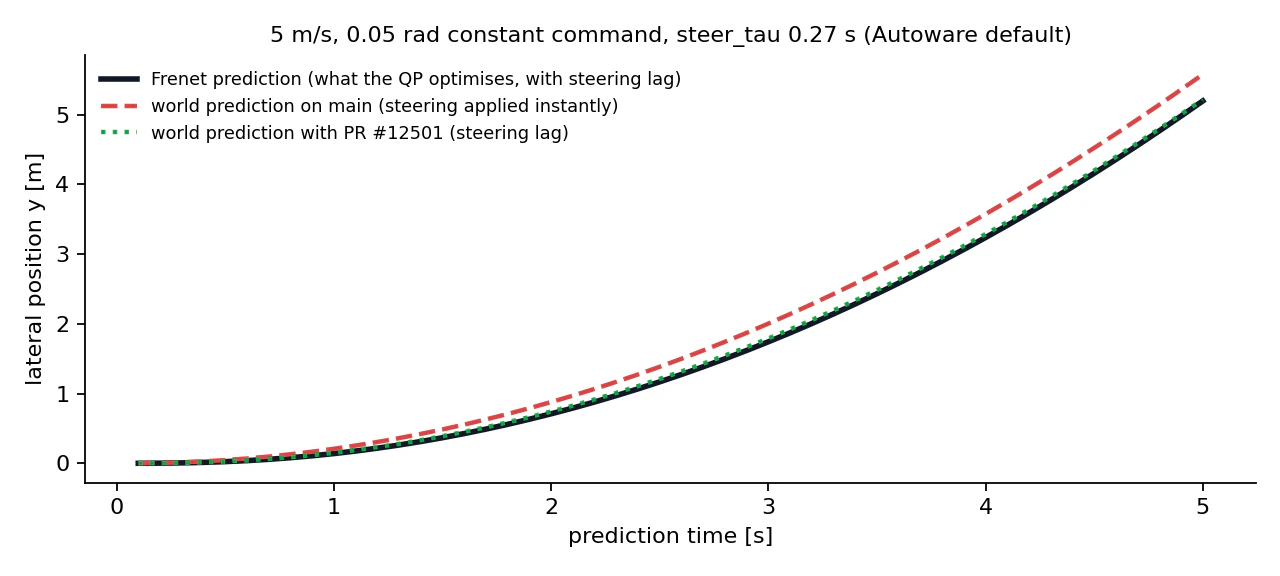
結論: MPC が最適化に使う Frenet 座標の予測はステアの 1 次遅れを考慮していますが、外に出す world 座標の予測軌道はステア指令を即座に反映していました。既定のステア時定数 0.27 s では、5 秒先で横方向に最大 0.381 m ずれます。PR #12501 を当てると 0.051 m になります。既存のテストがこれを見逃していたのは、テストの時定数が 0.1 s で、そこではずれがほとんど出ないためでした。
何が問題か
autoware_mpc_lateral_controller は、MPC の解から 2 種類の予測軌道を作ります。
-
Frenet 座標の予測: 最適化(QP)で使う線形モデルそのもの。状態は
[横偏差, 方位偏差, ステア]で、ステアは時定数steer_tauの 1 次遅れとしてモデル化され、双一次変換で離散化されています。 -
world 座標の予測(
/control/trajectory_follower/lateral/predicted_trajectory): 外に出す軌道。車線逸脱チェッカーや制御・計画のバリデータが使います。
main の KinematicsBicycleModel::calculatePredictedTrajectoryInWorldCoordinate は、world 座標の予測で dyaw = v * tan(input) / L と、ステア指令をその瞬間に反映していました。コードのコメントにも「本来はステアの 1 次遅れを考慮すべきだが、長い dt で離散化すると精度が落ちたので無視している」とあります。つまり、最適化した軌道と外に出す軌道とで、別の車を予測していることになります。issue #12398 では、これが 90° のカーブで安全チェックを誤作動させると報告されています。
修正(PR #12501)
PR は world 座標の更新にステアの 1 次遅れを入れます。
const auto dt_ratio = std::min(dt / m_steer_tau, 1.0);
auto current_steer = x0(2);
// ...
current_steer += (input - current_steer) * dt_ratio;  // first-order delay
dstate(2) = velocity * std::tan(current_steer) / m_wheelbase;
min(dt/τ, 1) で上限を付けているので、dt が τ より長くても発散しません。コメントにあった「長い dt で精度が落ちる」懸念にも対応しています。
回帰テスト
直線の参照軌道の上で、5 m/s・一定のステア指令 0.05 rad を 50 ステップ(dt 0.1 s)与え、KinematicsBicycleModel の Frenet 予測と world 予測の横位置の差の最大値を見ます。行列の積み上げは MPC::generateMPCMatrix と同じ形にしています。しきい値は 0.15 m です。
TEST_F(MPCTest, KinematicsWorldPredictionFollowsSteeringDelay)
{
  constexpr double velocity = 5.0;
  constexpr double steer_tau_default = 0.27;  // autoware default vehicle_model_steer_tau
  constexpr double dt = 0.1;
  constexpr int horizon = 50;
  constexpr double steer_cmd = 0.05;
  // ... build a_ex / b_ex / w_ex as MPC::generateMPCMatrix does, predict in both frames ...
  EXPECT_LT(max_lateral_gap, 0.15);
}
(全文は PR のレビューに貼っています。)
ghcr.io/autowarefoundation/autoware:universe-devel でビルドして実行した結果です。
# main (3c7d46e)
Expected: (max_lateral_gap) < (0.15), actual: 0.381416 vs 0.15
[  FAILED  ] MPCTest.KinematicsWorldPredictionFollowsSteeringDelay

# main + PR #12501
[       OK ] MPCTest.KinematicsWorldPredictionFollowsSteeringDelay
(max lateral gap: 0.0513 m)
なぜ既存のテストが見逃したか
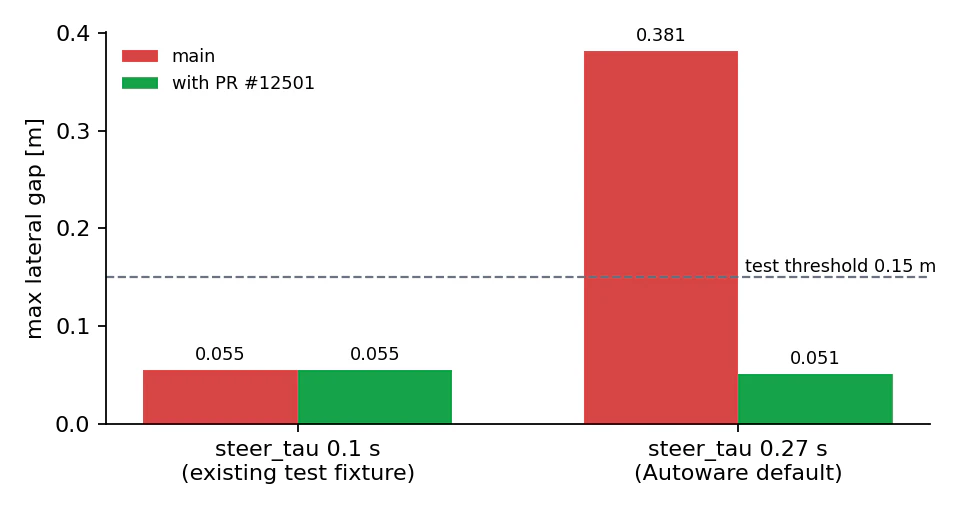
既存の MPCTest のフィクスチャは steer_tau = 0.1 でした。時定数が短いと遅れの影響が小さく、修正前後でずれがほとんど変わりません。
| steer_tau | main | PR #12501 |
|---|---|---|
| 0.1 s(既存テスト) | 0.055 m | 0.055 m |
| 0.27 s(Autoware 既定) | 0.381 m | 0.051 m |
テストの条件が、既定値より「簡単な」値に寄っていたために、既定値で起きている問題が見えていませんでした。修正後に残る 0.05 m は、Frenet 側(双一次変換)と world 側(陽的オイラー)の離散化の違いによるものです。
ほかの車両モデル
KinematicsBicycleModelNoDelay はそもそもステアの遅れを持たないモデルなので、即座に反映するのが正しい挙動です。DynamicsBicycleModel は状態にステアを持っていません。影響を受けるのは KinematicsBicycleModel(既定の vehicle_model_type: kinematics)だけだと考えています(レビューで作者に確認をお願いしています)。
自分のコードでも確認するなら
MPC の予測を外に出しているなら、「最適化に使ったモデル」と「外に出す軌道を作るモデル」が同じ遅れを持っているかを確認してください。テストは、実際に使う既定値(今回なら 0.27 s)で書くのがおすすめです。
AI の利用について
テストの作成には AI コーディングエージェントを使いました。数値は、上の C++ テストを main と PR 適用後の両方で実際にビルド・実行した結果と、同じモデルを Python で再実装した計算(図)で確認しています。両者の値は一致しています。
English
While working on MPC for the Autonomous Driving AI Challenge, we followed a "predicted trajectory deviation" in Autoware's autoware_mpc_lateral_controller and added a regression test to the fix PR as a review.
- Issue: https://github.com/autowarefoundation/autoware_universe/issues/12398 (reported by smk-robotics)
- Fix PR: https://github.com/autowarefoundation/autoware_universe/pull/12501 (by mkquda); our review carries the test
In short: the Frenet-frame prediction that the MPC optimises models the steering as a first-order lag, but the world-frame predicted trajectory it publishes applied the steering command instantly. With the default steer_tau of 0.27 s, the two differ by up to 0.381 m laterally over a 5 s horizon; with PR #12501 the gap is 0.051 m. The existing test missed it because its fixture uses steer_tau = 0.1, where the gap is small either way (figures above).
What is wrong. The controller builds two predictions from the MPC solution. The Frenet one is the QP's linear model: state [lateral error, yaw error, steer], steering as a first-order lag with time constant steer_tau, discretised with the bilinear transform. The world one (/control/trajectory_follower/lateral/predicted_trajectory) feeds the lane departure checker and the control/planning validators. On main, calculatePredictedTrajectoryInWorldCoordinate integrates v * tan(input) / L, applying the command at once; a code comment even says the lag was ignored because discretising it with a long dt lost accuracy. So the published trajectory and the optimised one predict different cars. Issue #12398 reports safety checks triggering on 90-degree turns.
The fix. PR #12501 adds the lag to the world-frame update, current_steer += (input - current_steer) * min(dt / steer_tau, 1), seeded from the current steer. The clamp keeps it stable when dt exceeds tau, which answers the old concern about long dt.
The test. On a straight reference, a constant 0.05 rad command for 50 steps of 0.1 s at 5 m/s, stacking the matrices as MPC::generateMPCMatrix does; the maximum lateral gap between the two predictions must stay under 0.15 m. Built and run in ghcr.io/autowarefoundation/autoware:universe-devel: 0.381416 m on main (fails), 0.0513 m with the PR (passes). The remaining 0.05 m comes from the different discretisations (bilinear in the Frenet model, explicit Euler in the world update).
Why it was missed. With steer_tau = 0.1 the lag barely matters, so the gap is 0.055 m before and after the fix. The test ran at an easier value than the default, where the problem actually lives. When you test a model, test it at the defaults you ship.
Other models. KinematicsBicycleModelNoDelay has no steering lag, so applying the command at once is correct there; DynamicsBicycleModel has no steer state. As far as we can see, only KinematicsBicycleModel (the default vehicle_model_type: kinematics) is affected; we asked the author to confirm.
How this was made: we used AI coding agents to draft the test. The numbers come from building and running the C++ test on main and with the PR applied, and from a Python re-implementation of the same model (figures); the two agree.
Team Hayes (Ajayaditya Lokchandra, Nithisha Venkatesh)