
Vidu Q4's official pitch for reference-to-video is not a single face. The product page says “up to 15 reference images and 3 voice references,” and that 1 to 15 images can be combined for characters, scenes and style so that “complex concepts” are “told in one take.” A 3-to-16-second clip, at up to 4K, is the official length and resolution envelope. Whether several people and objects actually stay themselves in that take is a test question, and the published answers so far are short, dated, and useful within those limits.
Key Takeaways
- The official pack is large, and it is mixed. Vidu's Q4 page lists a maximum of 15 reference images and 3 reference audio clips, and names image-to-video and reference-to-video as the two modes. A FAQ on the same page does not list a pure text-to-video path for Q4. You start with at least one image.
- “One take” is official wording for a short, multi-subject clip. The page also says “up to 16s of multi-shot storytelling,” with 2K and 4K output, and “native aspect ratio” on image-to-video — the output keeps the ratio of the still you began with.
- ZOOOP's 11 October review is the clearest published multi-subject pass. The authors put two people, a scooter and a street into one shot, and reported that all four appeared, without the people being swapped or the scooter changing color. They also matched a voice reference: median pitch about 219 Hz on the source, about 225 Hz on the output, less than three percent apart. They used four reference images, not fifteen.
- Titanium Media's 12 November four-model editorial is a different job. The editors found Vidu Q4 expressive on acting and emotion, noted a 16-second take that fitted a nine-step action but garbled an end-title sign, and described physics and object-continuity misses, including a ball prompt that held and then overlapped. That is one editorial battery, not a subject-count study.
- The Vidu Q4 workspace this article links documents image-to-video and reference-to-video, in line with the official modes. It is a place to run those paths, not a 15-subject proof.
Vidu Q4 Multi-Subject Envelope at a Glance
| Specification | Official statement | Source |
|---|---|---|
| Status | Vidu Q4 Preview | Official product page; reviews in this window still mark Preview |
| Modes | Image-to-video and reference-to-video | Official FAQ |
| Reference images | 1–15 | Official page, “Vidu Q4 Highlights” |
| Voice references | Up to 3 | Same |
| Duration | 3–16 seconds | Same; image-to-video row |
| Resolution | Up to 4K (2K and 4K named) | Same |
| Text-to-video, end frame | Not listed as Q4 modes on the official FAQ | Official FAQ; ZOOOP reports the same absence |
| ZOOOP multi-subject pass | Four subjects in one shot, held; 4 images used; 11 October 2026 | ZOOOP |
| ZOOOP voice check | ~219 Hz reference, ~225 Hz output | ZOOOP |
  official pack                  one published multi-subject pass
  -------------                  -------------------------------
  up to 15 stills                ZOOOP, 11 Oct: 4 stills,
  up to 3 voices                 2 people + a scooter + a street,
  3 to 16 seconds, up to 4K      no swap, no color change
  “told in one take”             voice pitch within 3%
What the Official Page Promises
Vidu's Q4 page is organized as three promises. The first is a count — 1 to 15 images for characters, scenes and style. The second is a count and a claim — up to three voice clips, “natural emotion and lip-synced delivery.” The third is a length and a resolution — up to 16 seconds, multi-shot storytelling, 2K and 4K, and, in the vendor's wording, smoother motion on martial arts, running and combat.
That motion wording should be kept in the same register as any other official adjective. Titanium Media, a month later, reported physics misses on the same model. Both can be written down. Neither cancels the official count of 15 stills, which is this deep dive's subject.
Two absences are also part of the envelope. The official FAQ lists image-to-video and reference-to-video, and does not, on that page, offer a text-only Q4 path. ZOOOP independently noted the lack of an end-frame mode. A job that starts from a sentence alone, or that has to land on a specified last still, is outside this model's documented map. A 30 October joint note with WaveSpeed described faster generation and an upgraded recaptioning pipeline. It does not change the 15-and-3 pack, and it is not a multi-subject test.
What Published Tests Did With More Than One Subject
ZOOOP, writing in German on 11 October, is the rare review that packed several fixed subjects into one shot and then said what happened. Two people, a scooter and a street: all four present, no identity swap, no color change on the vehicle. A voice-reference clip, measured rather than only heard, stayed within three percent of the source pitch. Limits were listed without drama: no text-only mode, no end frame, slower reference-mode returns, and a Preview label. The authors also wrote a reference-image ceiling of 12, which disagrees with the official 15. This article uses the official 15, and treats ZOOOP as a four-image pass, which is what they actually ran. Four is not fifteen. One shot is not a series. Preview behavior, as ZOOOP itself said, can change.
Titanium Media's 12 November editorial put Vidu Q4 next to Seedance 2.5, Kling 4.0 and Wan 3.0. The editors liked its acting and emotional detail. They also wrote that a 16-second clip absorbed a nine-step action but finished with a garbled “AI Boss” sign, that a pasta-twirling beat appeared already curled in the next shot, and that a ball prompt went wrong after five seconds. Those observations are about acting, lettering and physics, not about a 15-image pack. They are a reminder that “one take” is still a 16-second Preview clip, and that official motion wording and a dated editorial can disagree.
How This Fits a Real Workflow
If the job is several known people or products in a short scene, with optional voice clips, Vidu Q4's official pack is built for that, and ZOOOP's four-subject pass is a reason to try it — starting with a count closer to four than to fifteen, and checking identity in the result. The 16-second ceiling is the official length of that try. A 30-second job, or a job with no starting image, is a different model's envelope. The linked workspace follows the official two-mode map. This article does not treat a Preview model as a finished proof, and it does not treat a four-subject pass as a fifteen-subject one.
What's Still Unclear
- There is no published official, or independent, score for identity as the pack grows from four stills to fifteen.
- ZOOOP's “12 images” and the official 15 are not reconciled here; the official page is the specification, and ZOOOP is a four-image test.
- How three voice references map onto three different speakers is not demonstrated in the reviews cited above. ZOOOP measured one voice.
- Q4 is still a Preview. Behavior can change between versions, which is the vendor's and the reviewers' own caution.
- This article did not rerun the four-subject prompt.
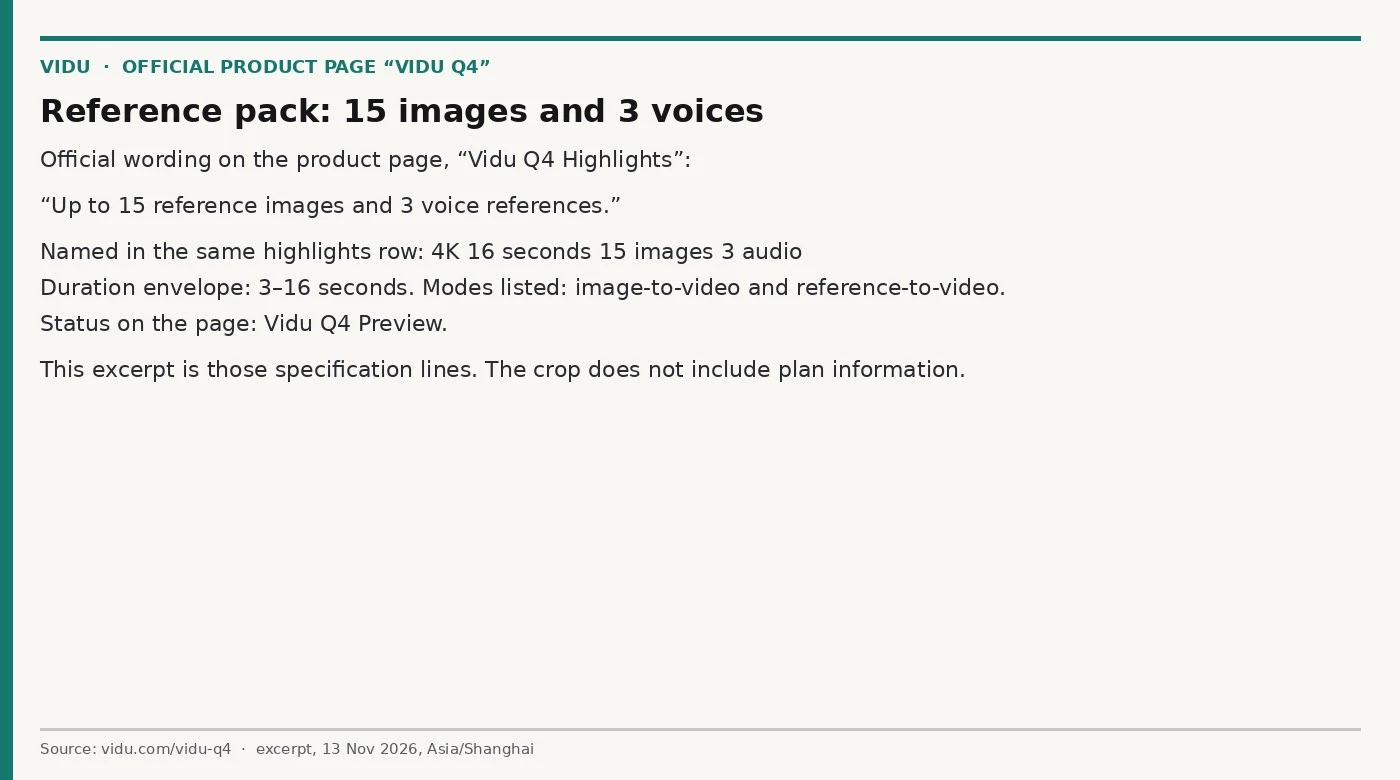
Source: Vidu, “Vidu Q4”, product page, “Up to 15 reference images and 3 voice references” and the Highlights row (4K, 16 seconds, 15 images, 3 audio). Captured 13 November 2026, Asia/Shanghai. The crop is those specification lines.