
A small product stays trustworthy when the promise it made on day one still matches what it does after a dozen changes.

Every product makes a promise, whether anyone writes it down or not. A user opens the product expecting one clear thing to happen, and judges everything after that against the expectation they formed in the first minute. When the product changes — and every living product changes — the question is never whether the promise will be tested. The question is whether the team still knows what the promise was.
Small teams feel this pressure first. There is no separate department guarding the original idea. The same few people answer support messages, fix the bug, ship the feature, and write the release note. That closeness is an advantage: the team hears the user directly. It is also a risk: each small change feels harmless on its own, and nobody notices the day the product quietly stops doing the one thing people chose it for.
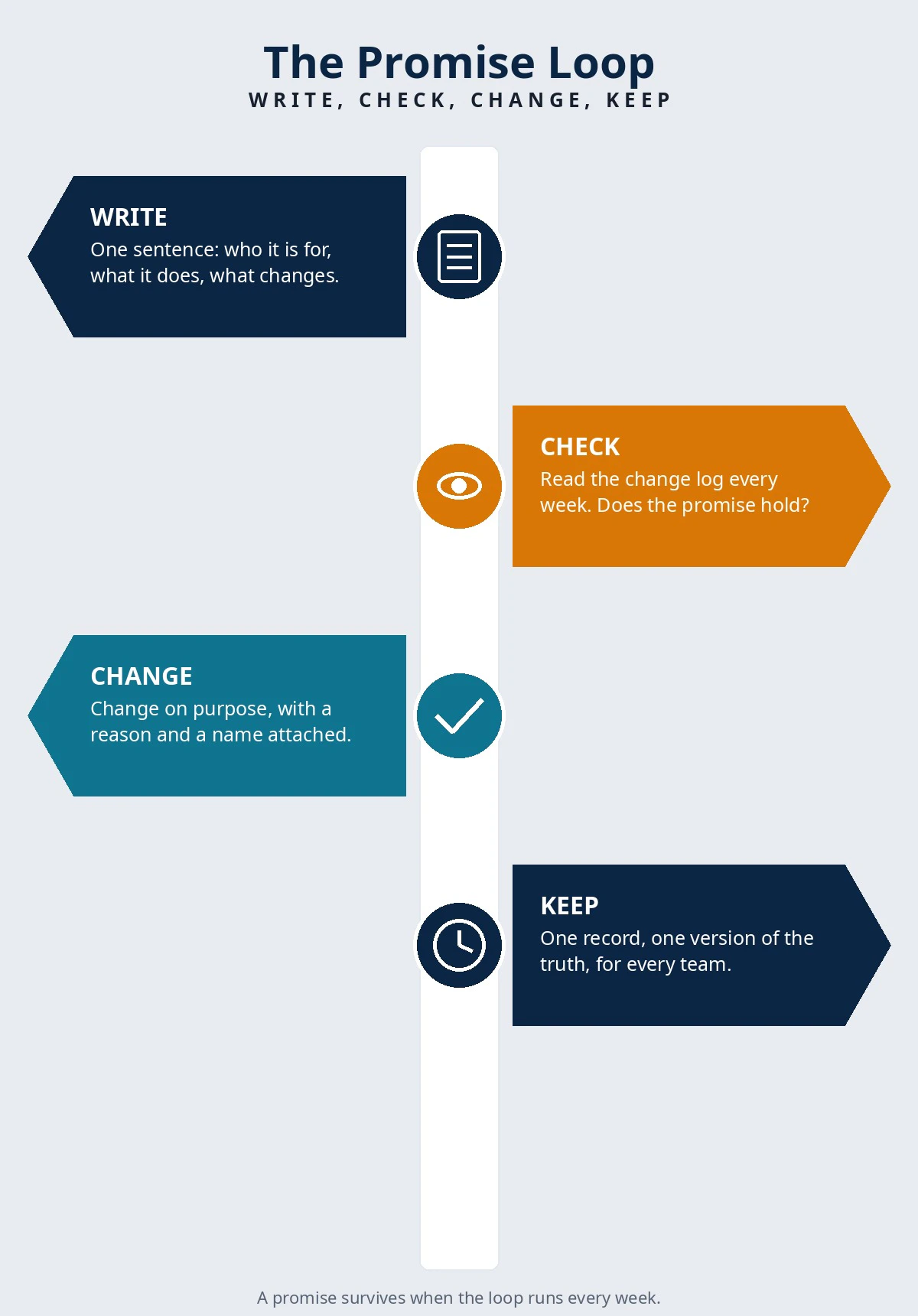
This article is about the working habits that keep a promise intact through change. They are not enterprise habits. They are small-team habits: write the promise down in one sentence, keep one record of what the product is, change things in writing with a name attached, and check the promise on a calendar instead of trusting memory. The ideas come from product lifecycle thinking, scaled down to a team that fits around one table.
Write the Promise Down in One Sentence
A promise that lives only in someone's head is not a promise. It is a feeling, and feelings drift. The first job is to write the promise in one sentence that names three things: who the product is for, what problem it solves for them, and what result they get. If the sentence needs a paragraph to explain itself, it is not finished yet.
The clearest name for that sentence is a value proposition. It is the promise written clearly: what a customer gets, who it is for, and why it beats the other options. The guide behind that link explains the idea in full, with a template and worked examples. Here, only one part of it matters: the promise has to be specific enough to test. "A better tool for teams" cannot be tested. "A shared note that shows every open decision, so a five-person team never re-decides the same thing twice" can be tested, because you can watch a team use it and see whether the second decision happens.
Writing the sentence is a team exercise, not a marketing exercise. Sit together and answer three questions in plain words. First, who exactly is this for? Name a real group of people, not "everyone." Second, what is the one job they are trying to get done when they open the product? Third, what changes for them when it works? The answers will be rough at first. Rough is fine. A rough sentence that everyone on the team has read is worth more than a polished sentence that lives in one person's notebook.
Put the finished sentence somewhere the whole team sees it every week. A note pinned at the top of the team's shared workspace works. A line at the top of the product's own documentation works. The location matters less than the rule: nobody changes the product without being able to see the sentence. When a new feature is proposed, the first question is not "can we build it" but "does it keep this sentence true?" If the answer is unclear, the feature waits until the sentence is checked against a real user, not against enthusiasm in a meeting.
A written promise also settles arguments. Small teams argue about features constantly, because every feature costs the same scarce resource: the team's time. Without a written promise, arguments are settled by whoever speaks loudest or longest. With one, arguments are settled by evidence. The feature that makes the promise more true wins. The feature that only makes the product bigger loses, however clever it sounds.
The Lifecycle the Promise Lives In
A promise does not live in a single release. It lives across the whole life of the product, from the first sketch to the day the product is retired. That is the territory of product lifecycle management, the discipline of keeping every fact about a product in one connected record from concept to retirement. Large companies run it on serious software. Small teams need the thinking, not the software.
Think of the life of a product in five broad stages. First comes the concept, when the idea is still a sketch and a few rough plans. Then design, when the idea becomes precise drawings, models, or code. Then building, when the product is actually made. Then service, when real users use it and need help, fixes, and spare parts. Then retirement, when the product is discontinued and its records are archived. The important point is that these stages are connected. A decision made at the design stage affects what service can promise years later. A shortcut taken during building becomes a support ticket during service.
Small teams usually live inside one stage at a time and forget the others exist. During building, nobody thinks about retirement. During service, nobody remembers why a design decision was made. The promise breaks in the gaps between stages, not inside any single stage. The fix is a habit, not a tool: whenever a decision is made, write down what was decided, why, and what it means for the later stages. A short note in the shared record is enough. "We chose this format because it keeps old files readable. If we change it later, every saved file must be converted." That note, found two years later, is the difference between a smooth change and a broken promise.
The other habit is to treat the product's record as one record. One folder per product, one parts list, one list of versions. The moment two copies of the same list exist, they will drift apart, and someone will build from the wrong one. This sounds like paperwork. It is actually the cheapest insurance a small team can buy, because the cost of a wrong version is always paid later, in public, by the user.
One Record, One Version of the Truth
Every team that has lost a promise can trace the loss to the same root: two versions of the truth. The design says one thing, the shipped product does another, and the help page describes a third. The user meets all three and trusts none of them.
The cure is boring and it works. Keep one master record per product. Every drawing, parts list, note, and decision lives in one shared place with a clear name. The master copy is never the file on someone's laptop. When a file is updated, the old version is archived, not deleted and not left beside the new one with a confusing name. Version numbers go on everything. A simple rule — every file name carries a version and the change is logged with a name and a date — ends most arguments about which file is current.
The parts list deserves special care, because it is the product's recipe. Whether the product is hardware or software, it has a list of pieces: components, libraries, services, data sources. Keep one shared list. When one piece changes, update the list once, in the one place, and let the change flow to the design, the cost estimate, the build, and the help page at the same time. The alternative is the familiar one: someone remembers to update three copies by hand, misses the fourth, and the user finds the mistake.
Change records matter just as much. A change is never a quiet edit. It is a short written record: what changed, who asked for it, who approved it, and when it takes effect. Two minutes of writing prevents the most expensive class of mistakes, the kind where nobody can say why the product behaves the way it does. When a user reports a problem, the first thing the team checks is the change log, not the code. If the log is honest, the answer is usually there.
None of this requires special software. A shared folder, a spreadsheet, and a change log are enough for a small team. The point is not the tool. The point is the rule: one record, one version, and every change in writing. Teams that keep this rule can grow without losing the promise. Teams that do not keep it lose the promise precisely when they start to grow, because growth multiplies the number of copies.
Change Without Breaking the Promise
Change is not the enemy of a promise. Uncontrolled change is. A product that never changes dies slowly, because the world around it moves on. A product that changes without control dies quickly, because its users stop trusting it. The work is to change on purpose, with a visible trail.
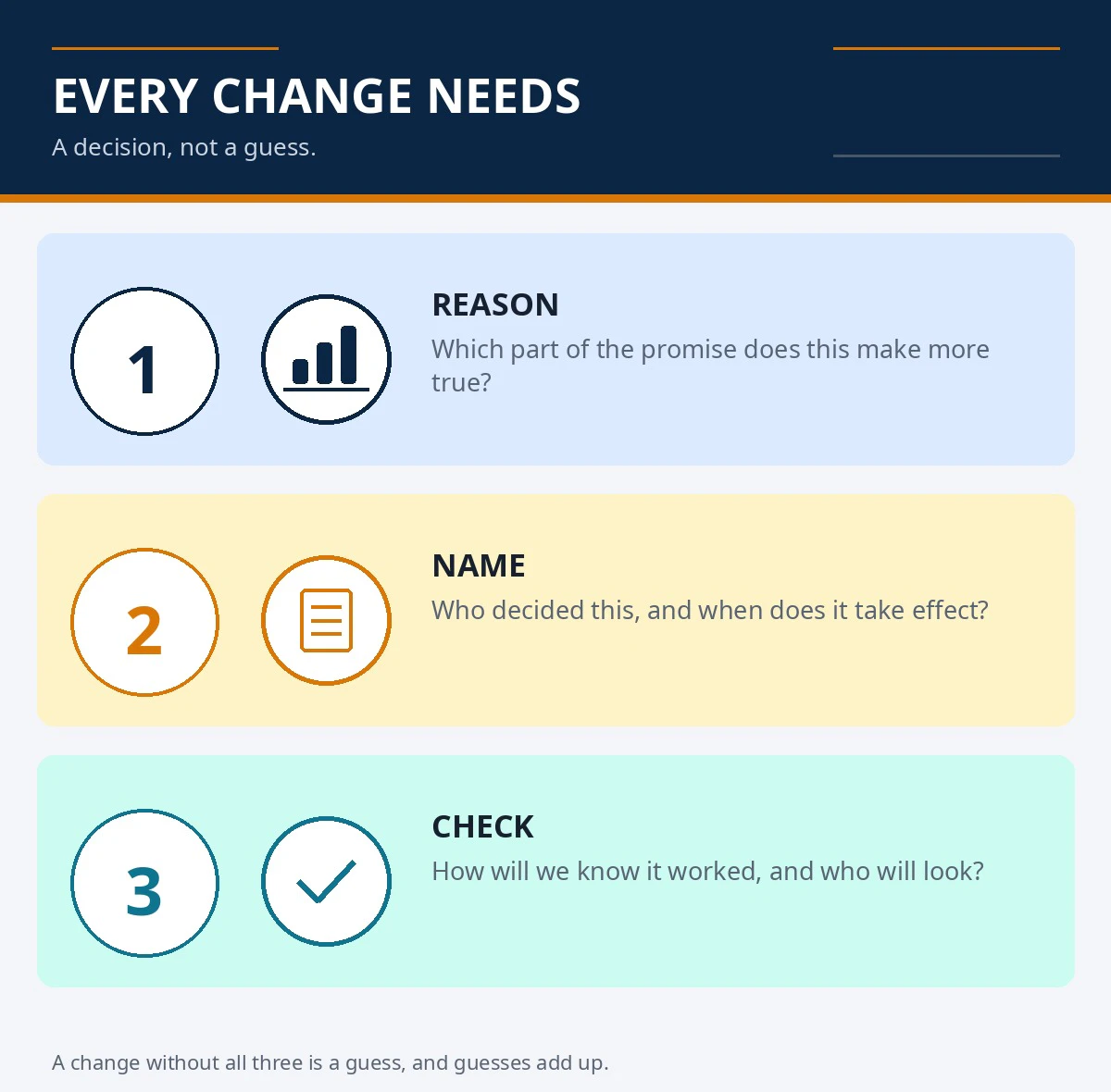
Start with a simple rule for every proposed change: it needs a reason tied to the promise, a name, and a check. The reason answers "which part of the promise does this make more true?" The name answers "who decided this?" The check answers "how will we know it worked?" A change with all three is a decision. A change without them is a guess, and guesses accumulate into a product nobody recognizes.
Small changes deserve the same treatment as large ones, because small changes are the ones that slip through. A label reworded here, a default changed there, a step removed from a setup flow — each one is small, and together they rewrite the product. The habit that stops this is a weekly review of what changed. Once a week, the team reads the change log together and asks one question about each item: does the promise still hold? The review takes less than an hour. It catches the drift while the drift is still cheap to reverse.
Testing the promise is part of the same habit. The team should check the product the way a new user meets it, not the way the people who built it see it. Open it fresh, follow the main task from the beginning, and watch where it hesitates. Ask a stranger to try it and say back what it is for. If the stranger cannot say it, the promise is not visible in the product anymore, no matter what the written sentence says. This check is uncomfortable and it is the most useful hour a small team spends.
When a change does break the promise, say so plainly and fix it in the open. Users forgive a team that admits a mistake and repairs it. They do not forgive a team that pretends the mistake was an improvement. The release note that says "this change broke the way saved files open, and here is the fix" builds more trust than ten release notes full of new features. The same long-view thinking shows up in hardware, where manufacturers who manage a whole product lifecycle carry a product from concept to long-term support, because a promise made at launch has to survive years of use.
What to Do When the Promise and the Product Drift Apart
Drift is normal. Every product drifts. The question is what the team does when it notices. There are only three honest responses, and the team should choose one deliberately instead of drifting further by accident.
The first response is to change the product back. The drift was a mistake, the promise was right, and the fix is to restore the behavior the promise describes. This is the most common case, and it is usually cheap if the drift is caught early. The change log makes it cheap, because it shows exactly when the behavior changed and what else changed with it.
The second response is to change the promise. Sometimes the world moves and the old promise stops being the right one. Users need something different now, and the product has quietly grown toward that need. In that case the team rewrites the sentence — together, in writing, with the same care as the first time — and then changes the product deliberately to match the new sentence. What the team must not do is change the promise silently, by letting the product drift and then pretending the new behavior was the plan all along. A rewritten promise is a decision. A drifted promise is an accident.
The third response is to split the product's attention honestly. Sometimes one product cannot keep two promises at once. The team then decides which promise this product keeps, and which need belongs somewhere else — a second product, a different tool, or a clear statement that this product does not do that job. Saying no to a request is hard for a small team that wants every user to be happy. But a product that tries to promise everything ends up promising nothing, and users can feel that even when they cannot name it.
Whichever response the team chooses, the rule is the same: write it down, with a name and a date, in the same place the promise lives. Future team members will read that note and understand why the product is the way it is. That understanding is the real product, more durable than any single feature.
Keep the Evidence You Can Actually Find
A promise is only as good as the evidence behind it. When a user asks "why does it work this way?" or "what changed?", the team should be able to answer from records, not from memory. Memory is generous to the person remembering and useless to everyone else.
The evidence a small team needs is small: the written promise, the parts list, the change log, and a short list of decisions with reasons. Four documents, kept in one place, updated as part of the work rather than after it. The discipline is to update the record in the same hour as the change, not at the end of the month. Records written a month later are reconstructions, and reconstructions flatter the person writing them.
Evidence also means keeping the user's voice in the record. Support messages, complaints, and requests are evidence about the promise, not interruptions to real work. Once a month, read them together and sort them into three piles: the promise is working, the promise is unclear, and the promise is broken. The first pile tells the team what to protect. The second tells it what to explain better. The third tells it what to fix first. Teams that do this stop guessing what users want, because the users have already told them.
A note about accuracy, because it matters on a technical platform: check every claim before it ships. If the article says a tool behaves a certain way, test it. If it cites a guide, open the guide and confirm the link leads where the text says it leads. The references in this article were checked before writing. For software teams, a practical tour of the software product lifecycle shows the same arc from idea to deployment to continuous improvement, and why the journey after launch matters most. Accuracy is not a style choice. It is the promise, applied to the writing itself.
A Week of Small Practice
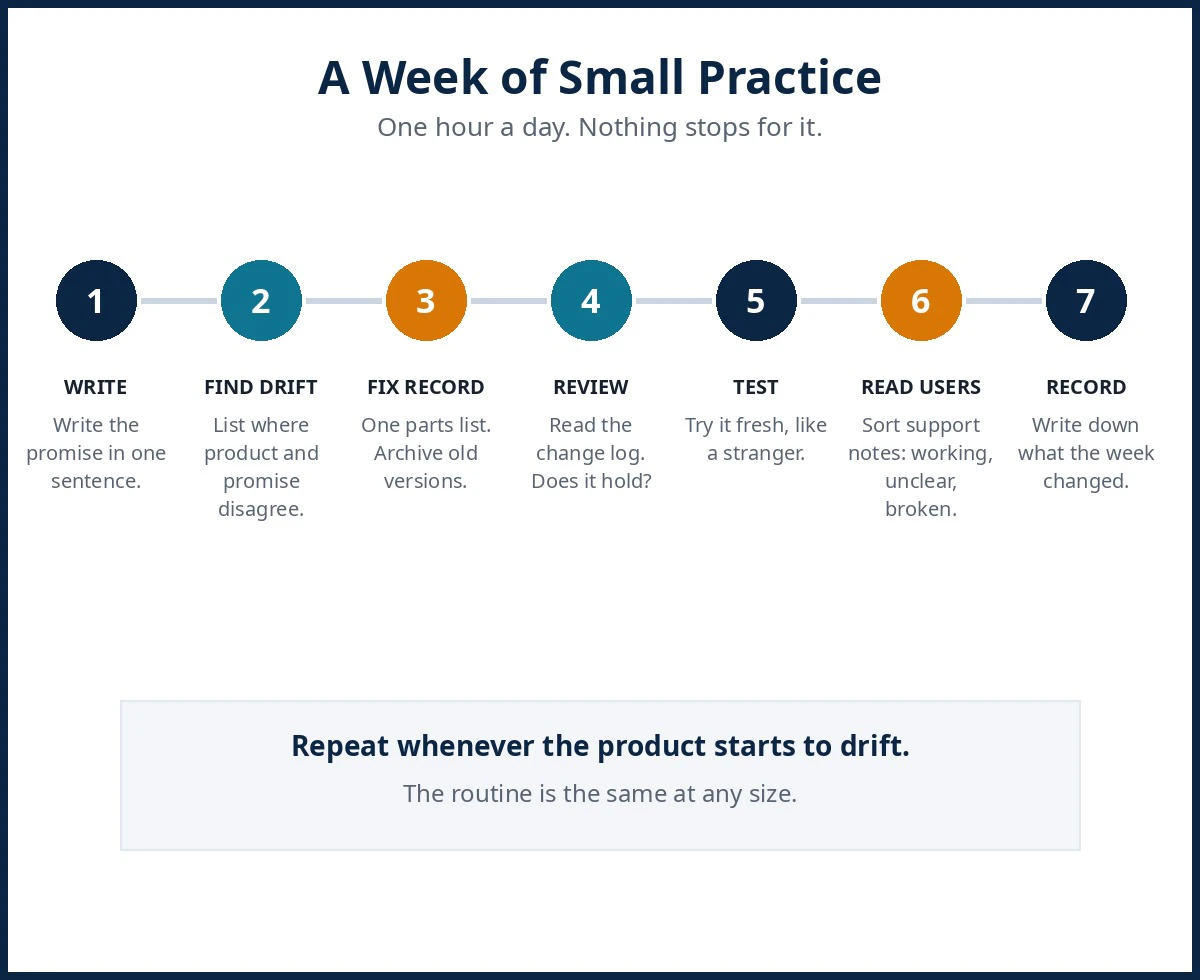
Habits become real when they are scheduled. Here is a week of small practice that a small team can run without stopping its other work. Each day takes less than an hour.
Day one: write the promise. Sit together and write the one-sentence promise. Put it where everyone sees it. If the team already has one, read it aloud and check whether it still matches the product.
Day two: find the drift. Each person lists one place where the product and the promise disagree. Compare the lists. Pick the disagreement that matters most to users and write it down as the week's fix.
Day three: fix the record. Gather the scattered copies of the parts list and the product notes into one place. Archive the old versions. Give every file a version number. This is unglamorous work and it pays for itself within days.
Day four: review the changes. Read the change log from the past month together. For each change, ask whether the promise still holds. Mark any change that needs a follow-up check.
Day five: test like a stranger. One person who did not build that feature tries the product fresh and says back what it is for. Write down where they hesitate. Those hesitations are the next fixes. Industrial teams plan the same way, and long-term availability and lifecycle management for industrial parts shows how multi-year lifecycles are handled when a part must stay available and supported.
Day six: read the users. Sort the past month of support messages into the three piles: promise working, promise unclear, promise broken. Choose one item from the broken pile and fix it.
Day seven: rest and write it down. Record what the week changed, in the same place the promise lives. A short note — what was fixed, what was decided, what is next — is the record the future team will thank the present team for.
Repeat the week whenever the product feels like it is drifting. The routine is the same at any size, and it is what keeps a small product honest as it grows.
The Bottom Line
A product promise is not a slogan. It is a working agreement between the team and the user: this is who the product is for, this is the job it does, and this is the result the user can count on. Keeping it through change takes no special tools. It takes a written sentence, one record, changes in writing, and a weekly check that the sentence is still true.
Small teams have one advantage that large companies envy: the people who make the promise are the people who keep it. Use that advantage. Write the promise down, keep one version of the truth, change things on purpose, and check the promise the way a stranger would. Do that every week, and the product will still be the product its users chose, long after the first version is forgotten.
FAQs
How small should the first version of the promise be?
One sentence, naming the user, the job, and the result. If it needs a second sentence to explain itself, shorten it until it stands alone. A short promise that the whole team can repeat is stronger than a long one that only its author remembers.
How often should the team check the promise?
Once a week, in the change review, and once a month against real user messages. A weekly check catches drift while it is cheap to reverse. A monthly check against support messages shows whether the promise still matches what users actually need.
What should the team do when a change breaks the promise?
Stop and choose one of the three honest responses: change the product back, rewrite the promise deliberately, or decide honestly that the job belongs elsewhere. Write the choice down with a name and a date. Never let a broken promise pass silently as if it were an improvement.
Do small teams need product lifecycle software?
Usually not at first. The habits matter more than the software: one master folder per product, version numbers on every file, one parts list, and changes recorded in writing. Dedicated software starts to make sense when products have many parts and variants, or when customers and regulators demand a full audit trail.
When is it time to stop adding features?
When a proposed feature does not make the written promise more true. If the feature only makes the product bigger, or serves a different promise, it belongs in a different product or on a list for later. A product that keeps one promise well beats a product that keeps five promises badly.