
Introduction
Modern businesses generate enormous volumes of data from customer interactions, digital platforms, enterprise applications, connected devices, and operational systems. Although this information can support better decisions, its value often remains untapped when data is scattered across disconnected systems, stored in inconsistent formats, or difficult to access. Organizations need a structured approach to managing information so that teams can use it confidently and efficiently.
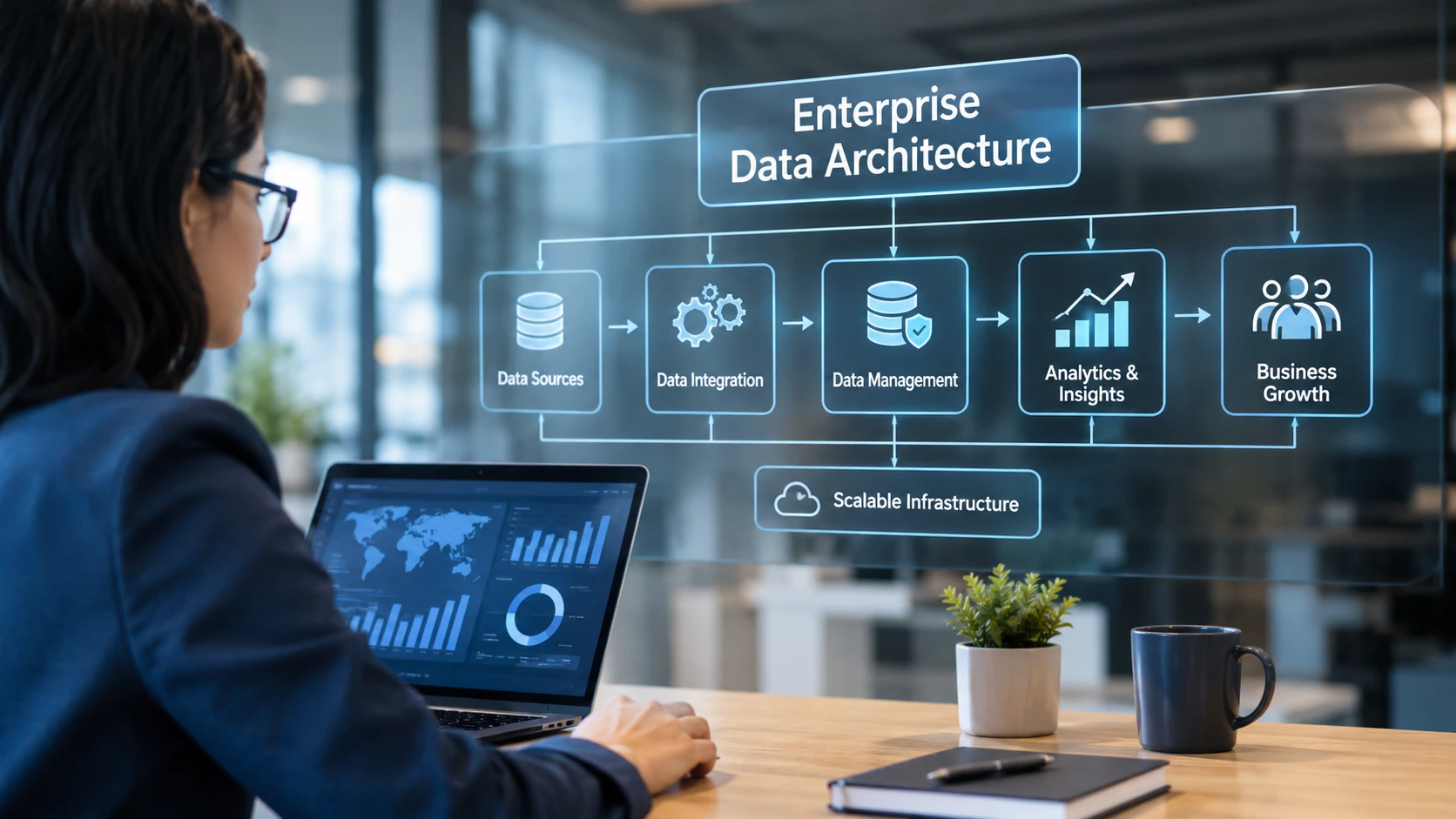
This is where enterprise data architecture becomes essential. It provides a framework for organizing, integrating, storing, governing, and accessing data across an organization. A well-designed architecture connects business objectives with data infrastructure, helping companies improve operational efficiency, strengthen decision-making, and prepare for emerging technologies such as artificial intelligence and advanced analytics.
Rather than treating data as a collection of isolated assets, organizations can use a unified architectural strategy to establish reliable information flows across departments. The result is a more connected business environment where data supports both everyday operations and long-term growth.
Understanding the Role of Enterprise Data Architecture
Enterprise data architecture defines how information is collected, organized, integrated, stored, protected, and delivered throughout an organization. It establishes the principles, technologies, standards, and processes that determine how data moves between business systems and reaches the people or applications that need it.
For example, a retail company may maintain separate systems for inventory, customer relationships, online transactions, and financial reporting. Without an effective architectural framework, these systems can develop inconsistent records and conflicting reports. Employees may spend valuable time reconciling information instead of using it to improve business performance.
An integrated architecture helps connect these sources while establishing consistent definitions and appropriate access controls. Business leaders can gain a more comprehensive understanding of performance, while operational teams can work from dependable information.
The objective is not simply to consolidate every dataset into one location. Instead, organizations should create an environment where information remains accessible, understandable, secure, and useful across different business functions.
Building a Scalable Foundation for Business Data
Business requirements rarely remain static. Organizations introduce new applications, expand into different markets, acquire other companies, and adopt technologies that generate additional information. A rigid data environment can struggle to accommodate these changes, increasing maintenance costs and creating integration challenges.
A scalable enterprise data architecture addresses these demands by defining flexible structures that can evolve alongside business priorities. Cloud infrastructure, distributed storage, data warehouses, and data lakes can contribute to this foundation, depending on the organization's requirements.
A data warehouse typically supports structured reporting and analytical workloads. A data lake can accommodate diverse information types, including structured records, documents, images, and machine-generated data. Some organizations combine these approaches or adopt lakehouse architectures to support multiple analytical needs within a connected environment.
The appropriate design depends on factors such as data volume, processing requirements, regulatory obligations, existing investments, and the skills available within the organization.
Scalability also requires thoughtful integration planning. Standardized interfaces, reusable data pipelines, and clearly defined data contracts can reduce dependencies between systems. These practices help teams introduce new capabilities without repeatedly redesigning the entire infrastructure.
A scalable foundation should therefore support present business needs while leaving room for future changes.
Connecting Data Integration and Business Applications
Information becomes more valuable when it can move reliably between systems. However, enterprise environments often contain legacy applications, cloud services, third-party platforms, and specialized departmental tools that were developed independently.
Connecting these systems requires more than moving records from one database to another. Organizations must address differences in data formats, naming conventions, update schedules, and business definitions.
An effective enterprise data architecture establishes integration patterns that help applications exchange consistent and timely information. Depending on the use case, organizations may rely on batch processing, application programming interfaces, event-driven integration, or real-time streaming.
For instance, a manufacturing business might connect production equipment, inventory systems, supplier platforms, and order management applications. When these sources communicate effectively, operational teams can identify supply shortages earlier and respond to changing production requirements.
Reusable integration components can also reduce duplication across projects. Instead of developing separate connections for every application, teams can establish common standards that simplify maintenance and improve reliability.
Organizations should evaluate integration methods according to business requirements rather than assuming that every process needs real-time data. Scheduled updates may be sufficient for historical reporting, while fraud detection or equipment monitoring may require faster processing.
The right approach balances performance, complexity, cost, and business value.
Strengthening Data Governance and Security
As data becomes more widely available, organizations must ensure that it remains trustworthy and protected. Poor governance can create conflicting reports, unclear ownership, unauthorized access, and uncertainty about how information should be used.
A strong architectural framework incorporates governance into the way data is created, processed, shared, and maintained. This includes defining data ownership, establishing quality standards, documenting metadata, managing access permissions, and maintaining appropriate records of data usage.
Data quality is particularly important. Incomplete customer records, inconsistent product identifiers, or outdated operational information can undermine analytics and lead to poor decisions. Validation rules, monitoring processes, and clear accountability help organizations identify problems before they spread across interconnected systems.
Security should also be considered throughout the data lifecycle. Encryption, identity management, access controls, auditing, and appropriate retention policies can help reduce exposure to unauthorized use.
Organizations handling personal or regulated information must additionally consider applicable privacy laws and industry requirements. The specific controls should reflect the sensitivity of the data, relevant regulations, and the organization's risk profile.
By integrating governance and security into enterprise data architecture, businesses can improve confidence in their information while supporting responsible data sharing.
Preparing Enterprise Data Architecture for Artificial Intelligence
Artificial intelligence depends on information that is sufficiently accurate, accessible, relevant, and appropriately governed. Yet many organizations encounter fragmented datasets, inconsistent definitions, and undocumented data sources when attempting to introduce AI into business operations.
These limitations can affect model quality, increase preparation time, and make it difficult to explain or reproduce analytical results.
A well-planned enterprise data architecture creates a stronger foundation for AI initiatives by improving data discoverability, establishing quality controls, and connecting relevant information sources. Metadata management and data lineage can help teams understand where information originates, how it has changed, and whether it is appropriate for a particular application.
For example, a financial services company developing an AI-assisted customer support solution may need information from customer relationship systems, transaction records, product documentation, and service histories. A governed architecture can help authorized applications access relevant information while respecting privacy and security requirements.
Organizations exploring generative AI may also need retrieval systems that connect language models to approved enterprise knowledge. Reliable document processing, access-aware retrieval, and current source information are important considerations for these applications.
However, an effective architecture does not guarantee successful AI outcomes. Businesses must also evaluate model performance, manage potential bias, establish human oversight where appropriate, and monitor applications after deployment.
The architectural foundation makes these responsibilities easier to implement, but governance and ongoing evaluation remain essential.
Overcoming Common Enterprise Data Architecture Challenges
Developing an effective data environment can be difficult when organizations operate legacy systems, maintain duplicated records, or lack consistent data ownership. Budget limitations and competing business priorities can make comprehensive modernization even more challenging.
Attempting to replace every existing system at once may introduce unnecessary disruption. A more practical approach is to identify the business problems that create the greatest operational or strategic impact.
An organization might begin by improving customer data quality, connecting critical reporting systems, or establishing common definitions for important business metrics. These initiatives can demonstrate value while creating reusable capabilities for future projects.
Legacy modernization should also account for existing dependencies. Some applications may require replacement, while others can continue operating through carefully designed integration layers.
Another challenge involves organizational alignment. Technology teams, business stakeholders, security specialists, and data owners may have different priorities. Establishing shared objectives and clear decision-making responsibilities helps ensure that architectural choices support measurable business needs.
Progress should be evaluated through relevant indicators, such as data quality, integration reliability, reporting turnaround time, infrastructure costs, and the effort required to onboard new data sources. Baseline measurements make it easier to determine whether architectural improvements are producing meaningful results.
Creating a Future-Ready Enterprise Data Strategy
A future-ready data strategy combines technical flexibility with clear business direction. Organizations should regularly assess whether their existing infrastructure supports current priorities, whether information can be trusted, and whether teams can access the data they need without unnecessary complexity.
Enterprise data architecture should evolve through continuous evaluation rather than remain a one-time technology project. As business requirements change, organizations can refine integration patterns, strengthen governance, modernize infrastructure, and introduce new analytical capabilities.
Architecture decisions should also reflect the broader technology landscape. Cloud adoption, automation, real-time analytics, and AI may create new opportunities, but each investment should address a defined business requirement.
Equally important is the human element. Employees need clear data definitions, appropriate training, and practical guidance on using information responsibly. Collaboration between technical and business teams helps ensure that architectural improvements translate into useful outcomes rather than additional complexity.
Organizations that connect architectural planning with measurable objectives are better positioned to adapt as information needs evolve.
Conclusion
Reliable data is an important foundation for informed decisions, efficient operations, and digital innovation. However, achieving these outcomes requires more than collecting information or investing in new platforms. Businesses need a coherent approach to connecting systems, maintaining quality, protecting sensitive information, and making data accessible for legitimate business purposes.
A thoughtfully designed enterprise data architecture brings these elements together in a structured and adaptable environment. It helps organizations reduce information silos, improve integration, strengthen governance, and establish a more dependable foundation for analytics and artificial intelligence.
The most effective approach begins with clear business priorities, practical implementation steps, and measurable outcomes. By continuously refining their data architecture, organizations can build information systems that respond to changing requirements and support sustainable business growth.