
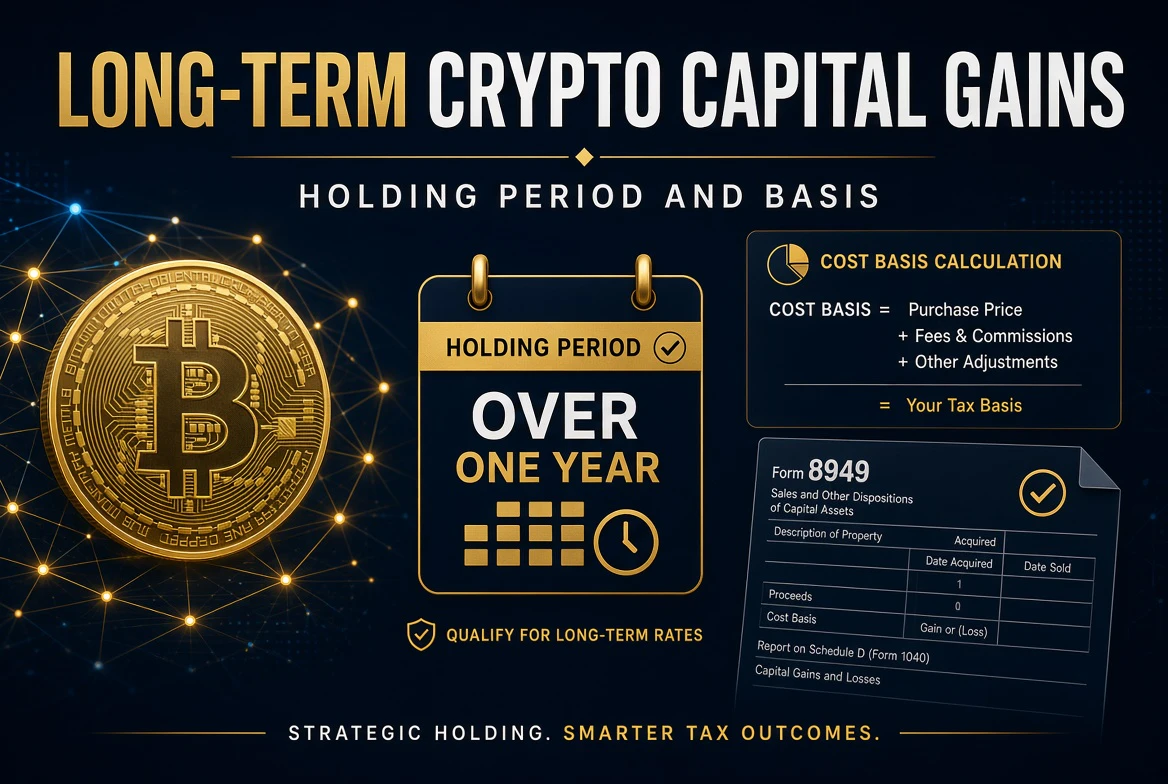
A U.S. capital gain or loss on cryptocurrency held as a capital asset is generally long-term when the disposed units were held for more than one year. The holding period begins the day after acquisition and ends on the sale or exchange date. Classification alone does not calculate tax: you also need the correct units’ adjusted basis, amount realized, and the rules for the filing year. Track each acquisition lot and its location before a disposal occurs.
Count days from the acquisition lot
The IRS digital asset FAQs state that a holding period of one year or less produces a short-term result, while more than one year produces a long-term result. Counting starts on the day after acquisition and ends on the disposition day.
Suppose a taxpayer acquires units on June 10 of Year 1. A sale on June 10 of Year 2 generally does not exceed one year under that counting method, while a sale on June 11 does. Calendar dates should be verified against the actual transaction records, especially around time zones and trades completed near midnight.
Bit.Fan’s introduction to long-term capital gains on crypto explains why holding period matters. Its historical tax-rate examples should not be reused for another year without checking current law, filing status, taxable income, and any additional taxes that apply.
Basis belongs to identifiable units
A person may buy the same asset on several dates at different prices. A later sale of part of the balance therefore requires identifying which units were disposed of under the applicable rules. Choosing a convenient old purchase after the trade is not the same as making a timely, adequate identification.
Imagine three hypothetical BTC lots: 0.01 BTC acquired for $300, another 0.01 for $500, and a third for $700. A sale of 0.01 BTC for $800 produces very different gains depending on which lot is properly identified: $500, $300, or $100 before transaction costs and adjustments.
The IRS FAQs added detailed identification rules for units held in unhosted wallets, hosted wallets, and broker custody. They require appropriate books and records, and broker-supported methods can affect what a customer may use. Review the current rule for the location of the units rather than applying one universal selection across all wallets.
Transfers should preserve history, not restart it
Moving the same digital asset between wallets or accounts you own generally is not itself the same as selling it. The transfer also does not automatically create a new acquisition date or reset the original basis. Preserve a link from the outgoing units to the receiving wallet’s records.
The IRS digital asset filing guidance distinguishes self-transfers from dispositions, with a separate warning when digital assets are used to pay a transaction fee. Record the network transaction and evidence that both endpoints were under your ownership or control.
Transfers can make lot history harder to follow because a blockchain transaction may combine inputs and create change. A spreadsheet that records only the destination balance can lose the acquisition details required later. Reconcile quantities, fees, and change when the movement occurs rather than reconstructing them years afterward.
Adjusted basis needs more than a purchase price
Basis commonly begins with cost in U.S. dollars, and qualifying transaction costs can affect adjusted basis under current digital-asset rules. Other acquisition methods can differ. Units received as compensation, mining income, a gift, or an inheritance should not be assigned the basis of an ordinary exchange purchase without examining the applicable facts.
For a sale, amount realized and adjusted basis must use compatible dollar valuations and include the relevant permitted adjustments. Subtracting a bank deposit from a remembered purchase total can miss trading charges, property received, or transactions completed on another platform.
Keep source documents rather than only a portfolio app’s current average cost. An app may use a display calculation that differs from the lot identification and tax rules applicable to the disposal. The useful record is one that supports dates, quantities, cost, adjustments, and the units actually sold.
Long-term does not mean tax-free
Long-term classification can affect the federal tax treatment, but it does not establish a zero rate or a final tax bill. The result can depend on income, filing status, other gains and losses, and state or local law. Special circumstances may also change whether a gain is capital or ordinary.
Use the current IRS capital-gain guidance and return instructions when applying the rules. If a tax situation involves gifts, inheritance, business activity, or complex wallet movements, obtain professional advice based on the records.
Before selling, identify the proposed units and verify their acquisition dates, adjusted bases, wallet or account, and supported selection method. Afterward, save the trade confirmation and dollar proceeds. That discipline makes the long-term label defensible and prevents a holding-period assumption from standing in for the complete gain calculation.