
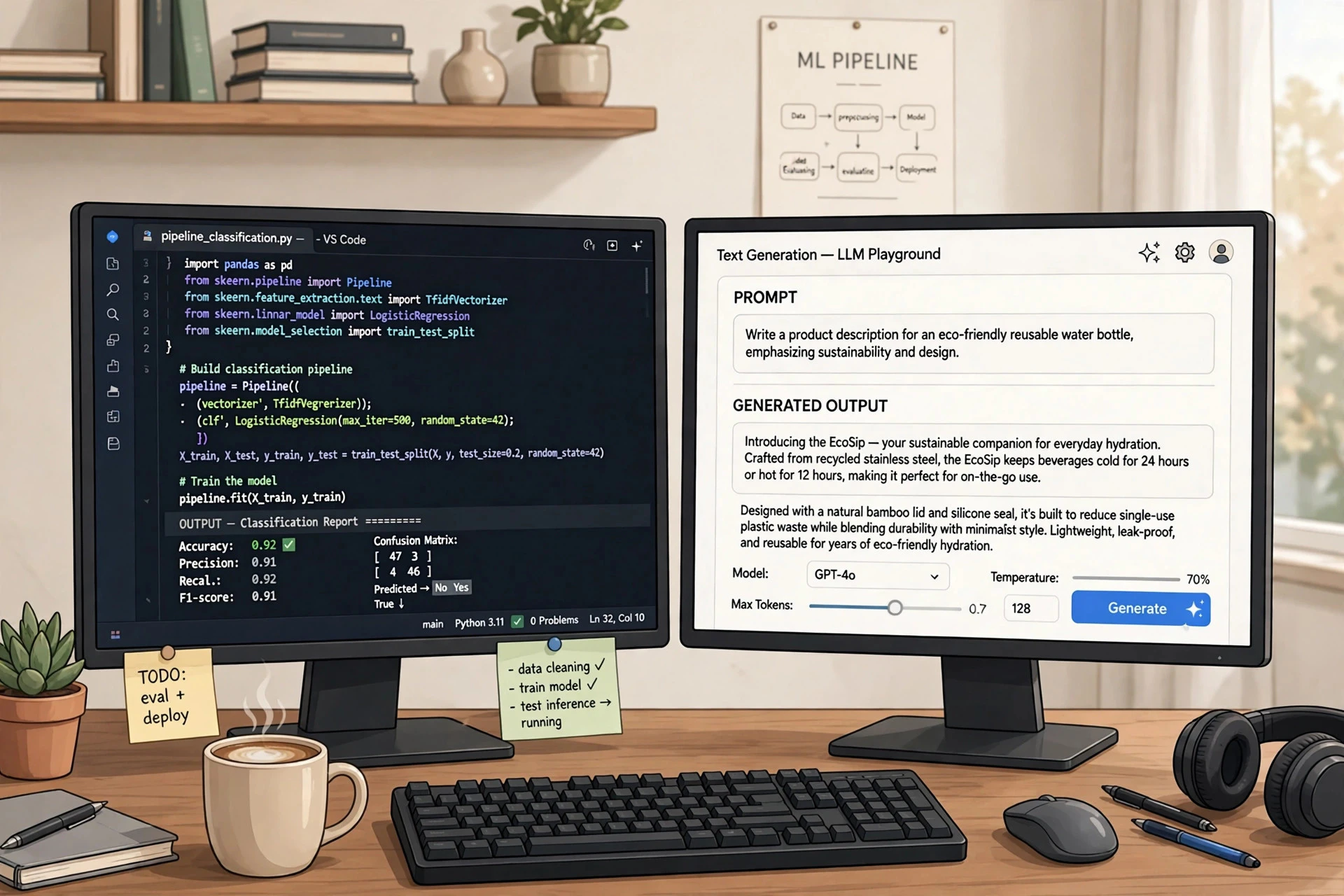
When a product team asks for "AI" in a feature, the first decision a developer faces is the choice in generative AI vs predictive AI. The two families of models solve different problems, and choosing the wrong one means rebuilding the feature later, usually at a higher cost than getting it right the first time. Predictive models answer a question about data you already have, such as whether a transaction is fraud or how many units will sell next week. Generative models produce something new, such as a draft, an image, or a block of code, in response to a prompt. Both are built on machine learning, but they differ in what they take in, what they give back, and what they demand from the system around them. This guide walks through those differences from a builder's point of view, so the choice of model follows the requirements of the feature instead of the other way around.
How Do Predictive and Generative Models Differ Under the Hood?
Predictive models learn a mapping from inputs to a known kind of output, and generative models learn the patterns of a dataset so they can produce new samples from it. That single difference shapes almost every engineering decision that follows. A predictive model takes structured features, such as a user age, a purchase history, or a sensor reading, and returns a label, a score, or a number. A generative model takes a prompt, which may be text, an image, or a mix of both, and returns new content that resembles the data it was trained on.
The architectures reflect this split. Predictive work commonly uses logistic regression, decision trees, gradient boosted trees, and smaller neural networks, all of which are trained to minimize the error between a prediction and a known answer. Generative work commonly uses transformer based models, diffusion models, and other architectures trained to model the distribution of the training data itself, so the model can sample new content from it. In practice this means a predictive model is usually a small, focused component with a narrow job, while a generative model is often a large, general purpose component that can be steered toward many jobs with prompts or fine tuning.
For a developer, the practical consequence is scope. A predictive model does one thing, and its behavior can be tested against labeled examples with clear pass and fail criteria. A generative model does many things, and its behavior is harder to pin down, because the same prompt can produce different outputs on different runs, and there is no single correct answer to compare against. If the feature needs a yes or no, a ranking, or a number, the predictive route is usually the shorter path. If the feature needs fresh text, images, or code, the generative route is the only one that produces them.
What Data Does Each Model Need Before Training Starts?
Predictive models need labeled data, and generative models need large volumes of raw data, so the data question often decides the approach before any code is written. A predictive model learns from examples where the correct answer is already known: past transactions labeled as fraud or legitimate, customers labeled as churned or retained, or days labeled with their actual sales figures. The quality of those labels sets a ceiling on the quality of the model, and no amount of tuning can fix labels that are wrong, inconsistent, or collected from a process that no longer matches the live system.
The data work for a predictive model is mostly feature engineering. A developer has to decide which inputs the model sees, how missing values are handled, how categorical values are encoded, and how the data is split into training and test sets without leaking information from the future into the past. Time based splits matter here: if the model is trained on data that includes events from after the prediction point, the test results will look better than the live results, and the team will find out only after launch.
Generative models shift the data burden in a different direction. Their pretraining stage consumes very large collections of text, images, or code, which is why most teams do not train a large generative model from scratch. Instead, a team typically takes a pretrained model and adapts it with prompting, retrieval, or fine tuning on a much smaller dataset that represents the team's own content and style. That smaller dataset still has to be clean and representative, because a model fine tuned on a few hundred low quality examples will produce low quality output. The other data question for generative work is what the model is allowed to see at inference time: the documents, records, or context that are supplied with the prompt, and the rules that keep private data out of that context.
A useful check before choosing is to count the labeled examples the team actually has. If the count is in the hundreds, a predictive model may still work for a simple problem, but a complex one will struggle, and a generative model with careful prompting may be the more realistic route. If the team has years of clean, labeled history, a predictive model can often deliver the result with less infrastructure and more predictable behavior.
How Do You Evaluate a Predictive Model vs a Generative Model?
A predictive model is evaluated with numbers, and a generative model is evaluated with a mix of numbers and human judgment, because only one of them has a single correct answer. For a predictive model, the developer splits off a test set the model has never seen, runs the model on it, and measures the gap between predictions and reality. Classification work uses accuracy, precision, recall, F1 score, and area under the ROC curve, while regression work uses mean absolute error and root mean squared error. These metrics are repeatable: run the same test set twice and the numbers are the same, which makes it possible to compare two model versions and say which one is better.
Generative evaluation is less settled. Automated scores exist for narrow tasks, such as comparing a generated summary against a reference summary, but for open ended generation there is no reference answer to compare against. Teams usually build an evaluation set of representative prompts, generate outputs, and score them with a rubric that covers correctness, relevance, tone, and safety, often with a human reviewer grading a sample. Some teams use a second model as a judge, which speeds up scoring but adds its own bias, so the results should be treated as a signal, not a verdict. A practical approach is to keep a fixed set of prompts and a fixed rubric, run the same evaluation on every model change, and track the scores over time the way a team tracks test coverage.
There is one evaluation habit that applies to both families: evaluate on data that resembles production. A predictive model tested on clean historical data can fail on messy live data, and a generative model that sounds good on ten hand picked prompts can fail on the long tail of real user requests. Logging a sample of live inputs and outputs, with privacy controls in place, gives the team the material to build a better evaluation set, and that set is often the most valuable artifact a team produces, more valuable than any single model version.
What Does Each Model Cost to Run in Production?
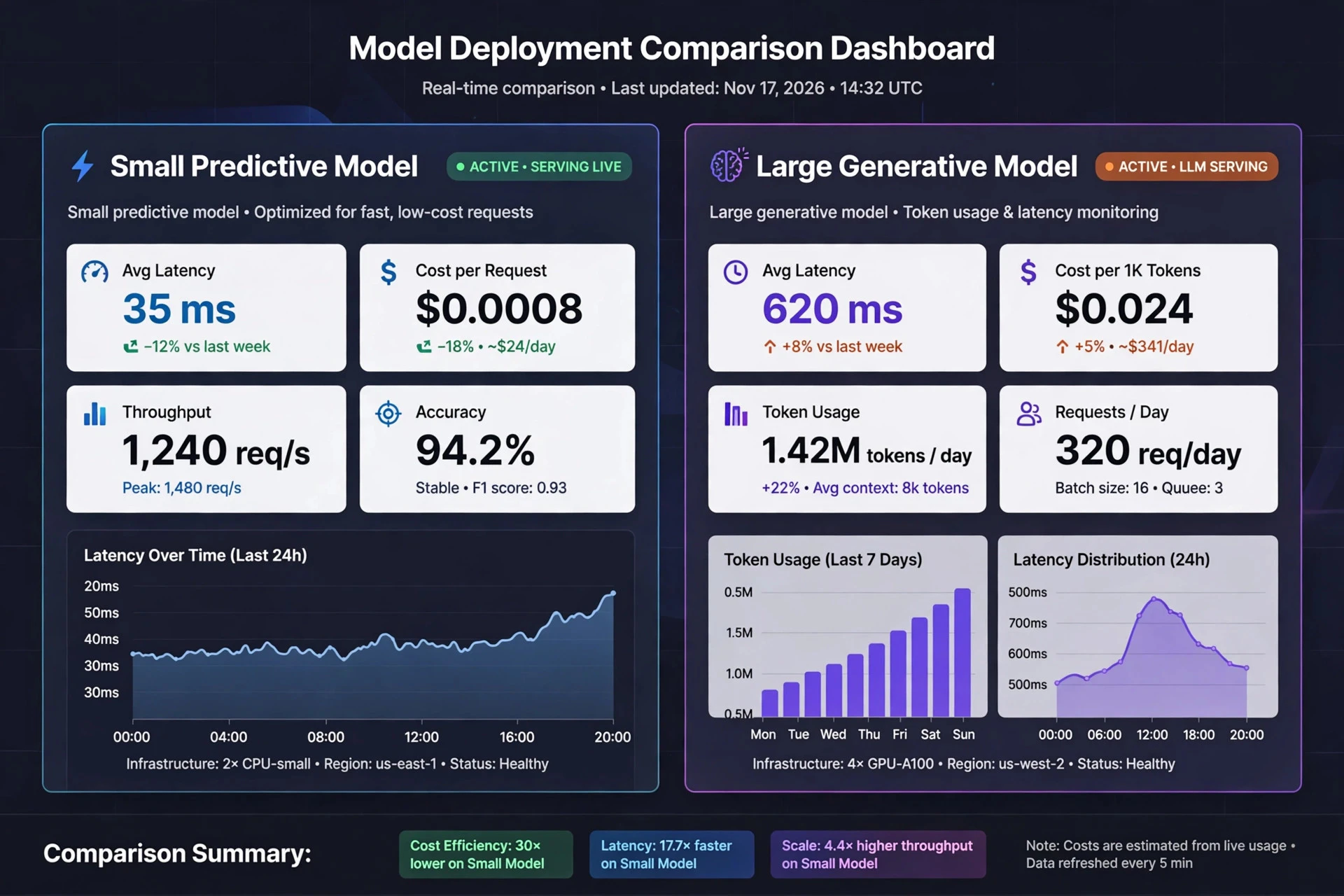
Predictive models are usually cheaper to run than generative models, because they are smaller, faster, and easier to host on ordinary infrastructure. A trained tree based model or a small neural network can answer a prediction in milliseconds on a CPU, serve thousands of requests per second from a single container, and be versioned like any other piece of code. The cost is dominated by data pipelines and monitoring, not by compute, and the team can often predict the monthly bill from the request volume with reasonable accuracy.
Generative models change the cost picture. A large language model typically needs GPU hardware or a managed API, and its cost grows with the number of tokens in the prompt and in the output. A feature that sends long documents with every request, or that asks for long responses, will cost far more than a feature that sends short prompts and receives short answers. Latency also grows with output length, because the model generates one token at a time, so a long response can take several seconds while a predictive model would have answered in milliseconds. Caching, prompt trimming, and choosing a smaller model for simple requests are the usual ways teams keep the bill down, but each of these adds complexity that a predictive model would not need.
Cost should be compared against value, not against other models. A fraud score that blocks a bad transaction is worth far more than the fraction of a cent it costs to compute, and a generated draft that saves a user ten minutes is worth more than the tokens it consumed. The expensive mistake is the opposite one: using a large generative model for a job a small predictive model could do for a fraction of the price, simply because the generative model was easier to demo. A short cost test on real traffic, with token counts and latency logged, will show the difference in days.
How Do You Ship Each Model to Production?
A predictive model ships like a normal software component, and a generative model ships like a service with a behavior that can change, so the deployment patterns differ. A predictive model is usually packaged as an artifact with a version number, a list of the features it expects, and a test set with known metrics. The serving code loads the artifact, validates the input schema, and returns a prediction. Rollback is straightforward: deploy the previous artifact version. Monitoring tracks prediction drift, which is the slow change in live data that makes a model less accurate over time, and input validation catches the malformed requests that would otherwise produce nonsense scores.
A generative model needs more guardrails around it. The prompt is part of the system, so prompt templates should be versioned like code, and changes to them should go through the same review and testing as a code change. Output needs checks before it reaches a user: format validation, length limits, filters for disallowed content, and, for high stakes features, a human review step. The team also needs a way to trace a bad output back to its prompt, its model version, and its context, because without that trace, debugging is guesswork. Rate limits and timeouts matter more here, because a single user request can trigger a long generation that ties up resources for other users.
One pattern that works well for both is to start with a shadow deployment. Run the new model alongside the existing behavior, log its outputs, and compare them against the current results without showing them to users. For a predictive model, the comparison is numeric and quick. For a generative model, the team reviews a sample of the outputs and looks for failures that the evaluation set missed. Only when the shadow results look good does the model take over real traffic, and even then a gradual rollout with a kill switch is the safer path.
When Does Combining Both Models Make Sense?
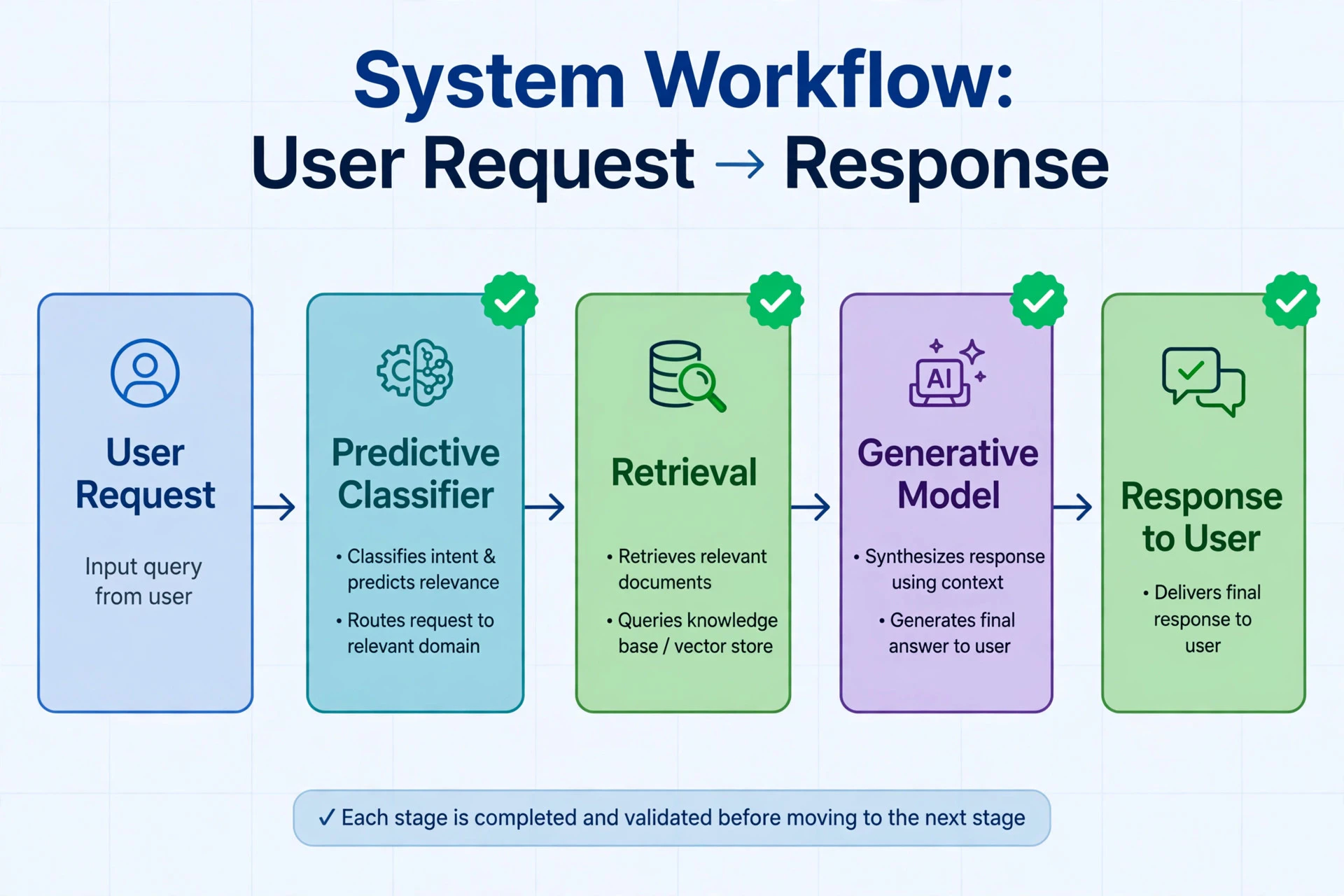
Combining both models makes sense when the feature needs both a decision and new content, because each family covers the weakness of the other. A common pattern is to use a predictive model to decide what should happen and a generative model to produce the words, images, or code that carry it out. A support system can use a classifier to route a ticket and estimate its urgency, then use a generative model to draft a reply in the right tone. A sales tool can use a forecasting model to rank the accounts most likely to buy, then use a generative model to draft a personalized message for each one. The predictive part brings measurement and control, and the generative part brings fluency and scale.
Another pattern runs in the opposite direction: a generative model creates synthetic data that helps train a predictive model. When labeled examples are scarce, a team can generate additional training examples, or variations of existing ones, and use them to expand a small dataset. This only works when the generated data is checked against real examples, because synthetic data that drifts from reality will teach the predictive model the wrong patterns. A held out set of real examples is the check: if the model trained with synthetic data performs better on real data, the approach is working, and if it performs worse, the synthetic data is doing harm.
Retrieval is the third common combination. A generative model on its own can only answer from what it learned during training, which may be out of date or incomplete. Pairing it with a retrieval step, where relevant documents are fetched first and supplied with the prompt, grounds the output in current information. A predictive model can help here too, by ranking or filtering the retrieved documents so the generative model sees the most relevant ones first. This is also where AI agent development enters the picture: an agent that plans a task, calls tools, checks results, and retries on failure is a system built from these pieces, and its reliability depends on each piece doing the job it is best at.
The rule for combining models is to keep the boundary between them explicit. Each model should have one job, a defined input and output, and its own tests, so a failure in one can be traced without guessing. A system where two models are tangled together is harder to debug than either model alone.
What Mistakes Do Teams Make When Choosing a Model?
The most common mistake is choosing a model before defining the output, because the output type is what decides the model family. A team that asks for "AI" without saying whether the feature should return a score, a ranking, a forecast, or a draft will usually end up with a generative demo that cannot be measured, or a predictive model that cannot produce the content users actually want. Writing down the exact output first, with an example of a good answer and an example of a bad one, resolves most of the debate before it starts.
The second mistake is trusting a demo instead of a test set. A generative model can produce an impressive answer to a prepared prompt, and a predictive model can score well on a test set that was built from the same data it trained on. Both look good in a meeting and fail in production. The fix is the same in both cases: test on data the team did not use to build the model, and include the awkward cases, the edge cases, and the inputs that real users actually send.
The third mistake is ignoring the failure mode. A predictive model fails quietly: it returns a confident looking number that is wrong, and nobody notices until the numbers stop adding up. A generative model fails loudly: it produces text that is fluent, plausible, and wrong, which is worse in some ways because it looks correct. Each failure mode needs its own safeguard. A predictive model needs drift monitoring and a fallback when confidence is low. A generative model needs output checks and, for anything that affects money, health, or safety, a human in the loop.
The fourth mistake is treating the model as the product. A model is a component, and the product is the workflow around it: the data pipeline, the interface, the error handling, and the feedback loop that tells the team whether the feature is working. Teams that ship a model without that workflow spend their time answering the same support questions, while teams that build the workflow first can swap the model later without rebuilding the feature. The question of what is generative AI matters here not as a definition but as a scope question: if the team cannot say what the model should generate and what it should never generate, the feature is not ready to build.
Conclusion
Predictive and generative AI are different tools, and the right choice follows from the output the feature must produce. A score, a ranking, or a forecast calls for a predictive model, with labeled data, numeric evaluation, and cheap, fast serving. New content calls for a generative model, with careful prompting, human judged evaluation, and guardrails around the output. Many real features need both, with a predictive model deciding and a generative model producing, and the teams that succeed are the ones that keep the boundary between the two explicit and test each one on its own terms. Start from the output, audit the data, measure the cost on real traffic, and ship behind a shadow deployment. The model is the easy part. The judgment about which model fits the problem is the work that decides whether the feature holds up in production.
FAQs
Is a generative model always more expensive than a predictive model?
Usually yes, but not always. A large generative model costs more per request than a small predictive model in most cases, because of the compute and the token based pricing. A small generative model used for a short task can cost less than a large predictive system with an expensive data pipeline, so the comparison should be made on real traffic with real token counts, not on assumptions.
Can a predictive model generate text?
No, not in the sense users expect. A predictive model can classify text, rank it, or fill in a missing value, but it does not produce open ended new content. If the feature needs fresh paragraphs, summaries, or code, a generative model is the right tool, even if a predictive model could handle the routing or ranking around it.
How much labeled data does a predictive model need?
It depends on the problem. A simple problem with a few strong signals can work with hundreds of labeled examples, while a complex problem with many weak signals may need thousands or more. The test is empirical: train on part of the data, test on the rest, and see whether the metrics meet the requirement. If they do not, the team either needs more labeled data or a different approach.
What is the biggest risk of using a generative model in production?
The biggest risk is fluent but wrong output reaching a user without any check. A generative model can produce text that reads well and states facts that are false, and users tend to trust confident sounding answers. Output validation, retrieval grounding, and a human review step for high stakes content are the usual safeguards.
Should a small team build its own models or use existing ones?
Most small teams should use existing models and focus on the workflow around them. Training a large generative model from scratch is out of reach for most teams, and even training a predictive model from scratch is rarely needed when a standard algorithm and a clean dataset will do. The team's effort is better spent on data quality, evaluation, and the interface, which are the parts that decide whether the feature works.
Can one system use both predictive and generative AI?
Yes, and many production systems do. A predictive model can rank, filter, or score, while a generative model drafts the content that follows from that decision. The key is to give each model a single job with a defined input and output, and to test each one separately, so a failure can be traced to the right component.