
概要
7から始めると、コラッツ操作は16回で1に着きます。では逆に、「奇数の操作が5回、2で割る操作が11回で1に着く」とだけ言われたら、始点まで戻れるんでしょうか?
実は、各段で何回2で割ったかが分かれば、始点は一つに決まります。各段の回数が分からなくても、候補の列を数えれば始点の個数が出ます。今回はその数え方を手で追ってみます。
7の軌道を奇数だけで書く
奇数 $x$ に $3x+1$ を施し、次の奇数が現れるまで2で割ります。この操作を $c(x)$ と書きます。たとえば $3\cdot7+1=22$ なので、$c(7)=11$ です。
| 今の奇数 | $3x+1$ | 何回2で割る? | 次の奇数 |
|---|---|---|---|
| 7 | 22 | 1 | 11 |
| 11 | 34 | 1 | 17 |
| 17 | 52 | 2 | 13 |
| 13 | 40 | 3 | 5 |
| 5 | 16 | 4 | 1 |
奇数から奇数への反復回数を $s$、2で割った総回数を $V$ とします。各段の除算回数の列が $(a_1,\ldots,a_s)$ です。7から1までなら $s=5$、$(a_1,\ldots,a_5)=(1,1,2,3,4)$、$V=11$ なので、通常の操作では $s+V=16$ 回です。
除算回数から始点を逆算する
次の奇数が $u$、その段で2で割った回数が $a$ なら、一つ前の値は $(2^a u-1)/3$ と決まります。では1から、さっきの列を後ろから使ってみましょう。
| 今の値 $u$ | 使う $a$ | $(2^a u-1)/3$ |
|---|---|---|
| 1 | 4 | $(16-1)/3=5$ |
| 5 | 3 | $(40-1)/3=13$ |
| 13 | 2 | $(52-1)/3=17$ |
| 17 | 1 | $(34-1)/3=11$ |
| 11 | 1 | $(22-1)/3=7$ |
7に戻ってきました! もし最後の段の除算回数を1とすると、最初の逆算が $(2-1)/3=1/3$ になります。この列には整数の始点がありません。
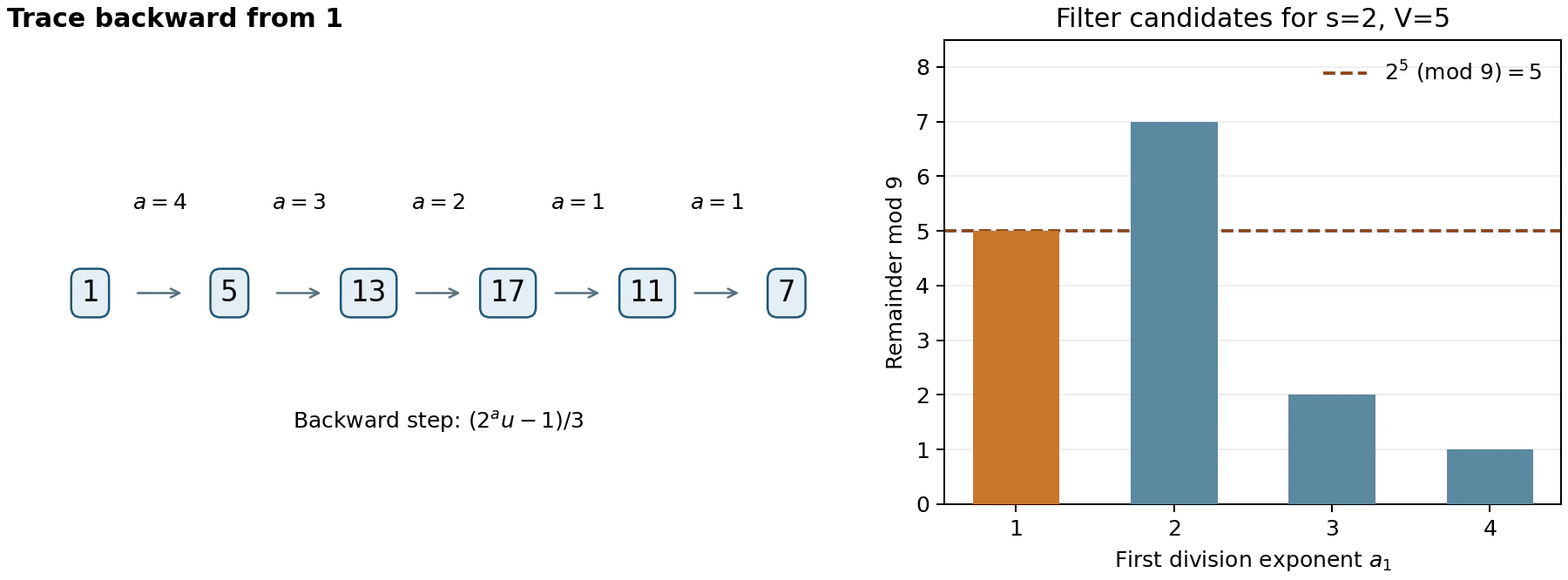
図の左は1から7まで逆に戻る経路です。矢印に付いた指数を後ろから順に読みます。右は後半で使う深さ2・総除算回数5の剰余の比較で、横線と一致する候補だけが残ります。
図を作るPythonコード
import matplotlib.pyplot as plt


def odd_step(x):
    next_value = 3 * x + 1
    exponent = 0
    while next_value % 2 == 0:
        next_value //= 2
        exponent += 1
    return next_value, exponent


values = [7]
exponents = []
while values[-1] != 1:
    value, exponent = odd_step(values[-1])
    values.append(value)
    exponents.append(exponent)

fig, (path, check) = plt.subplots(
    1, 2, figsize=(10, 3.7), layout="constrained",
    gridspec_kw={"width_ratios": [1.4, 1]},
)
path.set_title("Trace backward from 1", loc="left", fontweight="bold")
path.set_xlim(-0.6, len(values) - 0.4)
path.set_ylim(-0.75, 0.9)
path.set_axis_off()
for k, value in enumerate(reversed(values)):
    path.text(
        k, 0, str(value), ha="center", va="center", fontsize=13,
        bbox={"boxstyle": "round,pad=0.35", "fc": "#e4eff7", "ec": "#1a5677"},
    )
for k, exponent in enumerate(reversed(exponents)):
    path.annotate(
        "", xy=(k + 0.69, 0), xytext=(k + 0.31, 0),
        arrowprops={"arrowstyle": "->", "color": "#54707f"},
    )
    path.text(k + 0.5, 0.3, rf"$a={exponent}$", ha="center", fontsize=10)
path.text(2.5, -0.48, r"Backward step: $(2^a u-1)/3$", ha="center")

divisions = 5
first_exponents = list(range(1, divisions))
target = 2**divisions % 9
remainders = [(3 + 2**a) % 9 for a in first_exponents]
colors = ["#c77729" if remainder == target else "#5a899f" for remainder in remainders]
check.bar(first_exponents, remainders, color=colors, width=0.55, zorder=3)
check.axhline(target, color="#8d4316", linestyle="--", label=rf"$2^5\ (\mathrm{{mod}}\ 9)={target}$")
check.set(
    title="Filter candidates for s=2, V=5",
    xlabel=r"First division exponent $a_1$", ylabel="Remainder mod 9",
    xticks=first_exponents, ylim=(0, 8.5),
)
check.grid(axis="y", alpha=0.22, zorder=0)
check.legend(frameon=False, loc="upper right")
assert [a for a, remainder in zip(first_exponents, remainders) if remainder == target] == [1]
fig.savefig("01_reverse_and_congruence.png", dpi=180)
では、逆算の途中を毎回確認せず、式一つで候補を選別できるでしょうか?
合同式を一つ立てる
$v_j=a_1+\cdots+a_j$ を最初の $j$ 段での累計とし、$v_0=0$ とします。始点を $x$、終点を $u$ とすると、順方向の各式をつなぐことで次が成り立ちます。
2^V u = 3^s x + R_s(a),
\qquad
R_s(a)=\sum_{j=0}^{s-1}3^{s-1-j}2^{v_j}.
式の形は、まず2段で見るとすっきりします。中間を $x_1$ とすれば、$2^{a_1}x_1=3x+1$、$2^{a_2}u=3x_1+1$。後者に $2^{a_1}$ を掛けて前者を入れると、$2^{a_1+a_2}u=9x+3+2^{a_1}$ です。段が一つ増えるたびに、前の余りの部分を3倍して、直前の累計に対応する2の冪を足しています。
終点1の場合は次の合同式を使えます。
R_s(a)\equiv 2^V\pmod{3^s}.
たとえば7の例では、累計が $0,1,2,4,7,11$ です。よって $R_5=81+54+36+48+128=347$ で、$(2^{11}-347)/3^5=1701/243=7$ と戻せます。
合同式が通れば、途中も正奇数になる
ここが数え上げに使える理由です。一般の正奇数終点 $u$ について、$R_s(a)\equiv 2^V u\pmod{3^s}$ を仮定します。法3で見ると $R_s(a)$ の最後の項 $2^{v_{s-1}}$ だけが残るので、$2^{a_s}u\equiv1\pmod3$ です。従って一段前の値 $(2^{a_s}u-1)/3$ は正の整数です。分子は奇数なので、その商も奇数です。
さらに、$R_s(a)=3R_{s-1}(a)+2^{v_{s-1}}$ と書いて合同式を3で割ると、一段前の終点について同じ形の合同式が法 $3^{s-1}$ で成り立ちます。これを繰り返せば、途中の値が全部正奇数になります。そのため、順方向に戻したときに割る回数も指定した各 $a_j$ でぴったりです。
#X(s,V)を手で数える
$X(s,V)$ は、すべての成分が正で、和が $V$、かつ終点1の合同式を満たす指数列の集合です。$\#X(s,V)$ はその列の個数。始点からの軌道は一意なので、これは 指定した $s,V$ で1に着く正奇数の始点の個数でもあります。
深さ2では $R_2=3+2^{a_1}$。例えば $V=5$ なら、法9で次を比較するだけです。
| $a_1$ | $a_2=5-a_1$ | $3+2^{a_1}$ を9で割った余り |
|---|---|---|
| 1 | 4 | 5 |
| 2 | 3 | 7 |
| 3 | 2 | 2 |
| 4 | 1 | 1 |
$2^5=32$ の余りは5。従って該当する列は $(1,4)$ の一つで、始点は $(32-5)/9=3$ です。前に進めても $3\to5\to1$ になっています。
| $(s,V)$ | 通る指数列 | 始点 |
|---|---|---|
| $(2,3)$ | なし | なし |
| $(2,4)$ | $(2,2)$ | 1 |
| $(2,5)$ | $(1,4)$ | 3 |
| $(2,6)$ | $(4,2)$ | 5 |
| $(2,10)$ | $(2,8),(8,2)$ | 113, 85 |
表の $(2,6)$ に出る5は、$5\to1\to1$ を一つ数えたものです。$X(s,V)$ は指定した段で1にいる条件なので、1に着いた後の自己ループも含まれます。「初めて」の条件は第3回でこの計数から取り出します。
今回扱った研究
岡 將太・岡 万桜「コラッツ予想のステップ数(総停止時間)について」第2節。逆像の指数表示の背景については、Wirsching–Goodwin 表現の簡潔な証明を参照できます。