
目次
https://qiita.com/Shamoo/items/c9e43a6f4034f58e1a7e
前の記事
https://qiita.com/Shamoo/items/821629c44440194ec28d
概要
5から始めると、普通のコラッツ操作では $5\to16\to8\to4\to2\to1$ の5回です。ところが計算を止めずに続けると、$1\to4\to2\to1$ と回って、8回目にも1に着きます。5は「5回で初到達」の欄にだけ入れたいですよね。今回は、1に着いた後の一周を引くことで、逆像の個数から総停止時間のヒストグラムを作ります。
一周した組をまとめて引く
奇数から次の奇数まで進む操作を $c$ と書きます。正奇数 $x$ に $3x+1$ を施し、奇数になるまで2で割ったものが $c(x)$ です。反復の回数が $s$、その間に2で割った総回数が $V$ なら、普通の操作は合わせて $s+V$ 回です。
正の整数 $N$ を決めます。$T_N(s,V)$ は、$N$ 以下の正奇数のうち、$c$ をちょうど $s$ 回適用すると1に着き、その間の除算回数が $V$ となる始点の個数です。途中で1に着いた始点も含めます。また $T_N(0,0)=1$ は始点1の分で、$V\ne0$ のときは $T_N(0,V)=0$ とします。正の $s$ に対して $V<s$ の場合も0です。
最終段より前に1を踏んだ軌道は、末尾が必ず $c(1)=1$ です。この一段では $3\cdot1+1=4$ を2で2回割ります。その一段を外せば $(s,V)$ が $(s-1,V-2)$ になり、始点は同じです。逆に、一段付け足すと元に戻ります。よって、$(s,V)$ で初めて1に着く始点の個数を $K_N(s,V)$ とすると
K_N(s,V)=T_N(s,V)-T_N(s-1,V-2)
です。途中で何周したかは調べなくて大丈夫。末尾の一周の有無だけで、引くべき始点をちょうど拾えます。
深さ2で実際に引いてみる
最後の二段を逆向きにたどります。最初の除算回数を $a_1$ とすると、始点は $x=(2^V-3-2^{a_1})/9$ です。ここでは候補 $a_1=1,\dots,V-1$ を入れ、正の整数になるものを拾います。
除算5回。 $2^5-3=29$ から $2,4,8,16$ を引くと、分子は $27,25,21,13$。9で割れるのは27だけなので、始点は3です。実際に $3\to5\to1$ の除算回数は1回と4回。一段で除算3回の逆像はないので、$K_{20}(2,5)=1-0=1$ です。
除算6回。 今度は $2^6-3=61$ から $2,4,8,16,32$ を引きます。分子 $59,57,53,45,29$ のうち、9で割れるのは45だけ。始点5は $5\to1\to1$ と進みます。一段で除算4回なら同じ始点5が入るので、$K_{20}(2,6)=1-1=0$。8回目の到達が差分で消えました。
総停止時間の表を作る
$M_N(t)$ を、$N$ 以下の正奇数で、普通のコラッツ操作の総停止時間がちょうど $t$ であるものの個数とします。$t=0$ は始点1の1個。$t\ge1$ では $V=t-s$ とおけばよく、各段で少なくとも一度は2で割るので $V\ge s$、つまり $s\le\lfloor t/2\rfloor$ です。
M_N(0)=1,\qquad
M_N(t)=\sum_{s=1}^{\lfloor t/2\rfloor}K_N(s,t-s)\quad(t\ge1).
例えば $N=20$ で $t=7$ なら、調べる組は $(1,6),(2,5),(3,4)$ の三つ。$(1,6)$ の始点は $(64-1)/3=21$ で範囲の外。$(2,5)$ は上で求めた3です。$(3,4)$ で、最後に初めて1へ入るなら、最後だけで少なくとも4回の除算が必要です。前二段にも各1回が必要なので、この組からは初到達できません。よって $M_{20}(7)=1$ です。
$N=20$ の全表はこうなります。例えば17は $17\to13\to5\to1$。除算回数が $2+3+4=9$、奇数から次の奇数までが3段なので、$t=12$ の欄です。
| 総停止時間 | 始点 | 個数 |
|---|---|---|
| 0 | 1 | 1 |
| 5 | 5 | 1 |
| 7 | 3 | 1 |
| 9 | 13 | 1 |
| 12 | 17 | 1 |
| 14 | 11 | 1 |
| 16 | 7 | 1 |
| 17 | 15 | 1 |
| 19 | 9 | 1 |
| 20 | 19 | 1 |
まだ着いていない始点も数えられる
時刻 $T$ を決めたら、奇数の総数から、その時刻までに着いた分を引きます。
D_N(T)=\left\lfloor\frac{N+1}{2}\right\rfloor-\sum_{t=0}^T M_N(t).
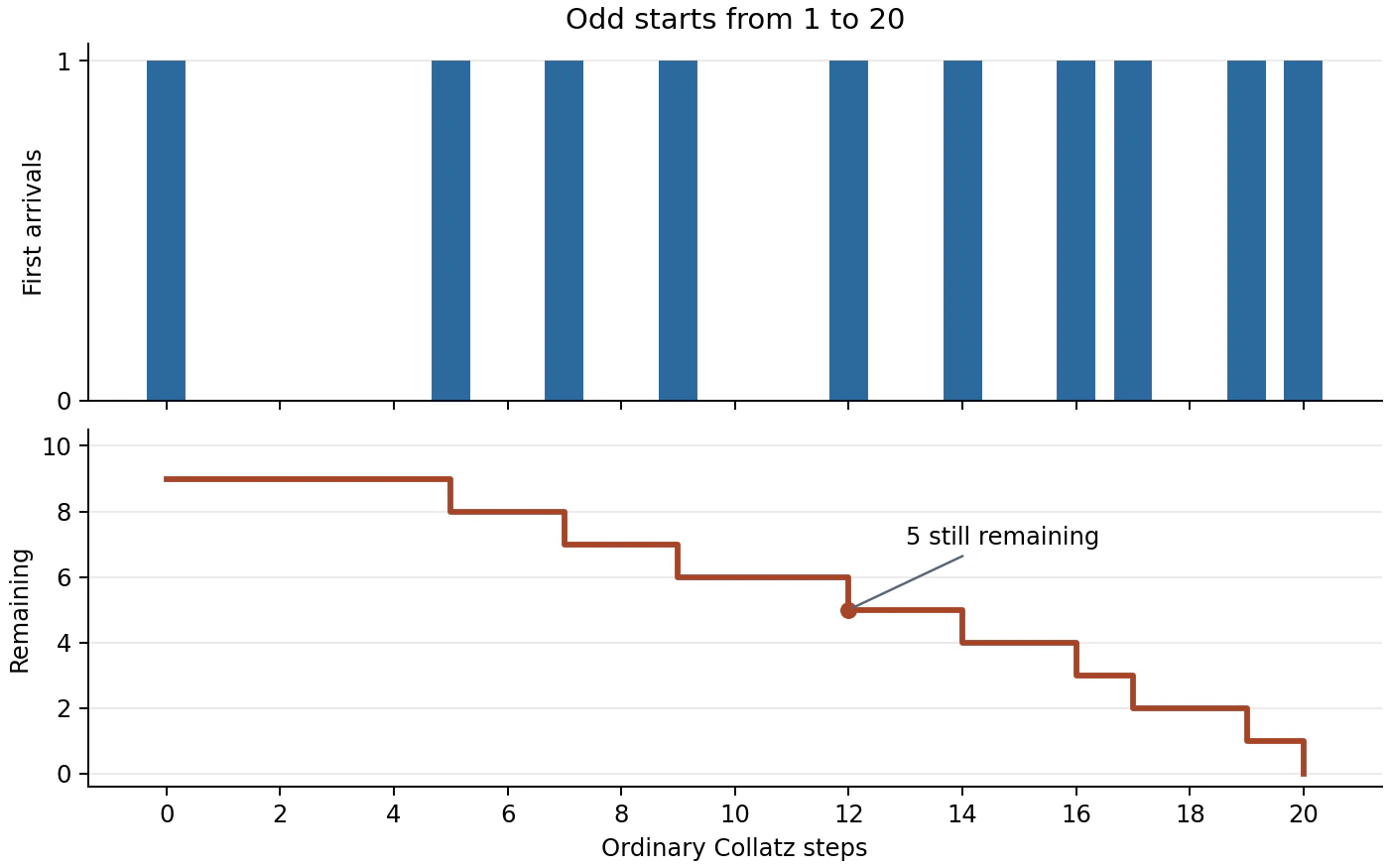
$D_N(T)$ は $N$ 以下の正奇数のうち、$T$ 回以内に1に着かなかった始点数です。例えば $D_{20}(12)=10-5=5$。時刻12で数えるので、12回目に着く17は到達済みです。この有限時刻で残った始点がその後どうなるかは、時刻を伸ばして初めて分かります。この例では $D_{20}(20)=0$ です。
図では、上段の棒が各時刻の初到達、下段の階段がその時刻を過ぎてもまだ残っている個数です。例えば12回目に17が着くと、下の階段は6から5へ一段下がります。横軸は、どちらも通常のコラッツ操作の回数です。
図を作るPythonコード
from collections import Counter
from itertools import accumulate

import matplotlib.pyplot as plt
from matplotlib.ticker import MaxNLocator


def backward_histogram(bound, horizon):
    counts = Counter({0: 1})

    def visit(value, elapsed):
        for divisions in range(1, horizon - elapsed):
            numerator = 2**divisions * value - 1
            if numerator % 3:
                continue
            start = numerator // 3
            if start == 1:
                continue
            time = elapsed + 1 + divisions
            if start <= bound:
                counts[time] += 1
            visit(start, time)

    visit(1, 0)
    return counts


def forward_histogram(bound, horizon):
    counts = Counter()
    for start in range(1, bound + 1, 2):
        value = start
        for time in range(horizon + 1):
            if value == 1:
                counts[time] += 1
                break
            value = value // 2 if value % 2 == 0 else 3 * value + 1
    return counts


bound, horizon = 20, 20
counts = backward_histogram(bound, horizon)
assert counts == forward_histogram(bound, horizon)
times = list(range(horizon + 1))
arrivals = [counts[time] for time in times]
remaining = [(bound + 1)//2 - n for n in accumulate(arrivals)]
assert remaining[12] == 5 and remaining[-1] == 0

fig, (top, bottom) = plt.subplots(2, 1, sharex=True, figsize=(8, 5), layout="constrained")
top.bar(times, arrivals, color="#2b6a9e", width=0.68)
top.set(ylabel="First arrivals", title="Odd starts from 1 to 20")
bottom.step(times, remaining, where="post", color="#a44528", linewidth=2.4)
bottom.scatter([12], [remaining[12]], color="#a44528", zorder=3)
bottom.annotate("5 still remaining", (12, 5), xytext=(13, 7),
                arrowprops={"arrowstyle": "-", "color": "#596477"})
bottom.set(xlabel="Ordinary Collatz steps", ylabel="Remaining", ylim=(-0.4, 10.5))
for axis in (top, bottom):
    axis.grid(axis="y", alpha=0.25)
    axis.set_axisbelow(True)
    axis.yaxis.set_major_locator(MaxNLocator(integer=True))
    axis.spines[["right", "top"]].set_visible(False)
bottom.set_xticks(range(0, horizon + 1, 2))
fig.savefig("03_histogram_and_tail.png", dpi=175)
plt.close(fig)
順方向の集計と逆方向の集計は、折りたたみのコードに両方入れました。逆向きでは初手の自己ループを外し、時刻の上限までたどります。始点の上限 $N$ は候補を表に入れるときに適用します。例えば19は、途中で $29>20$ を通ってから1に着くので、途中の値を20で切ると落としてしまいます。
この先につながる話
規模を大きくするとヒストグラムに細かい振動が出ます。第11回では、103を通る群と通らない群、始点上限の境界にかかる層を比べます。第15回は、残っている個数をある一つの等差数列で測ると、どうして全体の到達と関係するのか、という話です。
参考
- 岡 將太・岡 万桜「コラッツ予想のステップ数(総停止時間)について」第4節および続編第5節。