
Have you ever wondered how engineers can predict the way air moves around a car, how heat travels through a machine, or how liquid behaves inside complex equipment without building countless physical prototypes?
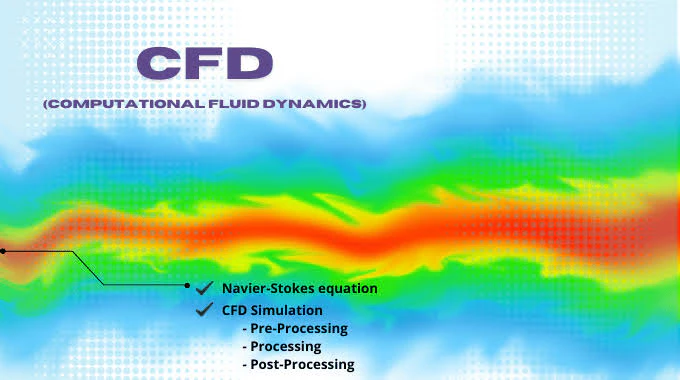
This is where Computational Fluid Dynamics (CFD) comes in. CFD uses numerical methods and computer simulations to study fluid flow, heat transfer, and related physical phenomena. At the center of a CFD simulation is something called a CFD solver.
For engineers, researchers, and students getting started with simulation software, understanding what a CFD solver does is important. In this article, I’ll explain CFD solvers in simple terms, how they work, the major types of solvers, and why tools such as Altair CFD Solvers are useful for engineering simulation.
What Is a CFD Solver?
A CFD solver is the part of a computational fluid dynamics software package that performs the mathematical calculations needed to simulate fluid behavior.
Instead of physically testing every design, engineers can create a digital model and use a solver to calculate things such as:
Airflow around an object
Pressure and velocity
Temperature distribution
Heat transfer
Turbulence
Fluid forces
Multiphase flow
Fluid interaction with moving components
Most CFD problems are based on fundamental conservation laws, including conservation of mass, momentum, and energy. The solver takes these mathematical equations along with the geometry, material properties, boundary conditions, and other settings and calculates an approximate numerical solution.
In simple words, the CFD solver is the mathematical engine behind a CFD simulation.
How Does a CFD Solver Work?
A CFD simulation usually follows several important stages.
- Create the Geometry
First, the object or system being studied is created as a digital model. This could be a car body, aircraft component, heat exchanger, pipe, fan, gearbox, or another engineering design.
- Define the Computational Domain
The surrounding fluid region also needs to be represented. For example, when analyzing airflow around a vehicle, the software needs a volume of air around the vehicle rather than only the vehicle surface.
- Create a Mesh or Use a Particle-Based Method
Traditional CFD methods divide the computational domain into many small elements or cells. This process is known as meshing.
Different CFD approaches use different numerical representations. For example, AcuSolve uses a finite-element formulation, while nanoFluidX uses a particle-based Smoothed Particle Hydrodynamics (SPH) approach.
- Define Physics and Boundary Conditions
The engineer specifies information such as:
Fluid properties
Inlet velocity
Pressure
Temperature
Wall conditions
Gravity
Heat sources
Turbulence models
These settings tell the solver what physical problem it needs to calculate.
- Run the Solver
This is the stage where the CFD solver performs the numerical calculations. Large simulations can contain huge numbers of equations, so the solver uses computing resources such as CPUs, GPUs, or high-performance computing systems.
- Analyze the Results
After the calculations are completed, engineers can examine the results using visualization and post-processing tools. Typical outputs include velocity contours, pressure maps, temperature fields, streamlines, turbulence information, and forces.
Why Are CFD Solvers Important?
CFD solvers have become an important part of modern engineering because physical testing alone can be expensive and time-consuming.
A simulation can help engineers investigate a design before manufacturing a prototype. It can also make it easier to compare several design concepts and identify potential problems earlier in the development process.
CFD simulation is used in areas such as automotive engineering, aerospace, energy, chemical processing, electronics cooling, and many other industries. Altair describes AcuSolve as a general-purpose CFD solver used across several of these application areas.
Main Types of CFD Solvers
Not every engineering problem requires the same numerical approach. Different CFD solvers are designed around different methods and applications.
Finite-Element CFD Solvers
Finite-element-based CFD solvers use the finite element method to solve fluid-flow equations. Altair AcuSolve is one example. Altair describes AcuSolve as a general-purpose, finite-element CFD solver capable of handling steady and transient flow as well as multiphysics applications.
This type of solver can be useful for applications involving airflow, heat transfer, fluid flow, and complex engineering simulations.
Particle-Based CFD Solvers
Particle-based methods represent fluid using particles instead of relying exclusively on a traditional fixed mesh.
Altair nanoFluidX uses Smoothed Particle Hydrodynamics (SPH) and is designed for simulations involving complex geometries and motion. Altair highlights applications such as drivetrain lubrication, gearboxes, differentials, and oiling systems.
This approach can be particularly interesting when fluid motion becomes difficult to represent using conventional mesh-based methods.
Lattice-Boltzmann CFD Solvers
Another approach is the Lattice Boltzmann Method (LBM).
Altair ultraFluidX is a GPU-based CFD solver using a lattice-based approach for fast aerodynamic simulation. Altair describes it as being designed for applications including vehicle aerodynamics and other external-flow problems.
GPU acceleration is particularly valuable when engineers need to run large numbers of simulations and reduce turnaround time.
Altair CFD Solvers: Three Different Approaches
When looking at modern CFD software, Altair's CFD solver family provides a useful example of how different numerical technologies can serve different engineering requirements.
The Altair CFD solver portfolio includes AcuSolve, nanoFluidX, and ultraFluidX.
AcuSolve focuses on general-purpose CFD and thermal simulation. It supports applications ranging from conventional fluid-flow problems to more advanced transient and multiphysics simulations.
nanoFluidX focuses on particle-based fluid dynamics and is optimized for GPU computing. It can be useful when studying fluid behavior in systems with complicated motion and geometry.
ultraFluidX focuses on fast aerodynamic simulation and uses GPU technology to accelerate computational workloads. It is especially relevant to external aerodynamics and vehicle-related applications.
The important point is that a "CFD solver" does not always mean one particular calculation method. The numerical method should match the physics, geometry, and engineering objective of the problem.
CFD Solver vs CFD Software: What Is the Difference?
This distinction can confuse beginners.
CFD software is the complete environment used to prepare, solve, and analyze a simulation.
A CFD solver, on the other hand, is the computational component that actually solves the mathematical problem.
A typical CFD workflow may include:
Geometry → Meshing/Model Setup → Solver → Post-Processing
The solver is therefore one major part of the overall CFD workflow, rather than necessarily being the entire software package.
What Should You Look for in a CFD Solver?
Choosing a CFD solver depends heavily on the problem you need to solve.
A few factors deserve attention:
Numerical Method
Look at the method used by the solver. Finite element, finite volume, particle-based, and lattice-based methods each have different strengths.
Physics Capabilities
Make sure the solver supports the physics required for your project. Your simulation may need turbulence, heat transfer, multiphase flow, radiation, combustion, moving bodies, or another specialized model.
Speed and Scalability
Simulation time can become a major consideration for large models. Parallel computing and GPU acceleration can significantly affect turnaround time.
Accuracy and Reliability
A fast simulation is not useful if the results are unreliable. Validation, appropriate modeling assumptions, mesh quality, and convergence all play important roles in producing trustworthy CFD results.
Ease of Setup
Complex simulations can require extensive preparation. Tools that simplify model setup, meshing, solver configuration, and post-processing can reduce the time required to get useful results.
Where Are CFD Solvers Used?
CFD solvers are used across a wide range of industries.
In the automotive industry, engineers can analyze vehicle aerodynamics, cooling, airflow, and thermal behavior.
In aerospace, CFD can help study airflow, pressure distribution, and aerodynamic performance.
In electronics, simulation can be used to investigate thermal management and cooling.
In energy and chemical engineering, CFD can help examine flow, heat transfer, and complex physical processes.
In industrial machinery, engineers can study lubrication, rotating machinery, ventilation, and fluid interaction with moving components.
The applications continue to expand as simulation software becomes more capable and computing hardware becomes faster.
Why CFD Solvers Matter in Modern Engineering
The biggest advantage of a CFD solver is not simply that it produces colorful pressure or velocity plots. Its real value is helping engineers understand how a design is expected to behave before committing significant time and money to physical testing.
A well-planned simulation can reveal design problems, support optimization, and provide additional insight into physical behavior that may be difficult or expensive to measure experimentally.
At the same time, CFD is not a magic button. Simulation quality depends on the selected physical models, boundary conditions, numerical settings, computational resolution, and validation against experimental or analytical data.
Getting Started With Altair CFD Solvers
For readers interested in exploring the software side of CFD, Altair's solver family is worth examining because it brings several different simulation approaches into one ecosystem.
I recently published a dedicated guide on Altair CFD Solvers 2026.1, covering AcuSolve, nanoFluidX, and ultraFluidX, along with their features, system requirements, and other useful information.
You can read the complete guide here:
Altair CFD Solvers 2026.1 – Complete Guide @ Softecz.com
It can be a useful starting point for anyone who wants to understand the available tools before choosing a CFD workflow.
Final Thoughts
A CFD solver is the computational engine that turns a mathematical description of fluid behavior into useful simulation results. It allows engineers to investigate airflow, pressure, temperature, heat transfer, turbulence, and many other physical effects without relying entirely on physical prototypes.
As CFD technology continues to evolve, different solver methods are becoming increasingly specialized. General-purpose finite-element solvers, particle-based methods, and GPU-accelerated lattice-based approaches can each provide advantages for particular engineering challenges.
For beginners, the most important thing is to understand that there is no single "best" CFD solver for every problem. The right choice depends on the physics, geometry, required accuracy, available computing resources, and the goal of the simulation.
Understanding these fundamentals makes it much easier to explore advanced CFD software and choose the right tool for your engineering work.