
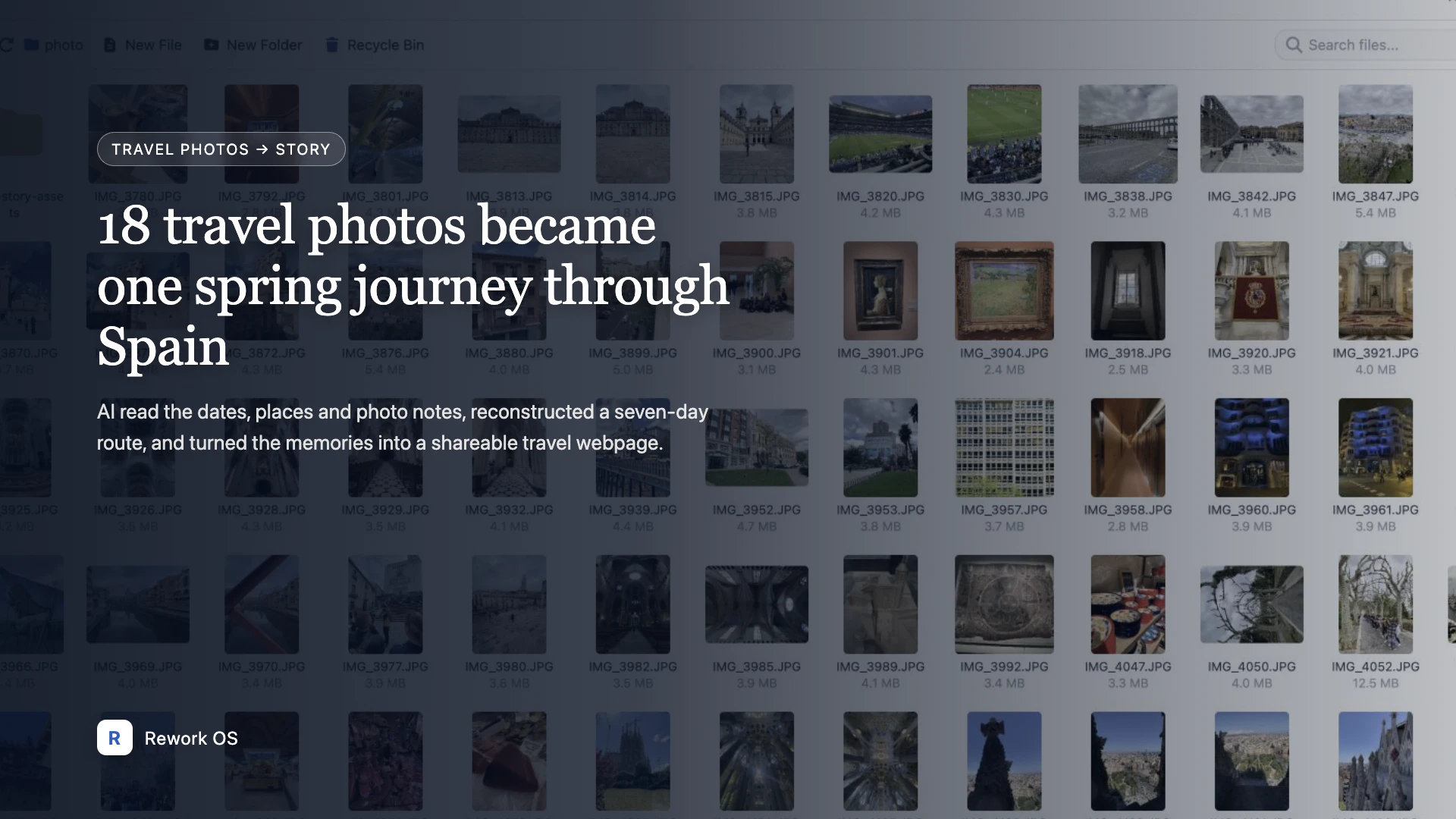
I turned 18 iPhone photos into a shareable travel story — without installing an app
Most travel photos never become a story.
They stay in a camera roll: hundreds of images, half-remembered places, and a route that becomes harder to reconstruct every year. I wanted to test a different kind of AI workflow: not asking a chatbot to invent a travel article, but giving it my actual files and asking it to recover the story already inside them.
The input was deliberately ordinary:
- 18 iPhone photos
- one spreadsheet containing dates, locations, coordinates, and photo notes
- no carefully written itinerary
- no video footage
The photos covered a seven-day spring trip through Madrid, El Escorial, Segovia, Girona, Barcelona, and Tossa de Mar.
From a folder to a narrative
I opened Rework OS in the browser and gave it the photo folder and index. There was nothing to install and no new creative tool to learn.
The AI used the timestamps and locations as a narrative skeleton. It connected the football match in Madrid, the Roman aqueduct in Segovia, the coloured houses of Girona, Gaudí's Barcelona, and the Mediterranean coast into a first-person travel story.
Instead of returning a wall of text, it generated a complete editorial webpage:
- a full-screen portrait cover
- six city chapters
- photo captions grounded in the source material
- a seven-day route overview
- a reflective ending
- all 18 photographs embedded in the final document
The useful constraint: one portable HTML file
I wanted the result to be easy to keep and share, so the final output had to be a self-contained HTML file rather than a project folder with missing assets.
The embedded photographs were resized to a maximum dimension of 1600 pixels and compressed as JPEGs before being added to the page. The final English story is about 12.4 MB and opens directly in a browser.
That constraint made the result feel like a real document, not a temporary AI preview.
What this experiment taught me
The interesting part was not that AI can write travel copy. That is easy.
The interesting part was that personal files can provide enough structure for AI to recover context:
- timestamps reveal sequence;
- locations reveal the route;
- photo descriptions reveal the memorable moments;
- the images provide the visual rhythm;
- the output can become a finished artifact instead of another chat response.
This is the direction I want to explore with Rework OS: opening a browser, working directly with real files, and producing something complete enough to send to another person.
You can try Rework OS here:
The short video shows the original photo folder and the finished English travel story.