

Kolla Ansibleとは
Kolla Ansibleは、Kollaプロジェクトから分離された成果物プロジェクトです
Kolla Ansible は、OpenStack サービスとインフラストラクチャ コンポーネントを Docker コンテナーにデプロイします。
Kolla のミッションステートメントは次のとおりです。
運用可能なコンテナとデプロイメントツールを提供する
OpenStackクラウド
Kollaは、初期状態では非常に独自の仕様になっていますが、完全なカスタマイズが可能です。これにより、経験の浅いオペレーターでもOpenStackを迅速に導入でき、経験を積むにつれて、オペレーターの正確な要件に合わせてOpenStackの設定を変更できます
ホストスペック
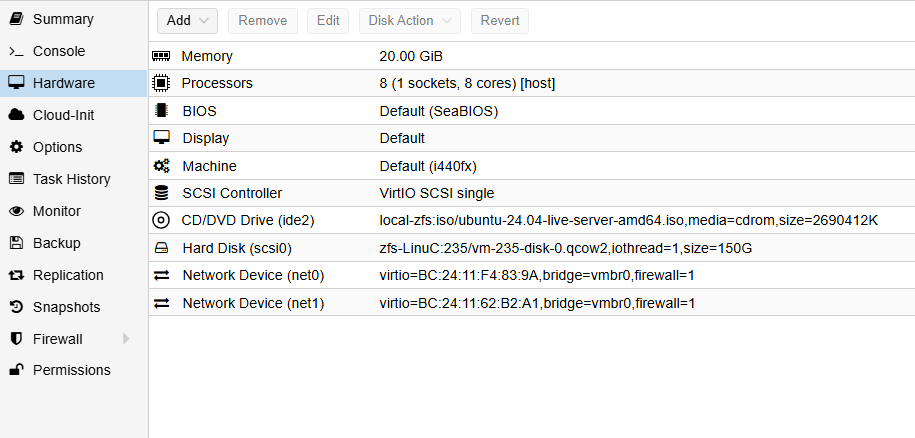
構築
OS準備とネットワーク設定(netplan)
インストール済みのアプリなりモジュールなりを最新版にします。
これを実行後、snapshotが取れる場合は取っておくといいかもしれません。
スクラップ&ビルドを繰り返す可能性もあるので。
sudo su -
apt update && apt upgrade -y
今回の環境を確認する。DHCPからネットワーク通信用の情報を取得しています。
ens18を管理用(sshやWebコンソール接続用)、ens19を外部通信用として使用します。ens19はIPアドレスを付与されている状態ではだめなので、netplanを使ってIPアドレスの付与を外します。
Linux OS自体がこのNICで通信するのではなく、OpenStackのネットワークコンポーネント(Open vSwitchなど)がこのNICをブリッジとして直接制御し、VMの通信を外部に流すために必要な処置というイメージです
ip a
2: ens18: <BROADCAST,MULTICAST,UP,LOWER_UP> mtu 1500 qdisc pfifo_fast state UP group default qlen 1000
    link/ether bc:24:11:f4:83:9a brd ff:ff:ff:ff:ff:ff
    altname enp0s18
    inet 172.18.250.75/16 metric 100 brd 172.18.255.255 scope global dynamic ens18
       valid_lft 85774sec preferred_lft 85774sec
    inet6 fd34:c6bb:656f:de65:be24:11ff:fef4:839a/64 scope global dynamic mngtmpaddr noprefixroute
       valid_lft 1591sec preferred_lft 1591sec
    inet6 fe80::be24:11ff:fef4:839a/64 scope link
       valid_lft forever preferred_lft forever
3: ens19: <BROADCAST,MULTICAST,UP,LOWER_UP> mtu 1500 qdisc pfifo_fast state UP group default qlen 1000
    link/ether bc:24:11:62:b2:a1 brd ff:ff:ff:ff:ff:ff
    altname enp0s19
    inet 172.18.250.79/16 metric 100 brd 172.18.255.255 scope global dynamic ens19
       valid_lft 85774sec preferred_lft 85774sec
    inet6 fd34:c6bb:656f:de65:be24:11ff:fe62:b2a1/64 scope global dynamic mngtmpaddr noprefixroute
       valid_lft 1591sec preferred_lft 1591sec
    inet6 fe80::be24:11ff:fe62:b2a1/64 scope link
       valid_lft forever preferred_lft forever
デフォルトゲートウェイは以下のコマンドでわかる
この場合172.18.255.254となる
ip route | grep default
default via 172.18.255.254 dev ens18 proto dhcp src 172.18.250.75 metric 100
default via 172.18.255.254 dev ens19 proto dhcp src 172.18.250.79 metric 100
/etc/netplan/配下に99-kolla-ansible-config.yamlを作成して中身を以下とする
cd /etc/netplan
vi 99-kolla-ansible-config.yaml
cat 99-kolla-ansible-config.yaml
network:
  version: 2
  renderer: networkd
  ethernets:
    # --- 管理用インターフェース (ens18) ---
    ens18:
      dhcp4: false
      dhcp6: false
      addresses:
        - 172.18.250.75/16  # 固定IP
      routes:
        - to: default
          via: 172.18.255.254  # ゲートウェイアドレス
      nameservers:
        addresses:
          - 8.8.8.8
          - 1.1.1.1
      optional: true

    # --- OpenStack外部接続用 (ens19) ---
    ens19:
      dhcp4: false
      dhcp6: false
      link-local: []
      addresses: []
      optional: true
以下のコマンドを実行して設定を反映する
netplan try
netplan apply
以下のコマンドを実行してens18と19について確認する。19からIPアドレスがはがれていることを確認する。
ip a
2: ens18: <BROADCAST,MULTICAST,UP,LOWER_UP> mtu 1500 qdisc pfifo_fast state UP group default qlen 1000
    link/ether bc:24:11:f4:83:9a brd ff:ff:ff:ff:ff:ff
    altname enp0s18
    inet 172.18.250.75/16 brd 172.18.255.255 scope global ens18
       valid_lft forever preferred_lft forever
    inet6 fe80::be24:11ff:fef4:839a/64 scope link
       valid_lft forever preferred_lft forever
3: ens19: <BROADCAST,MULTICAST,UP,LOWER_UP> mtu 1500 qdisc pfifo_fast state UP group default qlen 1000
    link/ether bc:24:11:62:b2:a1 brd ff:ff:ff:ff:ff:ff
    altname enp0s19
パッケージインストール
以下のコマンドを実行する
apt install -y git python3-dev python3-venv libffi-dev gcc libssl-dev libdbus-1-dev libglib2.0-dev pkg-config
Python仮想環境の構築
cd
python3 -m venv ~/kolla-venv
source ~/kolla-venv/bin/activate
pip install -U pip
pip install "ansible-core>=2.16,<2.18"
pip install git+https://opendev.org/openstack/kolla-ansible@stable/2024.2
kolla-ansible install-deps
pip install docker
pip install -U requests
設定ファイルの準備
mkdir -p /etc/kolla
chown $USER:$USER /etc/kolla
cp -r ~/kolla-venv/share/kolla-ansible/etc_examples/kolla/* /etc/kolla/
cp ~/kolla-venv/share/kolla-ansible/ansible/inventory/all-in-one .
vi /etc/kolla/globals.yml
# ベースOSの指定
# インストールタイプ (バイナリかソースか)
kolla_base_distro: "ubuntu"
kolla_install_type: "source" ★これはデフォルトで書いていない可能性があるので、ubuntuの下に追記しておく。

# 内部管理用VIPアドレス (ホストのIPとは別の、同一サブネット内の未使用IPを指定)
# 例: ホストが 192.168.1.10 なら 192.168.1.250 など。ens19に紐づいていた172.18.250.79を今回使用
kolla_internal_vip_address: "172.18.250.79"

# ネットワークインターフェース設定
# 管理用インターフェース (IPアドレスが設定されている側)
network_interface: "ens18"

# 外部接続用インターフェース (IPアドレスを設定していない側)
neutron_external_interface: "ens19"

# Neutronプラグインの有効化 (通常は "yes")
enable_neutron_provider_networks: "yes"
以下のコマンドを使ってOpenstackで使用するパスワード群を一括で作成する
kolla-genpwd
grep keystone_admin_password /etc/kolla/passwords.yml
keystone_admin_password: 04BVMV3qVXF6SWSbilL9I8Du0XWWH1eHWMM9CKyZ(これの出力結果がマネジメントコンソールのパスワード)
デプロイ
Bootstrap Servers: ホストOSにDockerなどをインストールします。
kolla-ansible bootstrap-servers -i all-in-one
Prechecks: 設定や状態のチェック
# ここで失敗しがちなので改めてパッケージをインストールする。dbus-pythonだけでよさそうだけど・・・
apt install -y libdbus-1-dev libglib2.0-dev pkg-config gcc
pip install dbus-python

kolla-ansible prechecks -i all-in-one
Deploy: OpenStackコンテナの展開。(1時間くらいはかかる)
kolla-ansible deploy -i all-in-one
コンテナを確認してみる。
docker ps
CONTAINER ID   IMAGE                                                                   COMMAND                  CREATED              STATUS                             PORTS     NAMES
35b4796b3368   quay.io/openstack.kolla/horizon:2024.2-ubuntu-noble                     "dumb-init --single-…"   33 seconds ago       Up 10 seconds (health: starting)             horizon
b1356b732490   quay.io/openstack.kolla/heat-engine:2024.2-ubuntu-noble                 "dumb-init --single-…"   About a minute ago   Up About a minute (healthy)                  heat_engine
25e76721faec   quay.io/openstack.kolla/heat-api-cfn:2024.2-ubuntu-noble                "dumb-init --single-…"   About a minute ago   Up About a minute (healthy)                  heat_api_cfn
4f13f40a6d5b   quay.io/openstack.kolla/heat-api:2024.2-ubuntu-noble                    "dumb-init --single-…"   About a minute ago   Up About a minute (healthy)                  heat_api
a3c6400264c5   quay.io/openstack.kolla/neutron-metadata-agent:2024.2-ubuntu-noble      "dumb-init --single-…"   4 minutes ago        Up 4 minutes (healthy)                       neutron_metadata_agent
77c5d56bb132   quay.io/openstack.kolla/neutron-l3-agent:2024.2-ubuntu-noble            "dumb-init --single-…"   5 minutes ago        Up 5 minutes (healthy)                       neutron_l3_agent
f87c6538e7a5   quay.io/openstack.kolla/neutron-dhcp-agent:2024.2-ubuntu-noble          "dumb-init --single-…"   5 minutes ago        Up 5 minutes (healthy)                       neutron_dhcp_agent
2897f5678736   quay.io/openstack.kolla/neutron-openvswitch-agent:2024.2-ubuntu-noble   "dumb-init --single-…"   5 minutes ago        Up 5 minutes (healthy)                       neutron_openvswitch_agent
535a928d66b2   quay.io/openstack.kolla/neutron-server:2024.2-ubuntu-noble              "dumb-init --single-…"   6 minutes ago        Up 6 minutes (healthy)                       neutron_server
ed3baa69466c   quay.io/openstack.kolla/nova-compute:2024.2-ubuntu-noble                "dumb-init --single-…"   13 minutes ago       Up 12 minutes (healthy)                      nova_compute
acc2587b8ffb   quay.io/openstack.kolla/nova-libvirt:2024.2-ubuntu-noble                "dumb-init --single-…"   14 minutes ago       Up 13 minutes (healthy)                      nova_libvirt
f0910f45de8e   quay.io/openstack.kolla/nova-ssh:2024.2-ubuntu-noble                    "dumb-init --single-…"   15 minutes ago       Up 15 minutes (healthy)                      nova_ssh
0c6ed63e9228   quay.io/openstack.kolla/nova-novncproxy:2024.2-ubuntu-noble             "dumb-init --single-…"   15 minutes ago       Up 15 minutes (healthy)                      nova_novncproxy
a766d806dbd8   quay.io/openstack.kolla/nova-conductor:2024.2-ubuntu-noble              "dumb-init --single-…"   16 minutes ago       Up 16 minutes (healthy)                      nova_conductor
4ccaa241e43e   quay.io/openstack.kolla/nova-api:2024.2-ubuntu-noble                    "dumb-init --single-…"   17 minutes ago       Up 17 minutes (healthy)                      nova_api
ad8e1615051f   quay.io/openstack.kolla/nova-scheduler:2024.2-ubuntu-noble              "dumb-init --single-…"   17 minutes ago       Up 17 minutes (healthy)                      nova_scheduler
fae0cf76971c   quay.io/openstack.kolla/openvswitch-vswitchd:2024.2-ubuntu-noble        "dumb-init --single-…"   24 minutes ago       Up 24 minutes (healthy)                      openvswitch_vswitchd
92fcad2af76f   quay.io/openstack.kolla/openvswitch-db-server:2024.2-ubuntu-noble       "dumb-init --single-…"   24 minutes ago       Up 24 minutes (healthy)                      openvswitch_db
46cbaf084e8c   quay.io/openstack.kolla/placement-api:2024.2-ubuntu-noble               "dumb-init --single-…"   25 minutes ago       Up 25 minutes (healthy)                      placement_api
4e04d54101e4   quay.io/openstack.kolla/glance-api:2024.2-ubuntu-noble                  "dumb-init --single-…"   26 minutes ago       Up 26 minutes (healthy)                      glance_api
307547b87d97   quay.io/openstack.kolla/keystone:2024.2-ubuntu-noble                    "dumb-init --single-…"   30 minutes ago       Up 30 minutes (healthy)                      keystone
1e271101cb4b   quay.io/openstack.kolla/keystone-fernet:2024.2-ubuntu-noble             "dumb-init --single-…"   30 minutes ago       Up 30 minutes (healthy)                      keystone_fernet
a13840f7f793   quay.io/openstack.kolla/keystone-ssh:2024.2-ubuntu-noble                "dumb-init --single-…"   30 minutes ago       Up 30 minutes (healthy)                      keystone_ssh
0499f37af290   quay.io/openstack.kolla/rabbitmq:2024.2-ubuntu-noble                    "dumb-init --single-…"   34 minutes ago       Up 34 minutes (healthy)                      rabbitmq
31a660a61323   quay.io/openstack.kolla/memcached:2024.2-ubuntu-noble                   "dumb-init --single-…"   35 minutes ago       Up 35 minutes (healthy)                      memcached
4618d2db5e0c   quay.io/openstack.kolla/mariadb-server:2024.2-ubuntu-noble              "dumb-init -- kolla_…"   35 minutes ago       Up 35 minutes (healthy)                      mariadb
e928f90b2d09   quay.io/openstack.kolla/keepalived:2024.2-ubuntu-noble                  "dumb-init --single-…"   37 minutes ago       Up 37 minutes                                keepalived
1e0f2a17d7c0   quay.io/openstack.kolla/proxysql:2024.2-ubuntu-noble                    "dumb-init --single-…"   37 minutes ago       Up 37 minutes (healthy)                      proxysql
bc2c3ca5b12d   quay.io/openstack.kolla/haproxy:2024.2-ubuntu-noble                     "dumb-init --single-…"   38 minutes ago       Up 38 minutes (healthy)                      haproxy
b1e316de2e6f   quay.io/openstack.kolla/cron:2024.2-ubuntu-noble                        "dumb-init --single-…"   40 minutes ago       Up 40 minutes                                cron
ef2a7dcb9013   quay.io/openstack.kolla/kolla-toolbox:2024.2-ubuntu-noble               "dumb-init --single-…"   41 minutes ago       Up 40 minutes                                kolla_toolbox
6a80677edb3a   quay.io/openstack.kolla/fluentd:2024.2-ubuntu-noble                     "dumb-init --single-…"   42 minutes ago       Up 42 minutes                                fluentd
デプロイされているものは以下。
| カテゴリ | サービス名 | コンテナ名 | 役割・説明 |
|---|---|---|---|
| Dashboard | Horizon | horizon |
OpenStackのWeb管理画面(ダッシュボード)。ブラウザからの操作を提供。 |
| Compute | Nova | nova-api |
Compute APIサービス。外部からのVM操作リクエストを受け付ける。 |
nova-scheduler |
新しいVMをどのホストで起動するかを決定する。 | ||
nova-conductor |
データベースへのアクセスや複雑なタスクの調整を行う。 | ||
nova-compute |
実際に仮想マシン(VM)のライフサイクル管理を行う。 | ||
nova-libvirt |
仮想化ハイパーバイザー(KVM/QEMU)を制御するドライバー。 | ||
nova-novncproxy |
ブラウザからVMのコンソール画面(VNC)を表示するためのプロキシ。 | ||
nova-ssh |
コンピュートノード間のマイグレーション等で使用されるSSHサービス。 | ||
| Placement | placement-api |
コンピュートリソース(CPU, メモリ等)の在庫管理を行う。 | |
| Network | Neutron | neutron-server |
Network APIサービス。ネットワーク設定の窓口。 |
neutron-l3-agent |
仮想ルーター機能(L3)を提供し、外部ネットワークとのルーティングを行う。 | ||
neutron-dhcp-agent |
仮想マシンにIPアドレスを配布するDHCPサーバー機能。 | ||
neutron-metadata-agent |
仮想マシンへクラウド初期化情報(メタデータ)を提供するプロキシ。 | ||
neutron-openvswitch-agent |
Open vSwitchを制御し、ネットワーク接続を確立するエージェント。 | ||
| Open vSwitch | openvswitch-vswitchd |
仮想スイッチのデーモンプロセス。パケット転送を行う。 | |
openvswitch-db-server |
仮想スイッチの設定情報を管理するデータベースサーバー。 | ||
| Identity | Keystone | keystone |
認証・認可サービス。ユーザー管理やサービスカタログを提供する。 |
keystone-fernet |
トークン生成のための鍵管理を行う。 | ||
keystone-ssh |
Keystone設定同期などの管理タスク用SSH。 | ||
| Image | Glance | glance-api |
OSイメージ(ISOやqcow2など)の保存・取得・管理を行うAPI。 |
| Orchestration | Heat | heat-api |
Orchestration APIサービス。テンプレートによる自動構築リクエストを受け付ける。 |
heat-api-cfn |
AWS CloudFormation互換のAPIエンドポイント。 | ||
heat-engine |
テンプレートを解析し、実際にリソースを作成する実行エンジン。 | ||
| Infrastructure | Database | mariadb-server |
OpenStack全体の情報を保存するデータベース(MySQL互換)。 |
| Messaging | rabbitmq |
サービス間通信を行うためのメッセージキュー。 | |
| Caching | memcached |
認証トークンやWebセッション情報をキャッシュして高速化する。 | |
| Load Balancer | haproxy |
各サービスへのアクセスを分散・中継するロードバランサー。 | |
| High Availability | keepalived |
VIP(仮想IPアドレス)を管理し、HAProxyの冗長化を行う。 | |
| DB Proxy | proxysql |
データベースへのクエリを中継・分散するプロキシ。 | |
| Logging | fluentd |
各コンテナのログを収集・集約する。 | |
| Tools | kolla-toolbox |
Ansible実行時に使用される管理用ツールセットを含むコンテナ。 | |
cron |
ログローテーションなどの定期実行タスクを管理する。 |
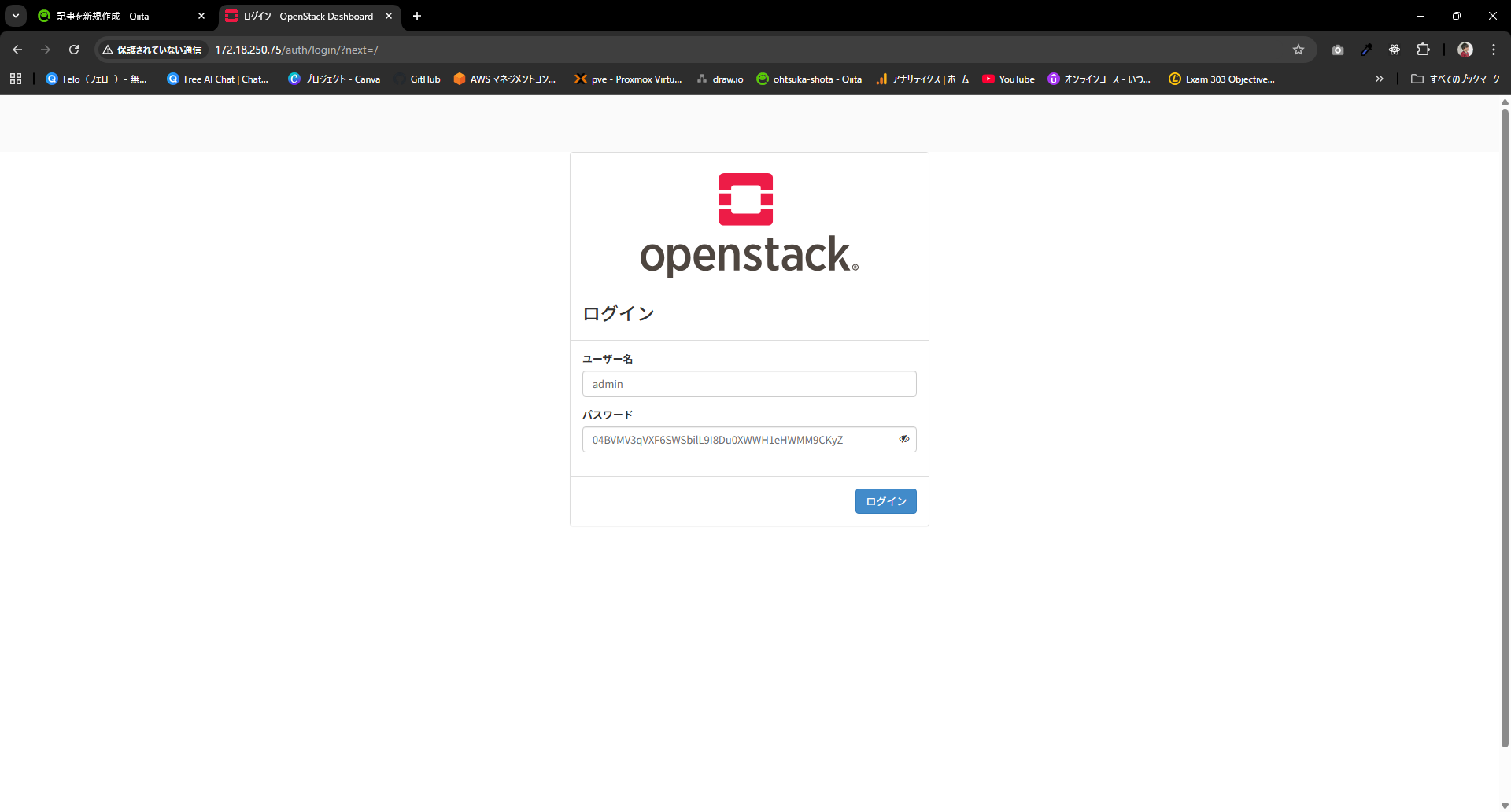
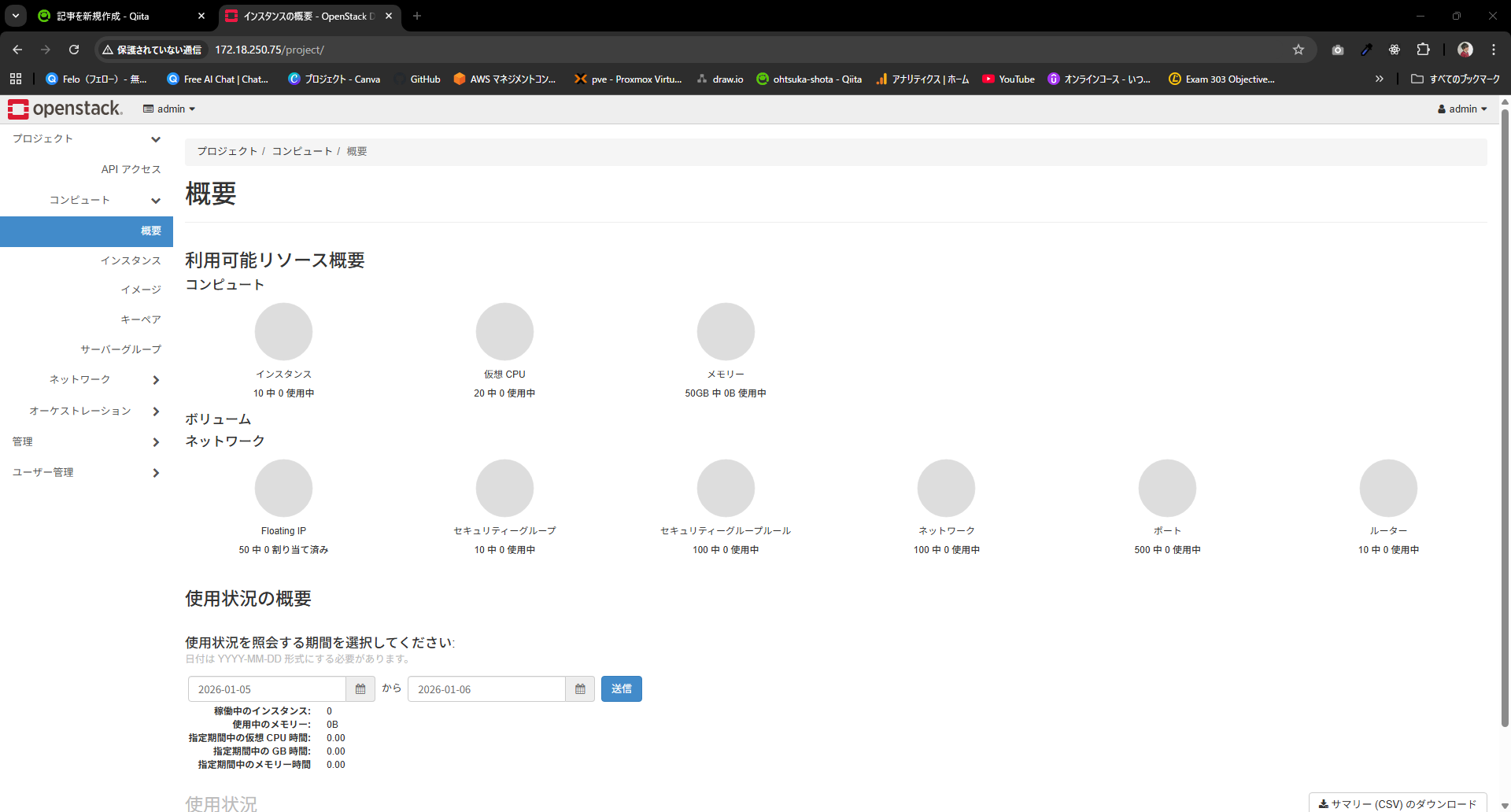
デプロイができたらhttp://管理用のIPアドレスでマネジメントコンソールにアクセスできる。
ユーザはadmin。パスワードは先ほど確認したもの。
CLIでOpenstackを操作できるように、以下のコマンドでインストールします。
source kolla-venv/bin/activate
pip install python-openstackclient python-glanceclient python-neutronclient python-novaclient
以下のコマンドを実行して、コマンドで操作するための設定を完了します。
1つ目は1回行えば以降は不要。2つ目は操作のタイミングで必要になるようです。
kolla-ansible post-deploy -i /root/kolla-venv/share/kolla-ansible/ansible/inventory/all-in-one
source /etc/kolla/admin-openrc.sh
openstackコマンドを実行して、出力があることを確認します。
(kolla-venv) root@allinone-openstack:~# openstack service list
+----------------------------------+-----------+----------------+
| ID                               | Name      | Type           |
+----------------------------------+-----------+----------------+
| 1101fd30dd264e0e8a2447374618504b | neutron   | network        |
| 35de3717e82b4aa4be2eaf56de30f74c | heat-cfn  | cloudformation |
| 62c02287781444e7ab7a01c203961b7c | keystone  | identity       |
| 69bc0eddab9a43b2bc32554471e69e7d | glance    | image          |
| 8bb8dd6351dc47598da453387f5e0947 | heat      | orchestration  |
| b73480cfeb9b4735a4a013764c71b149 | placement | placement      |
| e665696b467e48fbb0e5fd9e344f54e2 | nova      | compute        |
+----------------------------------+-----------+----------------+
【おまけ】globals.ymlの全量
---
# You can use this file to override _any_ variable throughout Kolla.
# Additional options can be found in the
# 'kolla-ansible/ansible/group_vars/all.yml' file. Default value of all the
# commented parameters are shown here, To override the default value uncomment
# the parameter and change its value.

###################
# Ansible options
###################

# This variable is used as the "filter" argument for the setup module.  For
# instance, if one wants to remove/ignore all Neutron interface facts:
# kolla_ansible_setup_filter: "ansible_[!qt]*"
# By default, we do not provide a filter.
#kolla_ansible_setup_filter: "{{ omit }}"

# This variable is used as the "gather_subset" argument for the setup module.
# For instance, if one wants to avoid collecting facts via facter:
# kolla_ansible_setup_gather_subset: "all,!facter"
# By default, we do not provide a gather subset.
#kolla_ansible_setup_gather_subset: "{{ omit }}"

# Dummy variable to allow Ansible to accept this file.
workaround_ansible_issue_8743: yes

# This variable may be used to set the maximum failure percentage for all
# plays. More fine-grained control is possible via per-service variables, e.g.
# nova_max_fail_percentage. The default behaviour is to set a max fail
# percentage of 100, which is equivalent to not setting it.
#kolla_max_fail_percentage:

###############
# Kolla options
###############
# Valid options are [ COPY_ONCE, COPY_ALWAYS ]
#config_strategy: "COPY_ALWAYS"

# Valid options are ['centos', 'debian', 'rocky', 'ubuntu']
kolla_base_distro: "ubuntu"
kolla_install_type: "source"

# Do not override this unless you know what you are doing.
#openstack_release: "2024.2"

# Docker image tag used by default.
#openstack_tag: "{{ openstack_release ~ openstack_tag_suffix }}"

# Suffix applied to openstack_release to generate openstack_tag.
#openstack_tag_suffix: ""

# Location of configuration overrides
#node_custom_config: "{{ node_config }}/config"

# This should be a VIP, an unused IP on your network that will float between
# the hosts running keepalived for high-availability. If you want to run an
# All-In-One without haproxy and keepalived, you can set enable_haproxy to no
# in "OpenStack options" section, and set this value to the IP of your
# 'network_interface' as set in the Networking section below.
kolla_internal_vip_address: "172.18.250.79"

# This is the DNS name that maps to the kolla_internal_vip_address VIP. By
# default it is the same as kolla_internal_vip_address.
#kolla_internal_fqdn: "{{ kolla_internal_vip_address }}"

# This should be a VIP, an unused IP on your network that will float between
# the hosts running keepalived for high-availability. It defaults to the
# kolla_internal_vip_address, allowing internal and external communication to
# share the same address.  Specify a kolla_external_vip_address to separate
# internal and external requests between two VIPs.
#kolla_external_vip_address: "{{ kolla_internal_vip_address }}"

# The Public address used to communicate with OpenStack as set in the public_url
# for the endpoints that will be created. This DNS name should map to
# kolla_external_vip_address.
#kolla_external_fqdn: "{{ kolla_external_vip_address }}"

# Optionally change the path to sysctl.conf modified by Kolla Ansible plays.
#kolla_sysctl_conf_path: /etc/sysctl.conf

##################
# Container engine
##################

# Valid options are [ docker, podman ]
#kolla_container_engine: docker


################
# Docker options
################

# Custom docker registry settings:
#docker_registry:
# Please read the docs carefully before applying docker_registry_insecure.
#docker_registry_insecure: "no"
#docker_registry_username:
# docker_registry_password is set in the passwords.yml file.

# Namespace of images:
#docker_namespace: "kolla"

# Docker client timeout in seconds.
#docker_client_timeout: 120

#docker_configure_for_zun: "no"
#containerd_configure_for_zun: "no"
#containerd_grpc_gid: 42463

###################
# Messaging options
###################
# Whether to enable TLS for oslo.messaging communication with RabbitMQ.
#om_enable_rabbitmq_tls: "{{ rabbitmq_enable_tls | bool }}"
# CA certificate bundle in containers using oslo.messaging with RabbitMQ TLS.
#om_rabbitmq_cacert: "{{ rabbitmq_cacert }}"

##############################
# Neutron - Networking Options
##############################
# This interface is what all your api services will be bound to by default.
# Additionally, all vxlan/tunnel and storage network traffic will go over this
# interface by default. This interface must contain an IP address.
# It is possible for hosts to have non-matching names of interfaces - these can
# be set in an inventory file per host or per group or stored separately, see
#     http://docs.ansible.com/ansible/latest/intro_inventory.html
# Yet another way to workaround the naming problem is to create a bond for the
# interface on all hosts and give the bond name here. Similar strategy can be
# followed for other types of interfaces.
network_interface: "ens18"

# These can be adjusted for even more customization. The default is the same as
# the 'network_interface'. These interfaces must contain an IP address.
#kolla_external_vip_interface: "{{ network_interface }}"
#api_interface: "{{ network_interface }}"
#swift_storage_interface: "{{ network_interface }}"
#swift_replication_interface: "{{ swift_storage_interface }}"
#tunnel_interface: "{{ network_interface }}"
#dns_interface: "{{ network_interface }}"
#octavia_network_interface: "{{ api_interface }}"

# Configure the address family (AF) per network.
# Valid options are [ ipv4, ipv6 ]
#network_address_family: "ipv4"
#api_address_family: "{{ network_address_family }}"
#storage_address_family: "{{ network_address_family }}"
#swift_storage_address_family: "{{ storage_address_family }}"
#swift_replication_address_family: "{{ swift_storage_address_family }}"
#migration_address_family: "{{ api_address_family }}"
#tunnel_address_family: "{{ network_address_family }}"
#octavia_network_address_family: "{{ api_address_family }}"
#bifrost_network_address_family: "{{ network_address_family }}"
#dns_address_family: "{{ network_address_family }}"

# This is the raw interface given to neutron as its external network port. Even
# though an IP address can exist on this interface, it will be unusable in most
# configurations. It is recommended this interface not be configured with any IP
# addresses for that reason.
neutron_external_interface: "ens19"

# Valid options are [ openvswitch, ovn, linuxbridge, vmware_nsxv, vmware_nsxv3, vmware_nsxp, vmware_dvs ]
# if vmware_nsxv3 or vmware_nsxp is selected, enable_openvswitch MUST be set to "no" (default is yes)
# Do note linuxbridge is *EXPERIMENTAL* in Neutron since Zed and it requires extra tweaks to config to be usable.
# For details, see: https://docs.openstack.org/neutron/latest/admin/config-experimental-framework.html
#neutron_plugin_agent: "openvswitch"

# Valid options are [ internal, infoblox ]
#neutron_ipam_driver: "internal"

# Configure Neutron upgrade option, currently Kolla support
# two upgrade ways for Neutron: legacy_upgrade and rolling_upgrade
# The variable "neutron_enable_rolling_upgrade: yes" is meaning rolling_upgrade
# were enabled and opposite
# Neutron rolling upgrade were enable by default
#neutron_enable_rolling_upgrade: "yes"

# Configure neutron logging framework to log ingress/egress connections to instances
# for security groups rules. More information can be found here:
# https://docs.openstack.org/neutron/latest/admin/config-logging.html
#enable_neutron_packet_logging: "no"

####################
# keepalived options
####################
# Arbitrary unique number from 0..255
# This should be changed from the default in the event of a multi-region deployment
# where the VIPs of different regions reside on a common subnet.
#keepalived_virtual_router_id: "51"

###################
# Dimension options
###################
# This is to provide an extra option to deploy containers with Resource constraints.
# We call it dimensions here.
# The dimensions for each container are defined by a mapping, where each dimension value should be a
# string.
# Reference_Docs
# https://docs.docker.com/config/containers/resource_constraints/
# eg:
# <container_name>_dimensions:
#    blkio_weight:
#    cpu_period:
#    cpu_quota:
#    cpu_shares:
#    cpuset_cpus:
#    cpuset_mems:
#    mem_limit:
#    mem_reservation:
#    memswap_limit:
#    kernel_memory:
#    ulimits:

#####################
# Healthcheck options
#####################
#enable_container_healthchecks: "yes"
# Healthcheck options for Docker containers
# interval/timeout/start_period are in seconds
#default_container_healthcheck_interval: 30
#default_container_healthcheck_timeout: 30
#default_container_healthcheck_retries: 3
#default_container_healthcheck_start_period: 5

##################
# Firewall options
##################
# Configures firewalld on both ubuntu and centos systems
# for enabled services.
# firewalld should be installed beforehand.
# disable_firewall: "true"
# enable_external_api_firewalld: "false"
# external_api_firewalld_zone: "public"

#############
# TLS options
#############
# To provide encryption and authentication on the kolla_external_vip_interface,
# TLS can be enabled.  When TLS is enabled, certificates must be provided to
# allow clients to perform authentication.
#kolla_enable_tls_internal: "no"
#kolla_enable_tls_external: "{{ kolla_enable_tls_internal if kolla_same_external_internal_vip | bool else 'no' }}"
#kolla_certificates_dir: "{{ node_config }}/certificates"
#kolla_external_fqdn_cert: "{{ kolla_certificates_dir }}/haproxy.pem"
#kolla_internal_fqdn_cert: "{{ kolla_certificates_dir }}/haproxy-internal.pem"
#kolla_admin_openrc_cacert: ""
#kolla_copy_ca_into_containers: "no"
#haproxy_backend_cacert: "{{ 'ca-certificates.crt' if kolla_base_distro in ['debian', 'ubuntu'] else 'ca-bundle.trust.crt' }}"
#haproxy_backend_cacert_dir: "/etc/ssl/certs"
#database_enable_tls_backend: "{{ 'yes' if kolla_enable_tls_backend | bool and enable_proxysql | bool else 'no' }}"
##################
# Backend options
##################
#kolla_httpd_keep_alive: "60"
#kolla_httpd_timeout: "60"

#####################
# Backend TLS options
#####################
#kolla_enable_tls_backend: "no"
#kolla_verify_tls_backend: "yes"
#kolla_tls_backend_cert: "{{ kolla_certificates_dir }}/backend-cert.pem"
#kolla_tls_backend_key: "{{ kolla_certificates_dir }}/backend-key.pem"

#####################
# ACME client options
#####################
# A list of haproxy backend server directives pointing to addresses used by the
# ACME client to complete http-01 challenge.
# Please read the docs for more details.
#acme_client_servers: []

####################
# LetsEncrypt options
####################
# This option is required for letsencrypt role to work properly.
#letsencrypt_email: ""

####################
# LetsEncrypt certificate server options
####################
#letsencrypt_cert_server: "https://acme-v02.api.letsencrypt.org/directory"
# attempt to renew Let's Encrypt certificate every 12 hours
#letsencrypt_cron_renew_schedule:  "0   */12   *   *   *"

################
# Region options
################
# Use this option to change the name of this region.
#openstack_region_name: "RegionOne"

# Use this option to define a list of region names - only needs to be configured
# in a multi-region deployment, and then only in the *first* region.
#multiple_regions_names: ["{{ openstack_region_name }}"]

###################
# OpenStack options
###################
# Use these options to set the various log levels across all OpenStack projects
# Valid options are [ True, False ]
#openstack_logging_debug: "False"

# Enable core OpenStack services. This includes:
# glance, keystone, neutron, nova, heat, and horizon.
#enable_openstack_core: "yes"

# These roles are required for Kolla to be operation, however a savvy deployer
# could disable some of these required roles and run their own services.
#enable_glance: "{{ enable_openstack_core | bool }}"
#enable_hacluster: "no"
#enable_haproxy: "yes"
#enable_keepalived: "{{ enable_haproxy | bool }}"
#enable_keystone: "{{ enable_openstack_core | bool }}"
#enable_mariadb: "yes"
#enable_memcached: "yes"
#enable_neutron: "{{ enable_openstack_core | bool }}"
#enable_nova: "{{ enable_openstack_core | bool }}"
#enable_rabbitmq: "{{ 'yes' if om_rpc_transport == 'rabbit' or om_notify_transport == 'rabbit' else 'no' }}"

# OpenStack services can be enabled or disabled with these options
#enable_aodh: "no"
#enable_barbican: "no"
#enable_blazar: "no"
#enable_ceilometer: "no"
#enable_ceilometer_ipmi: "no"
#enable_cells: "no"
#enable_central_logging: "no"
#enable_ceph_rgw: "no"
#enable_ceph_rgw_loadbalancer: "{{ enable_ceph_rgw | bool }}"
#enable_cinder: "no"
#enable_cinder_backup: "yes"
#enable_cinder_backend_iscsi: "{{ enable_cinder_backend_lvm | bool }}"
#enable_cinder_backend_lvm: "no"
#enable_cinder_backend_nfs: "no"
#enable_cinder_backend_quobyte: "no"
#enable_cinder_backend_pure_iscsi: "no"
#enable_cinder_backend_pure_fc: "no"
#enable_cinder_backend_pure_roce: "no"
#enable_cinder_backend_pure_nvme_tcp: "no"
#enable_cloudkitty: "no"
#enable_collectd: "no"
#enable_cyborg: "no"
#enable_designate: "no"
#enable_destroy_images: "no"
#enable_etcd: "no"
#enable_fluentd: "yes"
#enable_fluentd_systemd: "{{ (enable_fluentd | bool) and (enable_central_logging | bool) }}"
#enable_gnocchi: "no"
#enable_gnocchi_statsd: "no"
#enable_grafana: "no"
#enable_grafana_external: "{{ enable_grafana | bool }}"
#enable_heat: "{{ enable_openstack_core | bool }}"
#enable_horizon: "{{ enable_openstack_core | bool }}"
#enable_horizon_blazar: "{{ enable_blazar | bool }}"
#enable_horizon_cloudkitty: "{{ enable_cloudkitty | bool }}"
#enable_horizon_designate: "{{ enable_designate | bool }}"
#enable_horizon_fwaas: "{{ enable_neutron_fwaas | bool }}"
#enable_horizon_heat: "{{ enable_heat | bool }}"
#enable_horizon_ironic: "{{ enable_ironic | bool }}"
#enable_horizon_magnum: "{{ enable_magnum | bool }}"
#enable_horizon_manila: "{{ enable_manila | bool }}"
#enable_horizon_masakari: "{{ enable_masakari | bool }}"
#enable_horizon_mistral: "{{ enable_mistral | bool }}"
#enable_horizon_neutron_vpnaas: "{{ enable_neutron_vpnaas | bool }}"
#enable_horizon_octavia: "{{ enable_octavia | bool }}"
#enable_horizon_tacker: "{{ enable_tacker | bool }}"
#enable_horizon_trove: "{{ enable_trove | bool }}"
#enable_horizon_watcher: "{{ enable_watcher | bool }}"
#enable_horizon_zun: "{{ enable_zun | bool }}"
#enable_influxdb: "{{ enable_cloudkitty | bool and cloudkitty_storage_backend == 'influxdb' }}"
#enable_ironic: "no"
#enable_ironic_neutron_agent: "{{ enable_neutron | bool and enable_ironic | bool }}"
#enable_ironic_prometheus_exporter: "{{ enable_ironic | bool and enable_prometheus | bool }}"
#enable_iscsid: "{{ enable_cinder | bool and enable_cinder_backend_iscsi | bool }}"
#enable_kuryr: "no"
#enable_magnum: "no"
#enable_manila: "no"
#enable_manila_backend_generic: "no"
#enable_manila_backend_hnas: "no"
#enable_manila_backend_cephfs_native: "no"
#enable_manila_backend_cephfs_nfs: "no"
#enable_manila_backend_glusterfs_nfs: "no"
#enable_mariabackup: "no"
#enable_masakari: "no"
#enable_mistral: "no"
#enable_multipathd: "no"
#enable_neutron_vpnaas: "no"
#enable_neutron_sriov: "no"
#enable_neutron_dvr: "no"
#enable_neutron_fwaas: "no"
#enable_neutron_qos: "no"
#enable_neutron_agent_ha: "no"
#enable_neutron_bgp_dragent: "no"
enable_neutron_provider_networks: "yes"
#enable_neutron_segments: "no"
#enable_neutron_sfc: "no"
#enable_neutron_trunk: "no"
#enable_neutron_metering: "no"
#enable_neutron_infoblox_ipam_agent: "no"
#enable_neutron_port_forwarding: "no"
#enable_nova_serialconsole_proxy: "no"
#enable_nova_ssh: "yes"
#enable_octavia: "no"
#enable_octavia_driver_agent: "{{ enable_octavia | bool and neutron_plugin_agent == 'ovn' }}"
#enable_octavia_jobboard: "{{ enable_octavia | bool and 'amphora' in octavia_provider_drivers }}"
#enable_opensearch: "{{ enable_central_logging | bool or enable_osprofiler | bool or (enable_cloudkitty | bool and cloudkitty_storage_backend == 'opensearch') }}"
#enable_opensearch_dashboards: "{{ enable_opensearch | bool }}"
#enable_opensearch_dashboards_external: "{{ enable_opensearch_dashboards | bool }}"
#enable_openvswitch: "{{ enable_neutron | bool and neutron_plugin_agent != 'linuxbridge' }}"
#enable_ovn: "{{ enable_neutron | bool and neutron_plugin_agent == 'ovn' }}"
#enable_ovs_dpdk: "no"
#enable_osprofiler: "no"
#enable_placement: "{{ enable_nova | bool or enable_zun | bool }}"
#enable_prometheus: "no"
#enable_proxysql: "yes"
#enable_redis: "no"
#enable_skyline: "no"
#enable_swift: "no"
#enable_swift_s3api: "no"
#enable_tacker: "no"
#enable_telegraf: "no"
#enable_trove: "no"
#enable_trove_singletenant: "no"
#enable_venus: "no"
#enable_watcher: "no"
#enable_zun: "no"

#############
# S3 options
#############
# Common options for S3 Cinder Backup and Glance S3 backend.
#s3_url:
#s3_bucket:
#s3_access_key:
#s3_secret_key:

##################
# RabbitMQ options
##################
# Options passed to RabbitMQ server startup script via the
# RABBITMQ_SERVER_ADDITIONAL_ERL_ARGS environment var.
# See Kolla Ansible docs RabbitMQ section for details.
# These are appended to args already provided by Kolla Ansible
# to configure IPv6 in RabbitMQ server.
# More details can be found in the RabbitMQ docs:
# https://www.rabbitmq.com/runtime.html#scheduling
# https://www.rabbitmq.com/runtime.html#busy-waiting
# The default tells RabbitMQ to always use two cores (+S 2:2),
# and not to busy wait (+sbwt none +sbwtdcpu none +sbwtdio none):
#rabbitmq_server_additional_erl_args: "+S 2:2 +sbwt none +sbwtdcpu none +sbwtdio none"
# Whether to enable TLS encryption for RabbitMQ client-server communication.
#rabbitmq_enable_tls: "no"
# CA certificate bundle in RabbitMQ container.
#rabbitmq_cacert: "/etc/ssl/certs/{{ 'ca-certificates.crt' if kolla_base_distro in ['debian', 'ubuntu'] else 'ca-bundle.trust.crt' }}"

#################
# MariaDB options
#################
# List of additional WSREP options
#mariadb_wsrep_extra_provider_options: []

#######################
# External Ceph options
#######################
# External Ceph - cephx auth enabled (this is the standard nowadays, defaults to yes)
#external_ceph_cephx_enabled: "yes"

# Glance
#ceph_glance_user: "glance"
#ceph_glance_keyring: "client.{{ ceph_glance_user }}.keyring"
#ceph_glance_pool_name: "images"
# Cinder
#ceph_cinder_user: "cinder"
#ceph_cinder_keyring: "client.{{ ceph_cinder_user }}.keyring"
#ceph_cinder_pool_name: "volumes"
#ceph_cinder_backup_user: "cinder-backup"
#ceph_cinder_backup_keyring: "client.{{ ceph_cinder_backup_user }}.keyring"
#ceph_cinder_backup_pool_name: "backups"
# Nova
#ceph_nova_keyring: "{{ ceph_cinder_keyring }}"
#ceph_nova_user: "{{ ceph_cinder_user }}"
#ceph_nova_pool_name: "vms"
# Gnocchi
#ceph_gnocchi_user: "gnocchi"
#ceph_gnocchi_keyring: "client.{{ ceph_gnocchi_user }}.keyring"
#ceph_gnocchi_pool_name: "gnocchi"
# Manila
#ceph_manila_user: "manila"
#ceph_manila_keyring: "client.{{ ceph_manila_user }}.keyring"

#############################
# Keystone - Identity Options
#############################

#keystone_admin_user: "admin"

#keystone_admin_project: "admin"

# Interval to rotate fernet keys by (in seconds). Must be an interval of
# 60(1 min), 120(2 min), 180(3 min), 240(4 min), 300(5 min), 360(6 min),
# 600(10 min), 720(12 min), 900(15 min), 1200(20 min), 1800(30 min),
# 3600(1 hour), 7200(2 hour), 10800(3 hour), 14400(4 hour), 21600(6 hour),
# 28800(8 hour), 43200(12 hour), 86400(1 day), 604800(1 week).
#fernet_token_expiry: 86400

# Whether or not to apply changes to service user passwords when services are
# reconfigured
#update_keystone_service_user_passwords: "true"

########################
# Glance - Image Options
########################
# Configure image backend.
#glance_backend_ceph: "no"
#glance_backend_file: "yes"
#glance_backend_swift: "no"
#glance_backend_vmware: "no"
#glance_backend_s3: "no"
#enable_glance_image_cache: "no"
#glance_enable_property_protection: "no"
#glance_enable_interoperable_image_import: "no"
# Configure glance upgrade option.
# Due to this feature being experimental in glance,
# the default value is "no".
#glance_enable_rolling_upgrade: "no"

####################
# Glance S3 Backend
####################
#glance_backend_s3_url: "{{ s3_url }}"
#glance_backend_s3_bucket: "{{ s3_bucket }}"
#glance_backend_s3_access_key: "{{ s3_access_key }}"
#glance_backend_s3_secret_key: "{{ s3_secret_key }}"

####################
# Osprofiler options
####################
# valid values: ["elasticsearch", "redis"]
#osprofiler_backend: "elasticsearch"

##################
# Barbican options
##################
# Valid options are [ simple_crypto, p11_crypto ]
#barbican_crypto_plugin: "simple_crypto"
#barbican_library_path: "/usr/lib/libCryptoki2_64.so"

#################
# Gnocchi options
#################
# Valid options are [ file, ceph, swift ]
#gnocchi_backend_storage: "{% if enable_swift | bool %}swift{% else %}file{% endif %}"

# Valid options are [redis, '']
#gnocchi_incoming_storage: "{{ 'redis' if enable_redis | bool else '' }}"

################################
# Cinder - Block Storage Options
################################
# Enable / disable Cinder backends
#cinder_backend_ceph: "no"
#cinder_backend_vmwarevc_vmdk: "no"
#cinder_backend_vmware_vstorage_object: "no"
#cinder_volume_group: "cinder-volumes"
# Valid options are [ '', redis, etcd ]
#cinder_coordination_backend: "{{ 'redis' if enable_redis|bool else 'etcd' if enable_etcd|bool else '' }}"

# Valid options are [ nfs, swift, ceph, s3 ]
#cinder_backup_driver: "ceph"
#cinder_backup_share: ""
#cinder_backup_mount_options_nfs: ""

# Cinder backup S3 options
#cinder_backup_s3_url: "{{ s3_url }}"
#cinder_backup_s3_bucket: "{{ s3_bucket }}"
#cinder_backup_s3_access_key: "{{ s3_access_key }}"
#cinder_backup_s3_secret_key: "{{ s3_secret_key }}"

#######################
# Cloudkitty options
#######################
# Valid option is gnocchi
#cloudkitty_collector_backend: "gnocchi"
# Valid options are 'sqlalchemy' or 'influxdb'. The default value is
# 'influxdb', which matches the default in Cloudkitty since the Stein release.
# When the backend is "influxdb", we also enable Influxdb.
# Also, when using 'influxdb' as the backend, we trigger the configuration/use
# of Cloudkitty storage backend version 2.
#cloudkitty_storage_backend: "influxdb"

###################
# Designate options
###################
# Valid options are [ bind9 ]
#designate_backend: "bind9"
#designate_ns_record:
#  - "ns1.example.org"
# Valid options are [ '', redis ]
#designate_coordination_backend: "{{ 'redis' if enable_redis|bool else '' }}"

########################
# Nova - Compute Options
########################
#nova_backend_ceph: "no"

# Valid options are [ qemu, kvm, vmware ]
#nova_compute_virt_type: "kvm"

# The number of fake driver per compute node
#num_nova_fake_per_node: 5

# The "nova_safety_upgrade" controls whether the nova services
# are all stopped before rolling upgrade to the new version,
# for the safety and availability. If "nova_safety_upgrade" is "yes",
# that will stop all nova services (except nova-compute) for no failed
# API operations before upgrade to the new version. And opposite.
#nova_safety_upgrade: "no"

# Valid options are [ none, novnc, spice ]
#nova_console: "novnc"

##############################
# Neutron - networking options
##############################
# Enable distributed floating ip for OVN deployments
#neutron_ovn_distributed_fip: "no"

# Enable DHCP agent(s) to use with OVN
#neutron_ovn_dhcp_agent: "no"

#############################
# Horizon - Dashboard Options
#############################
#horizon_backend_database: false

#############################
# Ironic options
#############################
# dnsmasq bind interface for Ironic Inspector, by default is network_interface
#ironic_dnsmasq_interface: "{{ network_interface }}"
# The following value must be set when enabling ironic, the value format is a
# list of ranges - at least one must be configured, for example:
# - range: 192.168.0.10,192.168.0.100
# See Kolla Ansible docs on Ironic for details.
#ironic_dnsmasq_dhcp_ranges:
# PXE bootloader file for Ironic Inspector, relative to /var/lib/ironic/tftpboot.
#ironic_dnsmasq_boot_file: "pxelinux.0"

# Configure ironic upgrade option, due to currently kolla support
# two upgrade ways for ironic: legacy_upgrade and rolling_upgrade
# The variable "ironic_enable_rolling_upgrade: yes" is meaning rolling_upgrade
# were enabled and opposite
# Rolling upgrade were enable by default
#ironic_enable_rolling_upgrade: "yes"

# List of extra kernel parameters passed to the kernel used during inspection
#ironic_inspector_kernel_cmdline_extras: []

# Valid options are [ '', redis, etcd ]
#ironic_coordination_backend: "{{ 'redis' if enable_redis|bool else 'etcd' if enable_etcd|bool else '' }}"

######################################
# Manila - Shared File Systems Options
######################################
# HNAS backend configuration
#hnas_ip:
#hnas_user:
#hnas_password:
#hnas_evs_id:
#hnas_evs_ip:
#hnas_file_system_name:

# CephFS backend configuration.
# External Ceph FS name.
# By default this is empty to allow Manila to auto-find the first FS available.
#manila_cephfs_filesystem_name:

# Gluster backend configuration
# The option of glusterfs share layout can be directory or volume
# The default option of share layout is 'volume'
#manila_glusterfs_share_layout:
# The default option of nfs server type is 'Gluster'
#manila_glusterfs_nfs_server_type:

# Volume layout Options (required)
# If the glusterfs server requires remote ssh, then you need to fill
# in 'manila_glusterfs_servers', ssh user 'manila_glusterfs_ssh_user', and ssh password
# 'manila_glusterfs_ssh_password'.
# 'manila_glusterfs_servers' value List of GlusterFS servers which provide volumes,
# the format is for example:
#   - 10.0.1.1
#   - 10.0.1.2
#manila_glusterfs_servers:
#manila_glusterfs_ssh_user:
#manila_glusterfs_ssh_password:
# Used to filter GlusterFS volumes for share creation.
# Examples: manila-share-volume-\\d+$, manila-share-volume-#{size}G-\\d+$;
#manila_glusterfs_volume_pattern:

# Directory layout Options
# If the glusterfs server is on the local node of the manila share,
# it’s of the format <glustervolserver>:/<glustervolid>
# If the glusterfs server is on a remote node,
# it’s of the format <username>@<glustervolserver>:/<glustervolid> ,
# and define 'manila_glusterfs_ssh_password'
#manila_glusterfs_target:
#manila_glusterfs_mount_point_base:

################################
# Swift - Object Storage Options
################################
# Swift expects block devices to be available for storage. Two types of storage
# are supported: 1 - storage device with a special partition name and filesystem
# label, 2 - unpartitioned disk  with a filesystem. The label of this filesystem
# is used to detect the disk which Swift will be using.

# Swift support two matching modes, valid options are [ prefix, strict ]
#swift_devices_match_mode: "strict"

# This parameter defines matching pattern: if "strict" mode was selected,
# for swift_devices_match_mode then swift_device_name should specify the name of
# the special swift partition for example: "KOLLA_SWIFT_DATA", if "prefix" mode was
# selected then swift_devices_name should specify a pattern which would match to
# filesystems' labels prepared for swift.
#swift_devices_name: "KOLLA_SWIFT_DATA"

# Configure swift upgrade option, due to currently kolla support
# two upgrade ways for swift: legacy_upgrade and rolling_upgrade
# The variable "swift_enable_rolling_upgrade: yes" is meaning rolling_upgrade
# were enabled and opposite
# Rolling upgrade were enable by default
#swift_enable_rolling_upgrade: "yes"

###################################
# VMware - OpenStack VMware support
###################################
#vmware_vcenter_host_ip:
#vmware_vcenter_host_username:
#vmware_vcenter_host_password:
#vmware_datastore_name:
#vmware_vcenter_name:
#vmware_vcenter_cluster_name:

############
# Prometheus
############
#enable_prometheus_server: "{{ enable_prometheus | bool }}"
#enable_prometheus_haproxy_exporter: "{{ enable_haproxy | bool }}"
#enable_prometheus_mysqld_exporter: "{{ enable_mariadb | bool }}"
#enable_prometheus_node_exporter: "{{ enable_prometheus | bool }}"
#enable_prometheus_cadvisor: "{{ enable_prometheus | bool }}"
#enable_prometheus_fluentd_integration: "{{ enable_prometheus | bool and enable_fluentd | bool }}"
#enable_prometheus_memcached: "{{ enable_prometheus | bool }}"
#enable_prometheus_alertmanager: "{{ enable_prometheus | bool }}"
#enable_prometheus_alertmanager_external: "{{ enable_prometheus_alertmanager | bool }}"
#enable_prometheus_ceph_mgr_exporter: "no"
#enable_prometheus_openstack_exporter: "{{ enable_prometheus | bool }}"
#enable_prometheus_elasticsearch_exporter: "{{ enable_prometheus | bool and enable_elasticsearch | bool }}"
#enable_prometheus_blackbox_exporter: "{{ enable_prometheus | bool }}"
#enable_prometheus_libvirt_exporter: "{{ enable_prometheus | bool and enable_nova | bool and nova_compute_virt_type in ['kvm', 'qemu'] }}"
#enable_prometheus_etcd_integration: "{{ enable_prometheus | bool and enable_etcd | bool }}"

# The labels to add to any time series or alerts when communicating with external systems (federation, remote storage, Alertmanager).
# prometheus_external_labels:
#   <labelname>: <labelvalue>
# By default, prometheus_external_labels is empty
#prometheus_external_labels:

# List of extra parameters passed to prometheus. You can add as many to the list.
#prometheus_cmdline_extras:

# List of extra parameters passed to cAdvisor. By default system cgroups
# and container labels are not exposed to reduce time series cardinality.
#prometheus_cadvisor_cmdline_extras: "--docker_only --store_container_labels=false --disable_metrics=percpu,referenced_memory,cpu_topology,resctrl,udp,advtcp,sched,hugetlb,memory_numa,tcp,process"

# Extra parameters passed to Prometheus exporters.
#prometheus_blackbox_exporter_cmdline_extras:
#prometheus_elasticsearch_exporter_cmdline_extras:
#prometheus_memcached_exporter_cmdline_extras:
#prometheus_mysqld_exporter_cmdline_extras:
#prometheus_node_exporter_cmdline_extras:
#prometheus_openstack_exporter_cmdline_extras:

# Example of setting endpoints for prometheus ceph mgr exporter.
# You should add all ceph mgr's in your external ceph deployment.
#prometheus_ceph_mgr_exporter_endpoints:
#  - host1:port1
#  - host2:port2

##########
# Telegraf
##########
# Configure telegraf to use the docker daemon itself as an input for
# telemetry data.
#telegraf_enable_docker_input: "no"

##########################################
# Octavia - openstack loadbalancer Options
##########################################
# Whether to run Kolla Ansible's automatic configuration for Octavia.
# NOTE: if you upgrade from Ussuri, you must set `octavia_auto_configure` to `no`
# and keep your other Octavia config like before.
#octavia_auto_configure: yes

# Octavia amphora flavor.
# See os_nova_flavor for details. Supported parameters:
# - flavorid (optional)
# - is_public (optional)
# - name
# - vcpus
# - ram
# - disk
# - ephemeral (optional)
# - swap (optional)
# - extra_specs (optional)
#octavia_amp_flavor:
#  name: "amphora"
#  is_public: no
#  vcpus: 1
#  ram: 1024
#  disk: 5

# Octavia security groups. lb-mgmt-sec-grp is for amphorae.
#octavia_amp_security_groups:
#    mgmt-sec-grp:
#      name: "lb-mgmt-sec-grp"
#      rules:
#        - protocol: icmp
#        - protocol: tcp
#          src_port: 22
#          dst_port: 22
#        - protocol: tcp
#          src_port: "{{ octavia_amp_listen_port }}"
#          dst_port: "{{ octavia_amp_listen_port }}"

# Octavia management network.
# See os_network and os_subnet for details. Supported parameters:
# - external (optional)
# - mtu (optional)
# - name
# - provider_network_type (optional)
# - provider_physical_network (optional)
# - provider_segmentation_id (optional)
# - shared (optional)
# - subnet
# The subnet parameter has the following supported parameters:
# - allocation_pool_start (optional)
# - allocation_pool_end (optional)
# - cidr
# - enable_dhcp (optional)
# - gateway_ip (optional)
# - name
# - no_gateway_ip (optional)
# - ip_version (optional)
# - ipv6_address_mode (optional)
# - ipv6_ra_mode (optional)
#octavia_amp_network:
#  name: lb-mgmt-net
#  shared: false
#  subnet:
#    name: lb-mgmt-subnet
#    cidr: "{{ octavia_amp_network_cidr }}"
#    no_gateway_ip: yes
#    enable_dhcp: yes

# Octavia management network subnet CIDR.
#octavia_amp_network_cidr: 10.1.0.0/24

#octavia_amp_image_tag: "amphora"

# Load balancer topology options are [ SINGLE, ACTIVE_STANDBY ]
#octavia_loadbalancer_topology: "SINGLE"

# The following variables are ignored as along as `octavia_auto_configure` is set to `yes`.
#octavia_amp_image_owner_id:
#octavia_amp_boot_network_list:
#octavia_amp_secgroup_list:
#octavia_amp_flavor_id:

####################
# Corosync options
####################

# this is UDP port
#hacluster_corosync_port: 5405

##############
# etcd options
##############
# If `etcd_remove_deleted_members` is enabled, Kolla Ansible will automatically
# remove etcd members from the cluster that are no longer in the inventory.
#etcd_remove_deleted_members: "no"