
概要
micropythonでshrike-lite、やってみた。
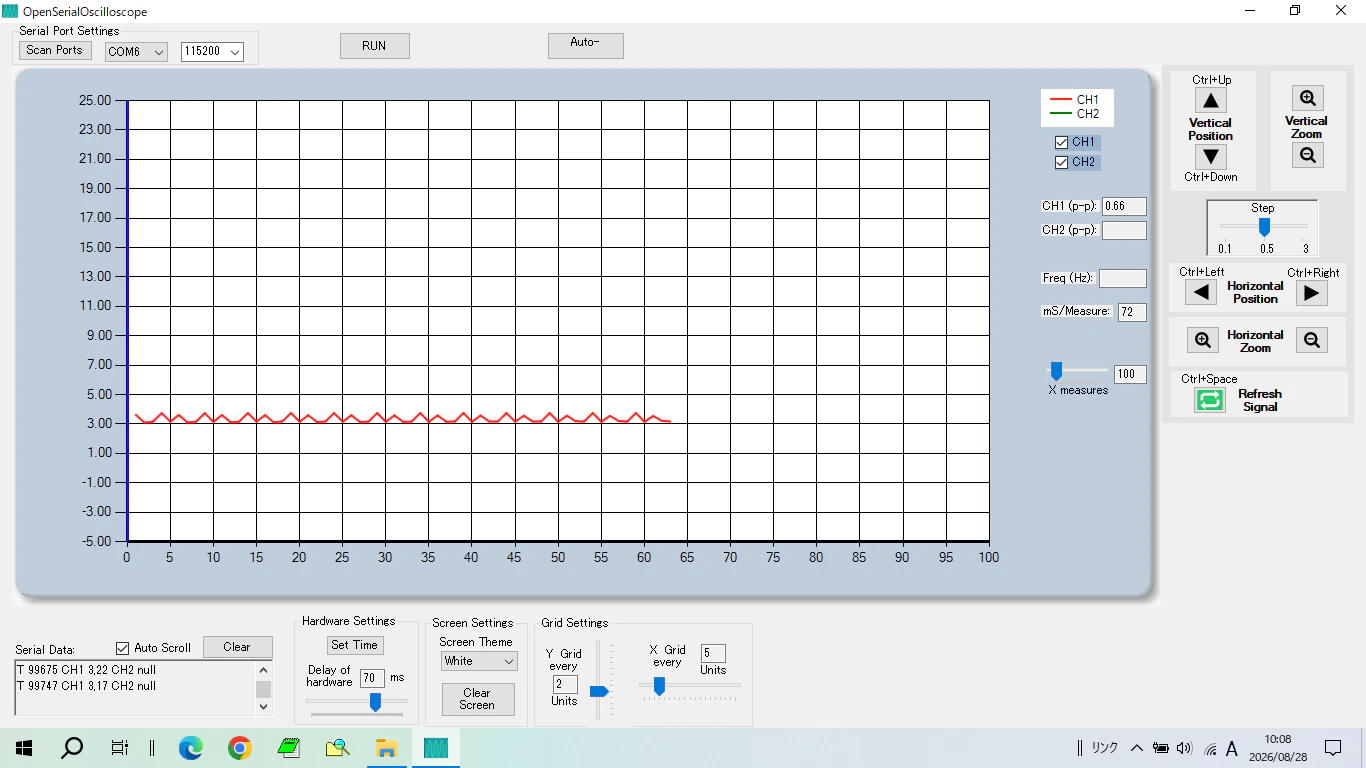
oscilloscope 見つけたので、やってみた。
ch1がadc0です。
参考にしたページ
写真
サンプルコード
import machine
import time

LED_PIN = 4
VIN_PIN = 26
start_time = time.ticks_ms()
temp_time = time.ticks_ms()
prev_led_state = False
time_value = 70
led = machine.Pin(LED_PIN, machine.Pin.OUT)
led.value(0)
adc = machine.ADC(VIN_PIN)
wdt = machine.WDT(timeout=4000)

class OSCObject:
	def __init__(self):
		self.ch1 = "null"
		self.ch2 = "null"
		self.msg = ""
	def float_to_string(self, flt: float, precision_num: int) -> str:
		fmt = "{:." + str(precision_num) + "f}"
		str_val = fmt.format(flt)
		return str_val.replace('.', ',')
	def set_ch1(self, val: float):
		self.ch1 = self.float_to_string(val, 2)
	def set_ch2(self, val: float):
		self.ch2 = self.float_to_string(val, 2)
	def build_packet(self):
		time_ms = str(time.ticks_ms())
		self.msg = f"T {time_ms} CH1 {self.ch1} CH2 {self.ch2} "
	def oscill_send(self):
		self.build_packet()
		print(self.msg)

def reverse_led_state():
	"""LEDの状態を反転"""
	global prev_led_state
	prev_led_state = not prev_led_state
	led.value(1 if prev_led_state else 0)

def timer_blink_led(max_time: int):
	"""ノンブロッキングでLEDを点滅"""
	global temp_time
	if time.ticks_diff(time.ticks_ms(), temp_time) > max_time:
		temp_time = time.ticks_ms()
		reverse_led_state()

def get_sample(sample_count: int) -> float:
	"""アナログ入力の平均値を取得 (MicroPythonのADCは基本16bit: 0-65535)"""
	if sample_count <= 0:
		return 0.0
	total = 0
	for _ in range(sample_count):
		total += adc.read_u16()
	return total / sample_count

def get_voltage_dv() -> float:
	"""分圧回路からの電圧を計算"""
	measure_volt = get_sample(10)
	max_volt = 3.3
	enc_max_val = 65535.0
	r1 = 60000.0
	r2 = 15000.0
	vs = (measure_volt * (r1 + r2)) / r2
	volt = vs * (max_volt / enc_max_val)
	return volt

while True:
	wdt.feed()
	osc = OSCObject()
	volt = get_voltage_dv()
	osc.set_ch1(volt)
	osc.oscill_send()
	timer_blink_led(250)
	time.sleep_ms(time_value)
以上。