
Software developers often encounter AI through the IDE first.
Autocomplete predicts the next line. A chat interface explains unfamiliar code. A coding agent receives a ticket and proposes a pull request.
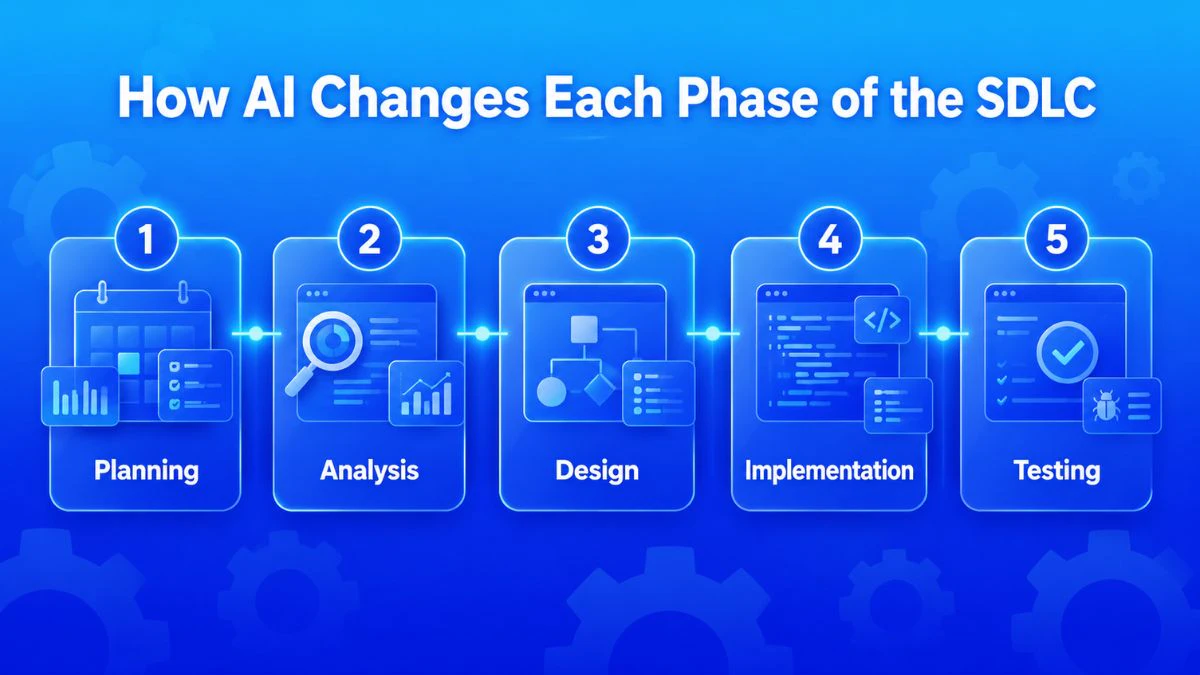
But viewing AI in software development lifecycle only through the coding stage misses most of the engineering problem.
The SDLC includes requirements, architecture, implementation, testing, CI/CD, deployment, observability, incident response, and maintenance. Each stage produces information that affects the stages around it.
AWS consequently frames generative AI as a development-wide capability covering requirements management, architecture, DevSecOps, operations, knowledge management, and engineering assistance.
The interesting technical question is not:
Can AI generate this artifact?
It is:
Can we verify the artifact, trace its context, integrate it into the toolchain, and safely use it in the next SDLC stage?
This article looks at AI from that engineering perspective.
1. Requirements: Use AI to Structure Information, Not Invent Intent
Requirements are one of the most underrated applications of generative AI.
Imagine a project with interview transcripts, support tickets, existing specifications, and a backlog of feature requests.
An LLM can summarize these materials and create draft user stories:
As a warehouse manager,
I want to receive an alert when projected inventory
falls below expected demand,
so that I can reorder stock before a shortage occurs.
The model can also draft acceptance criteria and identify apparent contradictions.
This is useful because requirements work contains a large amount of information processing.
The dangerous part is allowing the model to fill missing business context.
AI does not know that a particular customer has a contractual exception unless that information is provided. It does not know why the organization rejected a similar workflow two years earlier unless that decision exists in accessible documentation.
The pattern should therefore be:
Source information
      ↓
AI synthesis
      ↓
Human validation
      ↓
Approved requirement
AI accelerates requirements analysis.
Humans own product intent.
2. Architecture: Generate Alternatives, Then Apply Constraints
AI is useful during architecture discussions because it can produce multiple alternatives quickly.
For example:
Compare:
1. synchronous REST integration
2. asynchronous event-driven integration

Constraints:
- 10k requests/minute
- existing Kafka cluster
- strict audit logging
- eventual consistency acceptable
A good model can summarize trade-offs and identify obvious concerns.
That does not make it an architect.
Real systems contain undocumented dependencies, organizational standards, operational history, budget constraints, and deployment limitations.
A model may recommend an elegant architecture that the current engineering team cannot realistically operate.
AI therefore works best as an architecture exploration tool.
The final decision remains an engineering responsibility.
3. Implementation: Treat Generated Code as Untrusted Input
AI-generated code should enter the same engineering controls as human-written code.
The code may compile and still be wrong.
Potential issues include incorrect assumptions, unnecessary dependencies, insecure input handling, race conditions, obsolete APIs, or behavior that satisfies the prompt but not the actual requirement.
The correct mental model is:
AI-generated code != reviewed code
A safer pipeline looks like this:
Generate
   ↓
Developer review
   ↓
Static analysis
   ↓
Unit/integration tests
   ↓
Security checks
   ↓
Merge
The review step becomes more important as generation gets faster.
This is one reason AI productivity should not be evaluated by lines of code generated.
Learn More: https://newwavesolution.com/ai-in-software-development-lifecycle-sdlc/
More code also creates more code that somebody must own.
4. Testing: AI Can Increase Coverage, but Independence Matters
Test generation is a natural use case for LLMs.
Given a function, specification, or API contract, AI can draft:
- happy-path tests
- boundary-value tests
- null/empty input tests
- malformed input cases
- concurrency scenarios
- regression candidates
This can reduce the effort needed to establish an initial test suite.
The subtle problem appears when AI writes both implementation and validation.
Suppose an ambiguous requirement is interpreted incorrectly.
The model generates implementation A.
The same interpretation produces tests that expect behavior A.
All tests pass.
The software is still wrong.
This is why test generation should use independent inputs where possible.
For example:
Implementation context → coding agent

Approved acceptance criteria
+ API contract
+ risk scenarios
→ testing agent
Different context boundaries reduce the probability that implementation and validation repeat the same assumption.
5. CI/CD: AI Should Be Part of the Toolchain, Not Another Silo
Many AI initiatives start as individual developer experiments.
One developer uses one coding assistant. Another uses a different model. QA has another workflow.
Individual productivity may increase while the engineering system remains unchanged.
AWS recommends a more integrated approach, connecting AI across project management, development environments, version control, DevSecOps pipelines, deployment, and operations.
A simplified AI-enabled flow might look like:
Ticket
  ↓
Requirements assistant
  ↓
Developer / coding agent
  ↓
Pull request
  ↓
AI-assisted review + human review
  ↓
Automated tests + security scan
  ↓
CI/CD
  ↓
Production
  ↓
Observability / incident assistant
The advantage is context continuity.
Information created upstream can influence downstream validation instead of being trapped in separate tools.
6. Production Operations: Logs Are a Strong AI Use Case
Production incidents create a data-volume problem.
One incident may involve:
- application logs
- distributed traces
- infrastructure metrics
- alerts
- recent commits
- deployment history
- support reports
Humans often spend a significant portion of incident response simply collecting and correlating information.
AI can reduce that search space.
For example:
Incident:
Checkout API latency increased at 14:32 UTC.

Analyze:
- deployment history
- trace latency
- database metrics
- error logs

Return:
- likely causes
- supporting evidence
- recommended investigation order
The important phrase is recommended investigation order.
Allowing AI to diagnose is different from allowing AI to modify production automatically.
Automation authority should increase only when the organization has reliable safeguards.
7. Agentic SDLC: Permission Design Becomes Part of Architecture
AI agents change the security model because they can use tools.
A coding assistant that only returns text has limited operational authority.
An agent might receive permission to:
read repository
write branch
execute test suite
open pull request
read issue tracker
trigger CI pipeline
A more powerful operations agent might interact with cloud infrastructure.
This requires explicit permission boundaries.
Teams should decide:
What can the agent read?
What can it write?
Which commands can it execute?
Which environments are accessible?
Which actions require approval?
How are actions logged?
How can changes be rolled back?
PwC highlights governance, transparency, human oversight, and accountability as AI and agentic systems become more deeply integrated with software development.
Agent permissions should therefore be designed like any other privileged system identity.
8. Faster Coding Can Create a Slower Pipeline
One of the easiest mistakes with AI development is local optimization.
Imagine a simplified delivery pipeline:
Development capacity: 20 PR/day
Review capacity:      10 PR/day
QA capacity:           8 PR/day
Deployment:            5 releases/day
AI doubles development capacity:
Development capacity: 40 PR/day
Review capacity:      10 PR/day
QA capacity:           8 PR/day
Deployment:            5 releases/day
Nothing meaningful improved downstream.
The queue simply grew.
This is why engineering teams should measure AI using system-level metrics.
Examples include lead time for changes, review latency, deployment frequency, escaped defects, change failure rate, rework, and incident recovery time.
AI adoption is successful when software delivery improves.
AI utilization by itself is not an outcome.
9. Practical Adoption Strategy
A reasonable implementation sequence is:
Stage 1: Low-risk assistance
Start with code explanation, documentation, test drafts, and boilerplate.
These outputs are relatively easy to verify.
Stage 2: Workflow integration
Connect AI with repositories, issue tracking, CI/CD, testing, and engineering knowledge.
The objective is reducing manual handoffs.
Stage 3: Bounded agents
Allow agents to perform defined multi-step tasks within limited permissions.
For example:
issue → branch → code → tests → draft PR
Keep merge authority with humans initially.
Stage 4: Measure
Compare delivery and quality metrics before and after adoption.
If the workflow does not improve, adding more autonomy is unlikely to solve the underlying problem.
Stage 5: Expand carefully
Increase agent scope only after the organization understands failure modes and governance requirements.
10. Human Review Is Not a Temporary Limitation
It is tempting to assume human review will disappear once models become sufficiently capable.
That misunderstands software engineering.
Many decisions are not difficult because developers lack the ability to produce code.
They are difficult because the problem contains competing priorities.
Should we optimize performance or maintainability?
Should this dependency be introduced?
Is the edge case worth supporting?
Is the risk acceptable?
Does the implementation match the business objective?
These are engineering decisions, not autocomplete problems.
AI can provide evidence and alternatives.
Humans remain accountable for the outcome.
Conclusion
Using AI in software development lifecycle effectively requires thinking beyond coding assistants.
AI can accelerate requirements analysis, architecture exploration, implementation, testing, CI/CD, and incident investigation. Agentic systems may automate increasingly complex sequences of these tasks.
But every increase in generation speed increases the importance of verification.
Engineering teams should treat AI-generated artifacts as inputs to controlled workflows, give agents narrowly defined permissions, and measure improvements using end-to-end delivery metrics.
The goal is not an SDLC with the maximum amount of AI.
It is an SDLC where AI removes unnecessary engineering effort without weakening quality, security, or accountability.
For teams building AI-enabled products or integrating AI into existing engineering environments, Newwave Solutions provides AI development alongside software engineering, QA, cloud, and system integration capabilities across the full delivery lifecycle.