
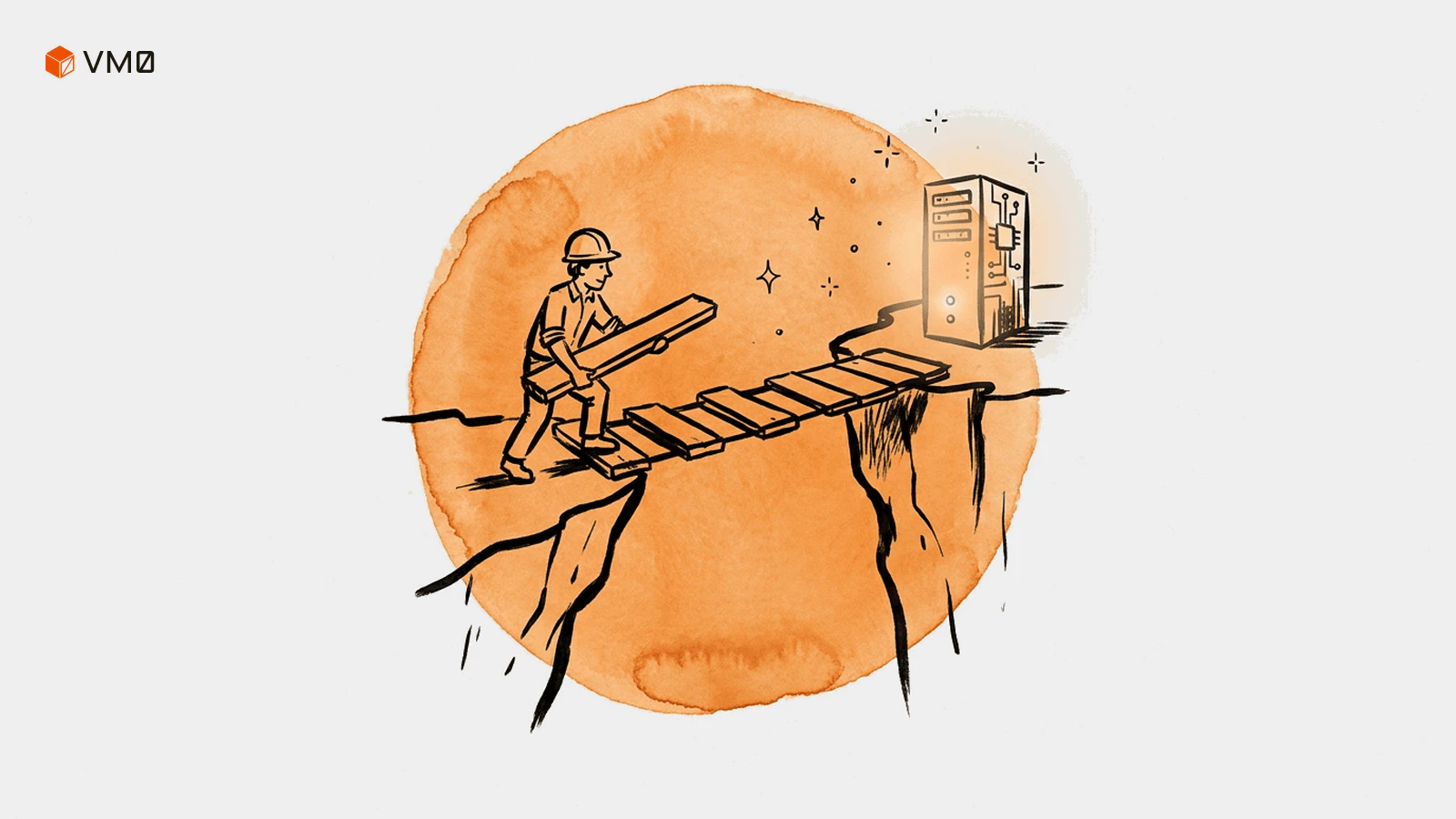
原文(VM0 ブログ)/ Originally published on the VM0 blog: https://www.vm0.ai/en/blog/posts/forward-deployed-engineer
日本語版(先)と英語版(後)を1つの記事にまとめています。 / Japanese version first, English version below.
日本語
フォワードデプロイドエンジニア(Forward Deployed Engineer、FDE)とは、顧客企業の内部に入り込み、AI システムを構築して本番稼働まで届けるエンジニアのことです。最初の曖昧で混沌とした要件定義から、ビジネスが実際に測定できる成果を出すところまでを担います。彼らは顧客のシステム上で本番コードを書きます。コンサルタントでもなければ、セールスエンジニアでもありません。この役割を生み出したのは Palantir で、2010 年代初頭に最初のメンバーを「Deltas」と呼びました。2026 年現在、これはエンタープライズ AI で最も急成長している職種になっています。求人数は 2025 年 4 月の 643 件から 1 年後には 5,330 件へと、729% も増加しました。
この役割が存在する理由はシンプルです。会議で見栄えのする AI デモと、本番で実際に動くシステムとの間には大きなギャップがあります。FDE はそのギャップを越える人です。そしてそのギャップには、FDE がテック業界で最も求められる役割の一つになるほどの価値があります。さらにいま、その同じエンジニアたちが AI エージェントと組み始め、一人が出せる成果を何倍にも押し上げています。注目すべきは、置き換えではなく、この「組み合わせ」のほうです。
フォワードデプロイドエンジニアとは何か?
フォワードデプロイドエンジニアとは、顧客組織の内部で直接働き、技術的な成功を最初から最後まで自分の責任として持つエンジニアです。問題のスコープ設定、コードの記述、システムのデプロイ、そして現場で学んだことを製品にフィードバックするところまでを担います。
この言葉は軍事用語に由来します。「forward deployed(前方展開)」とは、後方の基地ではなく、行動の最前線で働くことを意味します。エンジニアにとっては、本社を離れて顧客の現実の中に身を置くことを意味します。顧客のデータ、セキュリティ規則、レガシーシステム、そして締め切りの中で働くのです。
このモデルを築いたのは Palantir でした。自社のエンジニアを数週間から数ヶ月にわたって顧客の施設内に常駐させ、本番コードを書き、機密扱いのハードウェア上でパイプラインをデバッグし、顧客のスタンドアップミーティングに同席させました。2016 年まで、Palantir にはソフトウェアエンジニアよりもフォワードデプロイドエンジニアのほうが多くいました。
ソリューションアーキテクトは顧客に試乗をさせます。FDE は鍵そのものを手渡します。
フォワードデプロイドエンジニアは実際に何をするのか?
その仕事はデプロイメント全体の長さに及びます。典型的な一日は、どこで問題が起きているかを洗い出す顧客スタンドアップで始まり、午後はモデルをレガシー ERP に接続する Python を書くことに費やされ、夜は顧客のタイムゾーンで午前 2 時に倒れた連携処理を直して終わる、といった具合です。
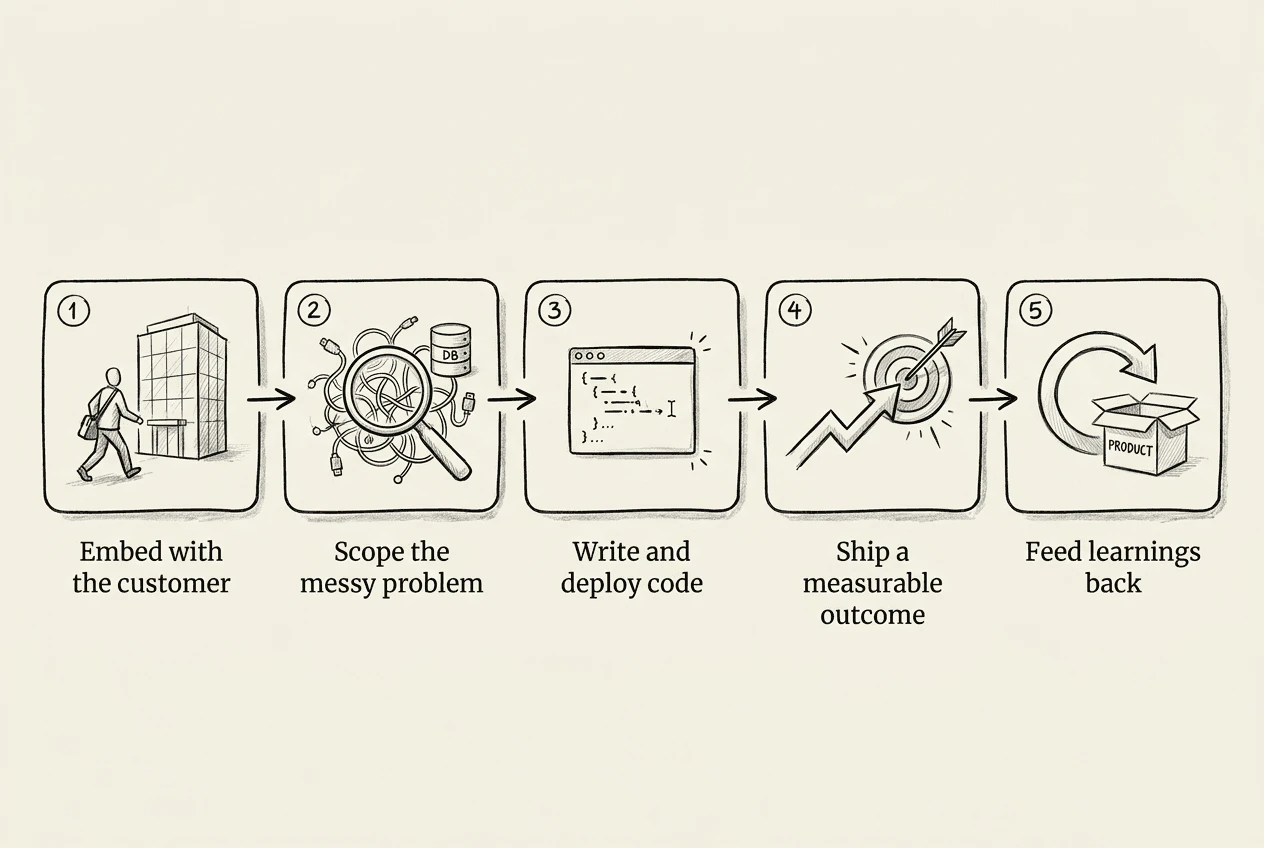
2026 年に企業が求めるスキルは、エージェント型 AI に近いところにあります。
- RAG パイプライン: 検索のチューニング、グラウンディング、コンテキスト管理
- 評価フレームワーク: ハルシネーションやグラウンディングの失敗を本番に届く前に捕まえる eval スイート
- エージェント開発: LangGraph、LangChain、CrewAI、DSPy の実務経験、そしてマルチステップのツール利用
- 本番オブザーバビリティ: 通常のソフトウェアでは起きない壊れ方をする確率的システムの監視
見落とされがちな側面が一つあります。FDE は現場で実際に何が壊れるかを見ているため、推測ではなく実際の利用に根ざしたインプットを持つプロダクトマネージャーのような役割も果たすことになります。このフィードバックループは、この役割がコストに見合う大きな理由の一つです。
フォワードデプロイドエンジニア vs. ソリューションアーキテクト vs. CSM
これらの役割の境界線は、誰が本番コードを書いて届けるかに行き着きます。
| 役割 | 本番コードを書く | 顧客環境にデプロイ | 関係性のオーナー |
|---|---|---|---|
| フォワードデプロイドエンジニア | はい | はい | 共同 |
| ソリューションアーキテクト | まれに | 設計はするがデプロイはまれ | 共同 |
| カスタマーサクセスマネージャー | いいえ | いいえ | はい |
FDE はコードを届けます。ソリューションアーキテクトはシステムを設計しますが、通常はデプロイしません。CSM は関係性を持ちますが、コードをコミットしません。
なぜ OpenAI、Anthropic、Databricks は 2026 年に FDE を採用しているのか?
エンタープライズ AI のボトルネックはモデルではなくデプロイメントにあり、2026 年に主要な AI ラボはそのボトルネックを自分たちで握ることを決めたからです。
数字は反論しがたいものです。MIT NANDA の『State of AI in Business 2025』レポートは、企業の生成 AI パイロットの 95% が測定可能なビジネスインパクトを生み出さなかったと報告しています。ほとんどの場合、モデルは問題ありませんでした。崩れたのはデプロイメントの部分です。
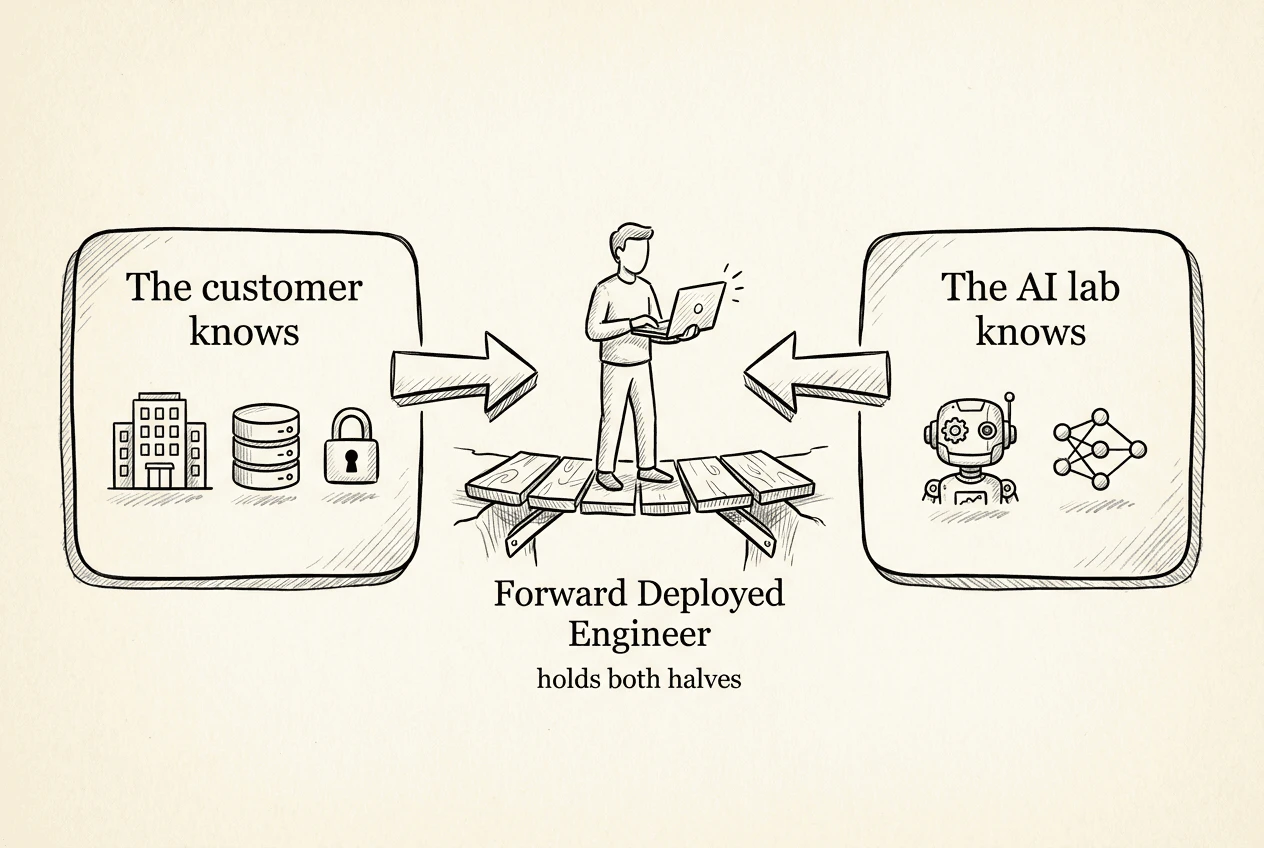
その多くは、いわゆる「双方向の知識ギャップ」に起因します。顧客側のエンジニアはビジネスを理解しています。データスキーマ、コンプライアンス規則、レガシーアーキテクチャです。ラボ側のエンジニアは、モデルが本番で動き出した後にどう振る舞うかを理解しています。プロンプティング、RAG、評価、失敗モードです。どちらの側も、単独では動くものを届けられません。FDE はその両方の半分を併せ持つ人です。
エージェントはこれをさらに難しくします。決定論的な SaaS 製品は「設定」されます。AI エージェントは、現実の人間のワークフローに「適応」させなければなりません。それは混沌としていて、判断を要する場面に満ちています。だからこそ、ラボはほぼ同時に動きました。
- OpenAI は 2026 年 5 月 11 日に The Deployment Company を立ち上げ、40 億ドル超の資本をコミットし、エディンバラの Tomoro を買収して初日から約 150 人の経験豊富な FDE を迎え入れました。
- Anthropic は数日のうちに、Blackstone および Goldman Sachs との 15 億ドルの合弁事業を発表しました。
- Databricks は 2026 年 6 月 11 日に独自のフォワードデプロイドエンジニアリング組織を正式に立ち上げ、コンサルタント型の引き継ぎを、まだ存在しないものを作るエンジニアへと置き換えました。
これはフロンティアのラボにとどまりません。2026 年 5 月下旬時点で、39 社にわたって 224 件の FDE 求人があり、Palantir、Mistral、Cohere、Cresta、Scale AI、Snowflake、GitLab、Stripe がいずれも採用を進めていました。
フォワードデプロイドエンジニアの年収はどのくらいか?
FDE の報酬が高いのは、この仕事をうまくこなせる人が希少で、かつ仕事の重要性が高いからです。2026 年の報告されているベース給与レンジは次のとおりです。
| 企業 | ベース給与レンジ |
|---|---|
| Palantir | $170K 〜 $340K+ |
| OpenAI | $220K 〜 $280K |
| Anthropic | $200K 〜 $300K |
この報酬には実際のコストも伴います。出張は仕事の 25% 〜 50% を占めることが多く、デスクワークよりも早く消耗させますし、常に異なる顧客業界の間を行き来することになります。
その見返りはキャリアのレバレッジです。FDE として過ごす数ヶ月には、何年分もの顧客接点が詰め込まれます。だからこそ、多くの FDE が独立して会社を立ち上げていきます。Palantir 出身者だけでも、Anduril、OpenGov、Addepar を創業しています。
AI エージェントはフォワードデプロイドエンジニアを置き換えられるか?
いいえ。この役割は自動化で消えていくのではなく、増幅されているのです。デモから本番までのギャップを埋めるその同じエンジニアたちが、AI エージェントと組み始めています。その結果は、スクリプトに置き換えられた一人ではなく、はるかに多くを届けられるようになった一人です。
FDE の週の大部分は定型作業です。ディスカバリーのインタビューを回し、プロトタイプの土台を組み、また別の連携を配線し、eval スイートの最初の一稿を書く。AI のチームメイトは、エンジニアの指示のもとでこうした作業を引き受けられます。FDE は、本当に判断を要する部分、つまりアーキテクチャ、顧客との関係、そして「何を出荷してよいか」の判断において、運転席に座り続けます。
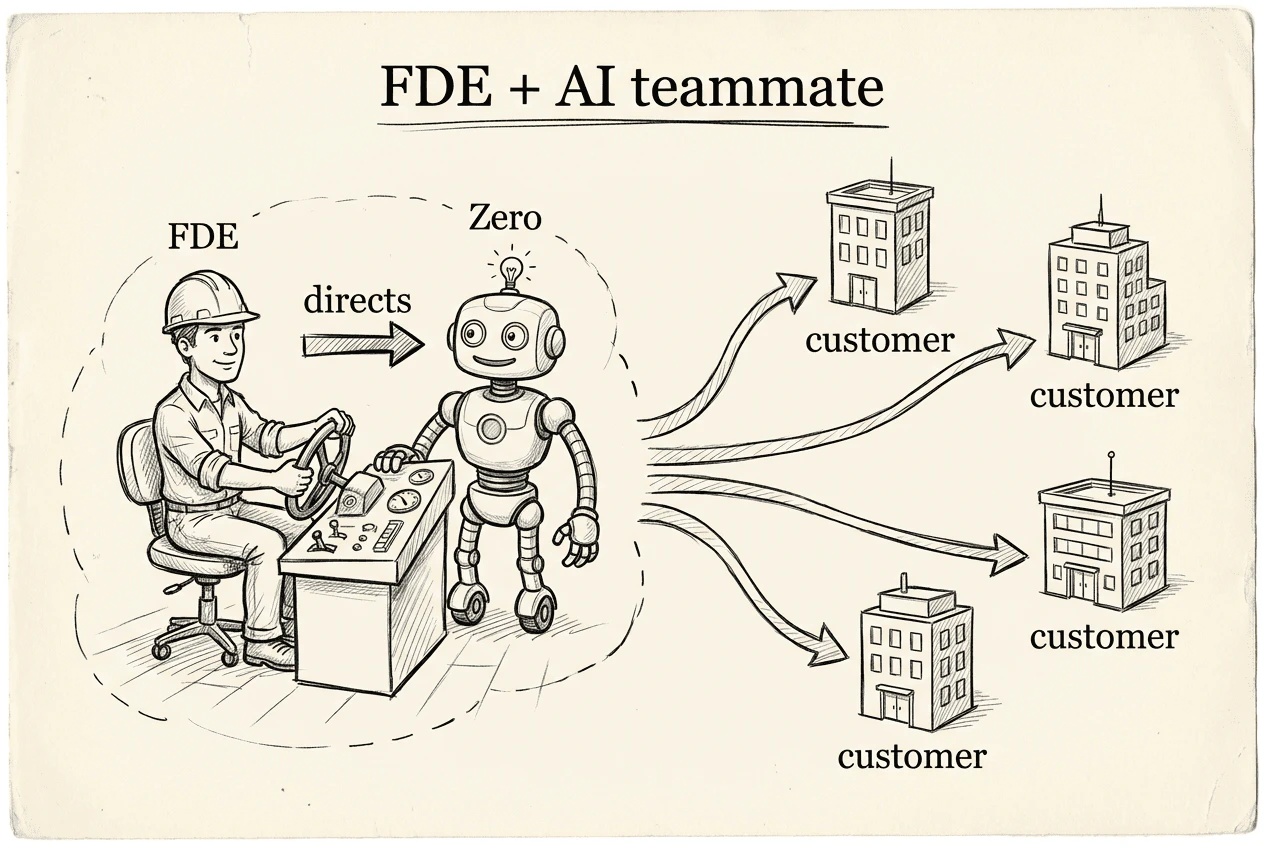
そのチームメイトこそ、Zero が目指して作られているものです。Zero はチームがすでに働いている場所で動き、すでに使われているシステムに接続し、タスクを問題から使える成果へと運びます。その間、エンジニアはレビューし、修正し、何を出荷するかを決めます。FDE がソフトウェアに引き継がれるのではありません。FDE がソフトウェアを操縦し、二者が協働することで、どちらか単独よりもはるかに広い範囲をカバーします。エージェントの艦隊を指揮できる一人のエンジニアは、その役割を機能させてきた判断力を手放すことなく、同時に多くの顧客に対応できるのです。
この役割の未来(2027 年とその先)
この職種名はおそらく分化していくでしょう。いまの「フォワードデプロイドエンジニア」は、非常に多くの異なる仕事を一括りにしています。2027 年半ばには、より整理されたサブスペシャリティが現れると見られます。FDE-Infrastructure、FDE-Eval、FDE-Agent、そして FDE-Sovereign です。最後のものは、ソブリン AI、つまり企業が誰かのクラウド上ですべてを動かすのではなく、自社のデータ・モデル・スタックを自ら所有したいという動きに後押しされています。
この役割がなくなることはありません。最も大規模で、最も賭け金の高いデプロイメントには、常にその場に座れる人が求められます。変わるのは、レバレッジの源泉がどこにあるかです。それは人員数からソフトウェアへと移っていき、FDE は連携を手作業で組み立てる時間を減らし、それを構築するエージェントを指揮する時間を増やしていきます。
よくある質問
フォワードデプロイドエンジニアはソフトウェアエンジニアか、それともコンサルタントか?
ソフトウェアエンジニアです。この役割の核心は、顧客環境の中で本番コードを書き、デバッグし、出荷することにあります。営業担当でもコンサルタントでもありません。
フォワードデプロイドエンジニアになるには何のスキルが必要か?
しっかりしたソフトウェアエンジニアリングに加えて、2026 年のエージェント型スタックです。RAG パイプライン、評価フレームワーク、エージェント開発(LangGraph、CrewAI、DSPy)、そして本番オブザーバビリティ。多くの場合、不慣れな企業の中で一人で働くことになるため、顧客と向き合う判断力も同じくらい重要です。
どの企業がフォワードデプロイドエンジニアを採用しているか?
始めたのは Palantir です。2026 年には、OpenAI、Anthropic、Databricks、Mistral、Cohere、Scale AI、Snowflake、GitLab、Stripe がいずれも採用しており、ほかにも 100 社以上が続いています。2026 年 5 月下旬時点で、39 社にわたり 224 件の求人がありました。
フォワードデプロイドエンジニアと AI エンジニアの違いは何か?
AI エンジニアは通常、自社の製品の中でモデルや AI 機能を構築します。フォワードデプロイドエンジニアは、その能力を顧客の環境に持ち込み、動く成果までのラストワンマイルを担います。
AI エージェントはフォワードデプロイドエンジニアを置き換えるか?
いいえ。仕事の分かれ方が変わるのです。AI エージェントは、エンジニアの指示のもとで定型的なディスカバリー、プロトタイピング、連携を引き受けます。一方でフォワードデプロイドエンジニアは、判断、アーキテクチャ、顧客との関係を持ち続けます。この役割は、AI チームメイトと競合するのではなく、それを操縦する方向へと移りつつあります。
English
A Forward Deployed Engineer (FDE) is an engineer who embeds inside a customer's company to build and ship an AI system, from the first messy requirements through to a result the business can actually measure. They write production code on the customer's systems. They are not consultants, and they are not sales engineers. Palantir invented the role in the early 2010s and called the first ones "Deltas." In 2026 it has become the fastest-growing job title in enterprise AI. Postings went from 643 in April 2025 to 5,330 a year later, a 729% jump.
The reason the role exists is simple. There is a gap between an AI demo that looks great in a meeting and a system that runs in production. The FDE is the person who crosses it. That gap is valuable enough that the FDE has become one of the most sought-after roles in tech. And now those same engineers are starting to pair with AI agents that multiply what one of them can ship. That pairing, not any kind of replacement, is the part worth paying attention to.
What is a Forward Deployed Engineer?
A Forward Deployed Engineer is an engineer who works directly inside a customer's organization and owns technical success from start to finish: scoping the problem, writing the code, deploying the system, and feeding what they learn back into the product.
The phrase comes from the military, where "forward deployed" means working at the point of action instead of from a base in the rear. For an engineer it means leaving headquarters and living inside the customer's reality: their data, their security rules, their legacy systems, their deadlines.
Palantir built the model. It put its own engineers inside client facilities for weeks or months at a time, writing production code, debugging pipelines on classified hardware, and sitting in customer standups. Until 2016, Palantir had more Forward Deployed Engineers than software engineers.
A solutions architect gives the customer a test drive. An FDE hands over the keys.
What does a Forward Deployed Engineer actually do?
The work runs the whole length of a deployment. A typical day might open with a customer standup to map out where things are breaking, move into an afternoon of writing Python to connect a model to a legacy ERP, and close with an evening spent fixing an integration that fell over at 2 a.m. in the customer's time zone.
The skills companies want in 2026 sit close to agentic AI:
- RAG pipelines: retrieval tuning, grounding, and context management
- Evaluation frameworks: eval suites that catch hallucinations and grounding failures before they reach production
- Agent development: real experience with LangGraph, LangChain, CrewAI, and DSPy, and with multi-step tool use
- Production observability: monitoring probabilistic systems that fail in ways ordinary software never does
One part of the job gets overlooked. Because the FDE sees what actually breaks in the field, they end up acting as a product manager whose input is grounded in real usage rather than guesswork. That feedback loop is a big reason the role is worth the cost.
Forward Deployed Engineer vs. Solutions Architect vs. CSM
The line between these roles comes down to who writes and ships production code.
| Role | Writes production code | Deploys in customer env | Owns the relationship |
|---|---|---|---|
| Forward Deployed Engineer | Yes | Yes | Shared |
| Solutions Architect | Rarely | Designs, rarely deploys | Shared |
| Customer Success Manager | No | No | Yes |
The FDE ships the code. The solutions architect designs the system but usually does not deploy it. The CSM owns the relationship but does not commit code.
Why are OpenAI, Anthropic, and Databricks hiring FDEs in 2026?
Because the bottleneck in enterprise AI is deployment, not the model, and in 2026 the major labs decided to own that bottleneck themselves.
The numbers are hard to argue with. MIT NANDA's State of AI in Business 2025 report found that 95% of enterprise generative AI pilots produced no measurable business impact. In most cases the model was fine. The deployment was where things fell apart.
A lot of that comes down to what people call the two-sided knowledge gap. The customer's engineers understand the business: the data schemas, the compliance rules, the legacy architecture. The lab's engineers understand how models behave once they are live: prompting, RAG, evaluation, failure modes. Neither side can ship something that works on its own. The FDE is the person who holds both halves.
Agents make this harder. A deterministic SaaS product gets configured. An AI agent has to be adapted to a real human workflow, which is messy and full of judgment calls. That is why the labs moved at almost the same time:
- OpenAI launched The Deployment Company on May 11, 2026, with more than $4B in committed capital, and bought Edinburgh's Tomoro to bring roughly 150 experienced FDEs in from day one.
- Anthropic announced a $1.5B joint venture with Blackstone and Goldman Sachs within days.
- Databricks formalized its own Forward Deployed Engineering org on June 11, 2026, replacing consultant-style handoffs with engineers who build what isn't there yet.
It goes well beyond the frontier labs. As of late May 2026 there were 224 open FDE roles across 39 companies, with Palantir, Mistral, Cohere, Cresta, Scale AI, Snowflake, GitLab, and Stripe all hiring.
How much do Forward Deployed Engineers get paid?
FDE pay is high because the people who can do the job well are rare and the work matters. Reported base-salary ranges for 2026:
| Company | Base salary range |
|---|---|
| Palantir | $170K – $340K+ |
| OpenAI | $220K – $280K |
| Anthropic | $200K – $300K |
The money comes with real costs. Travel often runs 25% to 50% of the job, which wears people down faster than a desk role, and you are constantly switching between customer industries.
The payoff is career leverage. A few months as an FDE packs in years of customer exposure, which is why so many of them leave to start companies. Palantir alumni alone went on to found Anduril, OpenGov, and Addepar.
Can AI agents replace Forward Deployed Engineers?
No. The role is not being automated away. It is being amplified. The same engineers who close the demo-to-production gap are starting to pair with AI agents, and the result is one person who can ship far more, not one person replaced by a script.
A large part of the FDE's week is routine: running discovery interviews, scaffolding a prototype, wiring up yet another integration, writing the first pass of an eval suite. An AI teammate can take on that work under the engineer's direction. The FDE stays in the driver's seat for the parts that actually need judgment: the architecture, the customer relationship, and the call on what is good enough to ship.
That teammate is what Zero is built to be. It runs where the team already works, connects to the systems already in use, and takes a task from problem to a usable result, while the engineer reviews, corrects, and decides what ships. The FDE is not handed off to software. The FDE drives the software, and together they cover far more ground than either could alone. One engineer who can direct a fleet of agents can serve many customers at once without giving up the judgment that made the role work in the first place.
The future of the role (2027 and beyond)
The title will probably split apart. Right now "Forward Deployed Engineer" covers a lot of different jobs. By mid-2027 expect cleaner subspecialties: FDE-Infrastructure, FDE-Eval, FDE-Agent, and FDE-Sovereign, the last one driven by sovereign AI, where companies want to own their data, models, and stack instead of running everything in someone else's cloud.
The role is not going away. The biggest, highest-stakes deployments will always want a person who can sit in the room. What shifts is where the leverage comes from. It moves from headcount toward software, and the FDE spends less time hand-building integrations and more time directing the agents that build them.
Frequently asked questions
Is a Forward Deployed Engineer a software engineer or a consultant?
A software engineer. The whole point of the role is that they write, debug, and ship production code inside the customer's environment. They are not sales reps or consultants.
What skills do you need to become a Forward Deployed Engineer?
Solid software engineering, plus the 2026 agentic stack: RAG pipelines, evaluation frameworks, agent development (LangGraph, CrewAI, DSPy), and production observability. Customer-facing judgment matters just as much, since you often work alone inside an unfamiliar company.
Which companies hire Forward Deployed Engineers?
Palantir started it. In 2026, OpenAI, Anthropic, Databricks, Mistral, Cohere, Scale AI, Snowflake, GitLab, and Stripe are all hiring, along with more than a hundred others. There were 224 open roles across 39 companies as of late May 2026.
What is the difference between a Forward Deployed Engineer and an AI Engineer?
An AI Engineer usually builds models and AI features inside their own company's product. A Forward Deployed Engineer takes those capabilities into a customer's environment and owns the last mile to a working result.
Will AI agents replace Forward Deployed Engineers?
No. The work splits differently. AI agents take on routine discovery, prototyping, and integration under the engineer's direction, while the Forward Deployed Engineer keeps the judgment calls, the architecture, and the customer relationship. The role is moving toward piloting AI teammates, not competing with them.