
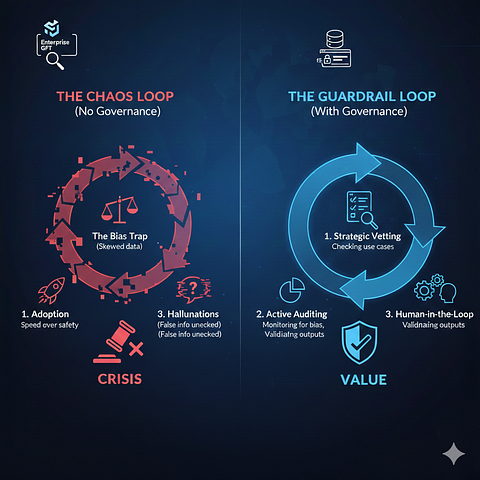
Artificial Intelligence is transforming how businesses operate, innovate, and compete. From automating workflows to delivering predictive insights, AI promises speed, scale, and efficiency. But beneath this promise lies a growing concern many organizations overlook: AI without governance is a business risk, not a competitive advantage.
As AI adoption accelerates, companies increasingly turn to AI consulting experts such as Nate Patel to ensure their AI initiatives are strategic, ethical, and compliant from day one. This article explores the hidden risks of AI without governance, why it matters for long-term success, and how organizations can build a responsible AI foundation.
What Is AI Governance?
AI governance refers to the policies, processes, standards, and oversight mechanisms that guide how AI systems are designed, deployed, monitored, and improved. It ensures AI aligns with business goals, legal requirements, ethical principles, and societal expectations.
Effective AI governance typically covers:
- Data quality and privacy
- Model transparency and explainability
- Bias detection and mitigation
- Security and risk management
- Accountability and human oversight
- Regulatory compliance
Without these safeguards, AI systems can create more problems than they solve.
Why AI Without Governance Is a Serious Risk
Many organizations rush to deploy AI tools to stay ahead of competitors. However, skipping governance often leads to unintended consequences that can impact revenue, trust, and brand credibility.
Below are the most critical hidden risks.
1. Bias and Discrimination at Scale
AI systems learn from historical data. If that data contains bias, the AI will not only replicate it but amplify it.
Examples include:
- Hiring algorithms favoring certain demographics
- Credit scoring models unfairly rejecting applicants
- Facial recognition systems misidentifying minority groups
Without governance frameworks to audit data and models, biased decisions can go unnoticed until legal or public backlash occurs.
Impact:
- Legal liability
- Loss of customer trust
- Brand damage
2. Lack of Transparency and Explainability
Many AI models, especially deep learning systems, function as “black boxes.” When organizations cannot explain how decisions are made, problems arise.
Why this matters:
- Regulators increasingly require explainable AI
- Customers want clarity and fairness
- Internal teams struggle to debug errors
AI consulting partners help organizations implement explainable AI practices that balance performance with accountability.
3. Regulatory and Legal Non-Compliance
Global AI regulations are evolving rapidly. Frameworks such as the EU AI Act, data protection laws, and industry-specific compliance standards place strict requirements on AI usage.
Without AI governance:
- Organizations may violate data privacy laws
- Automated decisions may break employment or consumer protection regulations
- Penalties, fines, and lawsuits become more likely
Strategic AI consulting ensures governance and compliance are built into AI systems, not patched in later.
4. Data Privacy and Security Risks
AI systems depend on massive volumes of data. Poor governance increases the risk of:
- Unauthorized data access
- Insecure model training pipelines
- Data leakage through AI outputs
Working with experienced AI consultants helps organizations design secure, privacy-first AI architectures aligned with global standards.
5. Operational Failures and Business Disruption
AI models degrade over time due to changing data patterns, known as model drift.
Without governance:
- Errors go undetected
- Decisions become inaccurate
- Business operations suffer silently
Governance introduces monitoring, testing, and human-in-the-loop processes to ensure AI remains reliable.
Read More here: The Hidden Risks of AI Without Governance
Final Thought:
AI can be a growth engine or a liability. The difference lies in governance.