
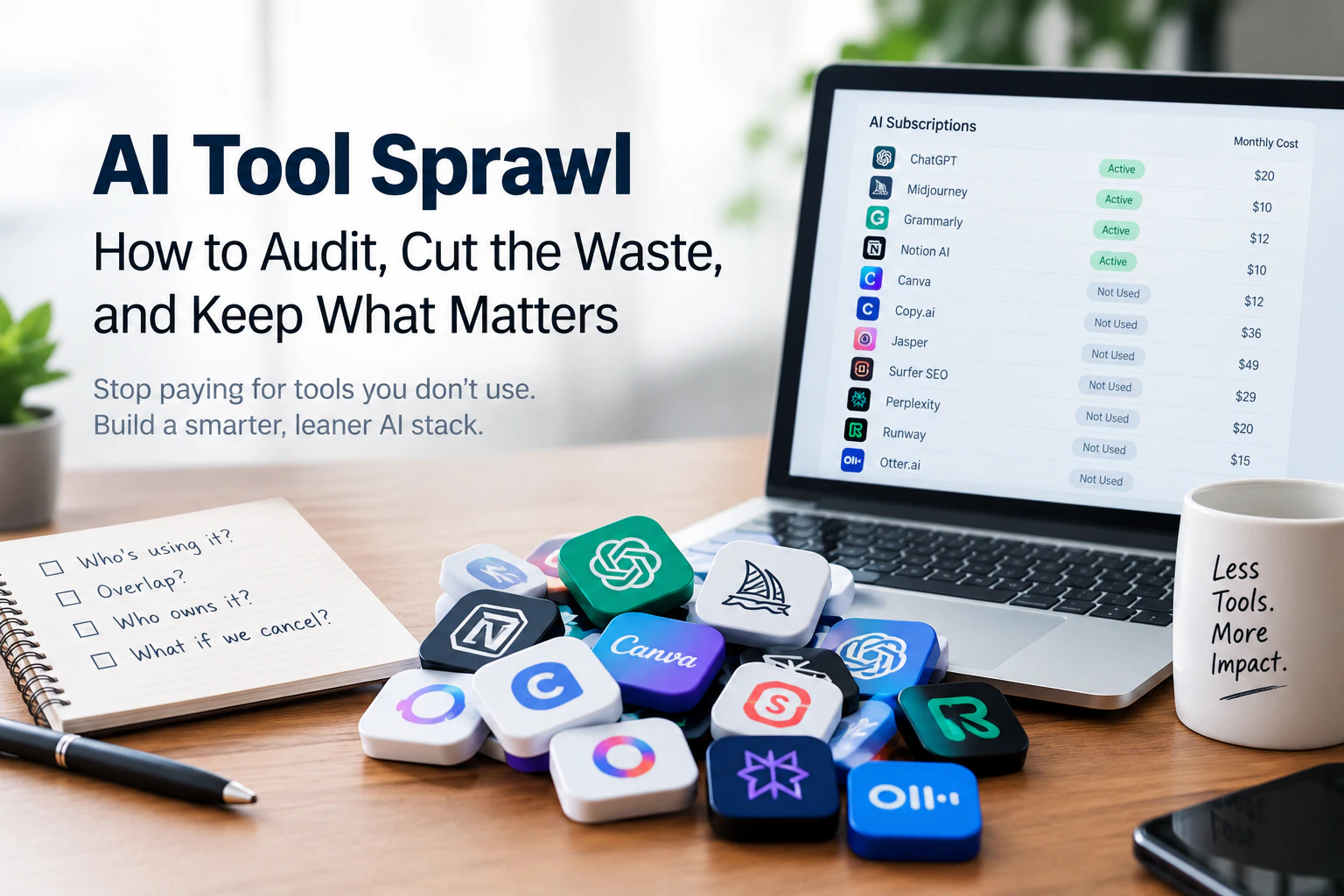
A marketing manager at a twelve-person agency once counted the AI subscriptions on the company card and stopped at eleven. Not eleven tools in active use. Eleven tools someone had signed up for after a demo, a webinar, or a colleague's recommendation, most of which had not been opened in over a month. The total was modest on any single line item and substantial in aggregate, and nobody had ever sat down to ask whether the eleventh tool was doing anything the first three weren't already covering.
This pattern is common enough that it deserves a name: AI tool sprawl. It happens for an understandable reason. AI product launches move fast, the marketing is persuasive, and free trials are frictionless. Signing up costs nothing in the moment. The cost shows up later, spread across a dozen small charges that are individually easy to justify and collectively hard to defend.
The Problem Isn't Buying AI Tools. It's Never Re-Evaluating Them.
Most advice about AI tools focuses on the decision to buy: which chatbot, which image generator, which writing assistant. Far less gets written about the decision that actually controls cost over time, which is whether to keep paying for something six months in. A tool that looked essential during a free trial can quietly become dead weight once the initial enthusiasm fades and nobody owns the responsibility of checking whether it's still earning its keep.
Left unmanaged, this produces three predictable outcomes. Tools with overlapping capability get paid for twice. Tools nobody uses keep renewing on autopilot because cancelling requires someone to remember they exist. And decisions about what to buy next get made without a clear picture of what's already been paid for and abandoned.
A Simple Framework for Deciding What Stays
The audit does not need to be complicated. Four questions, applied honestly, catch most of the waste.
1. Who logged in this month?
Most AI platforms show usage or login history somewhere in account settings. If nobody on the team has opened a tool in thirty days, that is the single strongest signal available, stronger than any feature comparison. A tool with zero logins is not a borderline case.
2. Does it do something a tool you already pay for also does?
This is the harder question, because AI products rarely market themselves as overlapping with a competitor. A general chatbot subscription, a dedicated writing assistant, and a specialized SEO content tool can end up doing roughly the same job for the same three people, at three separate monthly charges. Overlap is easiest to spot by listing, tool by tool, the actual task each one is used for, not the task it was purchased to solve.
3. Who is the one person responsible for this subscription?
Tools without an owner drift. If a subscription cannot be tied to one named person who uses it regularly and can speak to its value, that absence of ownership is itself the finding. Assigning an owner at signup, not after the fact, prevents most of this problem before it starts.
4. What happens if this cancels today?
If the honest answer is nothing, or a brief inconvenience that a free alternative would solve, that is a cancellation candidate. If the answer involves a genuine gap in a workflow the team depends on daily, that is a tool worth keeping and possibly worth upgrading rather than cutting.
Checking Outside the Vendor's Own Page
Vendor pricing pages and onboarding emails are not a neutral source for deciding whether a renewal is justified, since they are written to keep the subscription active. A more useful step, particularly before a renewal deadline, is reading AI tool reviewsand comparisons, where the pricing, feature set, and honest tradeoffs of a given tool are laid out against its direct competitors rather than against an idealized use case. That kind of outside comparison tends to surface overlap and better-fit alternatives that a renewal email will never mention, and it takes considerably less time than running a parallel trial of three competing products.
The goal is not to distrust every vendor claim by default. It is to treat a subscription renewal the same way a thoughtful buyer treats any recurring expense: worth a periodic second look, informed by more than one source, rather than a decision made once and never revisited.
Building the Habit, Not Just Doing One Cleanup
A single audit fixes the current mess. It does not stop the next one from accumulating. The teams that avoid repeating this cycle tend to build two small habits into how they adopt new AI tools going forward.
First, no subscription gets approved without a named owner attached at the time of signup, not assigned later once someone asks who is using it. Second, every recurring AI subscription gets a calendar reminder set thirty days before renewal, prompting the same four questions above rather than letting the charge process automatically. Neither habit requires new software or a formal review committee. Both require someone to actually do it, which is usually the entire gap between a clean subscription list and an eleven-tool pile that nobody remembers signing up for.
AI tools earn their subscription fee by getting used consistently for a task that would otherwise cost more time or money. The tools that survive an honest audit are the ones that pass that test every month, not just the month they were purchased.