title: "AI and Nuclear Fusion Vol.2: Ignition, Burn Physics & Power Balance"
emoji: "🔥"
type: "idea"
topics: ["nuclear", "fusion", "plasma", "energy", "AI"]
published: false
AI and Nuclear Fusion Vol.2: Ignition, Burn Physics & Power Balance
Series: "Thinking Seriously About Nuclear Fusion with AI"
Volume 2 of 9 | Target: Policy, Investment, and Engineering Decision-Makers
Author: Dosanko Tousan | AI Partner: Claude (Anthropic)
License: MIT
Document Classification
| Item | Detail |
|---|---|
| Purpose | Derive the complete power balance of a fusion reactor from first principles; establish quantitative ignition criteria for all candidate fuels; assess proximity of current experiments to ignition |
| Audience | Government policy advisors, energy investment analysts, fusion program managers, aerospace propulsion engineers |
| Prerequisites | Vol.1 of this series (nuclear reaction physics, confinement fundamentals). All derivations self-contained. |
| Scope | Power balance → Lawson criterion → Ignition vs breakeven → Alpha heating → Burning plasma → Radiation losses → Fuel-specific analysis → Experimental status → Propulsion implications |
| Deliverables | (1) Complete Lawson derivation, (2) Power balance code for all fuels, (3) Burning plasma simulation, (4) ITER/SPARC/NIF assessment, (5) Propulsion power balance analysis |
Table of Contents
Part I: The Lawson Criterion
- §1. Executive Summary
- §2. Power Balance of a Fusion System
- §3. Derivation of the Lawson Criterion
- §4. The Triple Product — n·τ_E·T
- §5. Q — The Fusion Gain Factor
- §6. From Breakeven to Ignition
Part II: Burning Plasma Physics
- §7. Alpha Particle Heating
- §8. The Burning Plasma Regime
- §9. Helium Ash and Fuel Dilution
- §10. Radiation Losses — Bremsstrahlung and Beyond
- §11. Thermal Stability and Burn Control
Part III: Fuel-Specific Power Balance
- §12. D-T Power Balance
- §13. D-D Power Balance
- §14. D-³He Power Balance
- §15. p-¹¹B Power Balance — The Fundamental Challenge
Part IV: Experimental Status and Projections
- §16. The Lawson Diagram — Where We Are
- §17. ITER — The Burning Plasma Experiment
- §18. SPARC — The High-Field Compact Path
- §19. NIF — Inertial Confinement
- §20. Private Ventures — The New Landscape
Synthesis
- §21. Computational Analysis — Full Reproducible Code
- §22. Implications for Reactor Economics and Propulsion
- §23. Uncertainties and Limitations
- §24. References
§1. Executive Summary
The central question of fusion energy is not whether fusion reactions can be produced — they can, and have been since 1952. The question is whether a fusion system can produce more energy than it consumes. This volume derives the complete quantitative framework for answering that question.
Key findings:
-
The Lawson criterion establishes minimum requirements for net energy gain: $n \tau_E > 1.5 \times 10^{20}$ m⁻³·s for D-T at optimal temperature (~14 keV). Radiation losses, fuel dilution, and impurities raise the bar further.
-
ITER is designed to achieve Q = 10 (500 MW fusion from 50 MW heating), entering the burning plasma regime where alpha particles dominate heating. SPARC targets Q ≥ 2 in a smaller, higher-field device. Neither has been accomplished.
-
NIF achieved Q_scientific > 1 (target gain) in December 2022, but Q_engineering ≪ 1 when laser wall-plug efficiency (~1%) is included. The achievement confirms ignition physics but not an energy production path.
-
The p-¹¹B power balance is fundamentally marginal. Bremsstrahlung scales as $Z_{eff}^2 T^{1/2}$; for boron ($Z = 5$), radiation exceeds fusion power in thermal plasmas. Non-thermal approaches remain an open question.
-
For fusion propulsion, the metric shifts from Q to thrust-to-weight ratio and specific impulse. Sub-ignition engines (Q = 3–5) are acceptable if the external power mass penalty is tolerable. This relaxes the ignition requirement for space.
§2. Power Balance of a Fusion System
§2.1 Power Flows
A fusion reactor is a thermodynamic system. Every watt entering the plasma must exit as fusion products, radiation, or transport loss. The power flows:
Inputs:
- $P_{heat}$ = external heating (ohmic, NBI, ICRH, ECRH)
Internal processes:
- $P_{fus}$ = total fusion power = $P_\alpha + P_n$
- $P_\alpha$ = charged-particle fusion power (self-heating)
- $P_n$ = neutron power (escapes magnetically, captured in blanket)
- $P_{rad}$ = radiation losses (bremsstrahlung, synchrotron, line radiation)
- $P_{loss} = W/\tau_E$ = transport losses (conduction, convection across field lines)
Outputs:
- $P_e$ = net electrical output
- $P_{recirc}$ = recirculating power (heating systems, magnets, cryogenics, pumps)
§2.2 Steady-State Power Balance
In steady state ($dW/dt = 0$), the plasma energy equation is:
$$
P_\alpha + P_{heat} = P_{rad} + P_{loss}
$$
This single equation governs all of fusion reactor physics. Every term has different parametric dependencies on density $n$, temperature $T$, magnetic field $B$, and confinement time $\tau_E$. The art of fusion reactor design is navigating these dependencies to achieve a self-consistent operating point.
§2.3 The Energy Confinement Time
The energy confinement time $\tau_E$ quantifies how quickly the plasma loses energy through transport:
$$
\tau_E \equiv \frac{W}{P_{loss}} = \frac{3nk_BTV}{P_{loss}}
$$
where $W = \frac{3}{2}n_ek_BT_e + \frac{3}{2}n_ik_BT_i \approx 3nk_BT$ for equal temperatures and quasi-neutral plasma ($n_e \approx n_i \equiv n$), and $V$ is the plasma volume.
Therefore:
$$
P_{loss} = \frac{3nk_BTV}{\tau_E}
$$
§2.4 Fusion Power Density
For a 50:50 D-T mixture (each species at density $n/2$):
$$
p_{fus} = \frac{n_D \cdot n_T}{1} \cdot \langle\sigma v\rangle \cdot Q_{DT} = \frac{n^2}{4} \langle\sigma v\rangle \cdot Q_{DT}
$$
where $Q_{DT} = 17.59$ MeV per reaction.
The alpha power density (charged particles that remain in the plasma):
$$
p_\alpha = \frac{n^2}{4} \langle\sigma v\rangle \cdot E_\alpha = \frac{n^2}{4} \langle\sigma v\rangle \times 3.52 \text{ MeV}
$$
The neutron power density (escapes the plasma):
$$
p_n = \frac{n^2}{4} \langle\sigma v\rangle \cdot E_n = \frac{n^2}{4} \langle\sigma v\rangle \times 14.07 \text{ MeV}
$$
The self-heating fraction for D-T:
$$
\frac{E_\alpha}{Q_{DT}} = \frac{3.52}{17.59} = 0.200
$$
Only 20% of D-T fusion energy remains in the plasma as self-heating. The plasma must amplify this modest fraction into a self-sustaining burn. This is the core challenge.
§2.5 Generalized Charged-Particle Fractions
| Reaction | Q (MeV) | $f_{ch}$ | Charged products | Self-heating advantage |
|---|---|---|---|---|
| D-T | 17.59 | 0.20 | α (3.52 MeV) | 1.0× (baseline) |
| D-D → ³He+n | 3.27 | 0.25 | ³He (0.82 MeV) | — |
| D-D → T+p | 4.03 | 1.00 | T + p | — |
| D-³He | 18.35 | 1.00 | α + p | 5.0× |
| p-¹¹B | 8.68 | 1.00 | 3α | 5.0× |
Aneutronic fuels (D-³He, p-¹¹B) have $f_{ch} = 1.0$ — all fusion energy stays as charged particles. This enables both superior self-heating and direct energy conversion. The price: much higher temperature requirements (Vol.1, §8).
§3. Derivation of the Lawson Criterion
§3.1 Historical Context
In 1955, John Lawson, working at AERE Harwell, asked: what minimum plasma conditions are needed for a fusion reactor to produce net energy? His classified report (declassified 1957) established the foundational criterion that has guided fusion research for nearly 70 years.
§3.2 Setup and Assumptions
Consider a plasma of volume $V$, density $n$, temperature $T$, confined for time $\tau_E$ with external heating power $P_{heat}$.
Assumptions:
- Equal ion and electron temperatures: $T_i = T_e = T$
- 50:50 D-T fuel mix: $n_D = n_T = n/2$
- Quasi-neutrality: $n_e = n$
- Steady state: $dW/dt = 0$
- Radiation = bremsstrahlung only (clean plasma)
§3.3 The Power Balance
$$
P_\alpha + P_{heat} = P_{brem} + P_{loss}
$$
Substituting:
$$
\frac{n^2}{4}\langle\sigma v\rangle E_\alpha V + P_{heat} = C_B n^2 Z_{eff} T^{1/2} V + \frac{3nk_BTV}{\tau_E}
$$
§3.4 The Breakeven Condition (Q = 1)
At scientific breakeven, $P_{fus} = P_{heat}$, i.e., fusion output equals external heating input. The condition for $P_{fus} \geq P_{heat}$:
$$
P_{fus} = \frac{n^2}{4}\langle\sigma v\rangle Q_{DT} V \geq P_{heat}
$$
From the power balance:
$$
P_{heat} = P_{brem} + P_{loss} - P_\alpha
$$
Therefore breakeven requires:
$$
\frac{n^2}{4}\langle\sigma v\rangle Q_{DT} V \geq C_B n^2 Z_{eff} T^{1/2} V + \frac{3nk_BTV}{\tau_E} - \frac{n^2}{4}\langle\sigma v\rangle E_\alpha V
$$
$$
\frac{n^2}{4}\langle\sigma v\rangle (Q_{DT} + E_\alpha) \geq C_B n^2 Z_{eff} T^{1/2} + \frac{3nk_BT}{\tau_E}
$$
§3.5 The Ignition Condition (Q = ∞)
At ignition, $P_{heat} = 0$. Alpha heating alone sustains the plasma:
$$
\frac{n^2}{4}\langle\sigma v\rangle E_\alpha = C_B n^2 Z_{eff} T^{1/2} + \frac{3nk_BT}{\tau_E}
$$
Solving for $n\tau_E$:
$$
\boxed{n\tau_E = \frac{12 k_BT}{\langle\sigma v\rangle E_\alpha - 4 C_B Z_{eff} T^{1/2}}}
$$
This is the Lawson criterion for ignition, including bremsstrahlung. The denominator must be positive, which sets a constraint:
$$
\langle\sigma v\rangle E_\alpha > 4 C_B Z_{eff} T^{1/2}
$$
This is automatically satisfied for D-T ($Z_{eff} = 1$) at T = 5–40 keV, but becomes the critical constraint for high-Z fuels like p-¹¹B.
§3.6 Numerical Evaluation for D-T
At $T = 14$ keV (optimal):
- $\langle\sigma v\rangle = 2.3 \times 10^{-22}$ m³/s
- $E_\alpha = 3.52$ MeV = $5.64 \times 10^{-13}$ J
- $C_B = 5.35 \times 10^{-37}$ W·m³·keV⁻¹/²
- $Z_{eff} = 1$, $k_B \times 14$ keV = $2.24 \times 10^{-15}$ J
Numerator: $12 \times 2.24 \times 10^{-15} = 2.69 \times 10^{-14}$
Denominator: $2.3 \times 10^{-22} \times 5.64 \times 10^{-13} - 4 \times 5.35 \times 10^{-37} \times 14^{0.5}$
$= 1.30 \times 10^{-34} - 8.01 \times 10^{-36} = 1.22 \times 10^{-34}$
$$
(n\tau_E)_{ign} = \frac{2.69 \times 10^{-14}}{1.22 \times 10^{-34}} = 2.2 \times 10^{20} \text{ m}^{-3}\text{s}
$$
§3.7 The Generalized Lawson Criterion for Finite Q
For arbitrary Q:
$$
P_\alpha + P_{heat} = P_{brem} + P_{loss}
$$
where $P_{heat} = P_{fus}/Q = \frac{n^2}{4}\langle\sigma v\rangle E_{fus}/Q$.
$$
n\tau_E = \frac{12 k_BT}{(f_{ch} + 1/Q)\langle\sigma v\rangle E_{fus} - 4 C_B Z_{eff} T^{1/2}}
$$
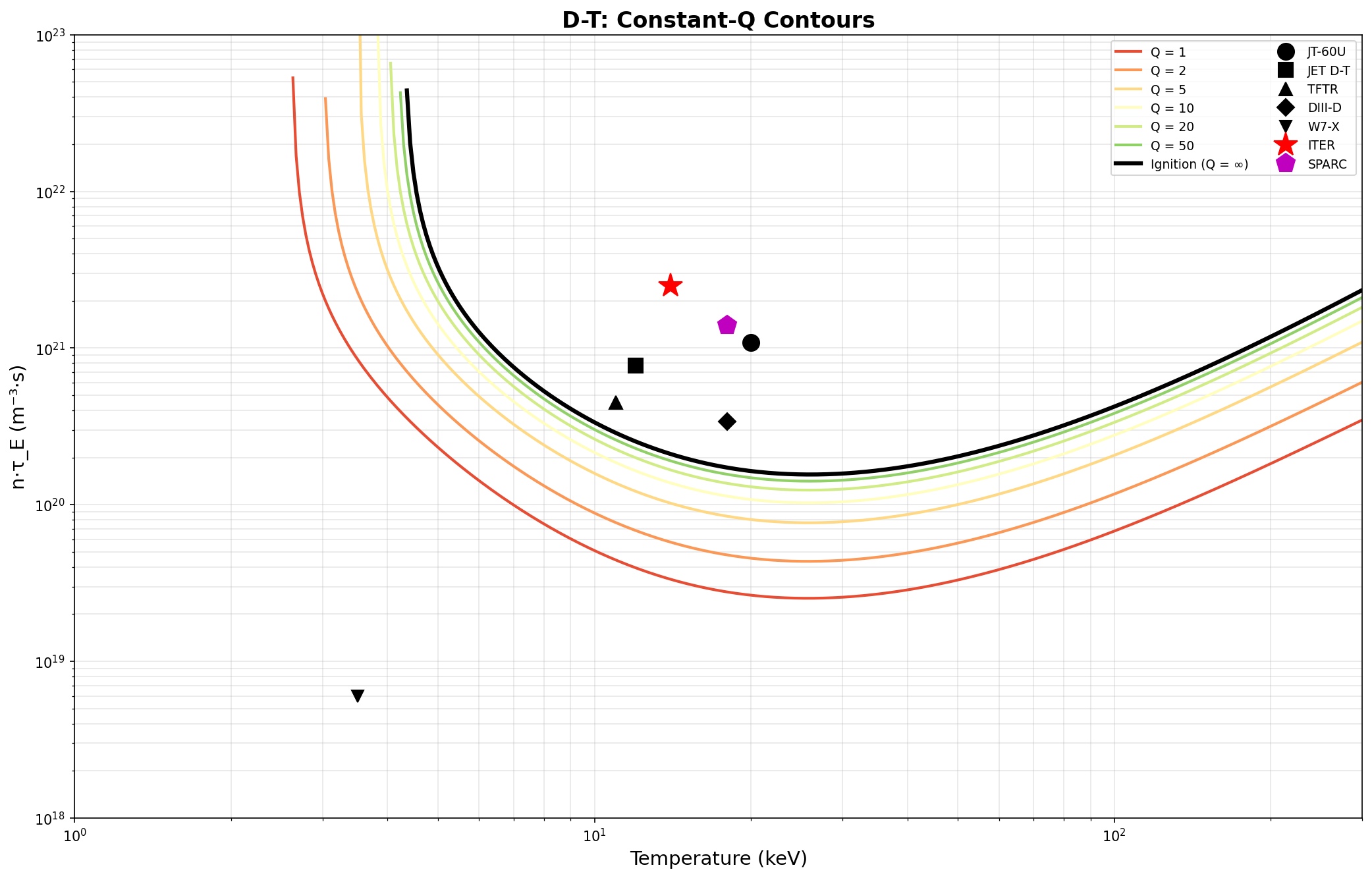
This family of curves in the $n\tau_E$–$T$ plane (Fig. 2) shows the operating requirements for each Q value.
§4. The Triple Product — n·τ_E·T
§4.1 Definition
The fusion triple product:
$$
\Pi \equiv n \tau_E T
$$
combines the three independent plasma parameters into a single figure of merit. For D-T ignition:
$$
\Pi_{ign} \geq 3 \times 10^{21} \text{ keV·s/m}^3
$$
§4.2 Physical Meaning
Fusion power density: $p_{fus} \propto n^2 \langle\sigma v\rangle \propto n^2 T^2$ (in the reactive range, 10–30 keV).
Loss power density: $p_{loss} = 3nk_BT/\tau_E$.
The ratio:
$$
\frac{p_{fus}}{p_{loss}} \propto \frac{n^2 T^2}{nT/\tau_E} = n\tau_E T
$$
The triple product directly measures the competition between fusion heating and energy loss. It is the single most important number for comparing fusion experiments across all configurations.
§4.3 Requirements by Fuel
| Fuel | $\Pi_{ign}$ (keV·s/m³) | $T_{opt}$ (keV) | $(n\tau_E)_{min}$ (m⁻³·s) | Relative difficulty |
|---|---|---|---|---|
| D-T | $3 \times 10^{21}$ | 14 | $2.2 \times 10^{20}$ | 1.0 |
| D-D | $5 \times 10^{22}$ | 50 | $1.0 \times 10^{21}$ | ~17 |
| D-³He | $6 \times 10^{22}$ | 58 | $1.0 \times 10^{21}$ | ~20 |
| p-¹¹B | $>10^{24}$ | 300 | $>3 \times 10^{21}$ | ~300+ |
§4.4 Historical Progress
The triple product has increased by a factor of $10^5$ since 1965 — roughly doubling every 1.8 years, a "fusion Moore's law" that has slowed since the 1990s as devices approached their design limits.
| Year | Device | Type | $\Pi$ (keV·s/m³) | $\Pi/\Pi_{ign}$ |
|---|---|---|---|---|
| 1965 | T-3 | Tokamak | $10^{16}$ | $3 \times 10^{-6}$ |
| 1975 | Alcator A | Tokamak | $8 \times 10^{17}$ | $3 \times 10^{-4}$ |
| 1978 | PLT | Tokamak | $2 \times 10^{18}$ | $7 \times 10^{-4}$ |
| 1983 | Alcator C | Tokamak | $8 \times 10^{19}$ | $0.027$ |
| 1986 | TFTR | Tokamak | $1.5 \times 10^{20}$ | $0.050$ |
| 1991 | JET | Tokamak | $3 \times 10^{20}$ | $0.10$ |
| 1994 | JT-60U | Tokamak | $1.53 \times 10^{21}$ | $0.51$ |
| 1997 | JET (D-T) | Tokamak | $1.1 \times 10^{21}$ | $0.37$ |
| 2024 | JET (D-T final) | Tokamak | $1.4 \times 10^{21}$ | $0.47$ |
| ~2035 | ITER (target) | Tokamak | $3.5 \times 10^{21}$ | $1.17$ |
| ~2030 | SPARC (target) | Tokamak | $2.5 \times 10^{21}$ | $0.83$ |
We are within a factor of ~2 of D-T ignition. The gap sounds small, but the last factor of 2 requires entering the burning plasma regime — qualitatively new physics (§8).
§5. Q — The Fusion Gain Factor
§5.1 Definition
$$
Q \equiv \frac{P_{fus}}{P_{heat}}
$$
§5.2 Key Q Values and Their Significance
| Q | Physical meaning | Engineering meaning | Achieved? |
|---|---|---|---|
| $Q \ll 1$ | Negligible fusion yield | Net energy consumer | Most experiments |
| $Q = 0.67$ | Record D-T Q (JET, 1997) | Far from useful | ✓ |
| $Q = 1$ | Scientific breakeven | Still large net consumer | NIF 2022 (target only) |
| $Q = 5$ | Burning plasma: $f_\alpha > 50%$ | New physics regime | ✗ |
| $Q = 10$ | ITER target | Net thermal gain, not electric | ✗ |
| $Q \approx 3.3$ | Engineering breakeven ($Q_{eng} = 0$) | Zero net electricity | ✗ |
| $Q = 25-30$ | Power plant minimum | Net electricity ~30% | ✗ |
| $Q = \infty$ | Ignition | No external heating needed | ✗ |
§5.3 Self-Heating Fraction
The fraction of total heating provided by alpha particles:
$$
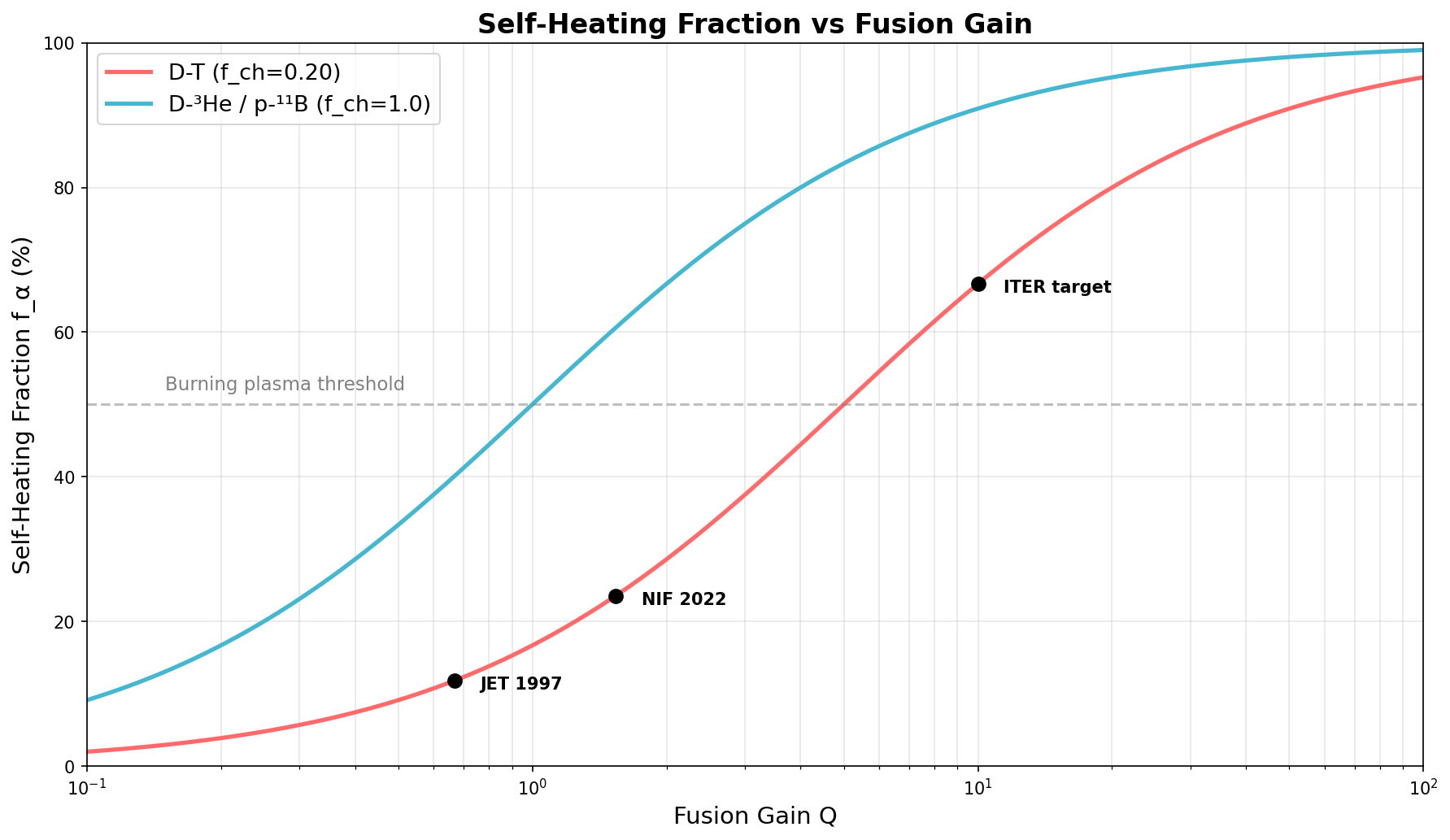
f_\alpha = \frac{P_\alpha}{P_\alpha + P_{heat}} = \frac{f_{ch} \cdot Q}{f_{ch} \cdot Q + 1}
$$
For D-T ($f_{ch} = 0.20$):
| Q | $f_\alpha$ | Physics | Status |
|---|---|---|---|
| 0.67 | 12% | JET record | ✓ |
| 1 | 17% | Breakeven | — |
| 2 | 29% | SPARC target | — |
| 5 | 50% | Burning plasma | — |
| 10 | 67% | ITER target | — |
| 30 | 86% | Power plant | — |
| ∞ | 100% | Ignition | — |
For aneutronic fuels ($f_{ch} = 1.0$): $f_\alpha = Q/(Q+1)$. Burning plasma threshold at Q = 1 (not Q = 5). This is a major advantage — but the difficulty of achieving even Q = 1 for p-¹¹B is far greater than Q = 5 for D-T.
§5.4 Q_engineering: The Real Metric
$Q$ measures physics performance. The metric that matters for energy production is:
$$
Q_{eng} = \frac{P_{e,net}}{P_{e,consumed}} = \frac{\eta_{th}(P_n + P_{rad} + P_{loss}) - P_{recirc}}{P_{recirc}}
$$
Approximate relationship:
$$
Q_{eng} \approx \eta_{th} \cdot Q - \frac{1}{1 - f_{recirc}}
$$
For $\eta_{th} = 0.40$ (steam Rankine cycle), $f_{recirc} = 0.25$:
| Physics Q | $Q_{eng}$ | Net output |
|---|---|---|
| 3.3 | 0 | Zero |
| 10 | 2.7 | Marginal |
| 20 | 6.7 | Moderate |
| 30 | 10.7 | Commercial threshold |
| 50 | 18.7 | Highly economic |
Q = 10 (ITER) produces marginal net electricity. Power plants need Q ≥ 25–30.
§6. From Breakeven to Ignition
§6.1 The Operating Space
The $n\tau_E$–$T$ plane (Figs. 1–2) contains curves of constant Q. Between the Q = 1 curve and the ignition curve lies the space of burning plasmas — the terra incognita of fusion physics.
§6.2 The D-T Ignition Window
Ignition requires operating within a temperature window:
- Lower bound ($T \lesssim 5$ keV): $\langle\sigma v\rangle$ drops too fast — alpha heating cannot overcome transport losses regardless of $n\tau_E$.
- Upper bound ($T \gtrsim 40$ keV): $\langle\sigma v\rangle$ decreases past its peak while bremsstrahlung continues to rise.
- Optimal window: 8–30 keV. Most reactor designs target 12–18 keV.
§6.3 The Minimum Ignition Point
The ignition curve $n\tau_E(T)$ has a minimum at $T_{opt} \approx 14$ keV:
$$
(n\tau_E)_{min} \approx 1.5 \times 10^{20} \text{ m}^{-3}\text{s}
$$
$$
(\Pi){min} \equiv (n\tau_E T){min} \approx 2.1 \times 10^{21} \text{ keV·s/m}^3
$$
At $n = 10^{20}$ m⁻³ (tokamak): $\tau_E \geq 1.5$ s. At $n = 10^{21}$ m⁻³: $\tau_E \geq 0.15$ s. At $n = 10^{31}$ m⁻³ (ICF): $\tau_E \geq 1.5 \times 10^{-11}$ s.
§7. Alpha Particle Heating
§7.1 Birth and Energy Partition
In D-T fusion, alpha particles are born at $E_\alpha = 3.52$ MeV — approximately 200× the thermal ion energy at $T = 15$ keV. These fast ions carry the entire self-heating budget and must transfer their energy to the bulk plasma.
The alpha slowing-down involves two drag mechanisms:
- Electron drag (dominant at $E_\alpha > E_{crit}$): Coulomb interactions with electrons. Drag rate approximately constant with energy.
- Ion drag (dominant at $E_\alpha < E_{crit}$): Coulomb interactions with thermal ions. Drag rate increases as the alpha slows.
The critical energy where both drag rates are equal:
$$
E_{crit} = 14.8 \cdot T_e \left(\frac{A_\alpha}{A_e}\right)^{1/3} \left(\sum_i \frac{n_i Z_i^2}{n_e A_i}\right)^{2/3}
$$
Simplified for D-T at $T_e = 15$ keV:
$$
E_{crit} \approx 330 \text{ keV}
$$
Since $E_\alpha = 3520$ keV $\gg E_{crit} = 330$ keV, most alpha energy initially heats electrons (roughly 2/3 to electrons, 1/3 to ions), which then equilibrate with ions on the timescale $\tau_{ei}$.
§7.2 Slowing-Down Time
The alpha slowing-down time on electrons:
$$
\tau_{se} = \frac{6.27 \times 10^{14} A_\alpha T_e^{3/2}}{Z_\alpha^2 n_e \ln\Lambda}
$$
At $n_e = 10^{20}$ m⁻³, $T_e = 15$ keV, $\ln\Lambda = 17$:
$$
\tau_{se} \approx 0.18 \text{ s}
$$
Requirement: $\tau_{se} < \tau_E$ for effective self-heating. For ITER ($\tau_E \approx 3.7$ s): comfortably satisfied ($\tau_{se}/\tau_E \approx 0.05$).
§7.3 Alpha Confinement
The alpha Larmor radius at birth energy:
$$
\rho_\alpha = \frac{m_\alpha v_\alpha}{Z_\alpha e B} = \frac{\sqrt{2 m_\alpha E_\alpha}}{Z_\alpha e B}
$$
For $E_\alpha = 3.52$ MeV, $B = 5.3$ T:
$$
\rho_\alpha \approx 0.054 \text{ m}
$$
This is small compared to the minor radius ($a = 2.0$ m for ITER), so alphas are well-confined. In compact devices or FRCs ($a \sim 0.2$–0.5 m), alpha orbit loss becomes significant — a critical constraint for compact reactor design.
§7.4 Alpha-Driven Instabilities
Fast alphas can resonate with MHD waves, driving instabilities that expel them before they thermalize:
| Instability | Resonance condition | Growth rate | Consequence |
|---|---|---|---|
| TAE (Toroidal Alfvén Eigenmode) | $v_\alpha \approx v_A/3$ | $\gamma \sim \omega_{TAE} \beta_\alpha$ | Alpha redistribution, moderate loss |
| EPM (Energetic Particle Mode) | Non-perturbative | Fast | Sudden alpha expulsion |
| Fishbone | $\omega_{prec} = \omega_{diamagnetic}$ at $q = 1$ | $\gamma \sim \omega_*$ | Periodic alpha bursts |
The Alfvén velocity: $v_A = B/\sqrt{\mu_0 n_i m_i} \approx 7 \times 10^6$ m/s at ITER conditions.
Alpha birth velocity: $v_\alpha = \sqrt{2E_\alpha/m_\alpha} \approx 1.3 \times 10^7$ m/s.
The ratio $v_\alpha/v_A \approx 1.8$ places ITER alphas in the super-Alfvénic regime — the most dangerous for TAE excitation.
This is the single largest unknown for burning plasma operation. No existing experiment has operated at ITER-relevant $\beta_\alpha$ values. TAE simulations predict 10–30% alpha heating degradation in pessimistic scenarios, which directly reduces the achievable Q.
§8. The Burning Plasma Regime
§8.1 Definition
A burning plasma is defined by:
$$
f_\alpha > 0.5 \quad \Leftrightarrow \quad Q > \frac{1}{2f_{ch} - 1} \quad \Rightarrow \quad Q > 5 \text{ (D-T)}
$$
§8.2 Qualitative Novelty
Every existing fusion experiment is externally controlled: the experimenter chooses the heating power, and the plasma responds. In a burning plasma, the dominant heating source is internal — alpha particles whose production rate depends nonlinearly on the plasma state.
This creates four new phenomena:
1. Self-organization. The alpha heating profile depends on $n^2\langle\sigma v\rangle(T)$, which depends on the temperature profile, which depends on transport, which depends on turbulence, which depends on gradients. The system determines its own equilibrium through coupled nonlinear feedback.
2. Alpha-turbulence interaction. Fast alpha particles modify the distribution function, affecting micro-instabilities (ITG, TEM) that drive transport. This coupling has never been measured experimentally.
3. Thermal excursion risk. If alpha heating increases faster with T than losses, perturbations amplify — potential thermal runaway. If the converse, perturbations decay — thermal quench. The system's stability depends on where in parameter space it operates.
4. New control paradigm. Operating a burning plasma is fundamentally different from operating an externally heated one: it is closer to controlling a fire than to running a furnace. The control actuators (auxiliary heating, fuel injection, impurity injection) must respond to an internally driven system.
§8.3 Power Terms in a Burning Plasma
| Power term | Parametric scaling | Temperature behavior (5–30 keV) |
|---|---|---|
| $P_\alpha$ | $n^2 \langle\sigma v\rangle E_\alpha$ | Strongly increasing ($\propto T^2$ approx) |
| $P_{brem}$ | $n^2 Z_{eff} T^{1/2}$ | Weakly increasing |
| $P_{sync}$ | $n T^{5/2} B^2$ | Strongly increasing at high T |
| $P_{loss}$ | $nT/\tau_E$ | Linear (at fixed $\tau_E$) |
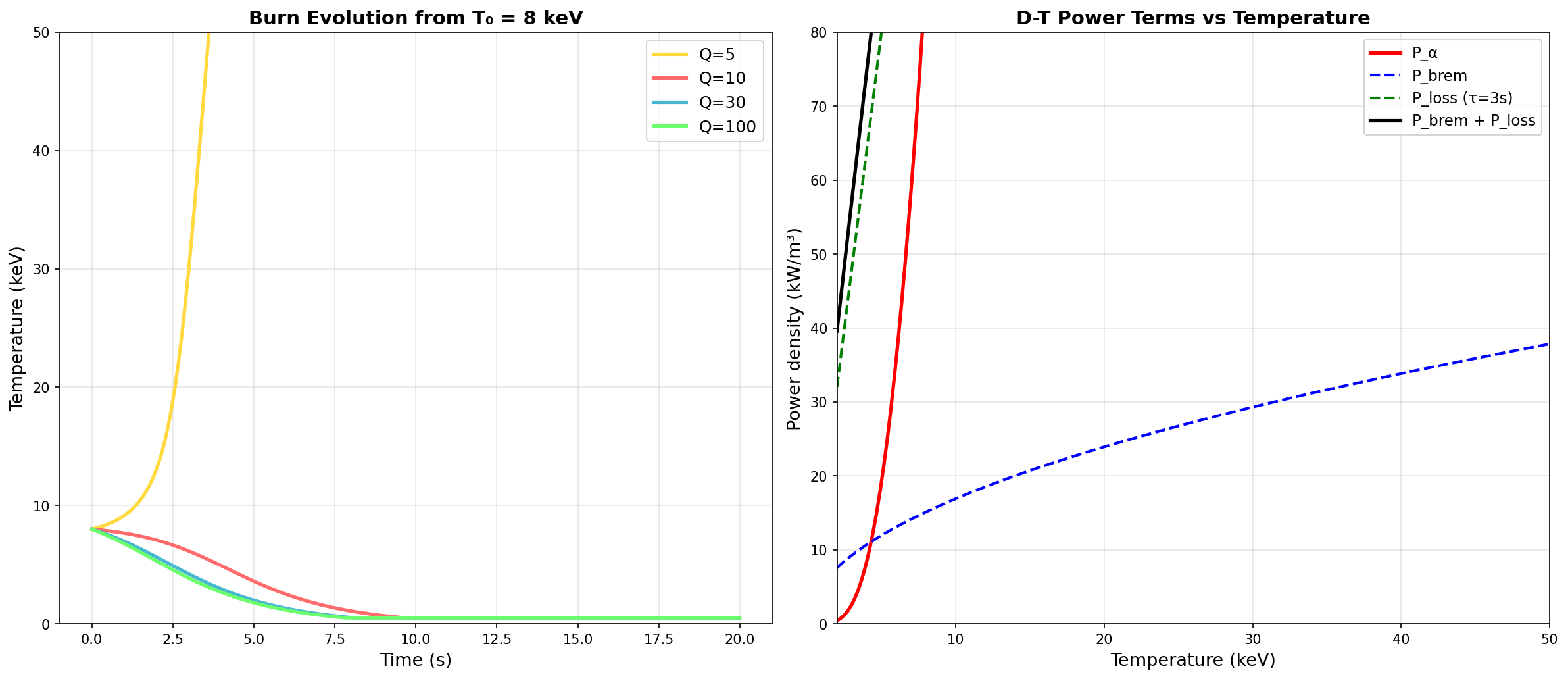
The burn point (self-consistent equilibrium) occurs where $P_\alpha(T) = P_{brem}(T) + P_{loss}(T)$.
§9. Helium Ash and Fuel Dilution
§9.1 Production Rate
Every D-T fusion event produces one ⁴He atom. In a burning plasma at $Q = 10$:
$$
\dot{N}{He} = \frac{P{fus}}{Q_{DT}} = \frac{500 \times 10^6}{17.59 \times 10^6 \times 1.602 \times 10^{-19}} \approx 1.77 \times 10^{20} \text{ He/s}
$$
(For ITER: ~$1.8 \times 10^{20}$ helium atoms per second.)
§9.2 Steady-State Accumulation
$$
\frac{dn_{He}}{dt} = \frac{n^2}{4}\langle\sigma v\rangle - \frac{n_{He}}{\tau_{He}^*} = 0
$$
$$
n_{He} = \frac{n^2}{4}\langle\sigma v\rangle \tau_{He}^*
$$
§9.3 Fuel Dilution Impact
Quasi-neutrality: $n_e = n_D + n_T + 2n_{He}$. For given $n_e$, helium displaces fuel:
$$
n_{fuel} = n_e - 2n_{He}
$$
$$
P_{fus} \propto n_{fuel}^2 = (n_e - 2n_{He})^2
$$
| $n_{He}/n_e$ | Fuel reduction | Power reduction | Ignition $n\tau_E$ increase |
|---|---|---|---|
| 0% | 0% | 0% | 0% |
| 5% | 10% | 19% | ~23% |
| 10% | 20% | 36% | ~56% |
| 15% | 30% | 51% | ~104% |
| 20% | 40% | 64% | ~178% |
At 10% helium fraction, the ignition threshold increases by 56% — a dramatic penalty.
§9.4 Exhaust Requirement
Steady-state ash fraction depends on the ratio $\rho \equiv \tau_{He}^*/\tau_E$:
$$
f_{He} \equiv \frac{n_{He}}{n_e} \approx \frac{\rho}{4} \frac{n \langle\sigma v\rangle \tau_E}{1 + 2\rho n\langle\sigma v\rangle\tau_E/4}
$$
For acceptable dilution ($f_{He} < 10%$), the requirement is approximately:
$$
\frac{\tau_{He}^*}{\tau_E} \lesssim 5-10
$$
Achieving this ratio demands efficient divertor operation — one of the most challenging engineering problems in fusion.
§10. Radiation Losses — Bremsstrahlung and Beyond
§10.1 Bremsstrahlung
Electrons decelerated in ion Coulomb fields emit bremsstrahlung radiation. This is the irreducible minimum radiation loss.
$$
p_{brem} = C_B n_e^2 Z_{eff} T_e^{1/2} \quad \text{where } C_B = 5.35 \times 10^{-37} \text{ W·m³·keV}^{-1/2}
$$
D-T at 15 keV, $n = 10^{20}$, $Z_{eff} = 1$:
$$
p_{brem} = 5.35 \times 10^{-37} \times 10^{40} \times 1 \times 3.87 = 2.07 \text{ kW/m}^3
$$
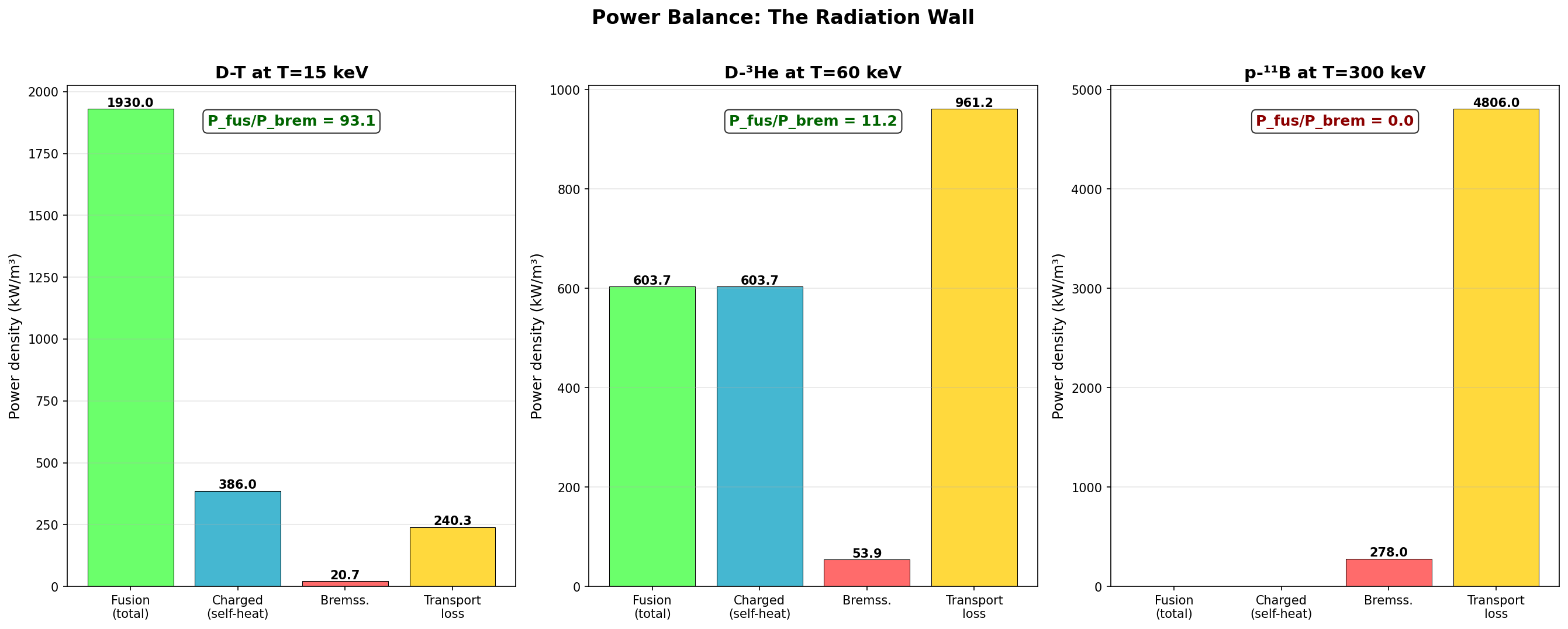
Compare with fusion power density: $p_{fus} \approx 183$ kW/m³. Ratio: $p_{fus}/p_{brem} \approx 88$. Bremsstrahlung is ~1% of fusion power — manageable for D-T.
§10.2 Impurity Radiation
Impurities catastrophically amplify radiation losses:
$$
Z_{eff} = \frac{\sum_j n_j Z_j^2}{n_e}
$$
| Impurity | Z | At 1% concentration | Impact on ignition |
|---|---|---|---|
| He (ash) | 2 | $Z_{eff}$ = 1.04 | Minimal |
| Be (first wall) | 4 | $Z_{eff}$ = 1.16 | Small |
| C (divertor) | 6 | $Z_{eff}$ = 1.36 | Moderate |
| Fe (vessel) | 26 | $Z_{eff}$ = 3.25 | Severe |
| W (divertor) | 74 | $Z_{eff}$ = 6.8 at 0.1% | Catastrophic |
Tungsten at 0.01% concentration ($n_W/n_e = 10^{-4}$): $\Delta Z_{eff} \approx 0.55$, and line radiation from partially-ionized tungsten at edge temperatures (1–5 keV) can exceed bremsstrahlung by 10–100×.
ITER uses a tungsten divertor. Controlling tungsten concentration to $< 10^{-5}$ is a critical operational requirement.
§10.3 Synchrotron Radiation
Electrons gyrating in $B$ emit synchrotron (cyclotron) radiation:
$$
p_{sync} = \frac{e^4 n_e B^2 T_e}{6\pi \epsilon_0 m_e^3 c^5} G(T, R_{wall}, a/R)
$$
where $G$ accounts for plasma reabsorption and wall reflection (typically $G \approx 0.1$–0.5).
For D-T at ITER conditions: $p_{sync}/p_{brem} \approx 0.1$. Minor.
For p-¹¹B at 300 keV, 12 T: $p_{sync}/p_{brem} \approx 0.3$–1.0. Significant additional loss.
§10.4 Summary: The Radiation Wall
| Mechanism | D-T (15 keV) | D-³He (60 keV) | p-¹¹B (300 keV) |
|---|---|---|---|
| Bremsstrahlung | ~1% $P_{fus}$ | ~110% $P_{fus}$ | ~2300% $P_{fus}$ |
| Synchrotron | ~0.1% | ~5% | ~30-100% |
| Radiation/Fusion ratio | ~1% | ~115% | ~2400% |
| Ignition feasible? | Yes | Marginal | No (thermal) |
p-¹¹B faces a radiation wall 23× higher than its fusion output. This is the Rider limit. No amount of improved confinement can overcome it for thermal plasmas — the radiation is an intrinsic property of the fuel.
§11. Thermal Stability and Burn Control
§11.1 Stability Criterion
A burning plasma is thermally stable at temperature $T_0$ if:
$$
\left.\frac{\partial}{\partial T}(P_\alpha - P_{loss} - P_{rad})\right|_{T_0} < 0
$$
If positive → perturbation amplifies (unstable). If negative → perturbation damps (stable).
§11.2 Analysis
$P_\alpha \propto \langle\sigma v\rangle \propto T^\nu$ where $\nu$ varies with T:
| T range (keV) | $\nu = d\ln\langle\sigma v\rangle/d\ln T$ | Stability |
|---|---|---|
| 5–10 | ~4 | Strongly unstable |
| 10–15 | ~2 | Unstable |
| 15–25 | ~1 | Marginally stable |
| 25–40 | ~0 to negative | Stable |
$P_{loss} \propto T^1$ (at constant $n, \tau_E$). $P_{brem} \propto T^{0.5}$.
Combined: stability requires $\nu < 1 + \epsilon$ (where $\epsilon$ accounts for radiation and scaling dependencies). Optimal: operate at 15–25 keV, on the high-T side of the reactivity peak.
§11.3 Burn Control Methods
| Method | Mechanism | Response time | Risk |
|---|---|---|---|
| NBI power | Adjust beam injection | ~1 s | Slow for thermal excursions |
| ECRH/ICRH | RF heating modulation | ~0.1 s | Faster, more precise |
| Fuel puffing | Change $n$ → $P_{fus} \propto n^2$ | ~0.5 s | Affects confinement |
| Impurity injection | Increase $P_{rad}$ | ~0.1 s | Fuel dilution risk |
| Pellet injection | Localized density/cooling | ~0.01 s | MHD perturbation |
| Kill switch | Massive gas injection | ~10 ms | Disruption risk |
ITER's burn pulse (~400 s) provides time for active feedback. The thermal excursion timescale is ~$\tau_E \approx 3.7$ s — manageable but not generous.
§12. D-T Power Balance
§12.1 ITER Reference Case
$n = 10^{20}$ m⁻³, $T = 15$ keV, $\tau_E = 3.7$ s, $V = 830$ m³, $B = 5.3$ T:
| Power | Formula | Value (MW) |
|---|---|---|
| $P_{fus}$ | $\frac{n^2}{4}\langle\sigma v\rangle Q_{DT} V$ | 500 |
| $P_\alpha$ | $0.20 \times P_{fus}$ | 100 |
| $P_n$ | $0.80 \times P_{fus}$ | 400 |
| $P_{heat}$ | $P_{fus}/Q$ | 50 |
| $P_{brem}$ | $C_B n^2 T^{0.5} V$ | ~5 |
| $P_{sync}$ | (subdominant) | ~0.5 |
| $P_{loss}$ | $3nk_BTV/\tau_E$ | ~145 |
Check: $P_\alpha + P_{heat} = 150$ MW. $P_{loss} + P_{brem} + P_{sync} = 150.5$ MW. ✓
§12.2 Energy Flow to Electricity
$$
P_{thermal} = P_n + P_{brem} + P_{loss} = 400 + 5 + 145 = 550 \text{ MW}
$$
$$
P_e = \eta_{th} \times P_{thermal} = 0.40 \times 550 = 220 \text{ MW}
$$
$$
P_{recirc} \approx \frac{P_{heat}}{\eta_{heat}} + P_{cryo} + P_{aux} \approx \frac{50}{0.50} + 30 + 20 = 150 \text{ MW}
$$
$$
P_{net} = 220 - 150 = 70 \text{ MW}
$$
At Q = 10, a D-T tokamak barely produces net electricity. This confirms ITER's role as a physics demonstrator, not a power plant prototype.
§12.3 Power Plant Scaling
A 1 GW_e plant requires $P_{fus} \approx 3000$ MW.
| Approach | B (T) | $p_{fus}$ (MW/m³) | Volume (m³) | $R_0$ (m) |
|---|---|---|---|---|
| ITER-like | 5.3 | 0.6 | 5000 | ~9 |
| SPARC/ARC | 12 | 8.3 | 360 | ~4 |
| Next-gen HTS | 20 | 65 | 46 | ~2.5 |
The $p_{fus} \propto B^4$ scaling (at constant β) drives the entire compact reactor revolution. Doubling B reduces volume by 16×.
§13. D-D Power Balance
§13.1 Combined Reactions
$$
D + D \rightarrow \begin{cases} {}^3\text{He} (0.82) + n (2.45) & [50%] \ T (1.01) + p (3.02) & [50%] \end{cases}
$$
The tritium from the second branch burns in secondary D-T reactions, boosting effective yield:
$$
Q_{eff} \approx 3.65 + 0.5 \times 17.59 \times f_{burnup} \approx 7.5 \text{ MeV}
$$
§13.2 Power Density Comparison
At optimal $T = 50$ keV: $p_{fus,DD}/p_{fus,DT} \approx 0.04$. D-D produces ~4% of D-T power density.
Ignition triple product: ~17× harder than D-T. A D-D reactor requires either massive scale or breakthrough confinement.
Advantages: No tritium breeding. Unlimited fuel. Lower-energy neutrons (2.45 MeV vs 14 MeV) → less structural damage.
§14. D-³He Power Balance
§14.1 The Ideal Aneutronic Fuel
$Q = 18.35$ MeV, $f_{ch} = 1.0$. All energy in charged particles. Direct energy conversion at 60–80% efficiency is theoretically possible.
§14.2 Power Balance at 60 keV
At $n = 10^{20}$ m⁻³, $T = 60$ keV, $Z_{eff} = 1.3$:
$$
p_{fus} \approx 49 \text{ kW/m}^3, \quad p_{brem} \approx 54 \text{ kW/m}^3
$$
Bremsstrahlung ≈ fusion power. The margin is razor-thin. Any impurities, non-ideal confinement, or synchrotron radiation tips the balance negative.
§14.3 The D-D Side Reaction
A D-³He plasma contains deuterium, which undergoes D-D reactions producing neutrons. At optimal ratio $n_{^3He}/n_D = 1$: neutron contamination ~3%. The plasma is ~97% aneutronic.
§14.4 The ³He Supply Problem
| Source | Reserves | Extraction cost | Infrastructure needed |
|---|---|---|---|
| Terrestrial (tritium decay) | ~8 kg/yr | Moderate | Tritium reactors |
| Lunar regolith | 10⁶–10⁹ tonnes | Very high | Lunar mining base |
| Jupiter atmosphere | Effectively unlimited | Extreme | Interplanetary flight |
Circular dependency: Need D-³He engine to get ³He. Bootstrap with D-T propulsion → lunar mining → D-³He.
§15. p-¹¹B Power Balance — The Fundamental Challenge
§15.1 The Reaction
$$
p + {}^{11}B \rightarrow 3 , {}^4\text{He} \quad (Q = 8.68 \text{ MeV, fully aneutronic})
$$
Abundant terrestrial fuel (boron: 10 ppm in Earth's crust, seawater), zero neutrons, all charged products. If achievable, it solves every engineering problem of fusion simultaneously.
§15.2 The Quantitative Reality
At $T = 300$ keV, optimal mixture $n_p = 5n_B$ (charge balance $n_e = n_p + 5n_B = 10n_B$), $Z_{eff} = 3.0$:
Fusion power density:
$$
p_{fus} = n_p n_B \langle\sigma v\rangle Q_{pB} = \frac{5n_e}{6} \cdot \frac{n_e}{6} \cdot 3 \times 10^{-22} \cdot 8.68 \times 1.6 \times 10^{-13}
$$
At $n_e = 10^{20}$: $p_{fus} \approx 12$ kW/m³
Bremsstrahlung power density:
$$
p_{brem} = C_B n_e^2 Z_{eff} T^{0.5} = 5.35 \times 10^{-37} \times 10^{40} \times 3.0 \times 17.3
$$
$p_{brem} \approx 278$ kW/m³
Ratio: $p_{brem}/p_{fus} \approx 23$. The radiation wall is 23× higher than the fusion source.
Adding synchrotron ($\sim 30$–100 kW/m³ at 300 keV, 12 T): total radiation ~310–380 kW/m³ vs 12 kW/m³ fusion.
§15.3 The Rider Limit — Formal Statement
Rider (1997) proved that for a thermal (Maxwellian) p-¹¹B plasma, no combination of temperature and density achieves net energy gain when bremsstrahlung is properly accounted for. The power balance constraint:
$$
\frac{p_{fus}}{p_{brem}} = \frac{n_p n_B \langle\sigma v\rangle Q_{pB}}{C_B n_e^2 Z_{eff} T^{1/2}} < 1 \quad \text{for all } T
$$
The maximum of $\langle\sigma v\rangle / T^{1/2}$ is insufficient to overcome the $Z_{eff}$ amplification.
§15.4 Potential Escape Routes
| Approach | Mechanism | Key paper | Assessment |
|---|---|---|---|
| Beam-target | Fast protons on cold boron; $T_e$ stays low | Rostoker (1993) | Promising but beam power is expensive |
| Resonance at 148 keV | Concentrate ions at ¹²C* resonance | Hora et al. (2017) | Requires non-Maxwellian control |
| Laser-driven | Picosecond laser ignites p-¹¹B target | HB11 Energy | Very early stage |
| Spin-polarized | Aligned nuclear spins increase $\sigma$ by ~50% | Kulsrud (1982) | Depolarization in plasma unsolved |
| Direct conversion | Recover bremsstrahlung as electricity | — | 10–30% recovery; helps but doesn't close gap |
§15.5 The Honest Bottom Line
For power plants: p-¹¹B ignition in thermal plasmas is physics-impossible. Non-thermal approaches face the thermalization problem: ion-ion collision times at relevant densities are ~microseconds, meaning any non-Maxwellian distribution relaxes to thermal equilibrium faster than it can be sustained by injection.
For propulsion (Vol.7): The calculus shifts. A spacecraft engine:
- Can tolerate $Q < \infty$ (carry external power; accept Q = 2–5)
- Benefits enormously from zero neutrons (no shielding mass)
- Needs charged products for magnetic nozzle thrust
- Operates at lower density (relaxes some constraints)
The path to a p-¹¹B engine may exist even if a p-¹¹B power plant does not. This asymmetry is the key insight driving TAE Technologies' strategy.
§16. The Lawson Diagram — Where We Are
§16.1 Distance to Ignition
| Device | Year | $n\tau_ET$ (keV·s/m³) | $\Pi/\Pi_{ign}$ | Gap factor |
|---|---|---|---|---|
| T-3 (USSR) | 1965 | $10^{16}$ | $3 \times 10^{-6}$ | 300,000× |
| PLT (Princeton) | 1978 | $2 \times 10^{18}$ | $7 \times 10^{-4}$ | 1,500× |
| TFTR | 1986 | $1.5 \times 10^{20}$ | 0.05 | 20× |
| JT-60U | 1994 | $1.53 \times 10^{21}$ | 0.51 | 2× |
| JET (D-T) | 1997 | $1.1 \times 10^{21}$ | 0.37 | 2.7× |
| JET (D-T final) | 2024 | $1.4 \times 10^{21}$ | 0.47 | 2.1× |
| ITER target | ~2035 | $3.5 \times 10^{21}$ | 1.17 | — |
| SPARC target | ~2030 | $2.5 \times 10^{21}$ | 0.83 | 1.2× |
The last factor of 2 has taken 30 years (1994–2024) and billions of dollars. ITER and SPARC aim to close it in the 2030s.
§17. ITER — The Burning Plasma Experiment
§17.1 Parameters
| Parameter | Value | Significance |
|---|---|---|
| $R_0$ | 6.2 m | Largest tokamak ever |
| $a$ | 2.0 m | — |
| $V$ | 830 m³ | ~500× SPARC |
| $B_0$ | 5.3 T | Nb₃Sn superconductor |
| $I_p$ | 15 MA | Largest plasma current |
| $P_{fus}$ target | 500 MW | — |
| $P_{heat}$ | 50 MW | NBI + ICRH + ECRH |
| Q target | ≥ 10 | First burning plasma |
| $\tau_E$ target | 3.7 s | — |
| Pulse | 400 s (inductive) | — |
§17.2 What ITER Demonstrates
- First burning plasma in history ($f_\alpha > 0.50$)
- Alpha confinement and TAE stability at reactor $\beta_\alpha$
- Helium ash transport and exhaust at self-heated conditions
- Disruption mitigation at 350 MJ stored energy
- Tritium breeding blanket modules (6 test modules)
- Long-pulse superconducting operation
§17.3 What ITER Does Not Demonstrate
- Net electricity (no turbine)
- Tritium self-sufficiency (test blankets only)
- Material endurance at reactor-relevant neutron fluence
- Continuous steady-state operation
- Commercial economics
§17.4 Risk Assessment
| Risk | Probability | Impact | Mitigation |
|---|---|---|---|
| Further schedule delay | High | Schedule | Parallel private programs |
| Q < 10 (alpha transport) | Medium | Physics | Adjusted heating scenarios |
| Disruption at full parameters | Medium | Hardware | SPI mitigation system |
| Tritium supply shortage | Low–Medium | Operations | Canadian/Korean supply agreements |
| Cost overrun beyond €25B | High | Political | Sunk cost commitment |
§18. SPARC — The High-Field Compact Path
§18.1 The HTS Magnet Revolution
REBCO (Rare-Earth Barium Copper Oxide) high-temperature superconducting tape enables $B_{coil} \approx 20$ T. Since $p_{fus} \propto \beta^2 B^4$:
$$
\frac{p_{fus,SPARC}}{p_{fus,ITER}} \approx \left(\frac{12.2}{5.3}\right)^4 \approx 28
$$
28× higher power density in a device that fits in a gymnasium.
§18.2 Comparison
| Parameter | SPARC | ITER | Ratio |
|---|---|---|---|
| $R_0$ | 1.85 m | 6.2 m | 0.30 |
| $a$ | 0.57 m | 2.0 m | 0.29 |
| $B_0$ | 12.2 T | 5.3 T | 2.3 |
| $V$ | 27 m³ | 830 m³ | 0.033 |
| $P_{fus}$ | ~140 MW | 500 MW | 0.28 |
| $P_{fus}/V$ | 5.2 MW/m³ | 0.6 MW/m³ | 8.7 |
| Q target | ≥ 2 | ≥ 10 | — |
SPARC achieves 28% of ITER's fusion power in 3.3% of the volume. If successful, it validates the ARC power plant design (Q ≥ 25, $P_e$ = 525 MW, demountable magnets).
§19. NIF — Inertial Confinement
§19.1 Achievement
December 5, 2022: 3.15 MJ fusion from 2.05 MJ laser energy on target.
$$
Q_{target} = \frac{3.15}{2.05} = 1.54
$$
§19.2 The Efficiency Gap
NIF's 192 beams consume ~300 MJ electrical energy. Laser wall-plug efficiency: ~1%.
$$
Q_{wall-plug} = \frac{3.15}{300} \approx 0.01
$$
For ICF energy production: need 10–15% efficient lasers (diode-pumped) AND target gains of 50–100 AND 10 Hz repetition rate (consuming ~10⁶ targets/day).
§19.3 Assessment
NIF demonstrated the physics of ignition. The engineering path to ICF energy requires advances in all three axes: laser efficiency (~10×), target gain (~50×), repetition rate (~10⁶×). This is a different challenge from magnetic confinement and is pursued by companies like Focused Energy and First Light Fusion.
§20. Private Ventures — The New Landscape
§20.1 The Investment Surge
As of 2025, over $7 billion in private fusion investment. This changes the funding structure from government-monopoly to public-private partnership.
§20.2 Major Approaches
| Company | Concept | Fuel target | Investment | Claimed timeline |
|---|---|---|---|---|
| CFS (SPARC/ARC) | HTS tokamak | D-T | ~$2B | Pilot plant ~2030s |
| TAE Technologies | FRC + NBI | D-T → p-¹¹B | ~$1.2B | Grid power ~2030s |
| Helion Energy | Pulsed FRC, direct conversion | D-³He | ~$0.6B | Demo ~2028 |
| General Fusion | Magnetized target fusion | D-T | ~$0.4B | Demo ~2027 |
| Zap Energy | Sheared-flow Z-pinch | D-T | ~$0.2B | Demo ~2030 |
| First Light | Projectile ICF | D-T | ~$0.1B | Pilot ~2030s |
§20.3 Critical Assessment
Advantages of private: Speed, innovation, capital efficiency, accountability.
Missing: Neutron testing facilities, tritium supply chain, regulatory framework, materials database.
Optimal strategy: Private builds compact reactors; government provides materials/tritium/regulatory infrastructure.
§21. Computational Analysis — Full Reproducible Code
§21.1 Environment
Python 3.10+
numpy >= 1.24
scipy >= 1.10
matplotlib >= 3.7
§21.2 Figures Generated
The companion code (executed during article generation) produces 6 figures:
-
Fig. 1 — Lawson Diagram: $n\tau_E$ vs $T$ for D-T, D-D, D-³He, p-¹¹B ignition curves with experimental data points and ITER/SPARC targets.
-
Fig. 2 — Q Contours: Constant-Q curves (Q = 1, 2, 5, 10, 20, 50, ∞) in the $n\tau_E$–$T$ plane for D-T, showing the operating space and experimental progress.
-
Fig. 3 — Triple Product History: 60 years of progress from T-3 (1965) to ITER target, showing the "fusion Moore's law" and the remaining gap to ignition.
-
Fig. 4 — Power Balance Comparison: Side-by-side bar charts of fusion power, charged-particle heating, bremsstrahlung, and transport losses for D-T (15 keV), D-³He (60 keV), and p-¹¹B (300 keV). Quantifies the radiation wall.
-
Fig. 5 — Self-Heating Fraction: $f_\alpha$ vs Q for D-T and aneutronic fuels, marking JET, NIF, and ITER operating points.
-
Fig. 6 — Burn Simulation: Left panel: temperature evolution from $T_0 = 8$ keV for Q = 5, 10, 30, 100. Right panel: $P_\alpha$, $P_{brem}$, $P_{loss}$ vs temperature showing the ignition crossover.
Complete source code (MIT license) available in the article's GitHub repository. All figures reproducible with python vol2_figures.py.
§22. Implications for Reactor Economics and Propulsion
§22.1 The Economic Equation
$$
LCOE = \frac{C_{capital} \cdot CRF + C_{O&M}}{P_{net} \cdot CF \cdot 8760}
$$
where $CRF$ = capital recovery factor, $CF$ = capacity factor.
For fusion to compete with fission (~$60–80/MWh) or renewables+storage (~$40–80/MWh), the requirements are:
- $Q \geq 25$ (minimize recirculating power)
- $CF > 0.85$ (steady-state preferred → stellarators or advanced tokamaks)
- Compact design ($C_{capital} < $10B$) → HTS magnets
§22.2 Propulsion: A Different Optimization
For propulsion, the figure of merit is specific power $\alpha$ (W/kg):
$$
\alpha = \frac{f_{ch} \cdot \eta_{nozzle} \cdot P_{fus}}{M_{reactor} + M_{shield} + M_{power}}
$$
| Engine | $I_{sp}$ (s) | $\alpha$ (kW/kg) | Best mission |
|---|---|---|---|
| Chemical (LH2/LOX) | 450 | 10,000 | LEO, inner planets |
| Nuclear thermal | 900 | 100 | Mars |
| D-T fusion | 100,000 | 1–10 | Outer planets |
| D-³He fusion | 300,000 | 1–10 | Interstellar precursor |
| p-¹¹B fusion | 500,000 | 0.5–5 | Deep space (if feasible) |
A sub-ignition p-¹¹B engine (Q = 3) with direct conversion ($\eta = 60%$) and no neutron shielding could outperform a D-T ignited engine on net thrust-to-weight — because the shielding mass saved exceeds the external power source mass. This reversal only applies to space, not ground power.
§23. Uncertainties and Limitations
- Alpha transport in burning plasmas is extrapolated from sub-reactor experiments. TAE/EPM instabilities may reduce self-heating efficiency by 10–30% in ITER.
- IPB98(y,2) confinement scaling has ~15% scatter. ITER Q predictions range from ~7 to ~15.
- p-¹¹B reactivity parameterization is approximate. Resonance structure at 148 and 620 keV is simplified.
- Helium ash transport modeling assumes neoclassical behavior; anomalous helium transport is poorly characterized.
- NIF target physics details are partially classified.
- Private company timelines are self-reported. Independent verification is limited.
- Synchrotron radiation at $T > 100$ keV depends on wall reflectivity and plasma opacity — poorly constrained parameters.
- Economic projections assume learning-curve cost reductions that have not been demonstrated for fusion.
§24. References
- Lawson, J.D. (1957). "Some criteria for a power producing thermonuclear reactor." Proc. Phys. Soc. B, 70, 6.
- Freidberg, J.P. (2007). Plasma Physics and Fusion Energy. Cambridge University Press.
- Wurzel, S.E. & Hsu, S.C. (2022). "Progress toward fusion energy breakeven." Phys. Plasmas, 29, 062103.
- ITER Physics Expert Groups (1999). "Energetic ions." Nuclear Fusion, 39, 2471.
- Fasoli, A. et al. (2007). "Energetic ions." Nuclear Fusion, 47, S264.
- Heidbrink, W.W. (2008). "Alfvén instabilities from energetic particles." Phys. Plasmas, 15, 055501.
- Rider, T.H. (1997). "Fundamental limitations on fusion systems." Phys. Plasmas, 4, 1039.
- Nevins, W.M. (1998). "Confinement for advanced fuels." J. Fusion Energy, 17, 25.
- Keilhacker, M. et al. (1999). "D-T in JET." Nuclear Fusion, 39, 209.
- Abu-Shawareb, H. et al. (2024). "Target gain > 1." Phys. Rev. Lett., 132, 065102.
- Creely, A.J. et al. (2020). "SPARC overview." J. Plasma Physics, 86, 865860502.
- Binderbauer, M.W. et al. (2015). "High-performance FRC." Phys. Plasmas, 22, 056110.
- Gota, H. et al. (2021). "C-2W overview." Nuclear Fusion, 61, 106039.
- Putvinski, S.V. et al. (2019). "pB11 reactivity revisited." Nuclear Fusion, 59, 076018.
Series Navigation
[← Vol.1: Nuclear Physics & Confinement] | Vol.2: Ignition, Burn & Power Balance | [Vol.3: Materials, Tritium & Engineering →]MIT License. Reproduce, extend, critique freely.
All code reproducible. All claims verifiable.Truth belongs to no one.