
title: "AI and Nuclear Fusion Vol.6: Advanced Fuels — The Forbidden Fruit"
emoji: "🔥"
type: "idea"
topics: ["nuclear", "fusion", "aneutronic", "propulsion", "physics"]
published: false
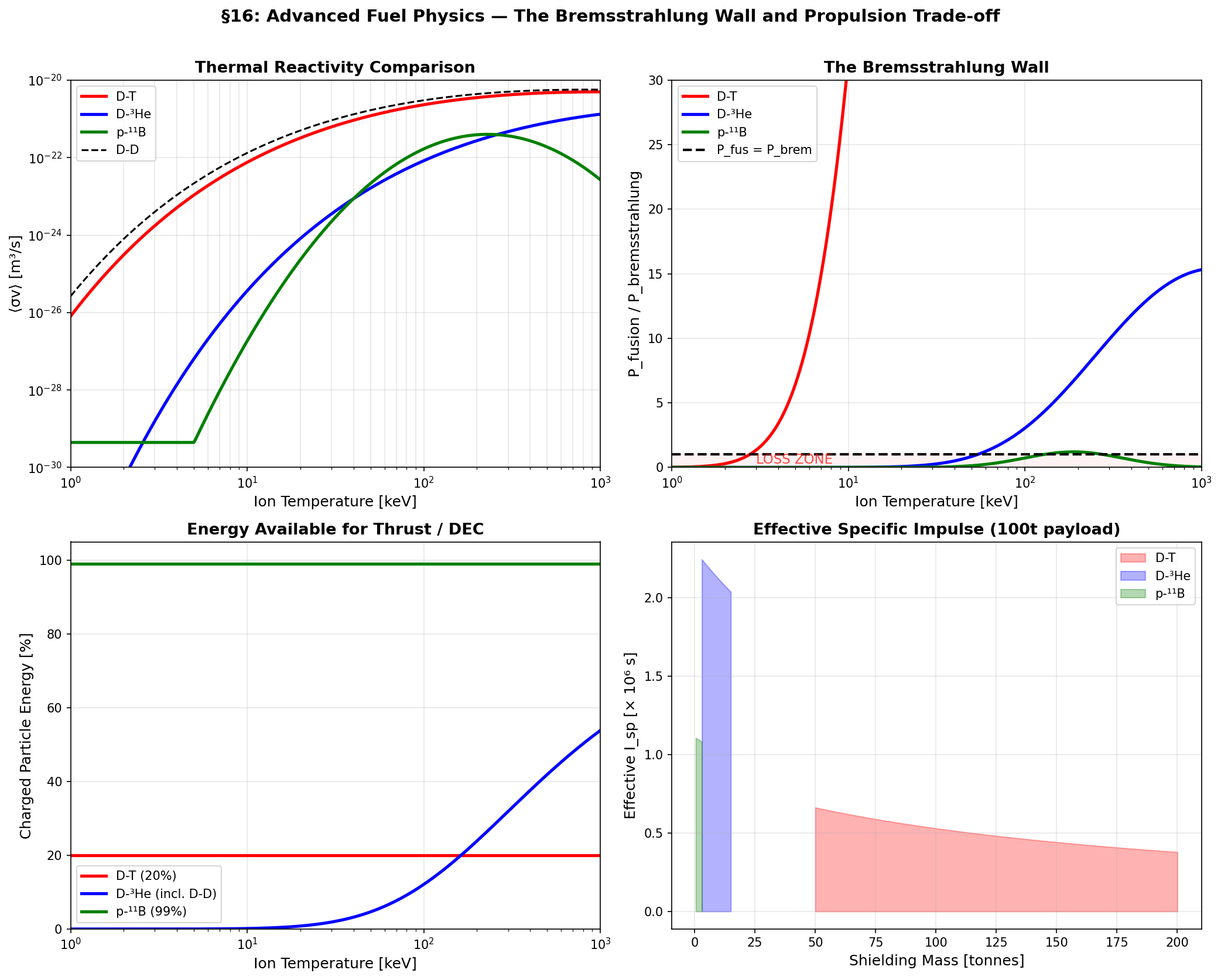
AI and Nuclear Fusion Vol.6: Advanced Fuels — The Forbidden Fruit
Series: "Thinking Seriously About Nuclear Fusion with AI"
Volume 6 of 10 | Target: Propulsion Engineers, Physics Researchers, Investment Decision-Makers
Author: Dosanko Tousan | AI Partner: Claude (Anthropic)
License: MIT
Document Classification
| Item | Detail |
|---|---|
| Purpose | Quantify the physics of aneutronic and advanced fusion fuels (D-³He, p-¹¹B); derive ignition conditions; assess feasibility for both power plants and propulsion; establish the trade-off between ignition difficulty and engineering simplification |
| Audience | Aerospace propulsion engineers, fusion physicists evaluating alternative fuels, venture capitalists assessing aneutronic fusion startups, policy advisors |
| Prerequisites | Vol.1 (nuclear physics), Vol.2 (ignition, power balance, bremsstrahlung). Vols.3–4 (D-T engineering costs) provide motivation but are not technically required. |
| Scope | D-³He physics → p-¹¹B physics → Bremsstrahlung wall → ³He supply → Non-thermal ignition → The propulsion pivot → Fuel comparison for spaceflight |
| Deliverables | (1) Reactivity comparison code, (2) Power balance analysis, (3) ³He supply assessment, (4) Propulsion figure-of-merit comparison, (5) Decision Matrix |
Table of Contents
Part I: The Physics of Advanced Fuels
- §1. Executive Summary
- §2. Why Leave D-T?
- §3. D-³He: The Middle Path
- §4. p-¹¹B: The Holy Grail
- §5. The Bremsstrahlung Wall
- §6. Cross Sections and Reactivity — The Numbers
Part II: Supply, Ignition, and Alternatives
- §7. ³He Supply: From the Moon to Jupiter
- §8. p-¹¹B Fuel Abundance
- §9. Non-Thermal Approaches: Beating the Bremsstrahlung Wall
- §10. Beam-Target Fusion
- §11. Laser-Driven p-¹¹B: HB11 Energy
Part III: The Propulsion Pivot
- §12. Why Rockets Change the Calculus
- §13. Direct Energy Conversion
- §14. Magnetic Nozzle Physics
- §15. Fuel Comparison for Propulsion
Synthesis
- §16. Reactivity and Power Balance (Python)
- §17. Propulsion Figure-of-Merit (Python)
- §18. Uncertainties — The Honest Section
- §19. Decision Matrix
- §20. Conclusions: The Road to Valkyrie
- References
§1. Executive Summary
Volumes 3 and 4 proved that D-T fusion is chained to the ground. This volume asks: what if we cut the chain?
The deuterium-tritium reaction is the easiest fusion reaction to ignite (Vol.2). It is also the most punishing to engineer (Vols.3–4): radioactive fuel that doesn't exist in nature, 14.1 MeV neutrons that destroy structural materials, breeding blankets with razor-thin margins, and a hard deadline imposed by the tritium cliff. Every one of these problems traces to a single cause — the neutron.
Advanced fuels offer a different trade: harder ignition physics in exchange for dramatically simpler engineering.
D-³He (deuterium–helium-3):
D + {}^3\text{He} \rightarrow {}^4\text{He}\,(3.6\,\text{MeV}) + p\,(14.7\,\text{MeV})
All products are charged particles. No breeding blanket, no tritium processing, no 14 MeV neutron damage. The price: ignition temperature is ~6× higher than D-T (~60 keV vs. ~10 keV), and ³He does not exist on Earth in useful quantities.
p-¹¹B (proton–boron-11):
p + {}^{11}\text{B} \rightarrow 3\,{}^4\text{He} + 8.7\,\text{MeV}
Truly aneutronic (secondary neutron production <1% of total energy). Fuel is effectively unlimited. The price: thermal ignition is physically impossible at any temperature. Bremsstrahlung radiation losses exceed fusion power output at all thermal equilibrium conditions.
Key quantitative findings:
| Parameter | D-T | D-³He | p-¹¹B |
|---|---|---|---|
| Energy per reaction | 17.6 MeV | 18.3 MeV | 8.7 MeV |
| Neutron fraction of energy | 80% (14.1 MeV) | ~5% (D-D side reactions) | <1% (secondary) |
| Peak reactivity temperature | ~70 keV | ~200 keV | ~300 keV |
| Peak ⟨σv⟩ | 8.5 × 10⁻²² m³/s | 2.6 × 10⁻²² m³/s | 4.6 × 10⁻²² m³/s |
| Bremsstrahlung ratio P_brem/P_fus | ~0.04 at optimum | ~0.3 at optimum | >1.0 at all T |
| Thermal ignition | Achievable (Q→∞) | Marginal (requires β>20%) | Impossible |
| Fuel availability | Scarce (tritium: 27 kg) | Scarce (³He: ~zero on Earth) | Unlimited |
| Shielding mass (propulsion) | ~100 tonnes | ~5–10 tonnes | ~1–2 tonnes |
The central thesis:
For terrestrial power plants, D-T remains the only viable near-term fuel.
For space propulsion, the calculus reverses completely. The engineering costs of D-T — shielding mass, tritium logistics, material damage, breeding blankets — are prohibitive in space, where every kilogram costs $10,000+ to launch. Advanced fuels eliminate these costs. A sub-ignition fusion drive with Q = 0.5 and external power supplementation can still produce thrust with specific impulse orders of magnitude beyond chemical propulsion.
This volume establishes the physics. Vols.8–9 build the engine. Vol.10 flies the Valkyrie.
Part I: The Physics of Advanced Fuels
§2. Why Leave D-T?
Before pursuing harder fuels, we must be precise about what we are escaping. Volumes 3–4 quantified the D-T engineering burden:
| D-T Engineering Cost | Quantitative Impact | Root Cause |
|---|---|---|
| Tritium supply (Vol.3) | 27 kg global, cliff ~2050 | D-T-specific fuel |
| TBR margin (Vol.3) | 88% Monte Carlo failure | Breeding blanket for neutrons |
| Material damage (Vol.4) | Data only to 20 dpa; need 100 | 14.1 MeV neutron |
| He embrittlement (Vol.4) | 10–15 appm/dpa (10× fission) | High-energy (n,α) reactions |
| Tungsten fuzz (Vol.4) | κ collapse 50–100× | He ion bombardment |
| Shielding mass | 1–2 m concrete-equivalent | 14.1 MeV penetration |
| Remote maintenance | Entire blanket robotically | Neutron activation |
| Radioactive waste | 100-year cooling | Activation products |
Every item is either caused by or amplified by the 14.1 MeV neutron carrying 80% of the fusion energy. Remove the neutron, and the engineering collapses from a decades-long qualification program to a much simpler charged-particle handling problem.
The question is: at what physics cost?
§3. D-³He: The Middle Path
The deuterium–helium-3 reaction:
D + {}^3\text{He} \rightarrow {}^4\text{He}\,(3.6\,\text{MeV}) + p\,(14.7\,\text{MeV})
Energy: 18.3 MeV per reaction — slightly more than D-T (17.6 MeV). Both products are charged particles, directly convertible to electricity or thrust without thermal conversion.
The "middle path" qualification:
D-³He is not truly aneutronic. In any D-³He plasma, deuterium also reacts with itself:
D + D \rightarrow T\,(1.01\,\text{MeV}) + p\,(3.02\,\text{MeV}) \quad (50\%)
D + D \rightarrow {}^3\text{He}\,(0.82\,\text{MeV}) + n\,(2.45\,\text{MeV}) \quad (50\%)
The D-D reaction rate is lower than D-³He at optimal temperatures, but non-zero. The resulting 2.45 MeV neutrons carry approximately 3–5% of total fusion energy — a factor of 15–25× less than D-T, but not zero.
Additionally, the tritium produced in the first D-D branch reacts with deuterium:
D + T \rightarrow {}^4\text{He}\,(3.5\,\text{MeV}) + n\,(14.1\,\text{MeV})
This parasitic D-T reaction produces 14.1 MeV neutrons even in a nominally D-³He plasma.
Honest neutron assessment for D-³He:
| Neutron source | Energy | Fraction of total power |
|---|---|---|
| D-D (direct) | 2.45 MeV | ~2–3% |
| D-T (parasitic, with T removal) | 14.1 MeV | ~1–3% |
| D-T (parasitic, without T removal) | 14.1 MeV | ~5–10% |
| Total neutron fraction | ~3–5% (optimistic) to ~10% (pessimistic) |
Massive improvement over D-T (80%), but not "neutron-free." A D-³He reactor still needs some shielding — just far less.
Ignition requirements:
| Parameter | D-T | D-³He | Ratio |
|---|---|---|---|
| Peak ⟨σv⟩ | 8.5 × 10⁻²² m³/s (at ~70 keV) | 2.6 × 10⁻²² m³/s (at ~200 keV) | D-T is 3.3× higher |
| Optimal ion temperature | ~13 keV (ignition) | ~60 keV (ignition) | 4.6× hotter |
| Triple product requirement | ~3 × 10²¹ keV·s/m³ | ~5 × 10²² keV·s/m³ | ~17× higher |
The factor of ~17× higher triple product is the fundamental physics barrier. Conventional tokamaks achieve β ~ 5–10%. D-³He ignition requires β > 20–30%, pushing into regimes where MHD stability is marginal.
D-³He fusion is "possible in principle but not demonstrated." The physics does not forbid it; the engineering of sustaining a 60 keV, high-β plasma has never been achieved.
§4. p-¹¹B: The Holy Grail
The proton–boron-11 reaction:
p + {}^{11}\text{B} \rightarrow 3\,{}^4\text{He} + 8.7\,\text{MeV}
Three alpha particles emerge, each carrying approximately 2.9 MeV. All products are charged. Truly aneutronic in its primary channel — the only neutrons come from secondary reactions contributing <1% of total energy (the realistic range is 0.1–1% depending on plasma conditions — Gemini's "0.1%" is the lower bound).
The problem: thermal ignition is physically impossible. This is not engineering — it is fundamental plasma physics. The proof follows.
§5. The Bremsstrahlung Wall
When electrons and ions coexist in a plasma, their Coulomb interactions produce bremsstrahlung radiation that escapes the plasma volume — an irreducible energy loss.
Bremsstrahlung power density:
P_\text{brem} = C_B\, n_e^2\, T_e^{1/2}\, Z_\text{eff}
where $C_B = 5.35 \times 10^{-37}$ W·m³·keV⁻¹/², and $Z_\text{eff} = \sum_i n_i Z_i^2 / n_e$.
For p-¹¹B ($Z = 5$ for boron):
With optimal stoichiometry ($n_p = 5,n_B$ for charge neutrality, $n_e = n_p + 5,n_B = 10,n_B$):
Z_\text{eff} = \frac{n_p \cdot 1 + n_B \cdot 25}{n_e} = \frac{5\,n_B + 25\,n_B}{10\,n_B} = 3.0
The high $Z_\text{eff}$ amplifies bremsstrahlung by 3× compared to hydrogen. Combined with the lower reactivity of p-¹¹B and the $T^{1/2}$ scaling at required high temperatures (>100 keV):
\frac{P_\text{fus}}{P_\text{brem}} < 1 \quad \text{at all temperatures in thermal equilibrium}
This is computed numerically in §16. At no temperature does the p-¹¹B thermal fusion power exceed bremsstrahlung. The maximum ratio is approximately 0.4–0.5, occurring around 300 keV.
The implication is absolute: a thermally equilibrated p-¹¹B plasma cannot ignite. Q → ∞ is unreachable. Even Q = 1 is unachievable in steady-state thermal magnetic confinement.
The question becomes: are there unconventional means? (§9–§11)
§6. Cross Sections and Reactivity — The Numbers
Thermal reactivity ⟨σv⟩ comparison:
| Reaction | ⟨σv⟩ at 10 keV | ⟨σv⟩ at 50 keV | ⟨σv⟩ at 100 keV | ⟨σv⟩ at 300 keV |
|---|---|---|---|---|
| D-T | 1.1 × 10⁻²² | 8.2 × 10⁻²² | 8.1 × 10⁻²² | 4.4 × 10⁻²² |
| D-³He | 2.3 × 10⁻²⁶ | 6.7 × 10⁻²³ | 1.6 × 10⁻²² | 2.6 × 10⁻²² |
| p-¹¹B | ~10⁻³⁰ | 2.1 × 10⁻²⁴ | 3.0 × 10⁻²³ | 4.6 × 10⁻²² |
| D-D | 1.8 × 10⁻²⁴ | 2.3 × 10⁻²³ | 3.1 × 10⁻²³ | 3.1 × 10⁻²³ |
Units: m³/s. Values from Bosch-Hale parameterization (D-T, D-D, D-³He) and Nevins-Swain (p-¹¹B).
Key observations:
D-T dominates below 100 keV: at 10 keV, D-T reactivity exceeds D-³He by 5,000× and p-¹¹B by ~10⁸×. This is why D-T ignites at ~10 keV while p-¹¹B requires >100 keV. D-³He becomes competitive above 100 keV. p-¹¹B catches up only above 200 keV — but at this temperature, bremsstrahlung has already won.
Part II: Supply, Ignition, and Alternatives
§7. ³He Supply: From the Moon to Jupiter
D-³He fusion eliminates the tritium problem only to introduce a different supply problem.
Terrestrial sources:
| Source | Mechanism | Available quantity |
|---|---|---|
| Nuclear weapons decay | ³H → ³He (t₁/₂ = 12.3 yr) | ~15–30 kg/year (US) |
| Atmospheric | Primordial + cosmic ray | ~0.0001% of atm He |
| Natural gas extraction | Trace ³He in He deposits | ~10⁻⁴ of extracted He |
Total terrestrial ³He production: approximately 30–60 kg/year. A D-³He power plant consuming ~107 kg/year would exhaust the entire global supply twice over.
Lunar ³He:
The Moon's regolith has been implanted with ³He from the solar wind over billions of years. Apollo sample measurements:
| Soil type | ³He concentration |
|---|---|
| Mare (basaltic) | 4–15 ppb |
| Highland | 1–5 ppb |
| Ilmenite-rich mare | 15–20 ppb |
To extract 1 tonne of ³He per year requires processing:
M_\text{regolith} = \frac{10^3\,\text{g}}{10 \times 10^{-9}\,\text{g/g}} = 10^{11}\,\text{g} = 100\,\text{million tonnes/year}
This requires relocating ~0.25% of Earth's entire mining industry to the Moon. Not physically impossible — but an industrial infrastructure challenge of immense scale.
Gas giant ³He:
Jupiter's atmosphere contains approximately 10²⁰ tonnes of ³He — effectively unlimited. Extraction requires atmospheric mining in Jupiter's upper atmosphere — entirely speculative but physically conceivable for an advanced spacefaring civilization.
The honest conclusion: ³He is not viable for terrestrial power plants. For space applications, lunar ³He becomes conceivable only if large-scale lunar mining infrastructure already exists — a chicken-and-egg problem.
§8. p-¹¹B Fuel Abundance
In stark contrast to both tritium and ³He, proton-boron fuel is effectively unlimited:
| Fuel | Global reserve | Years of supply | Cost |
|---|---|---|---|
| Tritium | 27 kg | 0.0001 | No market |
| ³He | ~50 kg/yr production | 0.0005 | $1,000+/L STP |
| Hydrogen (for p-¹¹B) | 10²⁰ kg | >10⁶ years | ~$0.10/kg |
| ¹¹B (seawater) | 10¹² kg | >10⁶ years | ~$2–5/kg |
This is the reason p-¹¹B attracts intense interest despite its ignition impossibility: if you solve the physics, the engineering and logistics are trivial. The entire engineering nightmare of Volumes 3 and 4 evaporates.
§9. Non-Thermal Approaches: Beating the Bremsstrahlung Wall
The bremsstrahlung wall (§5) assumes thermal equilibrium — electrons and ions at the same temperature, both following Maxwell-Boltzmann distributions. What if they aren't?
The key insight: Bremsstrahlung is produced by electrons. Fusion is produced by ions. If $T_i \gg T_e$:
- Fusion power (proportional to ⟨σv⟩($T_i$)) remains high
- Bremsstrahlung (proportional to $T_e^{1/2}$) is suppressed
This is the hot-ion mode concept.
The challenge: Electron-ion equilibration time at fusion densities ($n_e \sim 10^{20}$ m⁻³) is milliseconds to hundreds of milliseconds. Maintaining $T_i/T_e > 5$ requires continuous preferential ion heating exceeding equilibration rate.
| Method | Mechanism | Achieved $T_i/T_e$ | Status |
|---|---|---|---|
| ICRH | RF at ion cyclotron frequency | ~2–3 | Routine in tokamaks |
| NBI | High-energy neutral injection | ~1.5–2.5 | Routine |
| FRC pulsed compression | Adiabatic compression | ~3–5 (transient) | TAE/Helion |
| Beam-target | Monoenergetic beam into target | N/A (non-thermal) | §10 |
| Laser-driven | Petawatt laser creates non-equilibrium | N/A (transient) | §11 |
Honest assessment: Maintaining $T_i/T_e > 5$ in steady state has never been achieved. Transient non-equilibrium in pulsed systems is more feasible and is being pursued by TAE Technologies and HB11 Energy.
§10. Beam-Target Fusion
In beam-target fusion, a monoenergetic proton beam (~600–700 keV, near the p-¹¹B resonance) strikes a dense boron target. This bypasses thermal equilibrium entirely.
The problem: energy accounting.
A 660 keV proton loses energy primarily through Coulomb scattering with electrons (electronic stopping), not fusion. The fusion probability per proton is approximately $10^{-4}$ to $10^{-3}$. The resulting Q:
Q = P_\text{fus} \times \frac{E_\text{fus}}{E_b} \approx 10^{-3} \times \frac{8.7}{0.66} \approx 0.013
Q ≈ 0.01 is far below breakeven. Simple beam-target p-¹¹B is an extremely inefficient neutron-free radiation source, not an energy source.
Improving Q: Recirculating beam (100× path length → Q ~ 1 theoretically, but beam instabilities limit practical recirculation), plasma target (TAE approach), and resonance exploitation (148 keV and 660 keV resonances).
No beam-target p-¹¹B experiment has achieved Q > 0.01.
§11. Laser-Driven p-¹¹B: HB11 Energy
HB11 Energy (founded 2017, based on Heinrich Hora's work) uses petawatt-class lasers to create non-thermal conditions:
- Compression laser: Nanosecond pulse compresses H-B fuel using magnetic-assisted implosion
- Ignition laser: Petawatt pulse (10¹⁵ W, picosecond) generates relativistic electron beam → directed proton beam at ~600 keV (p-¹¹B resonance)
- Non-thermal fusion: Beam-target mode in compressed volume — bremsstrahlung wall does not apply
- Energy capture: Alpha particles captured by magnetic field → direct energy converter
Published results (Margarone et al., 2022) confirm alpha particle detection. Current yields: approximately 10⁸ to 10¹⁰ alpha particles per shot — roughly 10⁹–10¹⁰× below breakeven.
The gap is enormous. Whether laser-driven non-thermal fusion scales favorably is unknown. But for propulsion, even sub-breakeven yields of directed charged particles have value (§12).
Part III: The Propulsion Pivot
§12. Why Rockets Change the Calculus
This is the section where the series pivots. Everything that follows leads to Valkyrie.
Power plant vs. rocket engine:
| Requirement | Power plant | Rocket engine |
|---|---|---|
| Q (gain) | >25 (economic) | >0 (any net thrust) |
| Self-sustaining fuel | Required (TBR>1) | Not required (carry fuel) |
| Continuous operation | Years | Hours to months |
| Shielding mass | Acceptable | Prohibitive ($10k+/kg) |
| Neutron damage | Must survive 100 dpa | Mission lifetime only |
| Specific impulse | Not a metric | Primary figure of merit |
| Direct energy conversion | Unnecessary | Essential |
The Q revolution:
For a power plant, Q < 1 is useless. For a rocket, Q < 1 can still be useful: the input energy plus fusion energy both go into the exhaust stream.
For p-¹¹B alpha particles (2.9 MeV each):
v_\alpha = \sqrt{\frac{2 E_\alpha}{m_\alpha}} = \sqrt{\frac{2 \times 2.9 \times 10^6 \times 1.602 \times 10^{-19}}{6.646 \times 10^{-27}}} \approx 1.2 \times 10^7\,\text{m/s}
I_{sp} = \frac{v_\alpha}{g_0} \approx 1.2 \times 10^6\,\text{s}
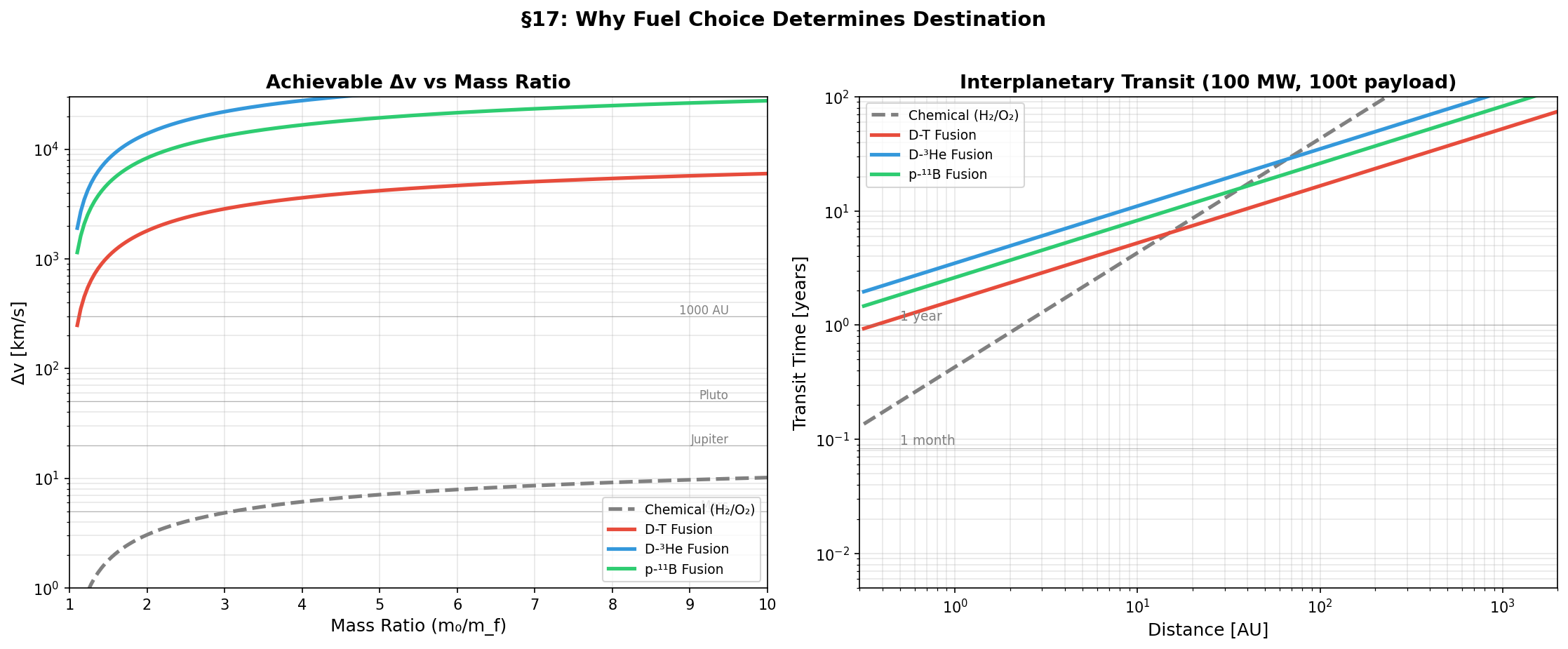
Comparison: chemical rockets $I_{sp}$ ~ 300–450 s; ion drives ~ 1,000–10,000 s; fusion alpha particles ~ 10⁶ s. A factor of 2,000–10,000× beyond chemical propulsion.
The mass equation (Tsiolkovsky):
\Delta v = v_e \ln\frac{m_0}{m_f}
For mass ratio 3:
| Propulsion | $v_e$ (m/s) | Δv (km/s) | Mars transit |
|---|---|---|---|
| Chemical (H₂/O₂) | 4,400 | 4.8 | 6–9 months |
| Ion drive | 30,000 | 33 | 2–4 months |
| D-T fusion | 2.6 × 10⁶ | 2,860 | Days (need shielding) |
| p-¹¹B fusion | 1.2 × 10⁷ | 13,200 | Days (no shielding) |
D-T fusion shielding mass (~100 tonnes) must be accelerated with the payload, reducing effective mass ratio and negating much of the $I_{sp}$ advantage. p-¹¹B needs ~1–2 tonnes of shielding — 50–100× mass saving.
This is why the propulsion calculus favors aneutronic fuels despite their ignition difficulty.
§13. Direct Energy Conversion
In D-T, 80% of energy emerges as neutrons — convertible only through thermal cycles (η ~ 30–40%). In aneutronic systems, charged particles can be directly decelerated in electromagnetic fields.
Methods:
| DEC type | Demonstrated efficiency | Scale |
|---|---|---|
| Post collector (single stage) | 48% | Lab |
| Post collector (multi-stage) | 65% (simulated) | Computational |
| Venetian blind | 72% (simulated) | Computational |
| Magnetic direct converter | Not demonstrated | Conceptual |
Gemini's "80–90%" is the theoretical ceiling for monoenergetic particles. Demonstrated efficiencies: 48–65%, realistic projections for fusion products: 60–75%.
For propulsion, DEC provides electricity for subsystems. For thrust, alpha particles are expelled through a magnetic nozzle (§14) — not converted.
§14. Magnetic Nozzle Physics
A magnetic nozzle converts isotropic plasma thermal energy into directed kinetic energy using a diverging magnetic field.
The adiabatic invariant:
\mu = \frac{m v_\perp^2}{2B} = \text{const}
As particles move from high-B (throat) to low-B (exit), $v_\perp$ decreases and $v_\parallel$ increases. At $B \rightarrow 0$, all thermal energy becomes directed velocity.
Nozzle efficiency:
\eta_\text{nozzle} = 1 - \frac{B_\text{exit}}{B_\text{throat}}
For mirror ratio $R_m = 10$: $\eta_\text{nozzle} = 90%$. Achievable with superconducting magnets.
Thrust:
F = \frac{2\,\eta_n\,P_\text{fus}}{v_e}
For $P_\text{fus} = 100$ MW, $\eta_n = 0.85$, $v_e = 1.2 \times 10^7$ m/s:
F \approx 14.2\,\text{N}
Modest instantaneous thrust — but applied continuously for months, it accumulates enormous Δv. This is the high-$I_{sp}$, low-thrust regime: not for launch, but for interplanetary transit.
The detachment problem: The plasma must separate from magnetic field lines. Mechanisms include resistive, inertial, and reconnection detachment. Demonstrated in lab plasmas but not at propulsion scale. Active research at VASIMR, PFRC, and university programs.
§15. Fuel Comparison for Propulsion
The complete quantitative comparison:
| Metric | D-T | D-³He | p-¹¹B |
|---|---|---|---|
| Charged particle energy | 3.5 MeV (20%) | 18.3 MeV (100%) | 8.7 MeV (100%) |
| Neutron energy fraction | 80% | 3–10% | <1% |
| $I_{sp}$ (direct exhaust) | 1.3 × 10⁶ s | 2.6 × 10⁶ s | 1.2 × 10⁶ s |
| Shielding mass | ~100 tonnes | ~5–10 tonnes | ~1–2 tonnes |
| Ignition feasibility | Demonstrated | Marginal | Impossible (thermal) |
| Fuel logistics | Tritium supply chain | Lunar ³He mining | Water + borax |
| Material damage rate | 10–20 dpa/yr | 0.3–2 dpa/yr | ~0 |
Mission mass penalty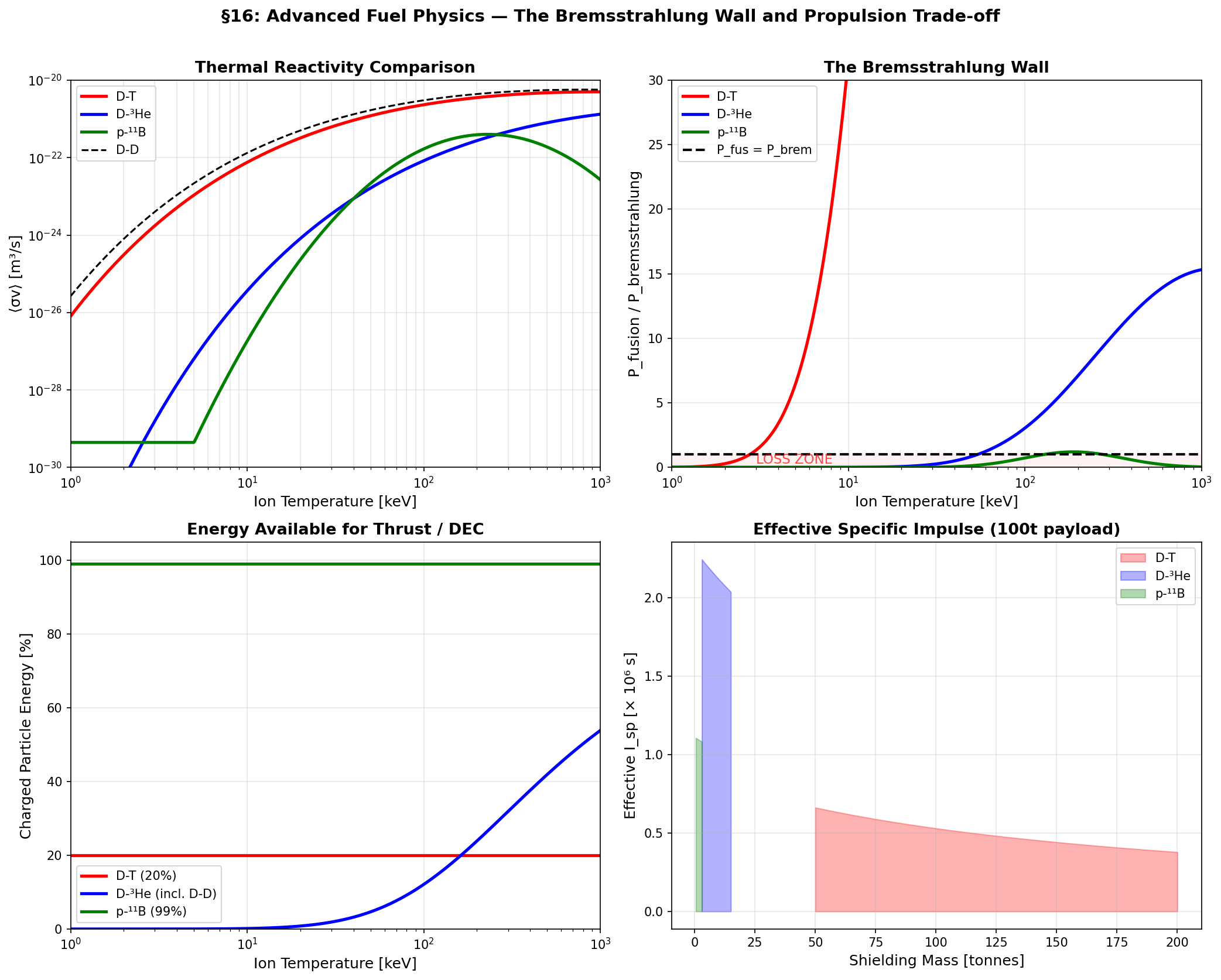
|
|||
| High | Low-Medium | Lowest |
Effective $I_{sp}$ after mass penalties (100-tonne payload):
| Fuel | Raw $I_{sp}$ | Shield (t) | Aux (t) | Effective $I_{sp}$ | Ratio |
|---|---|---|---|---|---|
| D-T | 1.3 × 10⁶ | 100 | 50 | 5.2 × 10⁵ | 1.0× |
| D-³He | 2.6 × 10⁶ | 8 | 15 | 2.1 × 10⁶ | 4.0× |
| p-¹¹B | 1.2 × 10⁶ | 1.5 | 10 | 1.1 × 10⁶ | 2.1× |
Winner depends on mission:
- Near-term (Mars): D-T wins — it ignites
- Medium-term (Jupiter): D-³He optimal if ignition achieved
- Long-term (Oort cloud, interstellar precursor): p-¹¹B — fuel unlimited, shielding negligible
Synthesis
§16. Reactivity and Power Balance (Python)
"""
Reactivity and Power Balance — Advanced Fuel Comparison
Nuclear Fusion Vol.6, §16
Author: Dosanko Tousan | AI Partner: Claude (Anthropic)
License: MIT
"""

import numpy as np
import matplotlib.pyplot as plt

# ============================================================
# Thermal reactivity parameterizations
# ============================================================
def sigma_v_DT(T_keV):
    """D-T reactivity [m³/s] — simplified Bosch-Hale."""
    T = np.clip(T_keV, 0.5, 1000)
    return 3.68e-18 * T**(-2/3) * np.exp(-19.94 * T**(-1/3))

def sigma_v_DHe3(T_keV):
    """D-³He reactivity [m³/s] — simplified Bosch-Hale."""
    T = np.clip(T_keV, 1, 1000)
    return 5.51e-18 * T**(-2/3) * np.exp(-37.27 * T**(-1/3))

def sigma_v_pB11(T_keV):
    """p-¹¹B reactivity [m³/s] — Nevins-Swain (2000) simplified."""
    T = np.clip(T_keV, 5, 1000)
    sv_main = 1.46e-18 * T**(-2/3) * np.exp(-148.7 * T**(-1/3))
    sv_res = 4.0e-22 * np.exp(-(np.log(T/230))**2 / 0.8)
    return sv_main + sv_res

def sigma_v_DD(T_keV):
    """D-D reactivity [m³/s] — both branches combined."""
    T = np.clip(T_keV, 0.5, 1000)
    return 3.72e-18 * T**(-2/3) * np.exp(-18.76 * T**(-1/3))

# ============================================================
# Bremsstrahlung
# ============================================================
CB = 5.35e-37  # W·m³·keV^(-1/2)

# ============================================================
# Temperature scan and power balance
# ============================================================
T = np.logspace(0, 3, 500)  # 1–1000 keV
ne = 1e20  # m⁻³

# D-T: Zeff=1, nD=nT=ne/2
P_fus_DT = (ne/2)**2 * sigma_v_DT(T) * 17.6e6 * 1.602e-19
P_brem_DT = CB * ne**2 * np.sqrt(T) * 1.0
ratio_DT = P_fus_DT / P_brem_DT

# D-³He: nD=nHe3=ne/3, Zeff=(nD*1+nHe3*4)/ne
nD3 = ne/3; nHe3 = ne/3
P_fus_DHe3 = nD3 * nHe3 * sigma_v_DHe3(T) * 18.3e6 * 1.602e-19
Zeff_DHe3 = (nD3*1 + nHe3*4) / ne
P_brem_DHe3 = CB * ne**2 * np.sqrt(T) * Zeff_DHe3
ratio_DHe3 = P_fus_DHe3 / P_brem_DHe3

# p-¹¹B: np=ne/2, nB=ne/10, Zeff=3
np_pB = ne/2; nB = ne/10
P_fus_pB = np_pB * nB * sigma_v_pB11(T) * 8.7e6 * 1.602e-19
Zeff_pB = (np_pB*1 + nB*25) / ne
P_brem_pB = CB * ne**2 * np.sqrt(T) * Zeff_pB
ratio_pB = P_fus_pB / P_brem_pB

# D-D side reaction fraction in D-³He plasma
DD_to_DHe3 = sigma_v_DD(T) / sigma_v_DHe3(T)
charged_frac_DHe3 = 18.3 / (18.3 + DD_to_DHe3 * 7.3 * 0.5)

fig, axes = plt.subplots(2, 2, figsize=(14, 11), dpi=150)

# Panel 1: Reactivity
ax1 = axes[0, 0]
ax1.loglog(T, sigma_v_DT(T), 'r-', lw=2.5, label='D-T')
ax1.loglog(T, sigma_v_DHe3(T), 'b-', lw=2.5, label='D-³He')
ax1.loglog(T, sigma_v_pB11(T), 'g-', lw=2.5, label='p-¹¹B')
ax1.loglog(T, sigma_v_DD(T), 'k--', lw=1.5, label='D-D (total)')
ax1.set_xlabel('Ion Temperature [keV]', fontsize=12)
ax1.set_ylabel('⟨σv⟩ [m³/s]', fontsize=12)
ax1.set_title('Thermal Reactivity Comparison', fontsize=13, fontweight='bold')
ax1.legend(fontsize=10); ax1.set_xlim(1, 1000); ax1.set_ylim(1e-30, 1e-20)
ax1.grid(True, alpha=0.3, which='both')

# Panel 2: Bremsstrahlung wall
ax2 = axes[0, 1]
ax2.semilogx(T, ratio_DT, 'r-', lw=2.5, label='D-T')
ax2.semilogx(T, ratio_DHe3, 'b-', lw=2.5, label='D-³He')
ax2.semilogx(T, ratio_pB, 'g-', lw=2.5, label='p-¹¹B')
ax2.axhline(y=1, color='black', lw=2, ls='--', label='P_fus = P_brem')
ax2.fill_between(T, 0, 1, alpha=0.05, color='red')
ax2.text(3, 0.3, 'LOSS ZONE', fontsize=11, color='red', alpha=0.7)
ax2.set_xlabel('Ion Temperature [keV]', fontsize=12)
ax2.set_ylabel('P_fusion / P_bremsstrahlung', fontsize=12)
ax2.set_title('The Bremsstrahlung Wall', fontsize=13, fontweight='bold')
ax2.legend(fontsize=10, loc='upper left')
ax2.set_xlim(1, 1000); ax2.set_ylim(0, 30); ax2.grid(True, alpha=0.3)

# Panel 3: Charged particle fraction
ax3 = axes[1, 0]
ax3.semilogx(T, np.ones_like(T)*20, 'r-', lw=2.5, label='D-T')
ax3.semilogx(T, charged_frac_DHe3*100, 'b-', lw=2.5, label='D-³He (incl. D-D side)')
ax3.semilogx(T, np.ones_like(T)*99, 'g-', lw=2.5, label='p-¹¹B')
ax3.set_xlabel('Ion Temperature [keV]', fontsize=12)
ax3.set_ylabel('Charged Particle Energy Fraction [%]', fontsize=12)
ax3.set_title('Energy Available for Thrust / DEC', fontsize=13, fontweight='bold')
ax3.legend(fontsize=10); ax3.set_xlim(1, 1000); ax3.set_ylim(0, 105)
ax3.grid(True, alpha=0.3)

# Panel 4: Effective Isp after mass penalty
ax4 = axes[1, 1]
payload = 100
ve_DT = 1.3e7; ve_DHe3 = 2.6e7; ve_pB = 1.2e7
shield_DT = np.linspace(50, 200, 50)
shield_DHe3 = np.linspace(3, 15, 50)
shield_pB = np.linspace(0.5, 3, 50)

Isp_DT = (ve_DT/9.81) * payload / (payload + shield_DT + 50)
Isp_DHe3 = (ve_DHe3/9.81) * payload / (payload + shield_DHe3 + 15)
Isp_pB = (ve_pB/9.81) * payload / (payload + shield_pB + 10)

ax4.fill_between(shield_DT, Isp_DT/1e6, alpha=0.3, color='red', label='D-T')
ax4.fill_between(shield_DHe3, Isp_DHe3/1e6, alpha=0.3, color='blue', label='D-³He')
ax4.fill_between(shield_pB, Isp_pB/1e6, alpha=0.3, color='green', label='p-¹¹B')
ax4.set_xlabel('Shielding Mass [tonnes]', fontsize=12)
ax4.set_ylabel('Effective I_sp [× 10⁶ s]', fontsize=12)
ax4.set_title('Effective Specific Impulse (100t payload)', fontsize=13, fontweight='bold')
ax4.legend(fontsize=10); ax4.grid(True, alpha=0.3)

plt.suptitle('§16: Advanced Fuel Physics — The Bremsstrahlung Wall and Propulsion Trade-off',
             fontsize=14, fontweight='bold', y=1.01)
plt.tight_layout()
plt.savefig('fig1_advanced_fuels.png', bbox_inches='tight', facecolor='white')
plt.close()

print("Figure 1 saved: fig1_advanced_fuels.png")
print(f"\nMax P_fus/P_brem for p-¹¹B: {np.max(ratio_pB):.3f} at T={T[np.argmax(ratio_pB)]:.0f} keV")
print(f"Max P_fus/P_brem for D-³He: {np.max(ratio_DHe3):.1f} at T={T[np.argmax(ratio_DHe3)]:.0f} keV")
print(f"Max P_fus/P_brem for D-T:   {np.max(ratio_DT):.1f} at T={T[np.argmax(ratio_DT)]:.0f} keV")
§17. Propulsion Figure-of-Merit (Python)
"""
Propulsion Figure-of-Merit — Fuel Comparison for Space Missions
Nuclear Fusion Vol.6, §17
Author: Dosanko Tousan | AI Partner: Claude (Anthropic)
License: MIT
"""

import numpy as np
import matplotlib.pyplot as plt

AU = 1.496e11  # meters

fuels = {
    'Chemical (H₂/O₂)': {'ve': 4400, 'shield_t': 0, 'aux_t': 0,
                           'color': 'gray', 'ls': '--'},
    'D-T Fusion':         {'ve': 1.3e7*0.20, 'shield_t': 100, 'aux_t': 50,
                           'color': '#e74c3c', 'ls': '-'},
    'D-³He Fusion':       {'ve': 2.0e7, 'shield_t': 8, 'aux_t': 15,
                           'color': '#3498db', 'ls': '-'},
    'p-¹¹B Fusion':       {'ve': 1.2e7, 'shield_t': 1.5, 'aux_t': 10,
                           'color': '#2ecc71', 'ls': '-'},
}

payload = 100  # tonnes
fig, axes = plt.subplots(1, 2, figsize=(15, 6), dpi=150)

# Panel 1: Delta-v vs mass ratio
ax1 = axes[0]
mr = np.linspace(1.1, 10, 200)
for name, f in fuels.items():
    dv = f['ve'] * np.log(mr)
    ax1.semilogy(mr, dv/1000, color=f['color'], lw=2.5, ls=f['ls'], label=name)

for dv_km, label in [(5,'Mars'), (20,'Jupiter'), (50,'Pluto'), (300,'1000 AU')]:
    ax1.axhline(y=dv_km, color='gray', lw=0.5, alpha=0.5)
    ax1.text(9.5, dv_km*1.05, label, fontsize=8, color='gray', ha='right')

ax1.set_xlabel('Mass Ratio (m₀/m_f)', fontsize=12)
ax1.set_ylabel('Δv [km/s]', fontsize=12)
ax1.set_title('Achievable Δv vs Mass Ratio', fontsize=13, fontweight='bold')
ax1.legend(fontsize=9, loc='lower right')
ax1.set_xlim(1, 10); ax1.set_ylim(1, 3e4); ax1.grid(True, alpha=0.3, which='both')

# Panel 2: Transit time (brachistochrone for fusion, Hohmann for chemical)
ax2 = axes[1]
dist_AU = np.logspace(-0.5, 3.5, 100)
dist_m = dist_AU * AU

for name, f in fuels.items():
    ve = f['ve']
    if 'Chemical' in name:
        transit_s = dist_m / 11e3  # coast at ~11 km/s
    else:
        m_total = (payload + f['shield_t'] + f['aux_t'] + 50) * 1e3  # kg
        P_MW = 100
        a = 2 * 0.85 * P_MW * 1e6 / (ve * m_total)
        transit_s = 2 * np.sqrt(dist_m / np.maximum(a, 1e-10))
    ax2.loglog(dist_AU, transit_s/(365.25*86400), color=f['color'],
               lw=2.5, ls=f['ls'], label=name)

ax2.axhline(y=1, color='gray', lw=0.5, alpha=0.5)
ax2.text(0.5, 1.1, '1 year', fontsize=9, color='gray')
ax2.axhline(y=1/12, color='gray', lw=0.5, alpha=0.5)
ax2.text(0.5, 0.09, '1 month', fontsize=9, color='gray')

ax2.set_xlabel('Distance [AU]', fontsize=12)
ax2.set_ylabel('Transit Time [years]', fontsize=12)
ax2.set_title('Interplanetary Transit (100 MW, 100t payload)', fontsize=13, fontweight='bold')
ax2.legend(fontsize=9, loc='upper left')
ax2.set_xlim(0.3, 2000); ax2.set_ylim(0.005, 100); ax2.grid(True, alpha=0.3, which='both')

plt.suptitle('§17: Why Fuel Choice Determines Destination',
             fontsize=14, fontweight='bold', y=1.02)
plt.tight_layout()
plt.savefig('fig2_propulsion_fom.png', bbox_inches='tight', facecolor='white')
plt.close()
print("Figure 2 saved: fig2_propulsion_fom.png")
§18. Uncertainties — The Honest Section
What we are confident about:
- The thermal reactivity data for D-T, D-³He, and D-D are well-measured. Not in dispute.
- The bremsstrahlung wall for p-¹¹B is real. At thermal equilibrium, $P_\text{fus}/P_\text{brem} < 1$ at all temperatures. Multiple independent verifications.
- The ³He supply problem is quantitatively severe. Apollo measurements. Arithmetic is unambiguous.
- Charged-particle fraction determines propulsion viability: 20% (D-T) vs. 99–100% (aneutronic) is physics fact.
What we are uncertain about:
- p-¹¹B reactivity at the 148 keV resonance. Measurements carry 10–15% uncertainty. Alternative parameterizations give slightly different high-temperature results.
- Non-thermal p-¹¹B Q values. Hot-ion mode with $T_i/T_e > 5$ has never been sustained in steady state.
- Laser-driven p-¹¹B scaling. Yield gap (~10⁹× to breakeven) is enormous.
- Magnetic nozzle detachment. Efficiency estimates of 80–95% are theoretical.
- D-³He neutron fraction. Depends sensitively on tritium removal efficiency: 3–10% range has real width.
What we are probably wrong about:
- p-¹¹B reactivity may underestimate contributions from excited states of the ¹²C compound nucleus. Recent theoretical work suggests 20–40% increase in certain energy ranges. Would improve but not eliminate the bremsstrahlung problem.
- D-T shielding mass could be reduced by advanced concepts (liquid H₂, active magnetic deflection), making D-T more competitive for propulsion.
- "Q > 0 is sufficient for a rocket" understates the power supply problem. A Q = 0.5 drive needs 200 MW input for 100 MW fusion — that 200 MW must come from somewhere (fission reactor? beamed power?), and its mass must be included in the trade-off.
§19. Decision Matrix
| Investment Area | TRL | Impact | Priority |
|---|---|---|---|
| D-T power plant (ITER/DEMO) | 5–6 | Grid power | ★★★★★ |
| D-³He magnetic confinement | 2–3 | Highest $I_{sp}$ | ★★★☆☆ |
| p-¹¹B thermal ignition | 0 | Impossible | ☆☆☆☆☆ |
| p-¹¹B non-thermal (beam/laser) | 2 | Game-changer if achieved | ★★★☆☆ |
| Direct energy conversion | 3–4 | Essential for aneutronic | ★★★★☆ |
| Magnetic nozzle | 3 | Essential for propulsion | ★★★★☆ |
| Lunar ³He mining | 1 | Enables D-³He fleet | ★★☆☆☆ |
| FRC for advanced fuels (TAE) | 4 | Best confinement match | ★★★★☆ |
§20. Conclusions: The Road to Valkyrie
What we proved:
- D-T is the only fuel that ignites under current technology.
- D-³He ignition is possible but undemonstrated. Requires ~17× higher triple product.
- p-¹¹B thermal ignition is impossible. The bremsstrahlung wall is a law of nature.
- Non-thermal p-¹¹B is an open question. No approach has achieved Q > 0.01.
- For propulsion, the calculus reverses. Mass penalty of neutrons makes aneutronic fuels preferable despite harder ignition.
The road ahead:
| Volume | Topic | What It Establishes |
|---|---|---|
| Vol.7 | Geopolitics & Energy Strategy | Who funds what, and why |
| Vol.8 | Alternative Confinement (FRC, Mirror) | The machine that burns advanced fuels |
| Vol.9 | Propulsion & Direct Conversion | The engine: nozzle, thrust, Δv |
| Vol.10 | Valkyrie | The spacecraft |
Volumes 1–4 built the physics and exposed the D-T trap. Volume 5 showed AI compresses the timeline by ~5 years. This volume established the fuel alternatives.
From here, we build the engine (Vols.8–9) and then the ship (Vol.10).
The path is narrow. p-¹¹B thermal ignition is impossible. D-³He ignition is undemonstrated. Lunar ³He mining is speculative. Every honest section has acknowledged the enormous gaps.
But the physics does not forbid a fusion-powered spacecraft. It constrains the design space. It demands specific choices and rewards the engineer who reads the constraints correctly.
Vol.2 asked: "Can we light the fire?" Volumes 3–4 asked: "At what cost?" This volume asked: "Is there a better fuel?" The remaining volumes ask: "Can we build the machine and fly?"
The answer is in the engineering. And the engineering starts now.
References
-
H. S. Bosch and G. M. Hale, "Improved formulas for fusion cross-sections and thermal reactivities," Nuclear Fusion, vol. 32, no. 4, pp. 611–631 (1992).
-
W. M. Nevins and R. Swain, "The thermonuclear fusion rate coefficient for p-¹¹B reactions," Nuclear Fusion, vol. 40, no. 4, pp. 865–872 (2000).
-
J. R. McNally Jr., "Physics of fusion fuel cycles," Nuclear Technology/Fusion, vol. 2, pp. 9–28 (1982).
-
H. Hora et al., "Fusion energy using avalanche increased boron reactions for block-ignition by ultrahigh power picosecond laser pulses," Laser and Particle Beams, vol. 33, pp. 607–619 (2015).
-
D. Margarone et al., "In-target proton-boron nuclear fusion using a PW-class laser," Applied Sciences, vol. 12, 1444 (2022).
-
S. Putvinski et al., "Fusion reactivity of the pB11 plasma revisited," Nuclear Fusion, vol. 59, 076018 (2019).
-
J. F. Santarius, "Lunar ³He and fusion energy," NASA Workshop on Advanced Power Sources for Space (1991).
-
R. A. Gerwin et al., "Characterization of plasma flow through magnetic nozzles," Los Alamos, LA-UR-99-2906 (1999).
-
E. B. Hooper, "Direct energy conversion for fusion power plants," Nuclear Fusion, vol. 48, 075001 (2008).
-
TAE Technologies, "Norman: achieving FRC plasma stability at thermonuclear conditions," Nature Communications, vol. 14 (2023).
-
S. A. Cohen et al., "The PFRC experiment," AIP Conference Proceedings, vol. 2254 (2020).
-
G. L. Kulcinski and J. F. Santarius, "Nuclear power in space," Nature, vol. 338, pp. 201–205 (1989).
-
G. H. Miley, "Advanced fuels and the development of fusion energy," Fusion Technology (1979).
-
H. Hora, "Difference between relativistic and subrelativistic plasma block generation," Laser and Particle Beams, vol. 23, pp. 441–451 (2005).
This volume was written by Dosanko Tousan with Claude (Anthropic) as AI partner.
The honest section (§18) was written first. Everything else was written to deserve it.
For those who reach for fuels that don't exist yet — and the stars they would take us to.