
Introduction
In an era where data is the backbone of digital transformation, organizations are generating and storing massive volumes of information every day. From enterprise applications to customer interactions, data continues to expand at an unprecedented rate. This rapid growth makes data storage optimization solutions a critical necessity for businesses aiming to maintain efficiency and control costs.
Without proper optimization strategies, storage systems can become inefficient, expensive, and difficult to manage. Businesses that fail to adopt data storage optimization solutions often struggle with performance issues, redundant data, and escalating infrastructure costs. As a result, organizations are increasingly turning to advanced technologies and strategies to ensure their data storage systems are both efficient and scalable.
The Importance of Data Storage Optimization Solutions
Modern enterprises rely heavily on data to drive decision-making and innovation. However, storing large volumes of data without optimization can lead to significant challenges. This is where data storage optimization solutions play a vital role in maintaining operational efficiency.
These solutions help organizations reduce redundancy, improve storage utilization, and enhance system performance. By implementing data storage optimization solutions, businesses can ensure that their storage infrastructure is used effectively, minimizing waste and maximizing value.
Another key benefit is cost management. Storage expenses can quickly add up, especially in cloud environments. Data storage optimization solutions enable organizations to control costs by eliminating unnecessary data and optimizing resource allocation.
Additionally, these solutions support better data accessibility. Optimized storage systems make it easier for users to retrieve and analyze data, leading to improved productivity and faster decision-making.
How Data Storage Optimization Solutions Enhance Performance
Performance is a critical factor in any data-driven organization. Slow or inefficient storage systems can hinder productivity and impact user experience. Implementing data storage optimization solutions helps address these challenges by improving data access speeds and system responsiveness.
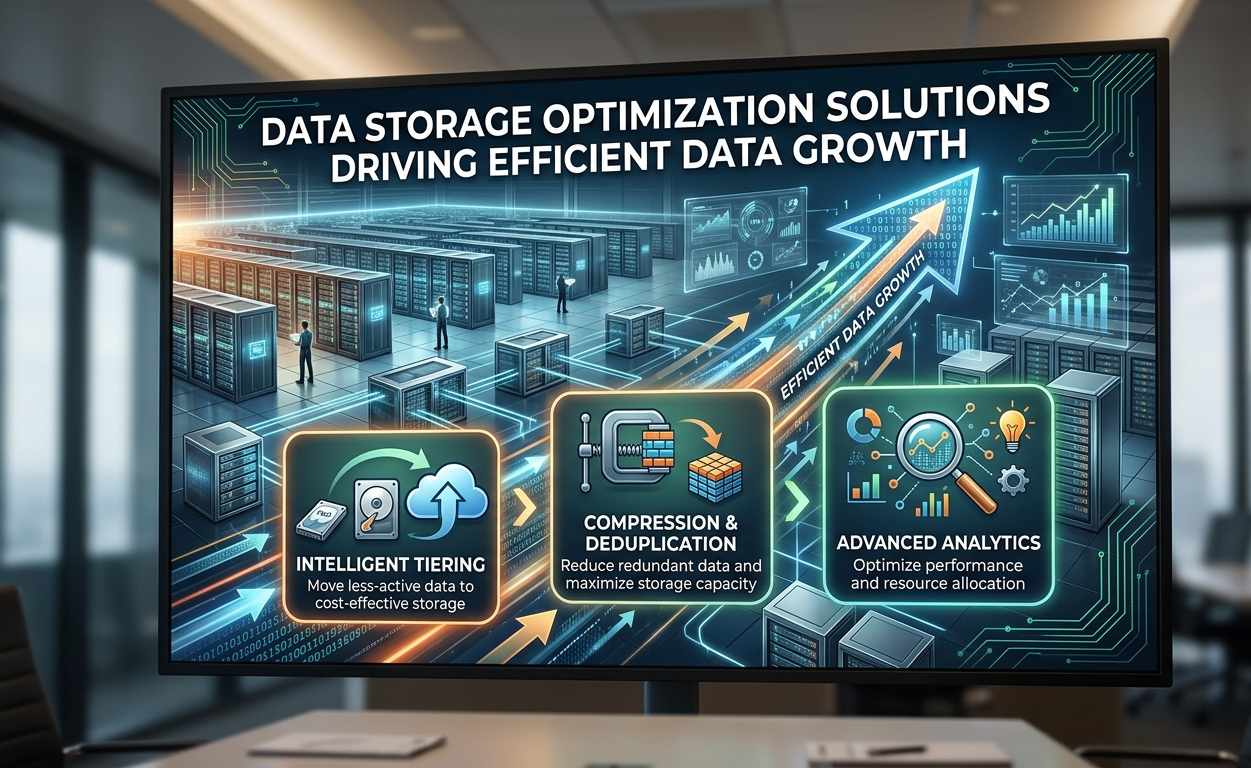
One of the primary ways these solutions enhance performance is through data tiering. Frequently accessed data is stored on high-performance systems, while less critical data is moved to cost-effective storage tiers. This approach ensures optimal performance while maintaining cost efficiency.
Compression and deduplication are also essential components of data storage optimization solutions. These techniques reduce the amount of storage space required, allowing systems to operate more efficiently without compromising data integrity.
Caching mechanisms further improve performance by storing frequently accessed data in faster storage layers. This reduces latency and enhances the overall user experience, making data storage optimization solutions indispensable for modern enterprises.
Key Technologies Behind Data Storage Optimization Solutions
The effectiveness of data storage optimization solutions depends on the technologies that power them. These technologies are designed to address the complexities of modern data environments and ensure efficient storage management.
Data deduplication is a widely used technique that eliminates duplicate copies of data, significantly reducing storage requirements. This is a fundamental aspect of many data storage optimization solutions.
Compression technology further enhances storage efficiency by reducing the size of data files. Combined with deduplication, it plays a crucial role in optimizing storage systems.
Another important technology is automated storage management. Automation allows organizations to dynamically allocate resources based on demand, ensuring that data storage optimization solutions remain effective even as data volumes grow.
Cloud-based storage platforms are also transforming the landscape. They offer scalability and flexibility, enabling businesses to implement data storage optimization solutions without significant upfront investment.
Challenges in Implementing Data Storage Optimization Solutions
While the benefits are clear, adopting data storage optimization solutions is not without challenges. One of the primary obstacles is the complexity of existing storage environments. Many organizations operate with legacy systems that are not easily compatible with modern optimization technologies.
Data migration is another significant challenge. Moving large volumes of data to optimized systems requires careful planning and execution to avoid disruptions. Despite these challenges, data storage optimization solutions remain essential for long-term success.
Cost considerations can also impact implementation. Although these solutions reduce expenses over time, the initial investment may be a concern for some organizations. However, the long-term savings and efficiency gains often justify the cost.
Security and compliance are additional factors to consider. Organizations must ensure that their data storage optimization solutions adhere to regulatory requirements and protect sensitive information from potential threats.
The Role of AI and Automation in Data Storage Optimization Solutions
Artificial intelligence and automation are playing an increasingly important role in enhancing data storage optimization solutions. These technologies enable organizations to manage their storage systems more efficiently and proactively.
AI-driven analytics can identify usage patterns and recommend optimization strategies. This allows businesses to make data-driven decisions and improve the effectiveness of their data storage optimization solutions.
Automation simplifies routine tasks such as data classification, resource allocation, and performance monitoring. By reducing manual intervention, organizations can achieve greater efficiency and consistency in their storage operations.
Predictive capabilities are another advantage of AI-powered data storage optimization solutions. These systems can anticipate future storage needs and adjust resources accordingly, ensuring optimal performance at all times.
Future Trends in Data Storage Optimization Solutions
The future of data storage optimization solutions is shaped by continuous innovation and evolving business requirements. As data volumes continue to grow, organizations will need more advanced tools to manage their storage systems effectively.
Edge computing is emerging as a key trend, bringing data processing closer to the source. This will require new approaches to data storage optimization solutions that focus on distributed environments.
Sustainability is also becoming a priority. Organizations are looking for energy-efficient storage systems, and data storage optimization solutions will play a crucial role in reducing environmental impact.
Integration with advanced analytics platforms is another trend to watch. Businesses will increasingly rely on data storage optimization solutions to not only manage data but also enable real-time insights and decision-making.
Conclusion
As data continues to grow in volume and importance, organizations must adopt effective strategies to manage their storage systems. Data storage optimization solutions provide the tools and technologies needed to achieve this goal.
By implementing robust data storage optimization solutions, businesses can improve performance, reduce costs, and enhance data accessibility. These solutions are essential for maintaining efficiency and staying competitive in today’s data-driven world.
Ultimately, data storage optimization solutions empower organizations to unlock the full potential of their data while ensuring long-term sustainability and growth.