
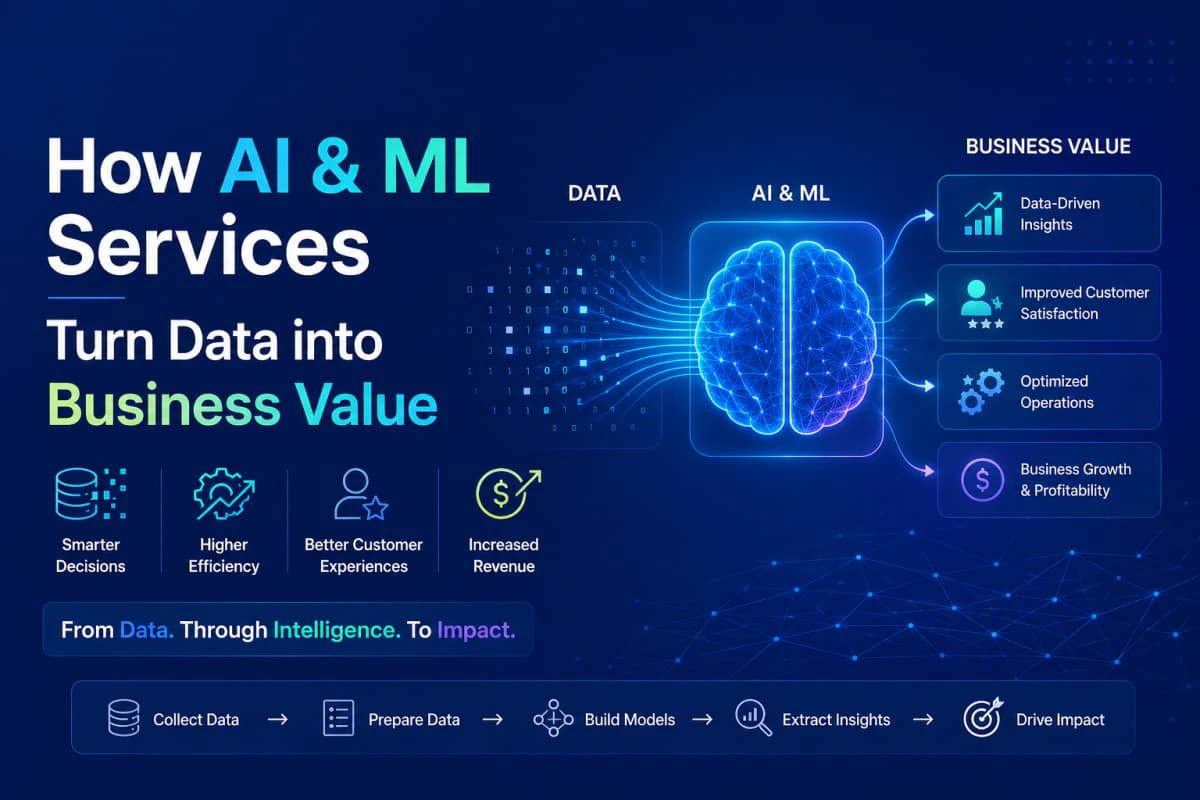
Most businesses already have more data than they know what to do with.
Sales reports pile up. Customer interactions sit across multiple platforms. Operations teams track thousands of moving parts every day. Marketing departments collect performance metrics from campaigns, websites, ads, emails, and social channels almost nonstop.
Yet despite this flood of information, leadership teams still struggle to answer basic questions:
- Why are customers dropping off?
- What is slowing operations down?
- Which products will perform next quarter?
- Where is revenue leaking?
The answers are usually buried somewhere inside the data. The problem is that raw information, by itself, does not create business value.
That is exactly why companies are investing heavily in AI & ML services. Not because AI sounds impressive in presentations, but because businesses are tired of making slow decisions with fragmented information.
That pressure is growing across industries. Retailers want better demand forecasting. Financial firms want faster fraud detection. Healthcare providers need stronger patient insights. Manufacturers want fewer disruptions and less downtime.
Everyone is looking for the same thing in different ways: better visibility, faster decisions, and smarter operations.
AI adoption continues to rise across business functions as organizations push beyond experimentation and focus more on operational use cases, and that shift matters.
A few years ago, many companies explored AI because they did not want to fall behind competitors. Now they are investing because they see a direct business impact. There’s a difference between curiosity and necessity. AI is crossing that line.
Businesses Do Not Need More Data; They Need Better Insight
This is where many organizations get stuck.
They spend years collecting information but never build systems capable of using it effectively. Different departments work with disconnected platforms. Reports take too long to generate. Teams rely on spreadsheets that become outdated almost immediately.
Eventually, decision-making slows down. And slow decision-making becomes expensive.
A logistics company dealing with delayed inventory updates can miss delivery windows. A retailer with inaccurate forecasting may overstock products that barely sell. A financial institution that fails to detect suspicious activity quickly enough increases risk exposure.
These problems are not usually caused by a lack of information. They happen because businesses cannot process information fast enough to act on it.
This is where AI & machine learning services start becoming practical instead of theoretical.
Machine learning models can identify trends across massive datasets much faster than traditional analysis methods. AI systems can surface patterns that teams may never notice manually.
Sometimes the insight is obvious after the fact. The challenge is finding it early enough to matter. That timing changes everything.
Why AI & Machine Learning Services Matter More Now
There was a time when AI projects mostly lived inside innovation departments. That has changed quickly.
Now, operational teams, customer service departments, finance groups, and even HR functions are exploring AI-driven systems to improve efficiency and reduce repetitive work.
Part of this shift comes from scale. Businesses are managing more data, more software, and more customer expectations than they were even five years ago. Manual processes simply do not hold up well under that pressure anymore.
Employees spend hours reviewing documents, answering repetitive questions, sorting requests, checking records, or compiling reports that should probably be automated already.
That operational drag adds up quietly over time. AI helps reduce some of that friction.
A support platform can automatically categorize incoming tickets. A healthcare provider can identify patient risk patterns earlier. A retailer can adjust inventory forecasts based on changing demand signals in real time.
These are not futuristic examples anymore; they are becoming standard operational goals.
Enterprise spending on generative AI continues to climb rapidly as organizations integrate AI into products, workflows, and business systems.
But something interesting is happening alongside that growth. Businesses are becoming less impressed by AI demos and more focused on outcomes.
Executives want to know whether AI can actually improve efficiency, reduce costs, or create measurable revenue opportunities. That is a far more grounded conversation than the market was having two years ago.
Curiosity drove the first wave of adoption. Necessity is driving the next.
Artificial Intelligence and Machine Learning Services Help Businesses Make Faster Decisions
Most business problems are ultimately decision-making problems.
- Leaders decide where to invest.
- Operations teams decide how to allocate resources.
- Marketing teams decide which audiences to target.
- Supply chain managers decide how to respond to disruptions.
The problem is that those decisions often happen with incomplete visibility. AI helps close some of those gaps.
Machine learning and AI services help process huge amounts of historical and real-time information far faster than human teams can manage manually. Over time, those systems learn from patterns, outcomes, and behavioral signals. That creates a more predictive environment.
Retailers can forecast purchasing trends more accurately. Manufacturers can predict maintenance failures before systems break down. Financial institutions can flag suspicious activity much earlier.
The benefit is not just automation; it is confidence. Businesses can make decisions faster because they have stronger insight supporting them.
And that matters more than many people realize. Delayed decisions create operational hesitation. Teams wait too long. Opportunities disappear. Small problems become larger ones.
Companies that move faster usually gain an advantage long before competitors fully react.
The Best AI Projects Usually Solve Ordinary Problems
This is something businesses are learning the hard way: not every successful AI project looks revolutionary from the outside.
Sometimes the biggest value comes from fixing very ordinary operational issues:
- Reducing support response times.
- Improving invoice processing.
- Predicting inventory shortages.
- Flagging anomalies automatically.
- Improving reporting accuracy.
These are not flashy headlines, but they create measurable business improvements.
That is why reliable AI and machine learning solutions tend to focus heavily on operational bottlenecks first instead of trying to reinvent entire business models overnight.
The companies getting real value from AI are usually practical about it. They identify areas where teams lose time repeatedly. Then they use AI to reduce friction, improve visibility, or automate repetitive workflows. Small efficiency gains at scale become significant over time.
AI & ML Services Are Changing Customer Expectations
Customers have become much less patient over the last few years. People expect faster responses, better recommendations, smoother digital experiences, and fewer delays across almost every industry. Businesses feel that pressure constantly.
AI helps companies respond more effectively by improving personalization and operational speed. Streaming platforms recommend content dynamically. Retail brands personalize shopping experiences. Financial institutions use AI-driven support systems to reduce wait times.
Most customers do not think about the technology powering these interactions. They just notice when the experience feels easier and when it does not.
Research continues to show measurable efficiency and operational gains among organizations successfully integrating AI into business workflows. Still, businesses are learning that automation alone is not enough.
Customers still want trust. Transparency is essential. Human support still matters in sensitive situations. The strongest AI strategies usually support human teams instead of trying to eliminate them entirely.
Final Thoughts
Most businesses already understand that data matters. What many are realizing now is that data only becomes valuable when organizations can actually use it effectively.
That is where AI & ML services are making a real difference. They don’t replace every process overnight or turn companies into fully automated machines. Instead, they help businesses make faster decisions, reduce operational friction, and uncover patterns that were previously difficult to spot.
The companies getting the most value from AI right now are usually not chasing hype. They are solving practical business problems more intelligently than before. And honestly, that approach tends to age much better than trends do.