
Introduction
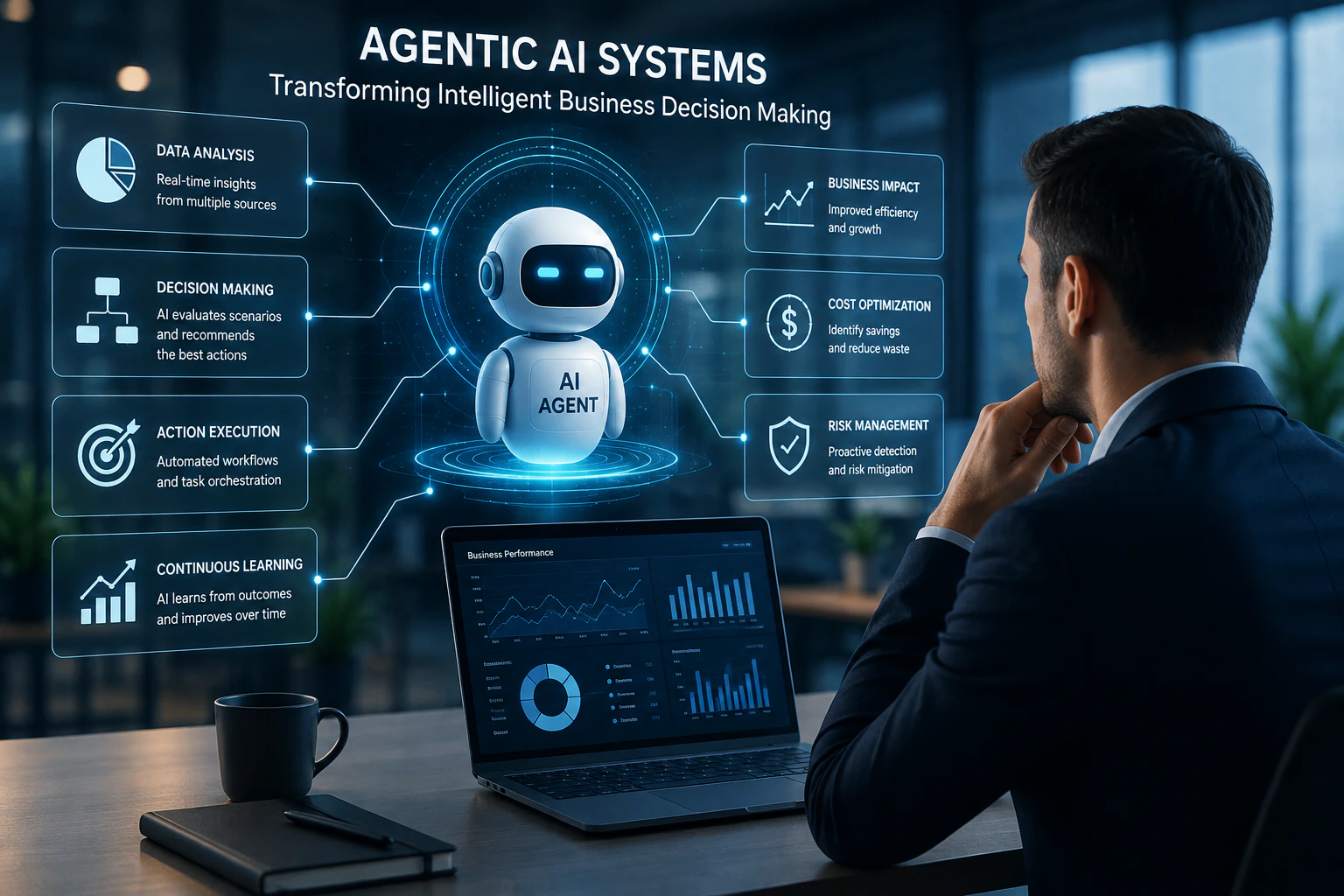
Artificial intelligence is evolving rAPIdly, and businesses are looking beyond traditional automation to solutions that can reason, plan, and complete tasks with minimal human intervention. This is where Agentic AI Systems are changing the landscape. Instead of responding to a single prompt, these intelligent systems can understand objectives, create execution plans, use external tools, and adapt their actions based on changing information.
Organizations across healthcare, finance, manufacturing, retail, logistics, and customer service are adopting Agentic AI Systems to improve productivity, reduce manual effort, and accelerate innovation. As AI technologies mature, enterprises are recognizing that autonomous decision-making capabilities can unlock greater business value while allowing employees to focus on strategic initiatives.
This article explains what Agentic AI Systems are, how they work, their business benefits, common use cases, implementation challenges, and future opportunities.
What Are Agentic AI Systems?
Agentic AI Systems are intelligent software systems designed to perform complex tasks independently while working toward a defined objective. Unlike conventional AI models that simply answer questions or generate content, these systems can analyze situations, create plans, execute multiple actions, evaluate outcomes, and refine their approach without constant human guidance.
An agentic AI solution combines large language models, reasoning engines, memory capabilities, APIs, automation tools, and external data sources. Together, these components enable the AI to complete workflows that normally require human decision-making.
For example, an enterprise assistant powered by Agentic AI Systems can gather information from multiple business applications, analyze customer requirements, prepare reports, recommend actions, and even trigger approved workflows automatically.
How Agentic AI Systems Work
The intelligence behind Agentic AI Systems comes from combining several technologies into a coordinated framework.
The system begins by understanding the user's objective instead of merely processing a single instruction. It then breaks the objective into smaller tasks and creates a logical execution strategy.
After planning, the AI retrieves relevant information from internal databases, cloud applications, APIs, or knowledge repositories. It continuously evaluates new information while completing each task and adjusts its decisions whenever necessary.
Memory also plays a critical role. Unlike traditional AI interactions, Agentic AI Systems can remember previous actions during a workflow, making future decisions more accurate and context-aware.
Finally, the system reviews the completed work, validates outputs, identifies errors, and makes improvements before delivering results.
Why Businesses Are Investing in Agentic AI Systems
Organizations are under increasing pressure to improve efficiency while managing growing volumes of data and customer expectations. Agentic AI Systems provide a practical way to automate knowledge-intensive work rather than only repetitive tasks.
Businesses benefit from faster decision-making because AI agents can process enormous datasets within seconds. Employees spend less time switching between applications, gathering information, or performing manual research.
Operational costs also decrease as autonomous systems handle repetitive business processes around the clock. Customer satisfaction improves because AI agents can respond faster while maintaining consistency across multiple communication channels.
Another important advantage is scalability. As business operations expand, Agentic AI Systems can support additional workloads without requiring proportional increases in staffing.
Business Applications of Agentic AI Systems
Modern enterprises are discovering new ways to integrate Agentic AI Systems into everyday operations.
Customer support teams use autonomous agents to resolve inquiries, access customer history, recommend solutions, and escalate only complex issues that require human expertise.
Healthcare organizations rely on intelligent AI agents to assist clinicians by organizing patient records, summarizing medical information, and supporting administrative workflows while maintaining regulatory compliance.
Financial institutions implement Agentic AI Systems to monitor transactions, identify unusual activity, generate financial reports, and improve risk analysis.
Manufacturing companies use intelligent agents to monitor equipment performance, predict maintenance requirements, optimize production schedules, and reduce operational downtime.
Marketing departments benefit from AI agents capable of researching competitors, analyzing customer behavior, preparing campaign insights, and generating personalized recommendations for different audience segments.
Human resources teams also adopt autonomous AI assistants for recruitment, employee onboarding, documentation management, and workforce analytics.
Key Features of Agentic AI Systems
Several characteristics distinguish Agentic AI Systems from conventional AI applications.
Autonomous planning allows AI agents to determine the sequence of actions needed to achieve business objectives.
Reasoning capabilities enable intelligent decision-making when unexpected situations arise.
Memory functions help the system retain workflow context and previous interactions, resulting in more consistent outcomes.
Tool integration allows AI agents to connect with enterprise software, cloud platforms, databases, and external APIs.
Continuous learning helps improve future recommendations based on previous experiences and business feedback.
Goal-oriented execution ensures that every action contributes toward completing the assigned objective rather than generating isolated responses.
Challenges of Implementing Agentic AI Systems
Although Agentic AI Systems offer substantial advantages, successful implementation requires thoughtful planning.
Data quality remains one of the biggest challenges. Poor or incomplete information can reduce decision accuracy regardless of how advanced the AI model becomes.
Security is equally important. Organizations must establish strong governance policies to ensure AI agents access only authorized information.
Compliance requirements also vary across industries. Businesses operating in healthcare, finance, or government sectors should ensure AI deployments meet all applicable regulatory standards.
Human oversight continues to play an important role. While Agentic AI Systems can perform many autonomous tasks, critical business decisions often require expert review and approval.
Finally, organizations should invest in employee education so teams understand how to collaborate effectively with AI rather than viewing it as a replacement.
Best Practices for Adopting Agentic AI Systems
Successful organizations begin with clearly defined business objectives before deploying Agentic AI Systems.
Instead of automating every process immediately, enterprises often start with smaller workflows that demonstrate measurable business value. These early successes help build confidence before expanding AI adoption across departments.
Regular performance monitoring is equally important. Businesses should measure accuracy, efficiency, response times, operational savings, and user satisfaction to continuously improve system performance.
Strong governance frameworks help ensure transparency, accountability, and responsible AI usage throughout the organization.
Collaboration between business leaders, IT teams, data scientists, and compliance specialists creates a balanced implementation strategy that aligns technology investments with organizational goals.
The Future of Agentic AI Systems
The future of Agentic AI Systems looks increasingly promising as artificial intelligence becomes more capable of handling sophisticated business operations.
Future AI agents will coordinate with multiple specialized agents to complete larger projects efficiently. They will better understand organizational priorities, adapt to changing environments, and provide increasingly accurate recommendations.
Advancements in reasoning, long-term memory, multimodal AI, and enterprise automation will make Agentic AI Systems valuable partners across virtually every industry.
Organizations that establish responsible AI governance today will be better positioned to leverage these intelligent systems for sustainable innovation and competitive advantage.
Conclusion
Agentic AI Systems represent a significant advancement in enterprise artificial intelligence. Rather than simply responding to user prompts, they can understand goals, create action plans, execute workflows, learn from previous interactions, and continuously improve results.
Businesses adopting Agentic AI Systems can increase operational efficiency, enhance customer experiences, improve decision-making, and reduce repetitive manual work while maintaining human oversight where necessary.
As AI technology continues to mature, Agentic AI Systems will become an essential component of modern digital transformation strategies. Organizations that embrace this evolution responsibly will be well-positioned to achieve long-term growth, innovation, and operational excellence in an increasingly AI-driven world.