
Introduction
Every business today runs on information, yet raw information rarely arrives in a shape anyone can use. Somewhere between the moment a customer clicks a button and the moment a leadership team sees a dashboard, an entire discipline works quietly in the background. That discipline is data engineering, and it has become one of the most sought-after skill sets in modern technology teams. If you have ever wondered how massive volumes of information get collected, cleaned, and made ready for analysis, you have already started asking what is data engineering and why it deserves your attention.
This guide breaks down the concept in plain language and explains why organizations of every size are investing in it, whether you are a business owner or a professional considering a career shift.
What Is Data Engineering In Simple Terms
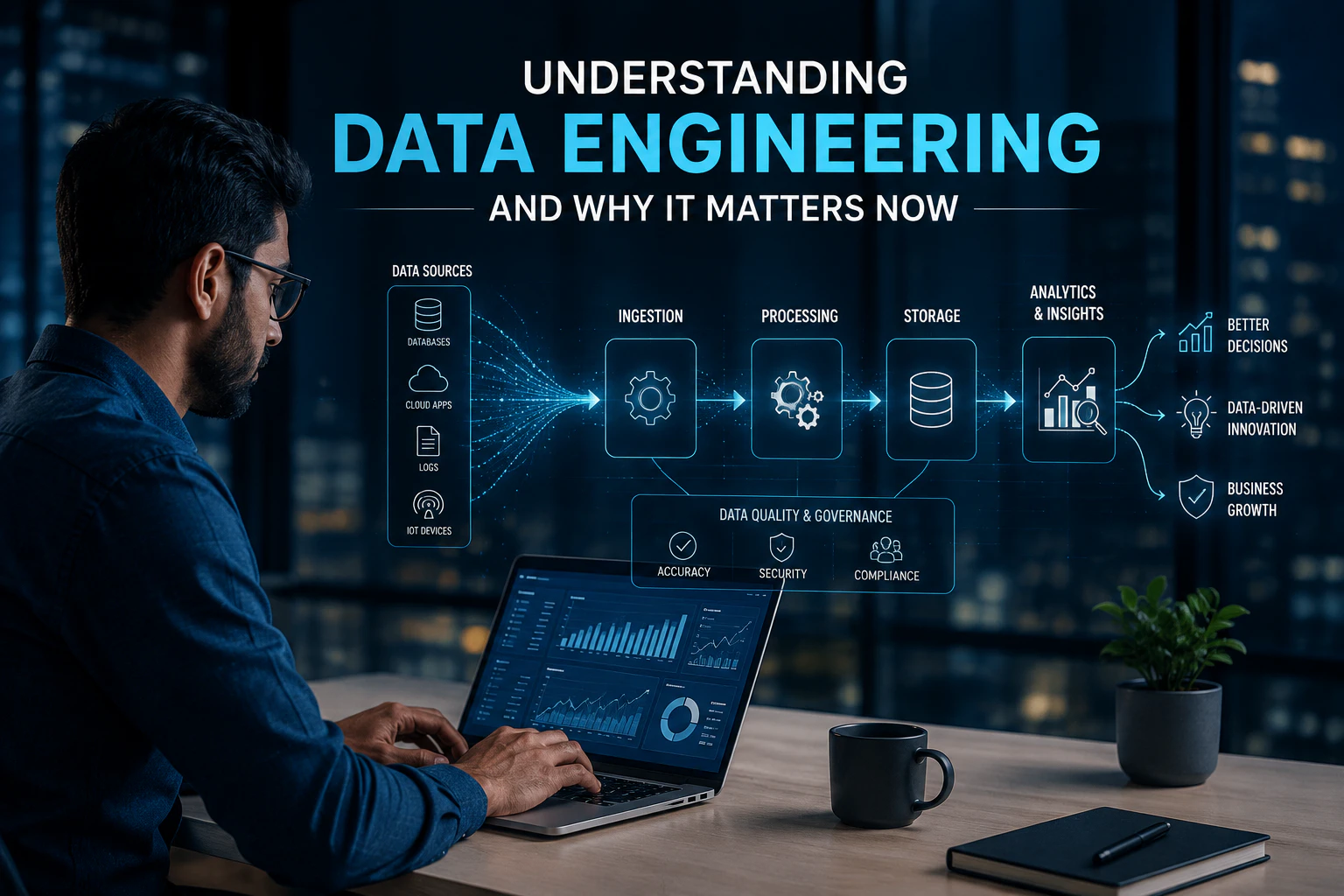
At its core, data engineering is the practice of designing, building, and maintaining the systems that collect, store, and move information so it can be used effectively. Think of it as the plumbing of the digital world. Water does not simply appear at a tap; pipes, treatment plants, and pressure systems make that possible behind the scenes. Similarly, dashboards, reports, and machine learning models do not simply appear either. Someone has to build the pipelines that gather data from apps, websites, sensors, and databases, then transform that data into a clean, reliable, and accessible format.
Professionals who do this work, known as data engineers, focus heavily on infrastructure. They write code, manage databases, and build automated workflows called pipelines that move information from one place to another without manual intervention. Their goal is not to analyze the data themselves but to make sure the data is trustworthy, well-organized, and available whenever analysts, scientists, or business teams need it.
The Difference Between Data Engineering And Data Science
People often confuse data engineering with data science, and the overlap does create some blur. However, the two roles serve distinct purposes. A data scientist typically works with information that has already been cleaned and structured, using statistical models and algorithms to uncover patterns or make predictions. A data engineer, by contrast, builds the foundation that makes that analysis possible in the first place.
Without solid engineering work behind it, a data scientist would spend most of their time cleaning messy spreadsheets instead of generating insights. The relationship is similar to that of an architect and a builder. One designs the vision, and the other constructs something sturdy enough to support it.
Core Responsibilities Within The Field
A typical data engineer spends time designing systems that extract information from multiple sources such as customer relationship platforms, transaction logs, or third-party APIs. They then transform that raw information into a consistent structure and load it into warehouses or lakes where it becomes searchable and usable. This entire sequence is commonly referred to as ETL, short for extract, transform, and load, although many modern teams now favor a reversed approach known as ELT.
Beyond building pipelines, professionals in this space also monitor performance and ensure that systems scale as data volume grows. A pipeline that works smoothly with a thousand records daily might collapse under a million, so scalability and reliability sit at the heart of the job. Security and governance also fall under this umbrella, since sensitive information must stay protected.
Tools And Technologies Used In Data Engineering
The technical toolkit varies by company, but certain technologies appear repeatedly across data engineering projects. Structured Query Language remains a foundational skill, since most data still lives inside relational databases. Cloud platforms such as Amazon Web Services, Google Cloud, and Microsoft Azure provide the storage and computing power needed to handle massive datasets without maintaining physical servers.
Programming languages like Python and Scala are widely used for building automated workflows, while orchestration tools help schedule these workflows so nothing breaks silently overnight. Distributed processing frameworks allow teams to handle enormous datasets that a single machine could never manage alone.
Why Businesses Are Prioritizing This Discipline
Organizations generate more information today than at any point in history, and that volume continues to expand rAPIdly. Without a strong engineering foundation, this growth becomes a liability rather than an asset. Reports become inconsistent, dashboards show conflicting numbers, and decision-makers lose confidence in the systems meant to guide them.
Companies that invest properly in data engineering gain a competitive advantage because their teams can trust the numbers in front of them. Faster, cleaner access to information supports better forecasting, more accurate customer insights, and quicker responses to market shifts. This is precisely why demand for skilled data engineering professionals has grown so sharply across industries ranging from healthcare to finance to retail.
Getting Started In This Field
For anyone curious about entering this profession, the path typically begins with strong programming fundamentals and a solid understanding of databases. Many professionals come from computer science backgrounds, though career changers with analytical mindsets often succeed too, through targeted coursework and hands-on projects. Building small pipelines using publicly available datasets is a practical way to gain experience before applying for entry-level roles. Certifications from major cloud providers can also strengthen a resume, since so much modern infrastructure now lives in the cloud rather than on physical servers.
Final Thoughts
So, what is data engineering when you strip away the technical language? It is the behind-the-scenes work that turns scattered, messy information into something dependable enough to guide real business decisions. As businesses continue generating unprecedented volumes of information, the professionals who build and maintain these systems will only become more essential to how organizations operate and grow.