
Introduction
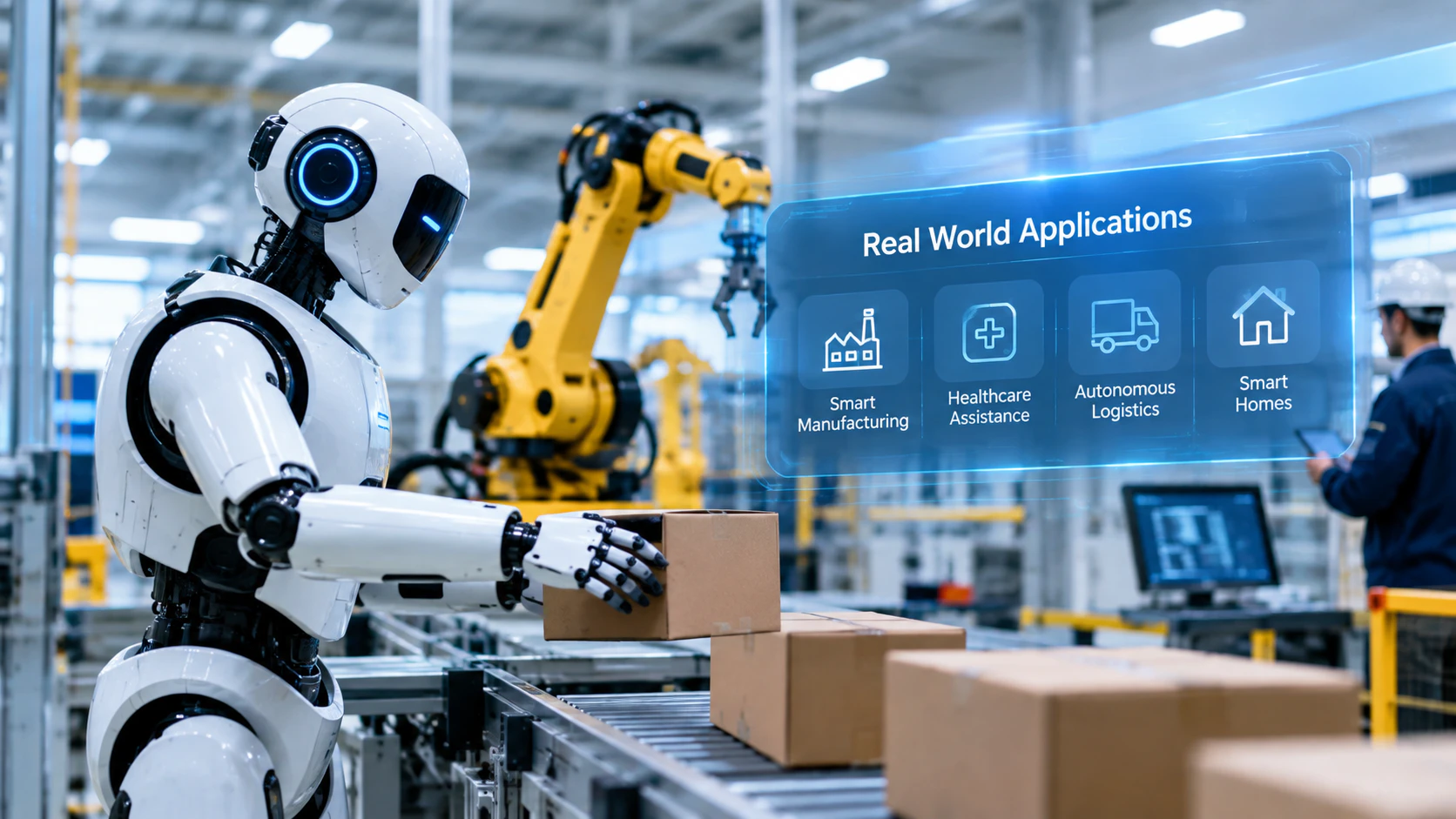
The evolution of artificial intelligence has moved beyond screen-based algorithms and conversational interfaces. Intelligence now connects directly with real-world environments through advanced sensors, spatial awareness systems, and specialized hardware. This intersection of hardware and digital brains is driving the growth of physical ai applications across global industries.
Unlike traditional digital software, these systems must continuously react to physical laws, unpredictable environments, and direct real-time feedback. Devices equipped with embodied intelligence can perceive their surrounding context, make operational decisions on the edge, and execute physical tasks with extreme precision. Understanding these technological advances reveals how intelligent automated systems are redesigning logistics, modern medicine, heavy industrial operations, and smart urban infrastructure.
Transforming Logistics and Autonomous Supply Chains
The logistics and distribution sectors represent one of the most active testing grounds for smart embodied systems. Modern supply chains require constant adaptation to unexpected delays, changing inventory levels, and dense packing layouts. The integration of physical ai applications within logistics enables dynamic route optimization, autonomous picking, and seamless warehouse operations without constant human intervention.
Autonomous mobile units navigate crowded fulfillment facilities using real-time spatial vision and distance sensors. These systems dynamic update pathing decisions on the fly when unexpected obstacles appear in their way. Modern robotic arms utilize multi-spectral vision combined with force-feedback sensors to grip delicate or oddly shaped items safely. Outside warehouse walls, autonomous delivery drones and self-navigating freight vehicles operate on busy public roadways by reading complex traffic flows, bad weather conditions, and unexpected pedestrian movements to complete last-mile transit reliably.
Precision Healthcare and Assistive Physical AI Applications
Healthcare delivery relies heavily on high touch precision, fine spatial execution, and split-second physical adaptability. Medical institutions are rapidly embracing adaptive spatial hardware to assist surgeons, improve patient monitoring, and speed up intensive physical therapy. Specialized physical ai applications in healthcare serve as responsive force multipliers for clinicians while reducing human error during delicate interventions.
Surgical robotic platforms use advanced force sensors to provide surgical teams with micro-movement guidance, compensating instantly for micro-tremors during delicate procedures. Rehabilitation environments now deploy smart exoskeletons that measure patient muscle activity and joint resistance in real time. These devices offer dynamic physical assistance that scales down automatically as the patient recovers strength. Intelligent hospital beds and non-invasive patient monitoring systems continuously process movement patterns to catch mobility risks before accidental falls happen on the floor.
Redefining Industrial Manufacturing and Smart Factories
Factory floors have used basic robotic automation for decades, but traditional industrial machines were rigid and strictly limited to identical, pre-programmed motions. Modern manufacturing demands extreme flexibility due to changing product lines and custom consumer demands. Deploying dynamic physical ai applications inside production facilities transforms static assembly setups into adaptable, self-correcting micro-factories.
Collaborative industrial units work right alongside human operators without requiring protective cages. High-speed camera arrays paired with force feedback actuators allow these collaborative machines to handle fragile assembly tasks, instantly adjust to misaligned components, and detect micro-defects during production. Predictive maintenance systems monitor physical vibration, temperature shifts, and acoustic profiles across heavy equipment. By processing operational telemetry directly on edge hardware, these systems catch early component wear and automatically prompt physical maintenance routines before an expensive system failure occurs.
Building Resilient Agriculture and Smart Infrastructure
Resource management, food production, and public infrastructure maintenance present tough, open-air physical challenges. Farming and municipal infrastructure both cover vast geographical areas that require continuous physical labor under variable weather conditions. Emerging physical ai applications provide efficient tools to monitor, maintain, and harvest farmlands and municipal assets autonomously.
Smart agricultural tractors and harvesting equipment navigate vast fields using high-definition spatial mapping, soil sensors, and computer vision. These field machines evaluate plant maturity individual by individual, applying precise amounts of fertilizer or removing weeds without disturbing nearby healthy crops. For public infrastructure, specialized crawling inspection units and airborne aerial drones examine bridges, power grids, pipelines, and remote energy facilities. Equipped with non-destructive testing sensors, these systems spot subtle structural degradation and conduct precise touch inspections in dangerous environments that would pose significant safety risks to human technicians.
Emerging Trends and Future Outlook
The momentum behind physical intelligence is accelerating rapidly due to breakthroughs in edge processing chips, high-density batteries, and advanced sensor hardware. Processing neural models directly on local hardware allows physical machines to react instantly without waiting for cloud computing responses, ensuring real-time safety during unexpected real-world situations.
As multimodal artificial intelligence platforms continue to integrate deeper with touch feedback sensors and physical spatial mapping, machines will gain unprecedented operational flexibility. The widespread adoption of these physical capabilities marks a broad shift toward fully responsive real-world environments. Organizations that systematically integrate smart spatial machines into their operational strategies will establish major competitive edges in speed, safety, and long-term execution resilience.