
Introduction
Software teams are under constant pressure to release better applications faster while keeping reliability, security, and user experience intact. Traditional development workflows can make that difficult because coding, testing, deployment, and infrastructure management often happen as separate activities. DevOps software development brings these activities closer together, creating a more connected approach to building and delivering applications.
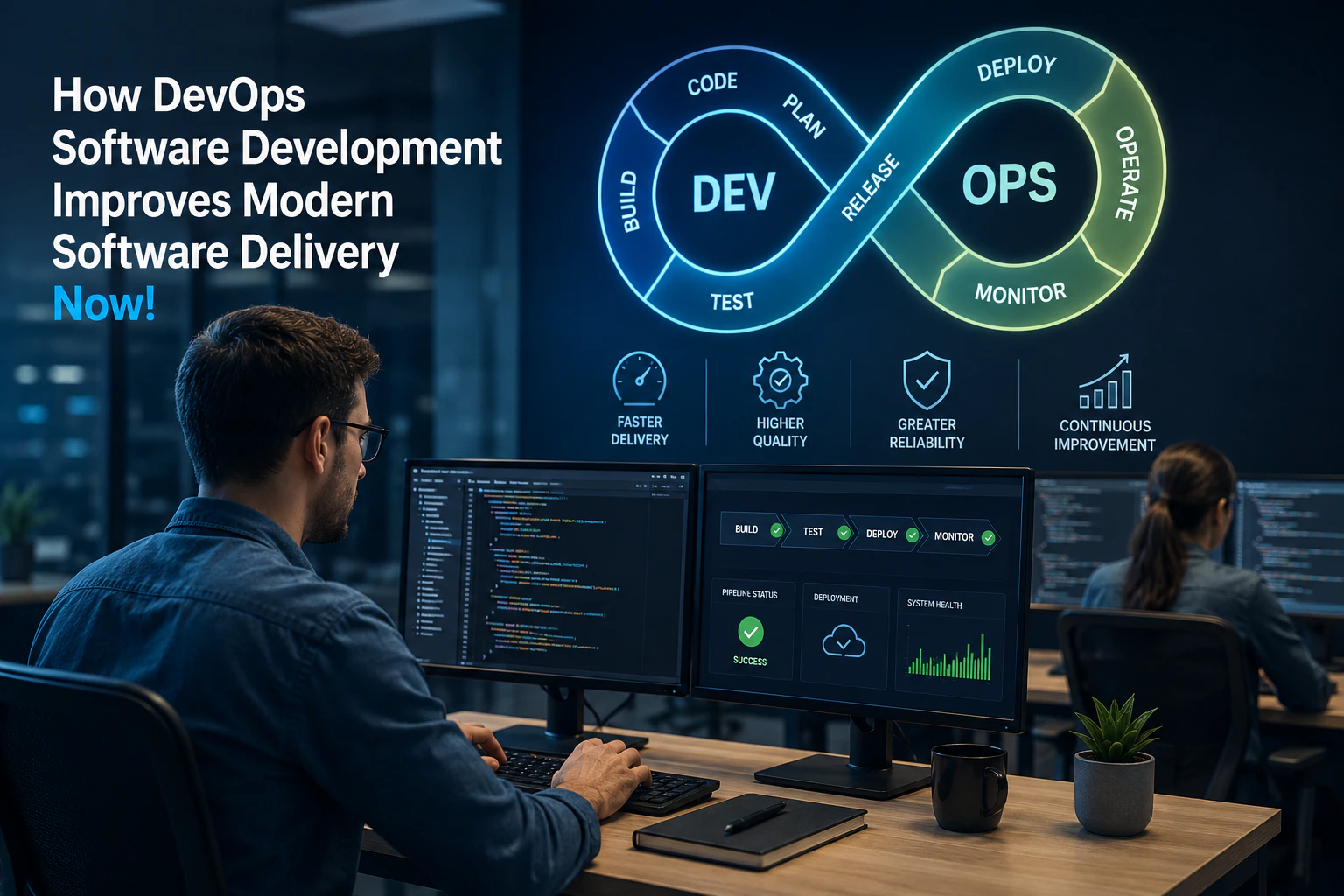
At its core, DevOps software development combines development and operations practices so teams can collaborate throughout the application lifecycle. Rather than treating development and IT operations as separate stages, DevOps encourages shared responsibility, automation, continuous feedback, and frequent delivery. Microsoft describes DevOps as an approach that brings people, processes, and technology together across planning, development, delivery, and operations.
Why DevOps Software Development Matters for Modern Teams
The value of DevOps software development goes beyond releasing code quickly. It changes how teams approach software quality and delivery. Developers, testers, security specialists, and operations professionals can work toward common goals instead of waiting for one group to complete its work before another begins.
This collaborative model can shorten feedback cycles. When developers receive information about defects or performance issues earlier, they have a better opportunity to resolve them before those problems become expensive production incidents. Continuous integration, for example, automatically builds and tests code changes as they are integrated into a shared repository.
For organizations managing frequently updated applications, DevOps software development also creates a foundation for more predictable releases. Smaller changes are generally easier to test, review, troubleshoot, and roll back than large batches of code.
Automation Becomes Part of the Development Culture
One of the strongest characteristics of DevOps software development is automation. Manual activities are not eliminated simply because automation is available; instead, teams identify repetitive processes where automation can improve consistency and reduce avoidable errors.
Builds, automated tests, code validation, deployment workflows, infrastructure provisioning, and monitoring can all become parts of an automated delivery process. Continuous delivery extends continuous integration by automatically preparing tested code for release, helping teams maintain deployment-ready software.
In practical terms, DevOps software development allows engineers to spend less time repeating operational tasks and more time solving meaningful product and customer problems. Automation also creates repeatable workflows, making it easier to understand how a change moves from a developer's workstation toward production.
CI/CD Strengthens DevOps Software Development
Continuous integration and continuous delivery are central practices within DevOps software development. CI encourages developers to integrate code frequently, while CD automates much of the process involved in validating and preparing software for deployment.
A well-designed CI/CD pipeline can automatically compile applications, run unit and integration tests, check code quality, package artifacts, and move validated builds through appropriate environments. This approach creates a shorter feedback loop between coding and delivery.
The relationship between DevOps software development and CI/CD is therefore practical rather than merely conceptual. Automation makes frequent delivery possible, while frequent delivery gives teams faster feedback. AWS notes that CI/CD can streamline application building, testing, and deployment while reducing deployment risks.
Security Needs a Place in DevOps Software Development
Security should not be treated as a final checkpoint before an application reaches production. Modern DevOps software development increasingly incorporates security considerations throughout the development lifecycle.
This approach is commonly associated with DevSecOps. Security testing, dependency checks, secrets management, access controls, vulnerability scanning, and compliance checks can become integrated into development and delivery workflows.
When security becomes part of everyday engineering work, teams can identify issues earlier instead of discovering them immediately before release. This does not mean every security decision should be automated. Human review remains important for high-risk changes, sensitive systems, and regulatory requirements.
Infrastructure and Applications Move Closer Together
Another important aspect of DevOps software development is the relationship between application code and infrastructure. Modern applications often depend on cloud resources, containers, networking, databases, APIs, and other infrastructure components.
Infrastructure as code allows teams to define infrastructure in configuration files that can be versioned, reviewed, tested, and reproduced. This helps reduce configuration differences between environments and supports more consistent deployments.
For DevOps software development, this matters because application delivery does not end when code is compiled. The application also needs a reliable environment in which it can run. Treating infrastructure as an integral part of the delivery process helps engineering teams manage that dependency more effectively.
Monitoring Creates a Continuous Feedback Loop
Successful DevOps software development does not stop after deployment. Once software reaches production, teams need visibility into application health, infrastructure performance, availability, errors, and user experience.
Monitoring and observability provide this feedback. Metrics, logs, traces, alerts, and application performance data can help teams identify abnormal behavior and investigate incidents.
This feedback loop also supports continuous improvement. Instead of assuming that a successful deployment means the work is finished, teams can examine real-world performance and use those insights to guide future development. Microsoft highlights monitoring and feedback as important parts of modern DevOps delivery practices.
Culture Is Just as Important as Technology
Tools alone cannot create effective DevOps software development. An organization can invest heavily in CI/CD platforms, cloud infrastructure, containers, monitoring tools, and automation frameworks and still struggle if teams do not communicate effectively.
The cultural side of DevOps encourages collaboration, shared ownership, transparency, and continuous learning. Developers should understand operational consequences, while operations teams should have visibility into application requirements and development priorities.
This shared responsibility makes DevOps software development more sustainable. Teams can learn from failed deployments, incidents, and performance problems instead of treating them only as individual mistakes. The goal is to improve the system and the process so similar problems become less likely in the future.
Measuring the Impact of DevOps Software Development
Organizations adopting DevOps software development should look beyond the number of tools they have implemented. Meaningful measurement focuses on delivery performance and software reliability.
Teams can evaluate deployment frequency, lead time for changes, change failure rate, recovery time, defect trends, pipeline performance, and production reliability. These measurements help reveal whether DevOps practices are actually improving software delivery.
For example, faster deployment is not necessarily a success if the change failure rate increases significantly. Likewise, highly automated pipelines provide limited value if testing is weak or production monitoring is poor. Effective DevOps software development balances speed, quality, security, and operational stability.
The Future of DevOps Software Development
As cloud-native architecture, artificial intelligence, automation, and distributed applications continue to evolve, DevOps software development will remain closely connected to how organizations build and operate software.
AI-assisted development may accelerate coding and testing activities, but organizations will still need reliable engineering practices, governance, security controls, testing strategies, and operational visibility. Automation can make processes faster, but thoughtful engineering determines whether those processes produce dependable results.
Ultimately, DevOps software development is less about adopting a particular tool and more about creating a dependable way to move from an idea to working software. When development, operations, testing, security, and infrastructure work as a connected system, organizations can respond to customer needs faster without treating quality as an afterthought.
The strongest DevOps software development environments are therefore built around continuous improvement. Teams automate where automation adds value, collaborate across traditional boundaries, learn from production feedback, and continuously refine the software delivery lifecycle. That combination creates a practical foundation for modern software development and long-term engineering resilience.