

はじめに
本記事では、DPoP proof JWT (RFC 9449, Section 4. DPoP Proof JWTs) を生成する Java コードを紹介します。
DPoP proof JWT 仕様
まず、コーディングに関係のある DPoP proof JWT の仕様を、簡潔に確認していきます。
ヘッダ
| パラメータ | 要否 | 説明 |
|---|---|---|
typ |
必須 | 値は dpop+jwt で固定 |
alg |
必須 | 非対称鍵系署名アルゴリズム |
jwk |
必須 | 公開鍵 |
ペイロード
| クレーム | 要否 | 説明 |
|---|---|---|
jti |
必須 | 一意識別子 |
htm |
必須 | リクエストの HTTP メソッド |
htu |
必須 | リクエストのターゲット URI |
iat |
必須 | 生成時刻 |
ath |
条件 | アクセストークンのハッシュ値 |
nonce |
条件 | DPoP nonce |
補足
-
htu— 『オリジナルリクエストのターゲットURIの解決』参照 -
ath— DPoP proof JWT をアクセストークンと一緒に使う場合、必須。アクセストークンの SHA-256 ハッシュ値を base64url エンコードしたもの。 -
nonce— サーバがDPoP-Nonceヘッダで nonce 値を提供してきた場合、必須。詳細は『DPoP Nonce』参照。
DPoP proof JWT 生成
入力パラメータ
DPoP proof JWT 生成処理の入力パラメータを整理します。
| 入力データ | 要否 | 補足 |
|---|---|---|
| 一意識別子 | 任意 | 不指定なら自動生成 |
| HTTP メソッド | 必須 | |
| ターゲット URI | 必須 | |
| アクセストークン | 任意 | |
| nonce | 任意 | |
| 発行時刻 | 任意 | 不指定なら現在時刻 |
| 署名鍵 | 必須 | 秘密鍵 |
設計
DPoP proof JWT を生成する処理を DpopProofBuilder という名前のユーティリティクラスとして実装します。
このクラスを、次の手順で使えるようにします。
-
DpopProofBuilderのインスタンスを生成する - 入力パラメータ群を設定する
-
build()メソッドを呼ぶ
最後の build() メソッドコールは DPoP proof JWT を表す SignedJWT インスタンス (Nimbus JOSE + JWT ライブラリ) を生成します。
想定する使い方は下記のとおりです。
// 入力パラメータ
String jwtId       = ...; // 一意識別子
String httpMethod  = ...; // HTTP メソッド
URI    targetUri   = ...; // ターゲット URI
String accessToken = ...; // アクセストークン
String nonce       = ...; // nonce
Date   issueTime   = ...; // 発行時刻
JWK    key         = ...; // 署名鍵

// DPoP proof JWT 生成
SignedJWT jwt =
    new DpopProobBuilder()
        .jwtId(jwtId)             // 一意識別子
        .httpMethod(httpMethod)   // HTTP メソッド
        .targetUri(targetUri)     // ターゲット URI
        .accessToken(accessToken) // アクセストークン
        .nonce(nonce)             // nonce
        .issueTime(issueTime)     // 発行時刻
        .key(key)                 // 署名鍵
        .build();
実装
それほど長いコードではないので、実装を丸ごと掲載します。
import java.net.URI;
import java.util.Date;
import java.util.UUID;
import com.nimbusds.jose.Algorithm;
import com.nimbusds.jose.JOSEException;
import com.nimbusds.jose.JOSEObjectType;
import com.nimbusds.jose.JWSAlgorithm;
import com.nimbusds.jose.JWSHeader;
import com.nimbusds.jose.JWSSigner;
import com.nimbusds.jose.crypto.factories.DefaultJWSSignerFactory;
import com.nimbusds.jose.jwk.JWK;
import com.nimbusds.jose.jwk.KeyType;
import com.nimbusds.jwt.JWTClaimsSet;
import com.nimbusds.jwt.SignedJWT;


public class DpopProofBuilder
{
    // typ ヘッダパラメータの値
    private static final JOSEObjectType TYPE_DPOP_JWT = new JOSEObjectType("dpop+jwt");

    // 入力パラメータ群
    private String jwtId;
    private String httpMethod;
    private URI targetUri;
    private String accessTokenHash;
    private String nonce;
    private Date issueTime;
    private JWK key;


    public DpopProofBuilder jwtId(String jwtId)
    {
        this.jwtId = jwtId;

        return this;
    }


    public DpopProofBuilder httpMethod(String httpMethod)
    {
        this.httpMethod = httpMethod;

        return this;
    }


    public DpopProofBuilder targetUri(URI targetUri)
    {
        this.targetUri = targetUri;

        return this;
    }


    public DpopProofBuilder accessToken(String accessToken)
    {
        // RFC 9449: OAuth 2.0 Demonstrating Proof of Possession (DPoP)
        // Section 4.2. DPoP Proof JWT Syntax
        //
        //   ath: Hash of the access token. The value MUST be the result of
        //        a base64url encoding (as defined in Section 2 of [RFC7515])
        //        the SHA-256 [SHS] hash of the ASCII encoding of the
        //        associated access token's value.
        //

        // BASE64URL( SHA256( accessToken ) )
        this.accessTokenHash =
                CodingUtility.toBase64Url(
                        DigestUtility.sha256(accessToken));

        return this;
    }


    public DpopProofBuilder accessTokenHash(String accessTokenHash)
    {
        this.accessTokenHash = accessTokenHash;

        return this;
    }


    public DpopProofBuilder nonce(String nonce)
    {
        this.nonce = nonce;

        return this;
    }


    public DpopProofBuilder issueTime(Date issueTime)
    {
        this.issueTime = issueTime;

        return this;
    }


    public DpopProofBuilder key(JWK key)
    {
        this.key = key;

        return this;
    }


    public SignedJWT build() throws IllegalStateException, JOSEException
    {
        // 署名アルゴリズムを決める
        JWSAlgorithm algorithm = determineAlgorithm(key);

        // ヘッダを用意する
        JWSHeader header = buildHeader(key, algorithm);

        // ペイロードに入れるクレーム群を用意する
        JWTClaimsSet claims = buildClaims();

        // 署名鍵と署名アルゴリズムから JWSSigner を用意する
        JWSSigner signer = buildSigner(key, algorithm);

        // 用意したヘッダとクレーム群を持つ JWT を作る (署名前)
        SignedJWT jwt = new SignedJWT(header, claims);

        // 署名する
        jwt.sign(signer);

        return jwt;
    }


    private static JWSAlgorithm determineAlgorithm(JWK jwk)
    {
        // JWK の alg パラメータ
        Algorithm alg = jwk.getAlgorithm();

        // JWK に alg パラメータが含まれていれば
        if (alg != null)
        {
            // alg パラメータの値を JWS アルゴリズムとして解釈する
            return JWSAlgorithm.parse(alg.getName());
        }

        // JWK の Key Type からアルゴリズムを決める
        return determineAlgFamily(jwk.getKeyType()).getFirst();
    }


    private static JWSHeader buildHeader(JWK jwk, JWSAlgorithm alg)
    {
        // 署名鍵をチェックする
        checkKey(jwk);

        // alg パラメータの設定
        JWSHeader.Builder builder = new JWSHeader.Builder(alg);

        // typ パラメータの設定 (値は "dpop+jwt")
        builder.type(TYPE_DPOP_JWT);

        // jwk パラメータの設定
        // 秘密鍵を公開鍵に変換している点に注目
        builder.jwk(jwk.toPublicJWK());

        return builder.build();
    }


    private static JWSAlgorithm.Family determineAlgFamily(KeyType keyType)
    {
        if (keyType == KeyType.EC)
        {
            return JWSAlgorithm.Family.EC;
        }
        else if (keyType == KeyType.RSA)
        {
            return JWSAlgorithm.Family.RSA;
        }
        else if (keyType == KeyType.OCT)
        {
            return JWSAlgorithm.Family.HMAC_SHA;
        }
        else if (keyType == KeyType.OKP)
        {
            return JWSAlgorithm.Family.ED;
        }

        // サポートしていない Key Type
        throw new IllegalStateException("The key type '" + keyType + "' is not supported.");
    }


    private static void checkKey(JWK jwk)
    {
        // 署名鍵が設定されていない場合
        if (jwk == null)
        {
            throw new IllegalStateException("No key is set.");
        }

        // 署名鍵が秘密鍵ではない場合
        if (!jwk.isPrivate())
        {
            throw new IllegalStateException("The key is not a private key.");
        }

        // 署名鍵の Key Type が OCT の場合 (対称鍵系の場合)
        if (jwk.getKeyType() == KeyType.OCT)
        {
            throw new IllegalStateException("The key is not an asymmetric key.");
        }
    }


    private JWTClaimsSet buildClaims()
    {
        JWTClaimsSet.Builder builder = new JWTClaimsSet.Builder();

        // RFC 9449: OAuth 2.0 Demonstrating Proof of Possession (DPoP)
        // Section 4.2. DPoP Proof JWT Syntax

        // jti: Unique identifier for the DPoP proof JWT. The value MUST be
        //      assigned such that there is a negligible probability that
        //      the same value will be assigned to any other DPoP proof used
        //      in the same context during the time window of validity. Such
        //      uniqueness can be accomplished by encoding (base64url or any
        //      other suitable encoding) at least 96 bits of pseudorandom
        //      data or by using a version 4 Universally Unique Identifier
        //      (UUID) string according to [RFC4122]. The jti can be used by
        //      the server for replay detection and prevention; see Section 11.1.
        builder.jwtID(buildJti());

        // htm: The value of the HTTP method (Section 9.1 of [RFC9110]) of
        //      the request to which the JWT is attached.
        builder.claim("htm", buildHtm());

        // htu: The HTTP target URI (Section 7.1 of [RFC9110]) of the request
        //      to which the JWT is attached, without query and fragment parts.
        builder.claim("htu", buildHtu());

        // iat: Creation timestamp of the JWT (Section 4.1.6 of [RFC7519]).
        builder.issueTime(buildIat());

        // ath: Hash of the access token. The value MUST be the result of a
        //      base64url encoding (as defined in Section 2 of [RFC7515]) the
        //      SHA-256 [SHS] hash of the ASCII encoding of the associated
        //      access token's value.
        if (accessTokenHash != null)
        {
            builder.claim("ath", accessTokenHash);
        }

        // nonce: A recent nonce provided via the DPoP-Nonce HTTP header.
        if (nonce != null)
        {
            builder.claim("nonce", nonce);
        }

        return builder.build();
    }


    private String buildJti()
    {
        if (jwtId != null)
        {
            return jwtId;
        }

        return UUID.randomUUID().toString();
    }


    private String buildHtm()
    {
        if (httpMethod != null)
        {
            return httpMethod;
        }

        throw new IllegalStateException("No HTTP method is set.");
    }


    private String buildHtu()
    {
        if (targetUri != null)
        {
            return targetUri.toASCIIString();
        }

        throw new IllegalStateException("No target URI is set.");
    }


    private Date buildIat()
    {
        if (issueTime != null)
        {
            return issueTime;
        }

        return new Date();
    }


    private static JWSSigner buildSigner(JWK jwk, JWSAlgorithm alg)
    {
        try
        {
            // 署名鍵とアルゴリズムをもとに JWSSigner を生成する
            return new DefaultJWSSignerFactory().createJWSSigner(jwk, alg);
        }
        catch (JOSEException cause)
        {
            throw new IllegalStateException(
                    "Failed to create a JWS signer for the key: " + cause.getMessage(), cause);
        }
    }
}
accessToken(String accessToken) メソッドの中では、渡されたアクセストークンの SHA-256 ハッシュを計算し、それを base64url でエンコードして、accessTokenHash フィールドに設定しています。
// BASE64URL( SHA256( accessToken ) )
this.accessTokenHash =
        CodingUtility.toBase64Url(
                DigestUtility.sha256(accessToken));
このコードに登場する SHA-256 ハッシュを計算する処理 (DigestUtility の sha256(String) メソッド) と base64url エンコードする処理 (CodingUtility の toBase64Url(byte[]) メソッド) は次のように実装することができます。
return MessageDigest.getInstance("SHA-256")
        .digest(input.getBytes(StandardCharsets.UTF_8));
return Base64.getUrlEncoder()
        .withoutPadding().encodeToString(input);
おわりに
アクセストークンを送信者限定にすることで、アクセストークンの漏洩に対する耐性を高めることができます。DPoP は送信者限定アクセストークンを実現する方法の一つです。
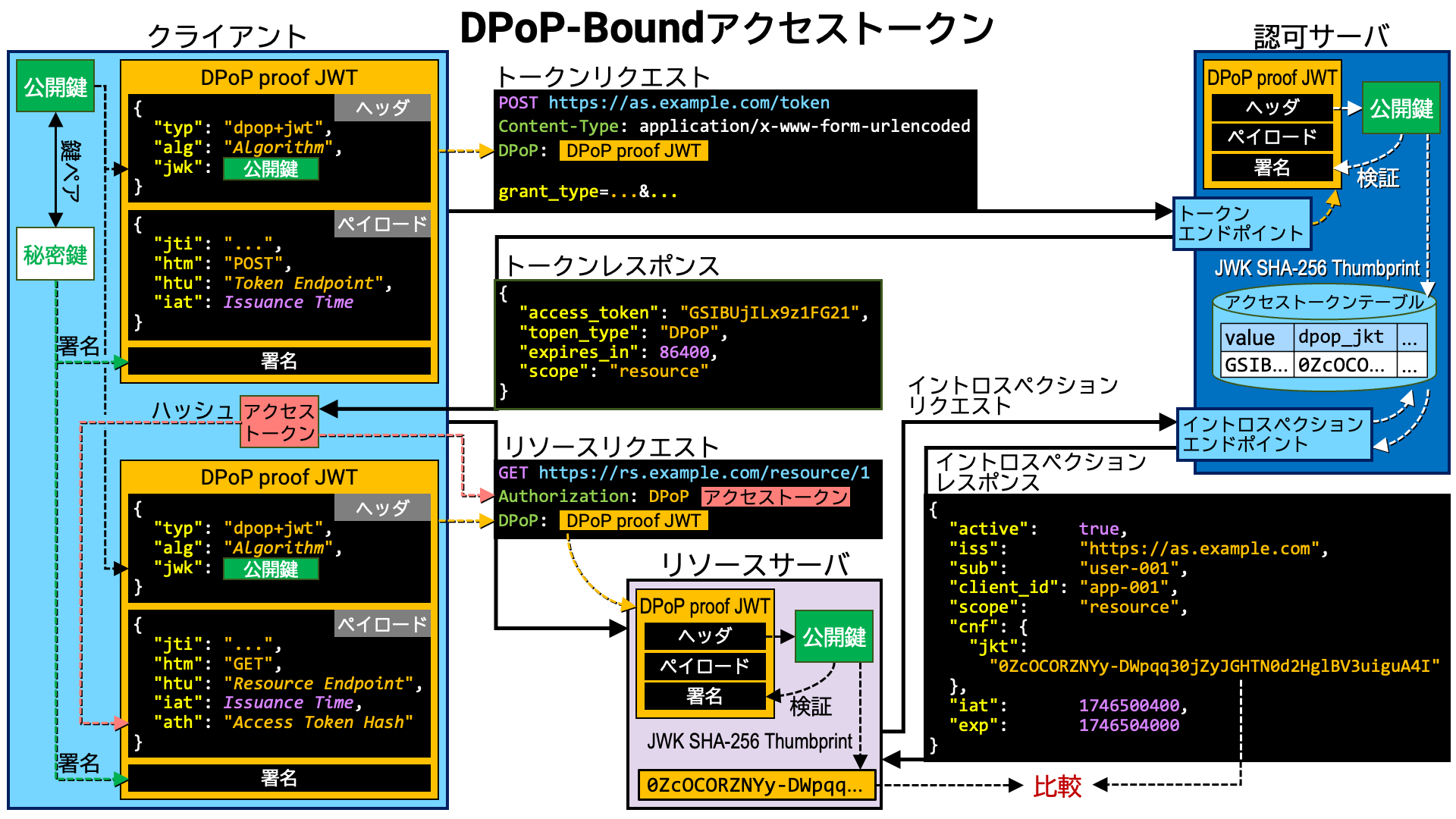
Authlete 社のウェブサイトで公開している『標準仕様による徹底的な API 保護』という文書で DPoP を解説していますので、詳細にご興味があればご参照ください。また、2025 年 10 月 29 日に開催したオンライン勉強会『OAuth・OpenID 標準仕様による徹底的な API 保護』でも解説しております。併せてご視聴ください。
OAuth・OpenID 標準仕様による徹底的な API 保護 | 送信者限定 / DPoP