
Why Solder Quality Matters in High-Frequency PCB Design
When designing high-frequency PCBs operating at 1 GHz and above, engineers usually focus on substrate materials, controlled-impedance routing, and component selection. However, solder joint quality is often underestimated, even though it plays a critical role in RF signal integrity.
At gigahertz frequencies, small imperfections in solder joints can introduce impedance discontinuities, increase insertion loss, and cause signal reflections that significantly degrade circuit performance. This article explains why solder quality is essential in high-frequency PCB design and how solder defects directly affect RF behavior.
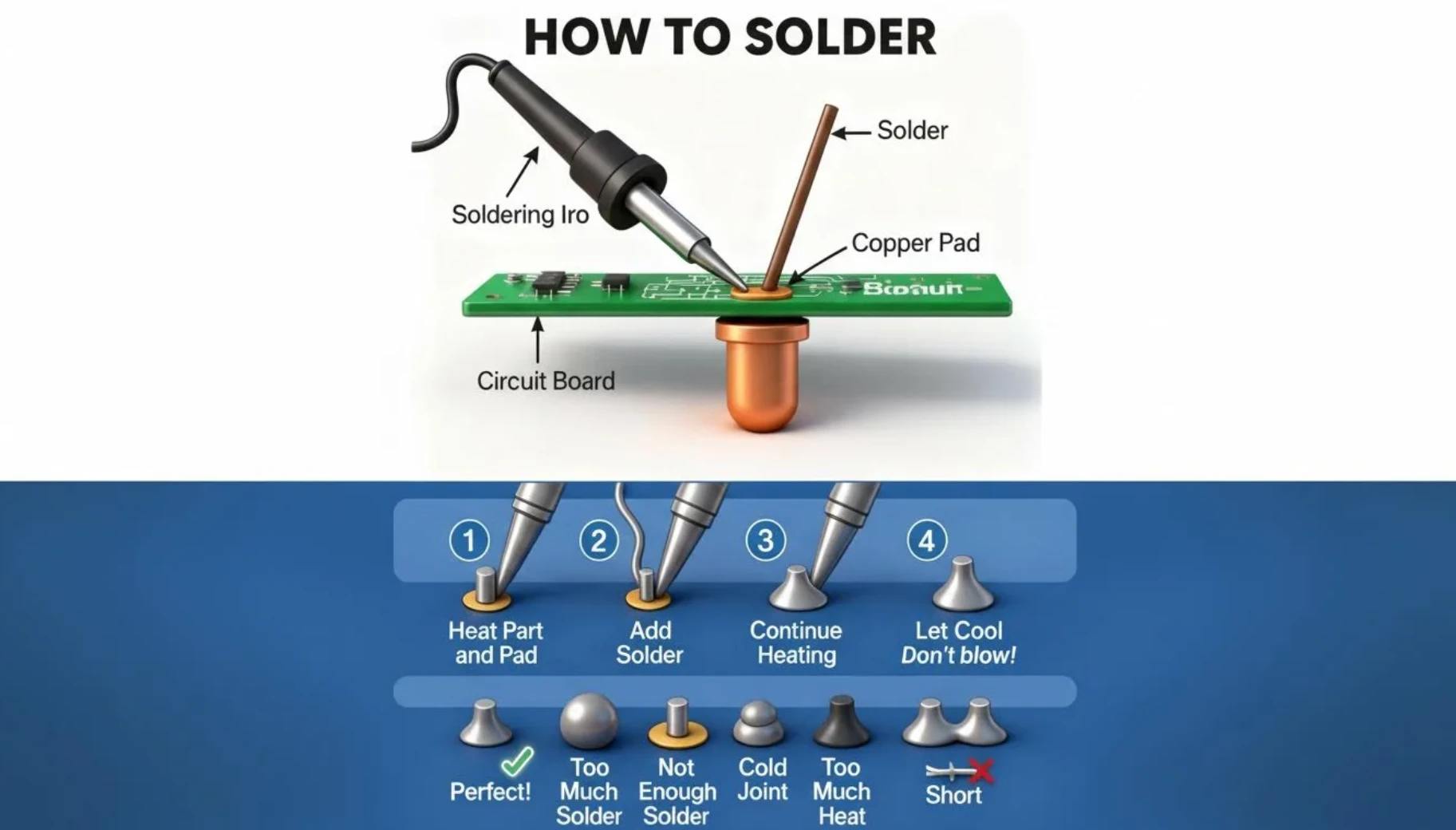
High-Frequency Signals Are Extremely Sensitive
At low frequencies, electrical signals behave predictably and tolerate minor discontinuities. At high frequencies, signals propagate as electromagnetic waves, and transmission-line theory dominates.
Two physical effects make solder quality critical:
Skin Effect
At high frequencies, current flows only on the surface of conductors.
At 10 GHz, the skin depth of copper is approximately 0.66 µm. Any surface roughness, void, or contamination in a solder joint increases resistance and signal loss.
Impedance Continuity
High-frequency traces are designed to maintain constant characteristic impedance (typically 50 Ω).
Solder joints act as transition regions. Poor joint geometry introduces impedance mismatch discontinuities, causing signal reflections and degraded return loss.
Solder Defects That Degrade RF Performance
1. Solder Voids
Solder voids are trapped gas pockets inside joints.
- Increase electrical resistance
- Create impedance mismatches
- Disrupt ground return paths under BGAs and QFNs
Even ~10% void content can degrade RF performance by 15–25% above 5 GHz.
For RF designs, void content is usually kept below 5%.
2. Cold Solder Joints
Cold joints form when solder does not fully melt or wet the pad.
- Weak intermetallic compound formation
- High-resistance interfaces
- Frequency-dependent signal attenuation
At RF frequencies, cold joints behave like lossy transmission elements.
3. Solder Bridges and Parasitic Capacitance
Bridges between pads introduce unintended capacitance.
At 5 GHz, even 0.5 pF of parasitic capacitance can:
- Shift resonant frequencies
- Degrade impedance matching
- Cause intermittent failures
4. Insufficient or Excessive Solder
- Insufficient solder: reduced contact area → higher resistance and skin-effect loss
- Excessive solder: uncontrolled geometry → parasitic inductance and capacitance
Both conditions may pass DC tests while failing RF validation.
Impedance Discontinuities and Measurement
High-frequency circuits require stable impedance throughout the signal path.
- Poor solder joints can degrade return loss from −15 dB to −5 dB
- Up to 30% of signal power may be reflected
Engineers commonly use:
- TDR (Time-Domain Reflectometry) to locate impedance changes
- VNA (Vector Network Analyzer) to measure S-parameters (S11, S21)
Defective solder joints often appear as clear impedance spikes in TDR measurements.
Surface Finish and Intermetallic Formation
Surface finish affects both solderability and RF loss:
- ENIG: good flatness, but nickel increases loss at higher frequencies
- Immersion Silver: lower RF loss, requires careful handling
- OSP: minimal loss, limited shelf life
Proper intermetallic compound (IMC) formation is also essential.
Optimal IMC thickness is typically 1–3 µm. Too little leads to weak joints, too much creates brittle connections.
Manufacturing Controls for RF Assembly
High-frequency PCB assembly requires tighter controls than standard electronics manufacturing:
- Precisely controlled reflow profiles (±2 °C uniformity)
- Fine-pitch solder paste (Type 4 or Type 5)
- Optimized stencil aperture design
- AOI for surface inspection
- X-ray inspection for void detection
Without these controls, RF performance variation between boards becomes unavoidable.
Design Practices That Improve Solder Reliability
Designers can reduce solder-related RF issues by:
- Optimizing pad geometry to balance solder volume and parasitics
- Using thermal reliefs on ground pads for proper reflow
- Preventing solder wicking with filled or plugged vias
- Selecting packages compatible with assembly capabilities
Early DFM reviews are especially important for RF designs.
Summary
In high-frequency PCB design, solder joints are not just mechanical connections—they are critical RF structures. Voids, cold joints, excess solder, or poor surface finishes can all introduce impedance discontinuities and signal loss.
As operating frequencies continue to rise in applications such as 5G, automotive radar, and satellite communications, solder quality becomes a limiting factor for performance and reliability. Treating solder joints as part of the RF signal path is essential for successful high-frequency designs.
Reference
- Detailed technical discussion:
https://morepcb.com/solder-quality-high-frequency-pcb-performance/