
Modern software teams are shipping products faster than ever before. Continuous deployment, cloud-native infrastructure, APIs, and microservices have made rapid development the standard across the tech industry.
But while deployment speed has improved, one major challenge continues to affect engineering teams everywhere: software reliability.
A single production bug can break payments, crash APIs, affect customer trust, and create massive operational costs. This is why software testing is no longer just a QA responsibility — it has become a critical engineering function.
The Software Testing Life Cycle (STLC) helps organizations create a structured testing process that improves software quality while reducing release risks.
Why Software Testing Is More Important Than Ever
Applications today are significantly more complex than traditional systems.
Modern engineering teams manage:
- Distributed microservices
- Third-party APIs
- Cloud infrastructure
- CI/CD pipelines
- Real-time systems
- Mobile and web platforms
In these environments, even a small backend issue can affect thousands or millions of users instantly.
For example, companies like Netflix need to validate updates across streaming services, recommendation engines, smart TVs, and mobile platforms before launching new features globally.
Similarly, Amazon performs extensive testing before major sales events because even a short outage in checkout systems can result in major revenue losses.
This level of complexity is exactly why structured testing workflows are essential for modern software teams.
Understanding the Software Testing Life Cycle
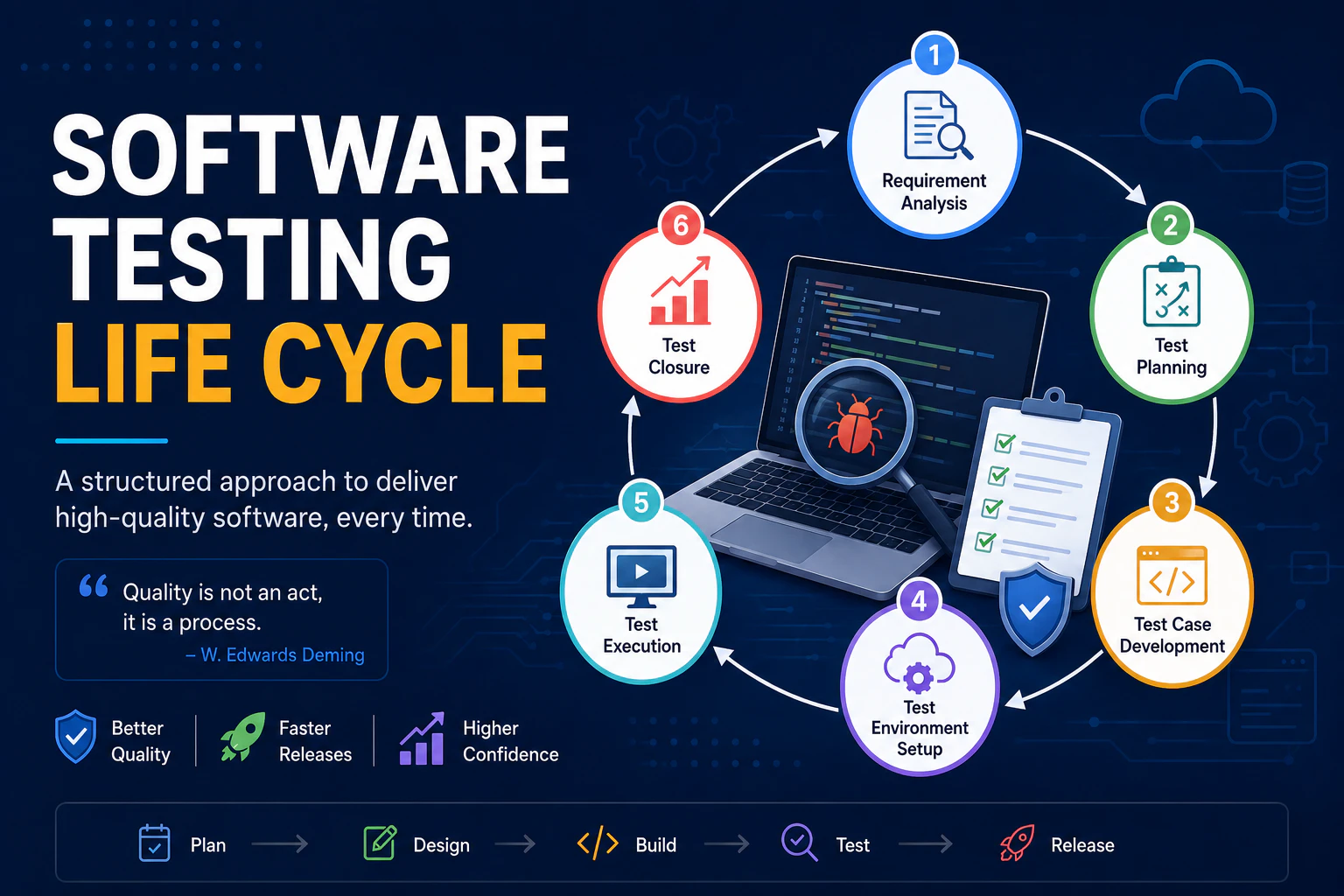
The Software Testing Life Cycle is a structured process that defines how testing activities should be performed throughout software development.
Instead of treating testing as a final release step, the STLC integrates testing into multiple development phases.
The primary goals include:
- Detecting defects early
- Improving software quality
- Increasing release confidence
- Reducing production failures
- Supporting continuous delivery
- Improving customer experience
The lifecycle helps teams maintain consistency and scalability across testing operations.
Key Phases of the STLC
The Software Testing Life Cycle typically includes several important stages.
1. Requirement Analysis
Everything begins with understanding the application requirements.
Testing teams review:
- Functional requirements
- APIs
- User workflows
- Technical architecture
- Business logic
The objective is to identify testing scope and understand which areas carry the highest risk.
Poor requirement analysis often creates testing gaps that become difficult to fix later in development.
2. Test Planning
This phase defines the overall testing strategy.
Teams determine:
- Testing objectives
- Resource allocation
- Automation strategy
- Testing timelines
- Environment requirements
- Risk management plans
Well-structured planning helps development and QA teams stay aligned throughout the release cycle.
Large SaaS organizations invest heavily in planning because software reliability directly affects customer retention and business growth.
3. Test Case Development
In this phase, testers create validation scenarios for the application.
This may include:
- Manual test cases
- API validations
- Automated scripts
- Regression workflows
- Performance scenarios
Automation has become increasingly important because manual testing alone cannot scale with modern release frequencies.
Platforms like Keploy help simplify regression testing by automatically generating API tests from real application traffic. This allows teams to build realistic test coverage without manually creating every regression scenario from scratch.
This approach is especially valuable for fintech and backend-heavy applications where API reliability is critical.
4. Test Environment Setup
Reliable environments are necessary for accurate validation.
Teams configure:
- Databases
- APIs
- Cloud infrastructure
- Containers
- Mock services
- Dependencies
Environment instability remains one of the most common causes of failed testing pipelines.
Streaming platforms like Spotify rely heavily on stable environments because recommendation systems, music delivery services, and real-time APIs all need to work consistently across millions of users.
5. Test Execution
This phase validates whether the software behaves as expected.
Teams perform:
- Functional testing
- Regression testing
- Integration testing
- API testing
- Performance testing
- Security testing
Any identified defects are documented and shared with developers for fixes and retesting.
As systems grow larger, regression testing becomes more difficult because updates in one service can unintentionally affect multiple downstream systems.
Ride-sharing companies like Uber heavily depend on automated regression testing because failures in ride matching, payment processing, or GPS systems can immediately affect customer experiences.
6. Test Closure
The final phase evaluates testing effectiveness and release quality.
Teams analyze:
- Test coverage
- Defect reports
- Automation metrics
- Release readiness
- Lessons learned
This stage helps organizations improve future testing workflows while identifying recurring quality issues.
Common Challenges in Modern Testing
Even with structured workflows, modern software testing introduces several operational challenges.
Flaky Automation
Unstable tests reduce trust in CI/CD pipelines and slow down development workflows.
Fast Release Cycles
Continuous deployment leaves limited time for manual validation.
Growing Regression Suites
As applications scale, maintaining regression coverage becomes increasingly expensive.
Environment Dependency Issues
Third-party APIs and distributed systems often create unstable testing conditions.
Limited Visibility
Complex architectures make it difficult to identify how changes affect downstream services.
Social media platforms like Instagram regularly face these challenges because backend updates must support billions of interactions without affecting user experience.
Why Automation Has Become Essential
Modern development speeds make manual testing alone unsustainable.
Automation helps teams:
- Execute tests faster
- Improve consistency
- Reduce human error
- Increase regression coverage
- Support CI/CD pipelines
- Scale testing across environments
Today’s testing platforms are moving beyond static scripted automation.
Tools like Keploy use real API traffic to automatically generate realistic test scenarios, helping teams validate production-like behavior while reducing maintenance overhead.
This approach is particularly effective for backend systems where APIs drive core application functionality.
Best Practices for Better Testing Workflows
Start Testing Early
Shift-left testing helps identify issues earlier in development.
Automate Repetitive Validation
Automation improves scalability and long-term efficiency.
Use Production-Like Test Scenarios
Realistic testing provides stronger release confidence.
Integrate Testing Into CI/CD
Continuous testing helps teams catch failures faster.
Monitor Testing Metrics
Tracking flaky tests, defect leakage, and coverage gaps improves testing quality over time.
Companies like Google continuously analyze testing metrics across large-scale distributed systems to maintain product stability despite rapid deployments.
The Future of Software Testing
Software testing is evolving rapidly alongside modern engineering practices.
Emerging trends include:
- AI-generated testing
- Self-healing automation
- Traffic-based regression testing
- Continuous quality engineering
- Intelligent failure detection
- Production-aware validation
As applications become increasingly API-centric, testing strategies must evolve beyond traditional manual workflows.
Final Thoughts
The Software Testing Life Cycle remains one of the most important frameworks for building reliable software in modern development environments. It helps organizations improve testing efficiency, reduce release risks, and maintain software quality at scale.
However, modern software systems require smarter testing approaches than traditional QA processes alone.
Automation, continuous testing, and realistic API validation are becoming essential for engineering teams operating in fast-moving development environments.
Platforms like Keploy are helping teams modernize testing by automatically generating realistic API tests from real traffic, enabling faster regression testing and more confident software releases.