
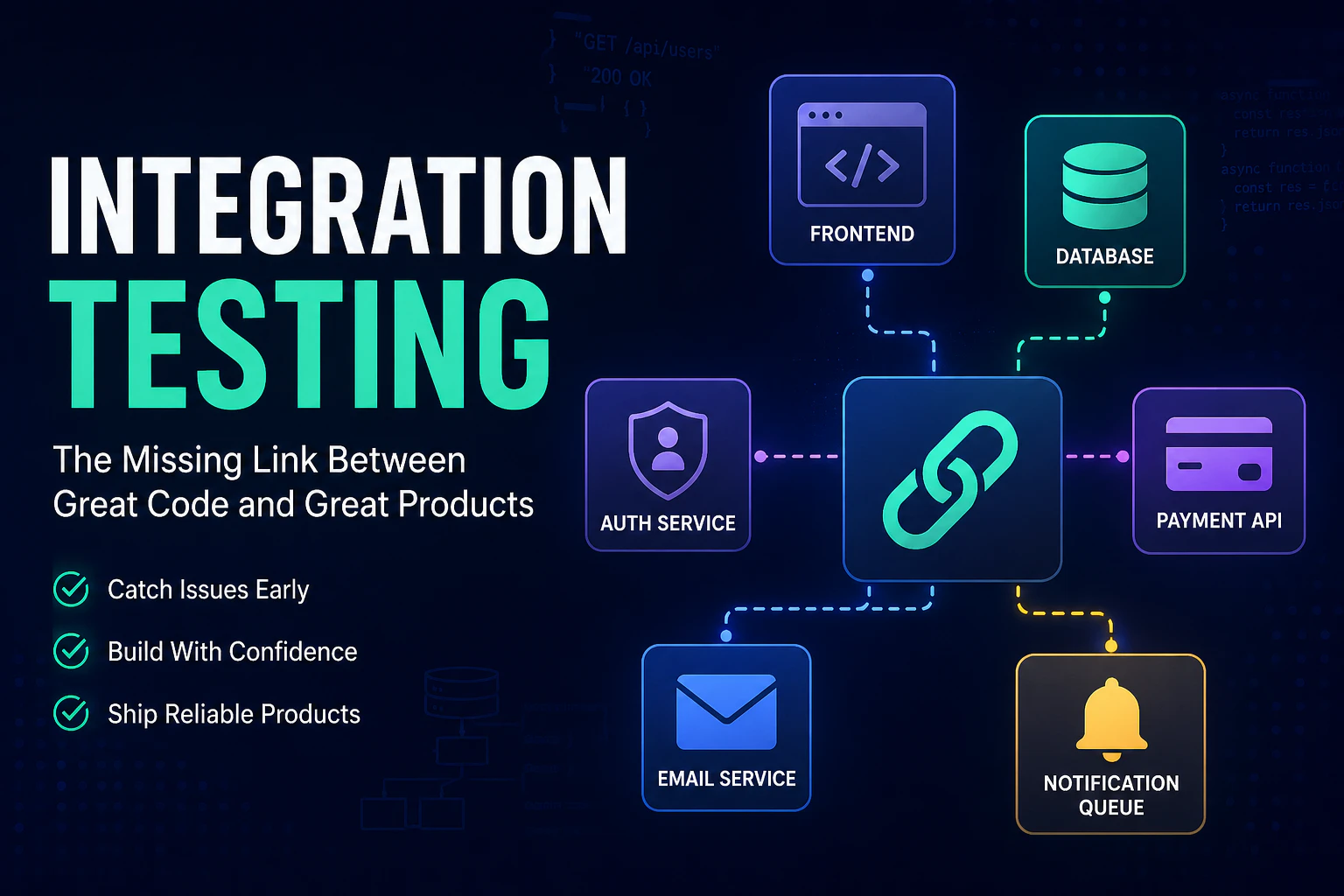
Modern applications are becoming more complex than ever. APIs communicate with multiple services, microservices depend on distributed systems, and deployments happen several times a day. In this environment, traditional testing approaches often struggle to keep up.
This is where AI-powered testing is changing the future of integration testing.
Why Traditional Integration Testing Is Difficult
Integration testing focuses on validating how different components work together. While this is essential for software reliability, it also introduces several challenges:
- Creating realistic test cases manually
- Maintaining mocks and test environments
- Handling constantly changing APIs
- Managing flaky tests
- Generating meaningful test coverage
As systems grow, maintaining integration tests becomes expensive and time-consuming.
Many teams eventually reduce test coverage simply because maintaining the testing infrastructure becomes too difficult.
How AI Is Transforming Integration Testing
AI-powered testing tools are helping developers automate large parts of the testing lifecycle.
Instead of manually writing every integration test, modern AI-driven systems can:
- Analyze API traffic
- Generate test cases automatically
- Detect unusual behavior patterns
- Identify edge cases
- Suggest missing test scenarios
- Reduce repetitive test maintenance
This allows engineering teams to focus more on building features instead of constantly updating test suites.
Smarter API Testing
One of the biggest advancements is happening in API integration testing.
Traditional API testing often requires:
- Manual request creation
- Writing assertions
- Maintaining mocks
- Updating schemas repeatedly
AI-based testing tools can now observe real application traffic and automatically generate reusable integration tests from production-like interactions.
This approach improves both speed and reliability while reducing human effort.
The Role of AI in CI/CD Pipelines
Modern CI/CD pipelines demand fast and reliable feedback.
AI-powered integration testing helps by:
- Prioritizing high-risk test cases
- Detecting failure patterns faster
- Reducing flaky test executions
- Improving regression testing efficiency
- Identifying unstable dependencies
Instead of running thousands of unnecessary tests, AI systems can intelligently determine which workflows require deeper validation.
This makes deployments faster without sacrificing quality.
Challenges Still Exist
AI-powered testing is promising, but it is not magic.
Teams still need:
- Strong testing strategies
- Reliable environments
- Proper observability
- Human validation for business logic
AI improves automation, but developers still play a critical role in defining quality standards and application behavior.
The best approach combines human expertise with intelligent automation.
The Future of Integration Testing
As software ecosystems continue to evolve, integration testing will become even more important.
Applications today depend heavily on:
- APIs
- Third-party services
- Cloud infrastructure
- Distributed architectures
- Real-time communication systems
AI-powered testing helps teams handle this growing complexity more efficiently.
Modern platforms like Keploy are already helping developers simplify integration testing by automatically generating test cases from API traffic and reducing the effort required to maintain test suites.
Final Thoughts
The future of integration testing is not just automation — it is intelligent automation.
AI-powered testing enables faster releases, better test coverage, and more reliable applications while reducing manual effort for developers.
As engineering teams continue adopting cloud-native architectures and microservices, AI-driven integration testing will likely become a standard part of modern software development workflows.