
Machine control systems are becoming more intelligent, connected, and software-defined. In the past, many machines were built around PLCs, relays, motor drivers, sensors, and simple operator panels. This structure is still widely used because PLCs and dedicated controllers are reliable for deterministic control. However, modern equipment often needs more than basic control logic. It may need a graphical HMI, data logging, remote diagnostics, industrial networking, protocol conversion, firmware updates, and integration with factory management systems.
An SBC based on the NXP i.MX8 series can be a practical platform for this new generation of machine control systems. The i.MX8 family provides ARM-based computing, Linux support, display capability, industrial interface options, camera support on selected models, and long-term embedded ecosystem support. When designed into a single-board computer, it can work as the HMI controller, gateway, data logger, monitoring unit, or supervisory computing platform inside industrial equipment.
In most machine control architectures, the i.MX8 SBC should not replace the PLC, safety controller, or precision motion controller. Instead, it should work together with them. The time-critical control tasks remain on deterministic controllers, while the i.MX8 SBC handles user interaction, system visualization, data processing, remote communication, and high-level coordination.
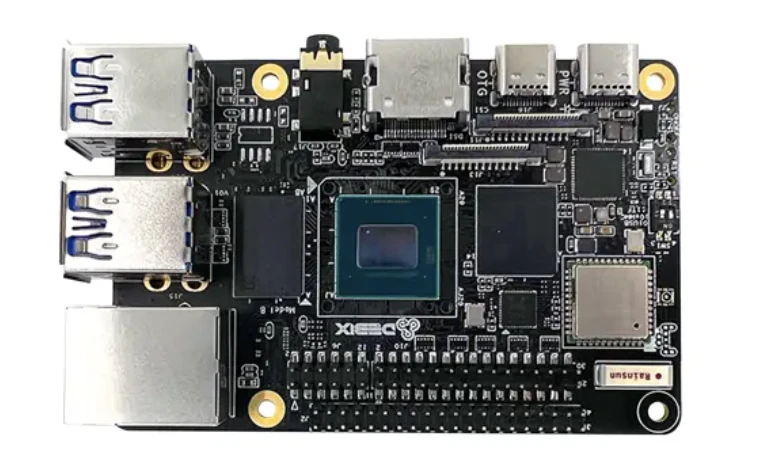
What Is an NXP i.MX8 SBC?
An NXP i.MX8 SBC is a single-board computer built around one of NXP’s i.MX8 processors. Depending on the exact processor and board design, it may include ARM Cortex-A application cores, Cortex-M real-time cores, GPU, display controllers, camera interfaces, Ethernet, USB, CAN, UART, SPI, I2C, GPIO, audio, PCIe, DDR memory, eMMC storage, and power management circuits.
The i.MX8 series includes several processor variants. Some are suitable for compact HMI devices. Some are better for multimedia systems, industrial gateways, camera applications, or AI-assisted edge devices. Common options include i.MX8M Mini, i.MX8M Nano, i.MX8M Plus, and other higher-performance i.MX8 platforms.
As an SBC, the processor is already integrated with memory, storage, power circuits, connectors, and expansion interfaces. This reduces development time compared with building a full processor board from scratch. Product teams can focus on machine communication, application software, enclosure design, production testing, and long-term maintenance.
Why Use i.MX8 for Machine Control?
Machine control products require reliability, long-term support, and stable software. NXP i.MX processors are often used in professional embedded systems because they provide good documentation, mature software resources, lifecycle planning, and broad ecosystem support.
Compared with a microcontroller, an i.MX8 SBC can run a full Linux system. This allows the machine to support a modern graphical interface, local data storage, secure networking, remote access, industrial protocols, and software update mechanisms.
Compared with a traditional industrial PC, an i.MX8 SBC is usually smaller, lower power, and easier to integrate into dedicated equipment. It can be installed inside a control cabinet, operator terminal, machine panel, production tester, or compact industrial device.
This makes the i.MX8 SBC useful as a bridge between traditional machine hardware and modern software requirements. It can connect PLCs, sensors, drives, and I/O modules to HMIs, factory networks, databases, cloud services, and remote maintenance platforms.
Typical Machine Control Applications
An i.MX8 SBC can be used in several roles within a machine control system.
One common role is industrial HMI. The SBC can drive a TFT LCD and capacitive touch panel. Operators can view machine status, alarms, recipes, production counters, parameter settings, maintenance pages, and diagnostic information.
Another role is industrial gateway. The board can collect data from PLCs, motor drives, meters, temperature controllers, barcode scanners, remote I/O modules, and sensors. It can convert field-level protocols into higher-level communication protocols used by SCADA, MES, local servers, or cloud platforms.
The SBC can also be used as an equipment monitoring unit. It can record temperature, pressure, current, voltage, vibration, cycle count, fault codes, runtime, and operator actions. This information helps maintenance teams detect problems earlier and reduce downtime.
In production test equipment, an i.MX8 SBC can manage test flows, display instructions, communicate with measurement instruments, control relays, store test reports, and upload production data.
Some machines may also require vision functions. With the right i.MX8 variant and camera interface, the SBC can support image capture, barcode reading, object presence checking, process monitoring, or basic quality inspection.
Linux Software Platform
Linux is one of the main reasons i.MX8 SBCs are useful in machine control. It provides mature support for networking, file systems, device drivers, process management, user permissions, security, and application development.
A Linux-based machine control system may run several services at the same time. For example, it may run a Qt HMI application, a Modbus service, an MQTT client, a local SQLite database, a watchdog process, a logging service, a web server, and a firmware update agent.
Developers can use C, C++, Python, Go, Rust, JavaScript, shell scripts, or other languages depending on the requirement. C and C++ are often used for performance-sensitive communication and interface services. Python or shell scripts can be useful for factory tools, testing, configuration, and automation.
Linux firmware for i.MX8 systems is commonly built using Yocto, Buildroot, or vendor-provided BSPs. Yocto is suitable for production-grade systems that need controlled package versions and long-term maintainability. Buildroot is useful for smaller systems that need a compact root filesystem and faster build flow. Debian-based systems can be convenient during development, but they often include unnecessary services for final production firmware.
Real-Time Control Boundaries
Machine control requires a clear understanding of timing. Standard Linux is not a hard real-time operating system. It is excellent for HMI, data logging, networking, file handling, remote access, and supervisory logic, but it is not normally the best choice for microsecond-level control loops or safety-critical response.
A good architecture separates tasks by timing requirement. The PLC, MCU, motion controller, or safety controller handles deterministic tasks. The i.MX8 SBC handles display, data, communication, configuration, diagnostics, and remote services.
Some i.MX8 processors include Cortex-M cores. These cores can be used for lower-level tasks while the Cortex-A cores run Linux. This heterogeneous design can be useful when the product needs both a rich Linux environment and more predictable low-level behavior.
PREEMPT_RT Linux can also improve scheduling latency for some applications. However, it should be validated under real system load. It should not be assumed to replace a dedicated safety controller or precision motion controller.
Industrial Communication Interfaces
Machine control systems depend heavily on communication. An i.MX8 SBC may need to communicate with PLCs, sensors, motor drives, meters, relays, barcode scanners, remote I/O modules, and factory servers.
Common interfaces include Ethernet, RS485, RS232, CAN, USB, UART, SPI, I2C, and GPIO. Ethernet is used for Modbus TCP, OPC UA, MQTT, HTTP, WebSocket, remote diagnostics, and factory network integration. RS485 is widely used for Modbus RTU and long-distance serial communication. CAN is useful in vehicles, energy systems, motion equipment, and some industrial control products.
The board-level design must include proper physical-layer circuits. A processor UART pin is not the same as a real industrial RS485 port. Industrial field wiring may face surge, ESD, ground potential differences, long cables, relay switching noise, motor interference, and unstable power.
For production equipment, engineers should consider isolation, ESD protection, surge protection, termination resistors, connector quality, cable routing, and grounding. Reliable communication is not only a software issue; it depends strongly on hardware design.
HMI Display and Touch Integration
Many machine control systems need a local operator interface. An i.MX8 SBC can support TFT LCDs, touch panels, and graphical software frameworks.
Depending on the processor and board design, display interfaces may include MIPI DSI, LVDS, HDMI, eDP, or RGB. Common industrial HMI sizes include 7 inch, 10.1 inch, 12.1 inch, and 15 inch. Smaller displays may be used in compact machines, while larger screens are suitable for complex control panels.
Capacitive touch is widely used in modern HMI products because it provides a clean and intuitive user experience. However, industrial touch design may require glove operation, water rejection, thick cover glass support, and anti-interference tuning.
Software frameworks such as Qt, LVGL, GTK, or browser-based interfaces can be used. Qt is widely used in industrial HMI because it provides a mature embedded graphical framework. LVGL is suitable for lightweight interfaces. A browser-based UI can be useful when the same interface needs to be accessed locally and remotely.
Display and touch should be tested inside the final enclosure. Grounding, cable routing, cover glass thickness, metal frames, power noise, and EMI can all affect the final user experience.
Data Logging and Local Storage
Modern machines generate valuable operating data. An i.MX8 SBC can collect, process, and store this data locally.
Typical data includes machine status, alarm history, production counts, cycle time, sensor values, temperature, pressure, vibration, current, voltage, user actions, maintenance records, and fault codes.
For simple records and configuration data, SQLite may be sufficient. For continuous machine data, engineers may use rotating log files, a lightweight database, or a custom storage format. The best choice depends on data volume, write frequency, query needs, and storage capacity.
Because eMMC has limited write endurance, storage design must be planned carefully. Frequent logs should be rotated. Debug output should be reduced in production. Data writes can be batched where possible.
A read-only root filesystem with a separate writable data partition can improve reliability. This is especially useful for machines that may experience sudden power loss.
Edge Processing and Remote Monitoring
An i.MX8 SBC can process machine data locally before sending it to another system. This reduces bandwidth, improves response time, and allows the machine to continue operating even if the network connection is unstable.
Edge processing may include filtering sensor data, calculating machine utilization, counting production cycles, detecting abnormal trends, generating maintenance alerts, compressing logs, or converting raw values into useful events.
For remote monitoring, the SBC can communicate through MQTT, HTTP, OPC UA, WebSocket, or custom protocols. It can also host a local web dashboard for maintenance engineers.
Remote access should be protected carefully. Authentication, encrypted communication, VPN access, firewall rules, and user permissions should be considered. A machine control device should not expose critical control functions directly to untrusted networks.
Camera and Vision Functions
Some machine control applications need camera input. Examples include barcode scanning, object presence detection, alignment checking, process monitoring, operator assistance, and basic quality inspection.
Certain i.MX8 platforms, such as i.MX8M Plus, are better suited for camera and AI-assisted applications. The actual capability depends on the processor, memory bandwidth, camera interface, driver support, and software stack.
Camera integration requires more than selecting a sensor. Engineers must consider lens selection, lighting design, mechanical alignment, sensor driver support, image pipeline, exposure control, and software framework. V4L2, GStreamer, OpenCV, and vendor tools may be used depending on the application.
For machine vision, stable lighting and mechanical repeatability are often as important as processor performance. A fixed camera position and controlled light source can improve system reliability more than simply increasing camera resolution.
Power Design for Industrial Equipment
Industrial machines often use 12V or 24V power systems. Some products require wide input voltage, reverse polarity protection, surge protection, ESD protection, and input filtering.
The SBC may share power with displays, sensors, relays, communication modules, and other electronics. Poor power design can cause rebooting, corrupted data, communication failures, display flicker, touch instability, or damaged interfaces.
Power behavior should be tested under real machine conditions. Voltage dips, motor startup, relay switching, power supply noise, and sudden shutdown can all affect stability.
If the device writes logs or configuration files during operation, power-loss recovery must be tested carefully. The system should reboot cleanly and return to normal operation without corrupting critical files.
Thermal and Mechanical Design
Machine control devices may be installed inside control cabinets, sealed enclosures, metal housings, or operator panels. Thermal behavior must be evaluated in the final product structure.
Heat sources include the i.MX8 processor, display backlight, power circuits, Ethernet PHYs, wireless modules, and industrial transceivers. Even if the processor itself is efficient, the complete system may become warm inside a closed enclosure.
Thermal solutions may include metal mounting plates, heat spreaders, thermal pads, copper areas, ventilation paths, or controlled CPU frequency. The goal is stable long-term operation under worst-case ambient temperature and workload.
Mechanical design should also protect cables and connectors from vibration. Display cables, touch cables, serial connectors, power connectors, and antenna cables should be fixed properly. If the machine vibrates during operation, connector reliability becomes critical.
Firmware Update and Maintenance
Machine control products often remain in the field for many years. Firmware updates are needed for bug fixes, security patches, new features, protocol changes, and customer-specific requirements.
Possible update methods include USB update, SD card update, Ethernet update, remote OTA update, application-only update, and full image update. For important equipment, an A/B update strategy with rollback can reduce risk. If an update fails, the device can return to the previous working version.
Update packages should be verified before installation. The system should handle failed downloads, wrong firmware versions, incompatible hardware revisions, and power loss during update.
Version management is also important. Each device should report firmware version, hardware revision, serial number, and update history. This makes field support and maintenance easier.
Security Considerations
Machine control systems are increasingly connected to factory networks and remote services. Security must be part of the system design.
Basic security measures include removing default passwords, disabling unused services, restricting SSH access, using encrypted communication, protecting credentials, verifying update packages, and limiting user permissions.
If the i.MX8 SBC communicates with PLCs or controls machine functions, network segmentation should be considered. Critical control interfaces should not be exposed directly to public or untrusted networks.
User roles may also be needed. Operators, maintenance engineers, and administrators may require different permissions. Important actions such as parameter changes, remote access, and firmware updates should be logged.
Security should be planned early. It is difficult to fix fundamental security weaknesses after machines are already deployed.
Production Testing
An i.MX8 SBC-based machine control product should support repeatable factory testing. This helps ensure that each shipped unit works correctly.
Production tests may include display test, touch test, Ethernet test, USB test, RS485 test, CAN test, UART test, GPIO test, audio test, camera test, eMMC test, and power input test. If the product includes relays or external I/O, these should also be verified.
Serial number programming, MAC address writing, firmware flashing, hardware revision detection, and aging tests should be included in the production process.
A dedicated factory test application can improve efficiency and reduce manual errors. Test results can be stored locally or uploaded to a production database.
How to Select the Right i.MX8 SBC
Selecting an NXP i.MX8 SBC for machine control should begin with the full system requirement rather than only the processor model.
Important factors include:
- Processor variant
- RAM capacity
- eMMC size
- Display interface
- Touch panel support
- Ethernet ports
- RS485 support
- CAN support
- UART and GPIO quantity
- USB expansion
- Camera input
- Power input range
- Operating temperature
- Mechanical dimensions
- Thermal design
- Linux BSP support
- Device tree examples
- Documentation quality
- Long-term supply
- Vendor technical support
- Production flashing tools
The most powerful board is not always the best choice. The best SBC is the one that fits the machine architecture, software plan, interface requirements, enclosure, cost target, and lifecycle expectation.
Conclusion
An NXP i.MX8 SBC is a reliable platform for modern machine control systems. It provides ARM computing, Linux software support, industrial interfaces, display capability, data processing, and long-term embedded ecosystem advantages.
In a well-designed machine system, the i.MX8 SBC can work as an HMI controller, industrial gateway, data logger, remote monitoring unit, or supervisory computing platform. It can operate together with PLCs, microcontrollers, motor controllers, sensors, and safety systems.
A successful project requires careful planning of real-time control boundaries, industrial communication, display and touch integration, power protection, thermal behavior, storage reliability, firmware updates, security, and production testing.
When the SBC, operating system, machine interfaces, enclosure, and application software are designed together, an NXP i.MX8 series SBC can provide a reliable foundation for intelligent, connected, and long-lifecycle machine control products.