
Traditional image-processing tests are comfortable when a function has a deterministic answer. Resize a 1200×800 image to 600×400 and you know the dimensions you should get. Convert a known RGB value to another color space and you can assert a numeric result. Run an edge detector with fixed parameters and a golden image can be useful.
Generative image editing is different.
If the request is “remove the red sign behind the scooter,” there is no single correct matrix of output pixels. Several reconstructions of the hidden wall could all be acceptable. A pixel-for-pixel golden file therefore turns into a brittle test: a model update can produce a different but equally good reconstruction and fail the test, while a visually wrong result can sometimes remain close enough to the old reference to pass a loose threshold.
This is a good fit for metamorphic testing.
Metamorphic testing is useful when the exact expected output is difficult or impossible to specify. Instead of asserting one final answer, we define relationships that should hold between multiple executions of the system.
For AI image editing, the question becomes:
If I change the input or instruction in a controlled way, what properties of the outputs should remain stable, and what properties should change predictably?
That gives us testable behavior without pretending that one generated image is the only correct image.

Why exact-image assertions are the wrong default
Suppose an edit endpoint accepts this conceptual request:
{
  "image": "scooter.jpg",
  "instruction": "Remove the red sign behind the scooter"
}
A conventional regression test might save yesterday's result as expected.png and compare today's result with it.
That strategy has three problems.
First, stochastic generation means two valid results may differ at many pixels.
Second, the quality we actually care about is semantic. We care that the sign disappeared, the scooter stayed the same, the road geometry was preserved, and no new object appeared. Pixel distance is only an indirect proxy for those requirements.
Third, a golden image can accidentally freeze model defects. If yesterday's output subtly changed the wheel shape, a regression test can start treating that mistake as expected behavior.
The better unit of specification is often not an output image. It is a relation between outputs.
MR1: a no-op instruction should preserve the image
The simplest metamorphic relation is the no-op test.
Take a source image I. Send an instruction that should not require visual modification, such as:
Keep the image unchanged.
or a domain-specific instruction whose condition is already satisfied:
Keep the existing white background and do not change the product.
Let the result be E_noop(I).
The expected relation is not necessarily exact pixel equality, because the pipeline may re-encode the file. But perceptually and structurally, the image should remain extremely close to the source.
A practical test can combine several checks:
assert same_dimensions(source, result)
assert perceptual_similarity(source, result) > NO_OP_THRESHOLD
assert detected_objects(source) == detected_objects(result)
assert text_regions(source) == text_regions(result)
The key failure signal is unnecessary generative activity. If a no-op request changes a face, label, crop, or background texture, the editing system has a preservation problem even if the output looks attractive.
MR2: narrowing the editable region should reduce collateral change
Consider two requests that ask for the same semantic modification.
Request A is broad:
Remove the red sign behind the scooter.
Request B includes a region or mask that tightly covers the sign and adds an explicit preservation constraint:
Remove only the red sign inside the selected region. Preserve the scooter, road, lighting, crop, and all pixels outside the region as much as possible.
Let their outputs be E_broad and E_masked.
A useful metamorphic relation is:
collateral_change(E_masked) <= collateral_change(E_broad)
We do not require E_masked to match E_broad. We require the tighter edit to disturb no more unrelated content than the broad edit.
One implementation is to define a protected-region mask P and compute a perceptual difference only over P:
broad_drift = lpips(source[P], broad_result[P])
masked_drift = lpips(source[P], masked_result[P])

assert masked_drift <= broad_drift + tolerance
This test is especially valuable after changing masking logic, prompt templates, model versions, or image-conditioning parameters.
MR3: strengthening a preservation constraint should not increase drift
Prompt-based image editors often expose preservation as language rather than an explicit numeric parameter.
We can still test the relationship.
Start with:
Replace the background with a light gray studio background.
Then create a stronger variant:
Replace only the background with a light gray studio background. Keep the bottle shape, cap, label text, logo, product colors, reflections, camera angle, and crop unchanged.
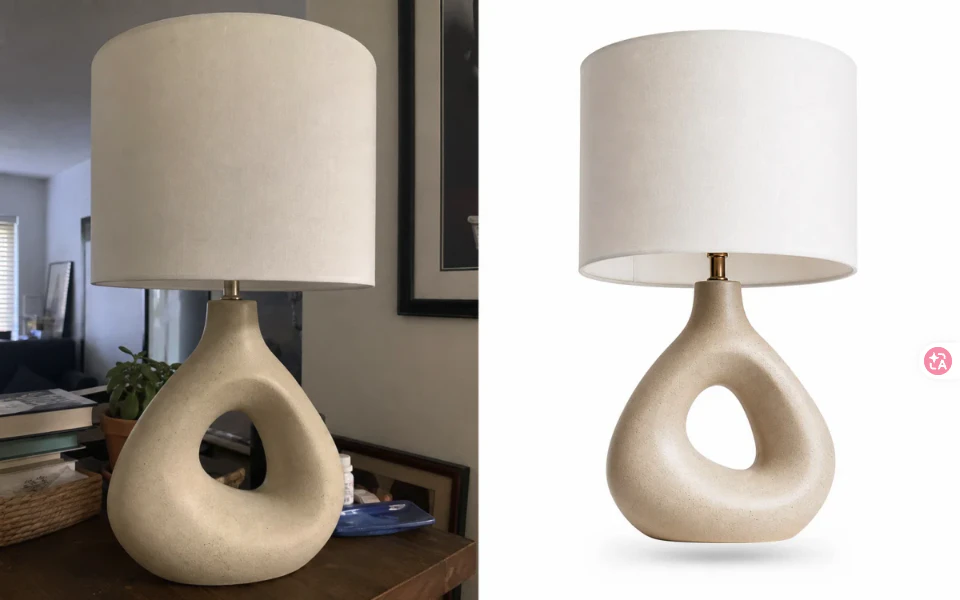
The second prompt does not need to generate the same background. But it should not cause more product drift than the first prompt.
We can define a product mask S and test:
weak_subject_drift = perceptual_diff(source[S], weak_result[S])
strong_subject_drift = perceptual_diff(source[S], strong_result[S])

assert strong_subject_drift <= weak_subject_drift + epsilon
For product images, I would add OCR and geometry checks:
assert ocr_similarity(source[S], strong_result[S]) >= OCR_MIN
assert contour_similarity(source[S], strong_result[S]) >= SHAPE_MIN
This catches a common regression where a model follows the new background request but quietly redesigns the product.
MR4: irrelevant wording changes should not radically alter protected content
Natural-language interfaces create another source of instability: paraphrases.
These two requests are semantically close:
Remove the person in the background.
Delete the background pedestrian and reconstruct the scene naturally.
The reconstructed pixels may differ, and that is fine. But protected content should remain stable across paraphrases.
For a set of equivalent instructions P = {p1, p2, ..., pn}, define:
protected_region_variance(edit(I, p1), ..., edit(I, pn)) < threshold
This is useful for testing prompt preprocessing, translation layers, or an “AI Enhance” feature that rewrites user instructions before sending them to the image model.
If two equivalent prompts produce radically different faces or product shapes, the system may be over-sensitive to wording.
The test does not tell us which output is prettier. It tells us that semantically irrelevant wording is leaking into protected visual regions.
MR5: changing only output size should not change scene semantics
Many image systems support multiple output resolutions or aspect-ratio-adjacent processing steps.
When the requested edit is otherwise identical, changing output resolution should not change scene semantics.
For example:
small = edit(image, prompt, output_size=(768, 768))
large = edit(image, prompt, output_size=(1536, 1536))
After normalizing both images to the same comparison scale, verify high-level properties:
assert same_primary_subject(small, large)
assert similar_object_count(small, large)
assert similar_layout(small, large)
assert ocr_semantics(small) == ocr_semantics(large)
This test can expose hidden prompt branching, model routing differences, or resolution-specific preprocessing bugs.
A larger output may legitimately contain more texture. It should not unexpectedly gain an extra object or change the identity of a person.
MR6: sequential local edits should not reopen solved regions
Real editing sessions often contain multiple passes.
Imagine this sequence:
- Remove a background sign.
- Fix a small artifact on the road.
- Brighten the sky slightly.
After step 1 is accepted, the sign region becomes a solved region. Step 2 should not bring the sign back. Step 3 should not rewrite the scooter.
This gives us a stateful metamorphic relation:
for each accepted edit k:
    previously_accepted_regions(k) remain stable after edit k+1
A test harness can keep masks for accepted regions and compare them after every later operation:
accepted_regions = []
current = source

for request in edit_sequence:
    next_image = edit(current, request.prompt, request.mask)

    for region in accepted_regions:
        assert perceptual_diff(current[region], next_image[region]) < REGION_LIMIT

    accepted_regions.append(request.accepted_region)
    current = next_image
This type of regression is easy to miss when each individual edit succeeds. The final image can gradually drift because later passes reopen earlier decisions.
MR7: an identity-preservation edit should keep identity embeddings close
Portraits provide a measurable semantic invariant: identity.
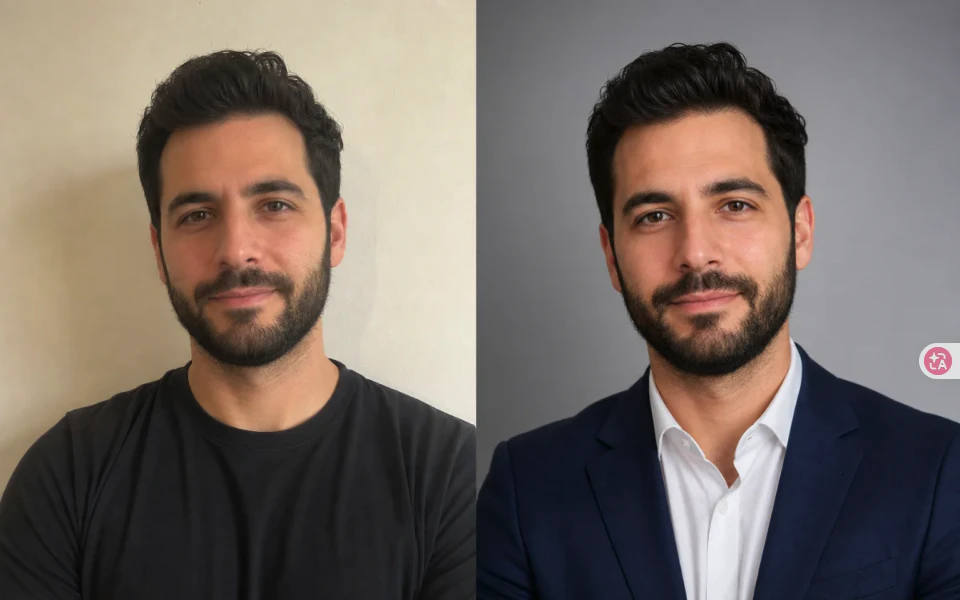
Suppose the request changes only the background or clothing presentation. The result may have different lighting or local texture, but the person's identity should remain close to the source.
A test can use a face embedding model:
source_embedding = face_embedding(source)
result_embedding = face_embedding(result)

assert cosine_similarity(source_embedding, result_embedding) >= IDENTITY_THRESHOLD
This should not be the only test. Face embeddings can fail across pose, age, occlusion, and demographic conditions. But as one signal in a larger test suite, it is much closer to the actual requirement than raw pixel distance.
The metamorphic version is even stronger: if a second prompt explicitly says “preserve facial identity exactly,” its identity similarity should not be worse than a weaker prompt.
Separate hard invariants from soft metrics
Not every relation should be expressed as a single similarity score.
I find it useful to divide checks into two groups.
Hard invariants
These should almost never change unless the prompt explicitly asks for it:
- image orientation;
- expected dimensions or aspect ratio;
- number of primary subjects;
- required logos or product text;
- protected-object geometry;
- face identity for non-identity edits;
- presence of required objects;
- absence of forbidden objects.
Soft metrics
These can move within a tolerance:
- perceptual similarity outside the edited region;
- color distribution;
- edge density;
- local texture statistics;
- brightness;
- embedding similarity;
- OCR confidence;
- segmentation overlap.
A robust test case often combines two or three hard invariants with several soft metrics.
For example:
case: replace_product_background
hard:
  subject_count: unchanged
  label_text: unchanged
  product_mask_iou: ">= 0.97"
soft:
  protected_lpips: "<= 0.08"
  color_delta_e_product: "<= 4.0"
  background_similarity: "not constrained"
This is much more informative than assert mse < 0.01.
Build a relation matrix, not a pile of screenshots
For each editing feature, I like to write a small matrix of source transformations, request transformations, and expected relations.
| Test transformation | Expected relation |
|---|---|
| No-op instruction | Near-zero perceptual change |
| Tighter mask | No increase in protected-region drift |
| Stronger preservation wording | No increase in subject drift |
| Equivalent prompt paraphrase | Stable protected semantics |
| Higher output resolution | Same scene semantics |
| Later local edit | Earlier accepted regions stay stable |
| Background-only portrait edit | Identity embedding stays close |
The output of the test runner can then be a report rather than a binary screenshot diff:
{
  "case": "product_background_preservation",
  "passed": false,
  "metrics": {
    "product_mask_iou": 0.982,
    "ocr_similarity": 0.91,
    "protected_lpips": 0.14
  },
  "failed_relation": "stronger preservation prompt increased subject drift"
}
That tells an engineer what kind of regression occurred.
Human review is still part of the oracle
Metamorphic testing does not eliminate human evaluation.
Some failures are semantic, contextual, or aesthetic in ways that are hard to encode. A reconstructed background can satisfy every numeric threshold and still look obviously fake. A portrait can preserve identity embeddings and still produce an unacceptable expression.
The goal is to use automated relations to catch repeatable classes of regression before a human has to inspect every image manually.
A practical CI setup might therefore be:
- Run hard invariant checks automatically.
- Run metamorphic metric comparisons.
- Store failing or borderline image pairs as artifacts.
- Route only those cases to human visual review.
- Keep accepted failures as labeled regression cases for future model changes.
This makes visual QA much more scalable than reviewing every generation from scratch.
The important shift: test behavior, not one picture
Generative image editing does not remove the need for testing. It changes what a good assertion looks like.
When there is no single exact expected image, ask what must remain true across related executions of the system.
A tighter mask should not increase collateral damage. Stronger preservation wording should not increase subject drift. A no-op should not rewrite the image. Equivalent prompts should keep protected semantics stable. Later edits should not reopen previously accepted regions.
Those are behavioral contracts.
I work on ClipLumi, the AI image editor referenced in this article. The examples above reflect the kinds of failure modes I think about when testing prompt-driven edits, but the metamorphic-testing approach is independent of ClipLumi and can be applied to any generative image-editing pipeline where a pixel-perfect expected result does not exist.